Psilocybin & Body Dysmorphic Disorder
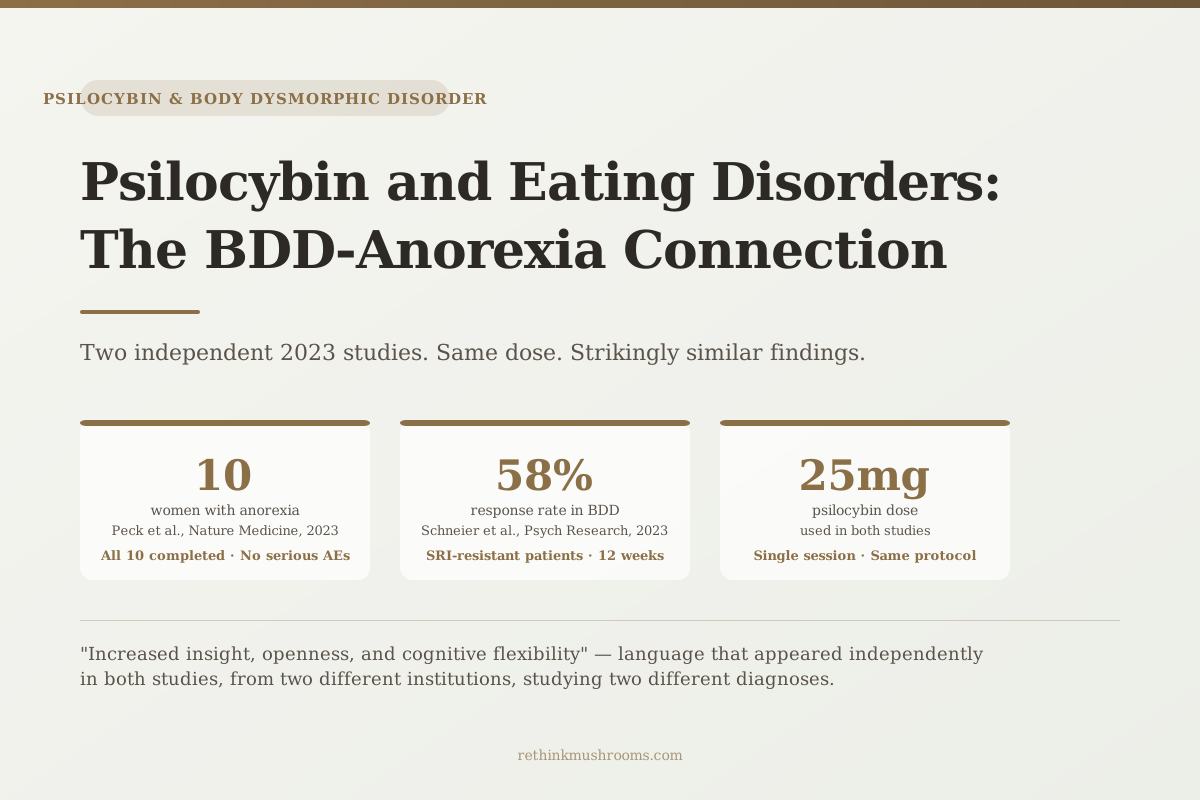
25mg psilocybin
The same single dose was given in both the 2023 anorexia nervosa feasibility trial and the 2023 BDD pilot. Both reported reductions in body image distress and increased cognitive flexibility.
Peck et al., Nature Medicine, 2023; Schneier et al., Journal of Psychiatric Research, 2023
10 women
with anorexia nervosa in the Peck 2023 Nature Medicine feasibility study
58%
response rate in SRI-resistant BDD patients after one psilocybin session (Schneier 2023)
12 weeks
duration of follow-up in the Schneier BDD pilot, with improvements still detectable
Peck et al., Nature Medicine, 2023; Schneier et al., Journal of Psychiatric Research, 2023
 View as image ↗
In 2023, Peck and colleagues at UC San Diego published the first Phase 1 feasibility study of psilocybin for anorexia nervosa in Nature Medicine. Ten adult women with the condition received a single 25mg session. All ten completed it. Researchers reported no serious adverse events, and participants described meaningful reductions in their preoccupation with weight and shape, along with increases in insight and cognitive flexibility that came through repeatedly in participant accounts.[1]
That same year, Schneier and colleagues at Columbia University published a psilocybin pilot for body dysmorphic disorder, a condition that looks different from anorexia on paper but shares its core feature: an intrusive, hard-to-stop preoccupation with physical appearance. They gave the same 25mg dose to 12 adults with BDD who hadn't responded to standard treatment. Seven of 12, 58%, showed clinically significant improvement 12 weeks later.[2]
These weren't coordinated studies. They came from different institutions, studied different diagnoses, and used different outcome measures. But the parallel findings, same dose, similar safety profiles, and nearly identical qualitative language from participants, sit at the center of a coherent idea: that psilocybin may act on something BDD and anorexia share. Research on psilocybin for anxiety had already established that single sessions can produce lasting shifts in entrenched thought patterns. The question this body of work raises is whether the rigid, intrusive body-focused thinking in BDD and anorexia is the same kind of thing.
Key Takeaways
- Peck et al. (Nature Medicine, 2023) gave 25mg psilocybin to 10 adult women with anorexia nervosa; all completed the session, and researchers reported significant reductions in concerns about weight and shape with no serious adverse events
- Schneier et al. (Journal of Psychiatric Research, 2023) gave 25mg psilocybin to 12 adults with SRI-resistant BDD; 58% met the threshold for clinical response (≥30% symptom reduction on BDD-YBOCS) at 12 weeks
- Both studies reported strikingly similar qualitative findings: participants described increased insight, openness, and cognitive flexibility — nearly identical language across two different diagnoses
- A 2025 brain imaging study by Zhu and colleagues found that increased Executive Control Network connectivity after psilocybin predicted BDD symptom improvement at week 1, providing a neural mechanism for the clinical findings
- Both BDD and anorexia involve body image distortion as a core symptom; both respond imperfectly to serotonin reuptake inhibitors; both appear to respond to psilocybin in small early-phase studies
- These are Phase 1 feasibility studies with no randomized controls; they establish safety and rationale for larger trials, not efficacy
The Shared Problem: Why BDD and Anorexia Overlap More Than Their Diagnoses Suggest
Body dysmorphic disorder and anorexia nervosa sit in different sections of the DSM-5. BDD is classified under OCD-related disorders; it involves obsessive preoccupation with perceived physical flaws, often ones that are minor or entirely invisible to outside observers. Anorexia nervosa falls under eating disorders; it involves severe food restriction driven by fear of weight gain and a distorted perception of one's own body as unacceptably large or flawed.
The shared thread is in how both conditions affect a person's relationship with their own appearance. Both involve intrusive thoughts about perceived physical problems that are difficult to stop voluntarily. Both organize daily life around rituals and avoidance behaviors connected to those thoughts. And both respond, partially and inconsistently, to the same class of drug: serotonin reuptake inhibitors, primarily fluoxetine and fluvoxamine.
That shared pharmacological response matters because it tells researchers something about the underlying mechanism. Both conditions appear to involve the serotonergic system, the brain's primary network for regulating mood, perception, and self-referential thought. That's the same system psilocybin works through. Psilocybin binds to a serotonin receptor subtype called 5-HT2A, activating it directly rather than simply keeping serotonin in circulation longer the way SSRIs do.
Many patients with BDD don't respond adequately to SRI treatment; the Schneier trial specifically recruited this SRI-resistant group. The pharmacological picture in anorexia is thinner still: no drug is currently approved for anorexia in adults, and the evidence for any medication in the condition is limited. That treatment gap is part of what prompted researchers to look at a compound that works on the same serotonergic foundation through a different mechanism entirely.
For more on why the OCD-spectrum classification of BDD led directly to psilocybin research, see psilocybin for BDD: why researchers are interested and the emerging BDD research.
The Nature Medicine Study: What Peck 2023 Found in Anorexia
The Peck 2023 study addressed one foundational question before anything else: is it safe to give psilocybin to people with anorexia nervosa?[1] That question mattered more here than in most psilocybin studies. Anorexia carries the highest mortality rate of any psychiatric condition, partly due to cardiovascular complications from malnutrition. Psilocybin transiently raises blood pressure and heart rate. The cardiac concern was real on paper.
In this small trial, it didn't materialize. All 10 participants completed the single 25mg session. No serious adverse events were reported. Peck's team described the drug as "safe, tolerable, and acceptable" in this population, with appropriate monitoring in place.
On outcomes, the researchers reported significant reductions in participants' concerns about weight and shape, the core preoccupations that drive food restriction in anorexia. These aren't outcomes the study was statistically powered to analyze with precision; there was no control group, and the sample was too small for that kind of inference. But the signal was consistent across participants, not driven by one outlier response.
What stood out in the qualitative accounts was language that kept appearing: increased insight, openness, and cognitive flexibility. Participants described experiencing their relationship with food, weight, and their own bodies differently during and after the session. That language isn't a quantified outcome. It's the kind of report that, repeated across participants in a study this size, suggests something real was happening.
The Peck study was designed to determine whether a Phase 2 randomized trial is worth running. In 2023, in Nature Medicine, that finding reached the largest audience any psilocybin eating disorder research has reached.
The BDD Pilot: Same Dose, 58% Response in Treatment-Resistant Patients
Schneier and colleagues at Columbia University enrolled 12 adults with moderate-to-severe BDD who had not responded to SRI treatment — a specifically difficult-to-treat group chosen because that's where an unmet need exists.[2] Each participant received a single oral 25mg psilocybin dose alongside psychological support.
The primary outcome was change on the BDD-YBOCS, a validated scale that measures how much time BDD thoughts consume, how much distress they cause, and how much they interfere with daily functioning. At week 1, the first measurement after the session, scores had decreased significantly. At week 12, eleven weeks after the single session, 7 of the 12 participants (58%) met the threshold for clinical response, defined as a reduction of 30% or more in BDD-YBOCS score.
Two aspects of that result are worth focusing on. First, the response rate came from a treatment-resistant group. These weren't patients trying psilocybin as a first option; they had already failed at least one SRI trial. The standard pharmacotherapy hadn't worked. More than half showed meaningful improvement after one session of a compound they had never tried. Second, the durability: the week-12 follow-up came three months after the treatment, yet the improvements remained detectable.
The qualitative reports echoed Peck's anorexia data: insight, flexibility, a changed relationship with the thoughts that had previously dominated daily life. Two research teams, two diagnostic categories, nearly identical language.
For a deeper look at the neural findings from the BDD trial specifically, the psilocybin and BDD: emerging research article covers the Schneier study alongside the 2025 brain imaging data.
Two Studies Side by Side: The Parallel That Makes the Research Interesting
| Peck 2023 (Anorexia) | Schneier 2023 (BDD) | |
|---|---|---|
| Journal | Nature Medicine | Journal of Psychiatric Research |
| Condition | Anorexia nervosa | Body dysmorphic disorder |
| Design | Phase 1 open-label feasibility | Open-label pilot |
| Participants | 10 adult women | 12 adults (mixed sex) |
| Dose | 25mg psilocybin | 25mg psilocybin |
| Primary finding | Safe, tolerable; significant reduction in weight and shape concerns | 58% response rate (≥30% BDD-YBOCS reduction) at 12 weeks |
| Safety | No serious adverse events | No serious adverse events |
| Participant reports | Increased insight, openness, cognitive flexibility | Increased insight, flexibility, changed relationship with BDD thoughts |
| Evidence level | Phase 1 feasibility, no control group | Open-label pilot, no control group |
| Trial registry | NCT04505189 | NCT04656301 |
The parallel is striking in its specificity. Same dose, same safety finding, and participant descriptions that use the same vocabulary across institutions that had no coordination. That kind of convergence in qualitative data across two separate research groups adds weight to the idea that something consistent is happening.
The parallel has a limit worth being clear about. BDD and anorexia are different conditions with different diagnostic criteria, different neural profiles, and different treatment histories. The fact that participant descriptions sound similar is suggestive, not confirmatory. A treatment that helps one might not help the other in the same way, even if early signals look similar. The 2024 systematic review of psychedelic efficacy across mental disorders noted exactly this: early open-label data from multiple conditions pointing in a similar direction is an argument for larger trials, not an argument for equivalence.[4]
What the Brain Imaging Adds: The ECN Finding in BDD
In 2025, Zhu and colleagues published an fMRI analysis of BDD patients from the Schneier trial, scanning their brains before and after the psilocybin session to look for changes in how brain regions communicated with each other.[3]
What they found: psilocybin increased connectivity within the Executive Control Network (ECN), a set of brain regions associated with managing attention, regulating emotional responses, and directing focus away from unwanted stimuli. The ECN is the brain's capacity to override what it's fixating on. More specifically, the change in communication between the ECN and the Default Mode Network (DMN) predicted symptom improvement at week 1. The DMN is most active during self-referential thinking, including the kind of looping, body-focused rumination that defines BDD. Patients whose ECN-DMN communication changed more after psilocybin improved more on clinical measures.
This is mechanistic data rather than just clinical observation. It suggests psilocybin isn't producing a non-specific feel-good response. Something specific is shifting in the neural architecture that governs how much attention the brain directs toward self-critical thought. The ECN becomes better able to modulate the DMN's tendency to run that loop.
The Zhu study does not include anorexia patients. Whether the same ECN connectivity shift occurs after psilocybin in anorexia, where a similar self-referential loop drives body image preoccupation, is an open question. The theoretical case is plausible. No imaging data exists yet to test it.
For the detailed neuroscience of how psilocybin may alter body image perception, including the DMN mechanism and the REBUS model, see how psychedelics may alter body image perception. For the broader fMRI evidence on connectivity changes under psilocybin, see functional connectivity changes under psilocybin: fMRI evidence.
What These Studies Can't Tell Us Yet
The Peck and Schneier studies together are two small open-label trials with no randomized controls. Open-label means participants knew they were receiving psilocybin. In psychedelic research, expectancy effects — improvements driven partly by the belief that a treatment will work — are real and difficult to separate from pharmacological effects. A 2024 systematic review of psychedelics across mental health conditions identified this as the core methodological problem the field needs to solve: the current evidence base for most conditions consists of open-label pilots that can't adequately account for placebo response.[4]
Condition-specific limitations also apply.
For anorexia: The Peck study enrolled adult women who were medically stable enough to participate. The most physiologically compromised anorexia patients, those at very low weight or with active cardiac complications, were excluded. The study tells us about safety in a relatively stable subset. Anorexia's cardiac risk profile means future trials need more extensive cardiovascular monitoring than standard psilocybin studies, and the question of whether the drug is safe in the full clinical range of the condition remains open.
For BDD: The Schneier trial enrolled 12 people. At that sample size, the movement of two or three participants can change the reported response rate substantially. The 12-week follow-up is promising but short; whether improvements persist at one year is unknown. The study used no control condition, which means the 58% figure cannot be separated from placebo response, natural fluctuation, or the psychological support that accompanied the session.
For both: Neither study has been replicated. Optimal dosing, number of sessions, who responds versus who doesn't, and long-term durability are all unanswered. These studies are designed to determine whether Phase 2 randomized trials are worth pursuing, not to establish treatment efficacy. They do that job well. They don't do anything more than that.
For a cross-condition overview of the current state of evidence including the clinical trials now underway, see psilocybin and body image: preliminary research on dysmorphic disorders.
The OCD-spectrum connection also shapes the evidence context here. BDD and anorexia share mechanistic features with OCD, and the OCD psilocybin literature, from the Moreno 2006 pilot through the 2025 randomized trial, helped give researchers the rationale to study both conditions. For that thread, see psilocybin for OCD: breaking the loop.
The Bottom Line
Two independent 2023 studies, Peck et al. in Nature Medicine and Schneier et al. in the Journal of Psychiatric Research, gave the same 25mg psilocybin dose to patients with anorexia nervosa and BDD respectively. Both reported no serious adverse events, reductions in body image distress, and qualitatively similar accounts of increased insight and cognitive flexibility. A 2025 brain imaging study found that Executive Control Network connectivity changes after psilocybin predicted BDD symptom improvement, adding a mechanistic layer to the clinical signal. Both studies are Phase 1 open-label trials without randomized controls; they establish feasibility and provide rationale for larger trials, not proof that psilocybin treats either condition.
Frequently Asked Questions
Sources & References
- 1RTHM-01762·Peck, Stephanie Knatz et al. (2023). “Psilocybin therapy for females with anorexia nervosa: a phase 1, open-label feasibility study..” Nature medicine.Study breakdown →PubMed →↩
- 2RTHM-01783·Schneier, Franklin R et al. (2023). “Pilot study of single-dose psilocybin for serotonin reuptake inhibitor-resistant body dysmorphic disorder..” Journal of psychiatric research.Study breakdown →PubMed →↩
- 3RTHM-02220·Zhu, Xi et al. (2025). “Single-dose psilocybin alters resting state functional networks in patients with body dysmorphic disorder..” Psychedelics.Study breakdown →PubMed →↩
- 4. Source details for this reference are not yet available.