Psilocybin & Body Dysmorphic Disorder
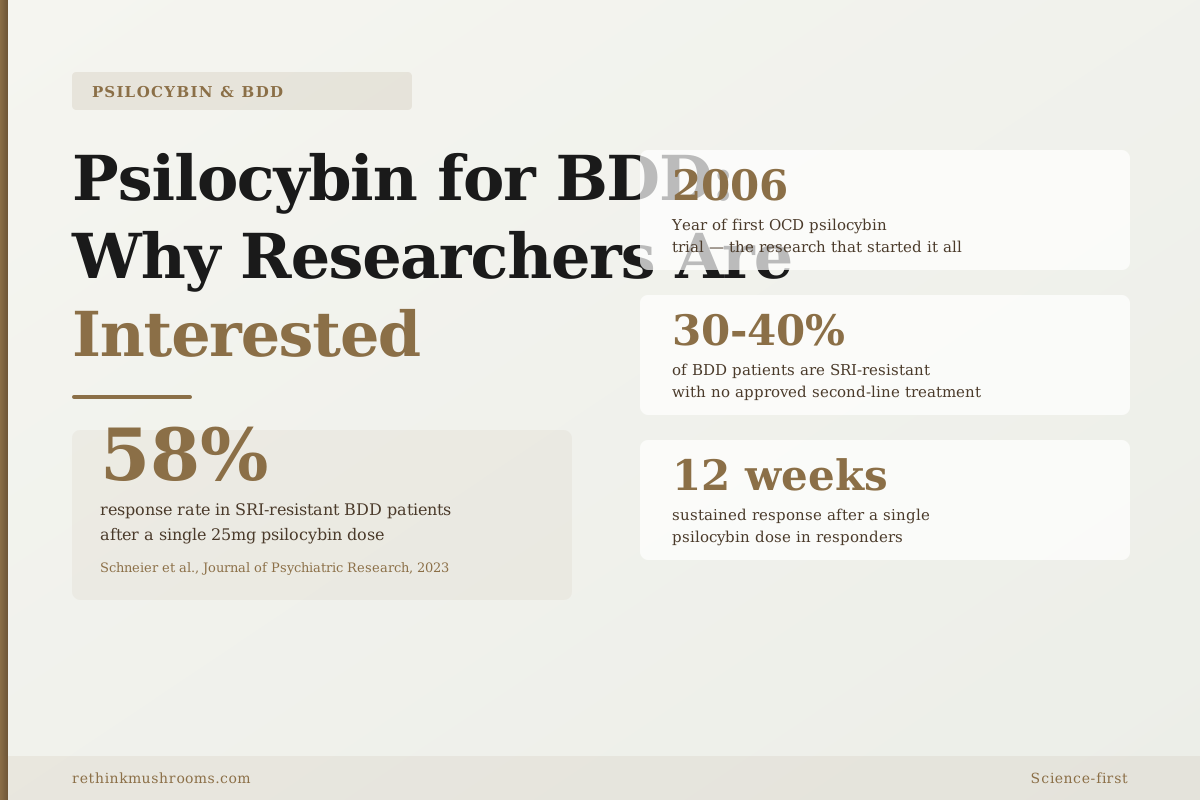
58%
Seven of twelve adults with treatment-resistant BDD showed clinically significant improvement after a single 25mg psilocybin dose, as measured by the Yale-Brown scale adapted for BDD.
Schneier et al., Journal of Psychiatric Research, 2023
12
adults enrolled in the first BDD psilocybin pilot
30-40%
of BDD patients don't respond to standard SRI treatment
2006
year of the first psilocybin trial for an OCD-spectrum disorder
Schneier et al., Journal of Psychiatric Research, 2023
 View as image ↗
The first psilocybin trial for body dysmorphic disorder did not begin with BDD researchers. It began in 2006, when a team at the University of Arizona gave psilocybin to nine patients with obsessive-compulsive disorder and watched every one of them improve.
That finding sat in the scientific literature for seventeen years. Then a Columbia University team used it as the logical foundation for the first study ever to test psilocybin specifically in BDD patients. Understanding why researchers became interested in psilocybin for BDD means following that chain of reasoning from its OCD starting point, through a key diagnostic reclassification, to the 2023 pilot that produced results no one had seen before in SRI-resistant BDD.
Psilocybin research now spans psychiatric conditions involving anxiety, obsession, and distorted self-perception. For broader context on the compound's effects across these conditions, see this overview of psilocybin's potential for anxiety and related disorders.
Key Takeaways
- DSM-5 classified BDD as an OCD-related disorder in 2013, establishing that both conditions share serotonergic biology, the same pathway SSRIs target
- 30-40% of BDD patients are SRI-resistant, meaning SSRIs and similar drugs fail to produce meaningful symptom improvement
- The Moreno 2006 trial gave psilocybin to 9 OCD patients and found symptom reduction in all 9, providing the first clinical proof-of-concept for psilocybin in OCD-spectrum disorders
- By 2025, OCD psilocybin research had advanced to a blinded, controlled dose-comparison trial (a 10mg dose versus a 1mg active dose), strengthening the Moreno signal beyond its open-label origins
- Schneier et al. 2023 gave 25mg psilocybin to 12 adults with SRI-resistant BDD; 7 of 12 (58%) met criteria for clinical response at 12 weeks
- No serious adverse events were reported in the Schneier 2023 pilot
The Five-Step Logic That Led Researchers to Test Psilocybin in BDD
No single discovery prompted BDD researchers to look at psilocybin. The rationale accumulated over nearly two decades, step by step.
-
BDD is an OCD-related disorder. In 2013, DSM-5 moved BDD into the same diagnostic chapter as OCD. Both conditions share overlapping symptom structure and serotonergic biology.
-
Serotonin-targeted medications work for BDD, but imperfectly. SSRIs are first-line treatment for BDD precisely because BDD is serotonin-responsive. But 30-40% of patients don't respond adequately.
-
In 2006, psilocybin reduced OCD symptoms in all 9 patients tested. Moreno's team at the University of Arizona ran the first psilocybin trial for an OCD-spectrum disorder. Every participant showed some improvement. This was the first signal that psilocybin acted on obsessional symptom circuits.[1]
-
By 2025, OCD psilocybin evidence reached a blinded, controlled trial. A 2025 study compared a 10mg psilocybin dose against a 1mg active dose in adults with OCD, with participants and raters blinded to dose order, and found the 10mg dose produced significantly greater symptom reduction. This moved the evidence from an uncontrolled open-label signal toward controlled confirmation.[2]
-
The 2023 BDD pilot found a 58% response rate in SRI-resistant patients. Schneier and colleagues at Columbia gave 25mg psilocybin to 12 adults who had already failed SRI treatment. Seven of twelve responded. Twelve-week response was sustained.[3]
The sections below trace each step in detail.
The OCD-Spectrum Evidence Base, Study by Study
From OCD to BDD: Four Studies Behind the Psilocybin–BDD Hypothesis
Moreno et al. — J. Clinical Psychiatry (OCD)
Positive9 adults with OCD (open-label) · Escalating doses across sessions
All 9 participants showed acute OCD symptom reduction under at least one dose condition
First psilocybin trial in an OCD-spectrum condition; small and uncontrolled
Schneier et al. — J. Psychiatric Research (BDD)
Positive12 adults, SRI-resistant BDD (open-label pilot) · Single 25mg oral dose
7 of 12 (58%) responded at week 12; large effect (partial η² = 0.54); no serious adverse events
First BDD-specific psilocybin trial; no placebo control
Zhu et al. — Psychedelics (fMRI sub-study)
Positive8 of the pilot participants (imaging sub-study) · Single 25mg oral dose
Increased executive-control–to–default-mode connectivity after dosing predicted week-1 symptom improvement
Mechanism sub-study; n = 8, uncontrolled
Pellegrini et al. — Comprehensive Psychiatry (OCD)
Mixed19 adults with OCD (non-randomized challenge study) · 1mg then 10mg, order-blinded
10mg produced a moderate-to-large drop in compulsive symptoms at week 1 (d = 0.82); effect faded over 3 weeks
Not randomized, no placebo; transient effect — but adds dose-comparison data
Sources: Moreno et al. (2006); Schneier et al. (2023); Zhu et al. (2025); Pellegrini et al. (2025). All BDD data derives from a single 12-person open-label pilot.
What BDD Is, and Why Existing Treatments Fail 30-40% of Patients
Body dysmorphic disorder is a psychiatric condition in which a person becomes obsessively preoccupied with one or more perceived flaws in their physical appearance. The perceived flaws are typically not visible to others, or are minimally noticeable. What distinguishes BDD from ordinary self-consciousness is the obsessional quality: people with BDD spend hours each day thinking about the flaw, checking mirrors compulsively, seeking reassurance from others, or avoiding situations where they might be seen.
The severity is easy to underestimate. BDD is associated with substantial occupational impairment, social isolation, and rates of suicidal ideation that exceed those seen in many other psychiatric conditions. For many patients, it is disabling.
The two established treatments are SSRIs (specifically fluoxetine, fluvoxamine, and clomipramine, which functions similarly despite being technically a different drug class) alongside cognitive behavioral therapy with exposure and response prevention, known as CBT-ERP. When both are used together, roughly 60-70% of patients see meaningful improvement.
That leaves 30-40% who do not respond adequately to either approach.[3]
For this group, the treatment options thin out quickly. There is no approved second-line pharmacological treatment for BDD. Clinicians may try dose adjustments, augmentation strategies, or additional rounds of therapy. For some patients, none of it produces acceptable improvement.
This gap is where psilocybin research enters the picture.
The Diagnostic Reclassification That Changed the Research Logic
In 2013, the DSM-5 reorganized where BDD sits among psychiatric diagnoses. Previously, BDD appeared in the somatoform disorders chapter, alongside conditions like hypochondria. In DSM-5, it moved to the newly created "Obsessive-Compulsive and Related Disorders" chapter, alongside OCD, hoarding disorder, and trichotillomania.
This was not administrative housekeeping. The reclassification formalized a clinical observation that psychiatrists had held for years: BDD and OCD share the same core symptom structure. Both involve intrusive, unwanted thoughts that a person cannot stop. Both involve compulsive behaviors designed to temporarily reduce distress from those thoughts. Both cause impairment in proportion to how much time the obsessional thinking consumes each day.
The serotonin connection follows directly from this shared structure. SSRIs reduce OCD and BDD symptoms by increasing serotonin availability in the synapses of brain circuits that generate obsessional thinking. The mechanism works imperfectly in both conditions, and it fails entirely in a similar proportion of patients in both.[4]
What the shared biology implied for research: any drug that worked for OCD through a serotonergic mechanism became a candidate for BDD investigation. When Moreno's team published psilocybin results in OCD patients in 2006, BDD researchers had reason to pay attention.
In 2006, Nine OCD Patients Got Psilocybin. Every One Improved.
Moreno and colleagues ran the first clinical study of psilocybin in OCD patients published in 2006.[1] The modified double-blind design gave nine adults with OCD up to four single-dose psilocybin sessions at escalating dose levels, ranging from very low (25 µg/kg, micrograms per kilogram of body weight) up to 300 µg/kg.
Every one of the nine participants showed some reduction in OCD symptoms during at least one session, with individual decreases ranging from 23% to 100% on the Yale-Brown scale. The reductions appeared across the range of doses tested, including the lowest, and the trial found no statistically significant difference in effect between dose levels. The effect appeared regardless of whether the session produced a full psychedelic experience.
Several things made this finding notable beyond the raw result. First, it was the first clinical evidence that a classical psychedelic could reduce obsessional symptoms at all. Second, the response at low doses suggested the mechanism was not simply a function of the subjective experience. Third, the results appeared within hours of dosing, which is qualitatively different from how SSRIs work. SSRIs require weeks to build up and their effects emerge gradually.
For OCD-spectrum researchers, the mechanistic implication was clear: psilocybin acts on 5-HT2A serotonin receptors in a way that disrupts the repetitive thought circuits underlying obsessional conditions. BDD involves the same type of repetitive, intrusive thinking. If the mechanism reduced symptoms in OCD, there was a principled rationale for testing it in BDD.
Detailed analysis of the Moreno trial and its implications is covered in psilocybin for OCD: rapid symptom relief in the Moreno trial. For the broader case that psilocybin can interrupt obsessive-compulsive cycles, see psilocybin for OCD: breaking the loop.
By 2025, OCD Psilocybin Research Had Matured to Blinded, Controlled Trials
The Moreno 2006 study was important but fragile as evidence. Nine participants, no placebo control, open-label design. The standard criticisms of an early-phase pilot all applied.
Over the following years, that evidence base strengthened. A 2025 controlled trial gave 18 adults with OCD two doses of psilocybin, a 1mg active dose and a 10mg dose, with participants and raters blinded to which dose came in which session. One week after dosing, the 10mg dose produced significantly greater reduction in OCD symptoms than the 1mg comparator (a moderate-to-large effect, Cohen's d = 0.82), an effect that then faded over the following three weeks.[2] This was not a placebo-controlled, parallel-group randomized trial, but the blinded within-subject dose comparison moved psilocybin's effect on obsessional symptoms beyond the open-label signal of 2006.
A 2024 review of psilocybin's pharmacological role in OCD treatment surveyed the clinical and mechanistic evidence and concluded that the serotonergic rationale was coherent and that the clinical findings were sufficiently consistent to justify ongoing trials.[4]
For the broader research program, this maturation of the OCD evidence base mattered practically. The Schneier BDD pilot was itself designed and run on the strength of the earlier open-label OCD work; the 2025 controlled data arrived afterward and reinforced, in retrospect, that the OCD-spectrum rationale the BDD study was built on had not been a fluke. Funders and ethics boards weigh exactly this kind of accumulating cross-condition evidence when deciding whether to support the next, larger BDD trial.
Why Psilocybin Acts on Serotonin Differently Than SSRIs Do
Two Ways to Act on Serotonin
SSRIs vs. Psilocybin: Same Neurotransmitter, Different Mechanism
SSRIs
Psilocybin
Molecular action
Blocks serotonin reuptake, raising synaptic serotonin indirectly
Metabolized to psilocin, which directly activates 5-HT2A receptors
Dosing schedule
Daily, ongoing — effect requires continued dosing
Single supported session
Time to effect
Builds gradually over weeks
Within hours of dosing
Brain-circuit target
Broadly raises serotonin tone across circuits
Temporarily destabilizes rigid default-mode-network activity
Whether this mechanistic difference translates into better outcomes for SRI-resistant BDD is exactly what current controlled trials are designed to test — a difference in mechanism is a hypothesis, not a result.
Source: 2024 review of psilocybin in the pharmacotherapy of obsessive-compulsive disorder (ref 4). SSRI pharmacology: established literature.
SSRIs work by slowing the rate at which serotonin is cleared from the space between neurons, which increases the amount of serotonin available to act on receiving neurons. This process is gradual, unfolds over weeks, and requires ongoing daily dosing to maintain.
Psilocybin works through a different mechanism. After the body metabolizes psilocybin into psilocin, psilocin binds directly to 5-HT2A receptors (a specific type of serotonin receptor concentrated in the cortex) and activates them directly.[4] This produces effects within hours of a single dose.
The downstream consequence of 5-HT2A activation in cortical brain regions is disruption of the default mode network. This is the brain circuit associated with self-referential thinking, the mental state in which people think about themselves and their personal characteristics. In BDD, this circuit is thought to run continuously in a narrow loop focused on the perceived physical flaw. In OCD, a closely related circuit runs in loops around obsessional content.
A 2024 pharmacotherapy review found that 5-HT2A agonism disrupts this rigid, repetitive circuit activity not by shutting it down, but by temporarily destabilizing its organization and creating conditions for a different pattern to emerge afterward.[4]
This is a testable biological hypothesis, which makes it more than speculation. It explains specifically why serotonin-targeted drugs might work differently in BDD depending on how they act on serotonin receptors, and it predicts what brain changes should be observable if psilocybin is reducing BDD symptoms through this pathway. For how those brain changes have been measured in imaging studies, see functional connectivity changes under psilocybin: fMRI evidence.
The 2023 BDD Pilot: 12 Patients, 25mg Psilocybin, 58% Response Rate
Schneier and colleagues at Columbia University published the first psilocybin study specifically in BDD patients in 2023.[3] The trial was registered at ClinicalTrials.gov (NCT04656301).
Schneier et al. (2023) · Journal of Psychiatric Research
- Population
- 12 adults (8 women, 4 men) with moderate-to-severe BDD, unresponsive to at least one SRI
- Intervention
- Single 25mg oral dose of psilocybin with psychological support before, during, and after
- Comparator
- None — open-label, no control group
- Finding
- BDD-YBOCS scores fell significantly over 12 weeks (large effect, partial η² = 0.54), with change from baseline present at week 1 and sustained through week 12. Seven of twelve participants (58%) were responders at week 12 by the ≥30% reduction threshold. No serious adverse events occurred.
preliminary A promising open-label signal, but small and uncontrolled — the authors themselves frame it as warranting future controlled studies, not as evidence of efficacy.
Schneier et al., Journal of Psychiatric Research, 2023 (NCT04656301)
The design was intentionally straightforward. Twelve adults with moderate-to-severe BDD who had already tried and failed SRI treatment received a single 25mg oral dose of psilocybin. Psychological support was provided before, during, and after the dosing session. No randomization, no placebo group. This was an open-label feasibility pilot designed to determine whether BDD patients could safely receive psilocybin and whether the signal of benefit was strong enough to warrant a larger controlled trial.
Symptom severity was measured using the BDD-YBOCS, a version of the Yale-Brown Obsessive-Compulsive Scale adapted for body dysmorphic disorder. A responder was defined as someone whose BDD-YBOCS score decreased by 30% or more from baseline. This is the same threshold used in SRI trials for BDD, which allows the response rate to be compared across treatments.
At week 1 after the dosing session, BDD-YBOCS scores had decreased significantly across the group. At week 12, 7 of the 12 participants (58%) still met the 30% reduction threshold. No serious adverse events occurred.
To understand what makes that number interesting, the baseline matters. These participants were SRI-resistant. They had tried standard first-line pharmacological treatment and not responded adequately. In typical BDD medication trials, SRI-resistant patients respond at lower rates than the general BDD population. A 58% response rate in this subgroup was not expected.
The 12-week timeframe is also worth noting. Psilocybin was given as a single dose. The fact that more than half of the group maintained meaningful symptom reduction three months after a single session was not a finding that existing BDD treatments, including those requiring daily dosing or regular therapy appointments, can consistently produce in SRI-resistant patients.
For a full breakdown of this study alongside the 2025 brain imaging research that followed it, see psilocybin and body dysmorphic disorder: emerging research.
What a 58% Response Rate Means in Context (and What It Doesn't)
A 58% response rate from 12 people in an open-label study is an early signal. It is not proof of efficacy.
The absence of a placebo control is the largest limitation. Psychedelic trials are notoriously difficult to blind because the subjective effects of psilocybin are unmistakable. Participants generally know whether they received the active drug or a placebo. When blinding fails, expectation effects can inflate response rates. Participants who believe they might improve sometimes do, independent of any pharmacological effect.
The counterargument from the research team is specific: these were SRI-resistant patients. People who have already failed to respond to SSRIs tend to have lower placebo response rates than treatment-naive populations, because they have learned through experience that medications don't reliably help them. A 58% response rate in a group conditioned by previous treatment failure is harder to attribute to expectation alone.
A 2024 systematic review of psychedelic efficacy across mental health conditions placed early BDD psilocybin data in the context of the broader evidence base: preliminary positive signals across OCD-spectrum, anxiety, and mood conditions, no serious safety signals across the literature, and a consistent need for randomized controlled data before clinical conclusions can be drawn.[5]
The honest reading of Schneier 2023: the results were strong enough to justify a Phase 2 randomized trial. They are not strong enough to conclude that psilocybin is an effective BDD treatment. That question requires controlled evidence, which the ongoing trial at NCT04656301 is designed to answer.
Safety & Legal
ModeratePsilocybin for BDD Is Investigational, Not an Available Treatment
Concern
The evidence here comes from a single small open-label pilot. Psilocybin is not an approved BDD treatment, and outside authorized research it remains a controlled substance that is illegal to possess or use in most jurisdictions. Self-treatment is especially risky in BDD, a condition tied to elevated rates of suicidal ideation, where an unsupervised psychedelic experience can deepen distress rather than relieve it.
What the research says
The only responsible path to psilocybin for BDD today is a supervised clinical trial. The ongoing controlled study (NCT04656301) is designed to test whether the early signal holds up under a placebo comparison.
Particularly relevant for: People with BDD, particularly those who have not responded to SRIs
What to do
If you have BDD, discuss your options — including whether you might be eligible for a trial — with a qualified clinician. This article is educational and is not medical advice.
Schneier et al., Journal of Psychiatric Research, 2023; ClinicalTrials.gov NCT04656301
For an overview of all preliminary evidence across BDD and related body image conditions, including the state of ongoing clinical trials, see psilocybin and body image: preliminary research on dysmorphic disorders. For the parallel research line in anorexia nervosa, another body image condition that showed early psilocybin promise in the same year, see psilocybin and eating disorders: the BDD-anorexia connection.
The Bottom Line
Researcher interest in psilocybin for BDD rests on a coherent chain of evidence: BDD shares obsessional symptom structure and serotonergic biology with OCD, OCD has shown measurable response to psilocybin since 2006, and by 2025 that OCD evidence had advanced to a blinded, controlled dose-comparison trial. The Schneier 2023 BDD pilot found a 58% response rate in 12 SRI-resistant patients after a single 25mg dose, with no serious adverse events and sustained response at 12 weeks. The evidence is early-stage and uncontrolled; Phase 2 randomized data is the required next step.
Frequently Asked Questions
Sources & References
- 1RTHM-00195·Moreno, Francisco A et al. (2006). “Safety, tolerability, and efficacy of psilocybin in 9 patients with obsessive-compulsive disorder..” The Journal of clinical psychiatry.Study breakdown →PubMed →↩
- 2. Source details for this reference are not yet available.
- 3RTHM-01783·Schneier, Franklin R et al. (2023). “Pilot study of single-dose psilocybin for serotonin reuptake inhibitor-resistant body dysmorphic disorder..” Journal of psychiatric research.Study breakdown →PubMed →↩
- 4. Source details for this reference are not yet available.
- 5. Source details for this reference are not yet available.