Psilocybin & OCD
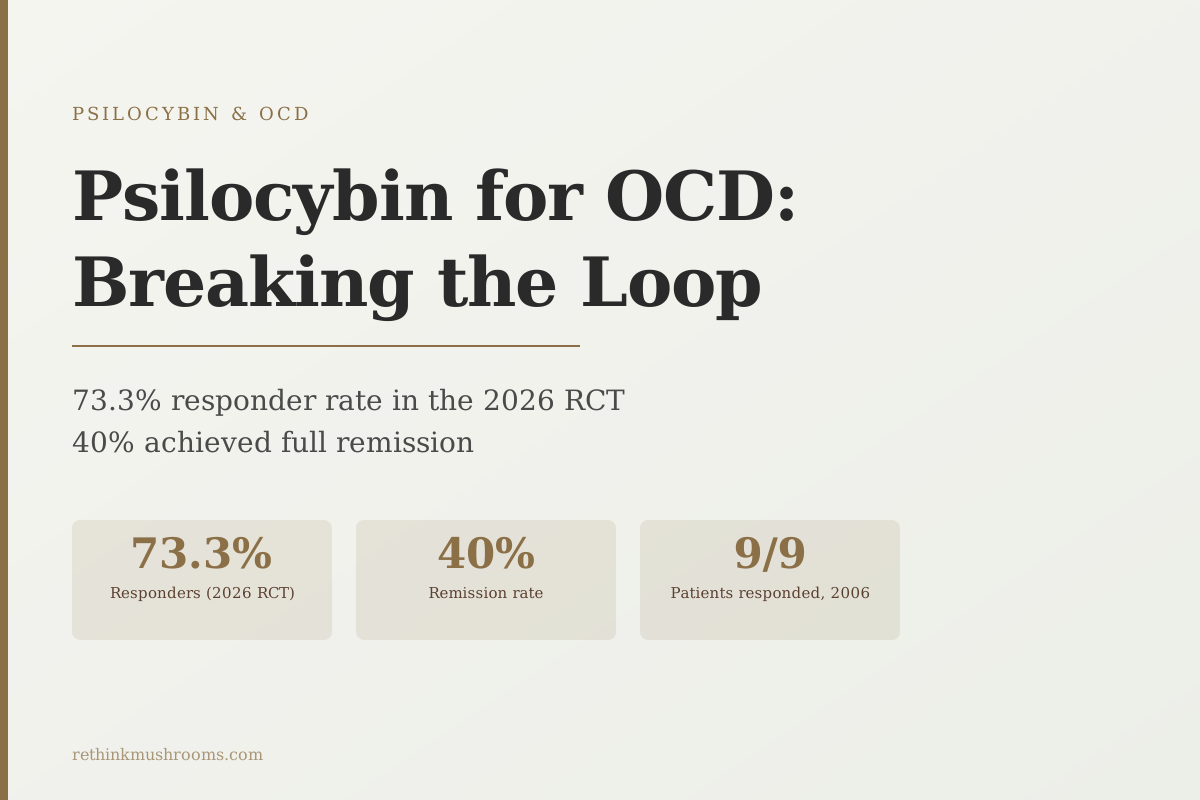
73.3% responder rate
A 2026 randomized controlled trial gave OCD patients weekly high-dose psilocybin. After four or more sessions, 73.3% were responders and 40% achieved full remission — the strongest clinical result ever recorded for this condition.
Moreno et al., J Psychopharmacol, 2026
9 patients
in the 2006 founding pilot — every one showed Y-BOCS symptom reduction within 24 hours
40%
achieved full remission after weekly high-dose psilocybin in the 2026 RCT
10 mg
single oral dose reduced compulsions specifically for up to one week in 18 patients (Pellegrini 2025)
Moreno et al., J Psychopharmacol, 2026
 View as image ↗
The first person to receive psilocybin in a formal OCD trial did so in 2006, at the University of Arizona. In the hours after the session, their score on the standard OCD severity scale dropped significantly. By the end of a 24-hour observation period, several of the nine patients in that pilot had achieved reductions the study authors described as "marked." One patient remained in remission for several months after a single session.[1]
That pilot never generated the follow-up research it deserved. Regulatory barriers made clinical studies with Schedule I compounds difficult to fund and conduct for years. Two decades later, the same research team published a randomized controlled trial with the same compound in OCD patients. The results were even stronger.[2]
Psilocybin for OCD is now one of the most active corners of psychedelic medicine research. For the broader evidence base on psilocybin in anxiety-related conditions, see psilocybin and existential anxiety in cancer patients. For a detailed look at how psilocybin physically disrupts the brain circuit that drives OCD, see how psilocybin disrupts obsessive-compulsive cycles.
Key Takeaways
- In the 2006 founding pilot (Moreno et al., J Clin Psychiatry), all 9 OCD patients showed Y-BOCS score reductions within 24 hours of psilocybin, ranging from 23% to 100%; one patient remained in remission for months
- A 2026 randomized controlled trial (Moreno et al., J Psychopharmacol) found 73.3% of OCD patients were responders after weekly high-dose psilocybin — 40% achieved full remission
- A 2025 pharmacological challenge (Pellegrini et al., Compr Psychiatry) found that a single 10mg oral dose reduced compulsions specifically — not obsessions or depression scores — for up to one week in 18 adults with OCD
- A 2023 pilot (PMID 37004409) found clinically meaningful OCD reductions in patients who had already failed multiple serotonin reuptake inhibitor trials — the most treatment-resistant population
- Whole psilocybin mushroom extract produced OCD-behavior reductions as durable as purified psilocybin in a validated animal model, with effects lasting 21 days after a single dose (Brownstien et al., Mol Psychiatry, 2025)
- Psilocybin remains a Schedule I controlled substance in the United States; all results come from licensed research settings, not approved treatments
The 40% Problem: When Standard OCD Treatments Stop Working
Obsessive-compulsive disorder affects roughly 2-3% of people at some point in their lives. It is not a quirk of personality or a source of mild anxiety. For the people most affected, OCD involves relentless intrusive thoughts followed by repetitive rituals that feel impossible to resist. Compulsive behaviors provide brief relief, but the cycle begins again almost immediately. Daily functioning is often severely impaired.
The standard treatment is a class of medications called serotonin reuptake inhibitors, or SRIs. These are the same drugs used for depression, taken at higher doses and for longer periods in OCD. They work well enough for about 60% of patients when combined with cognitive-behavioral therapy. The remaining 40% — roughly one in four adults diagnosed with the disorder — do not achieve adequate relief despite multiple medication trials and therapy approaches.[5]
When SRIs fail, clinicians have few good options. Adding an antipsychotic medication helps a subset of patients. Intensive behavioral therapy can reduce symptoms but requires sustained effort and access to specialized providers. Deep brain stimulation exists for the most refractory cases but involves neurosurgery and significant risk.
This is the gap psilocybin research is working to fill. The core question is not whether psilocybin can replace first-line treatment for everyone with OCD. It is whether psilocybin can help the substantial minority for whom current options are inadequate. The early clinical data suggest it can.
The Founding Trial: What Happened to 9 OCD Patients in 2006
Francisco Moreno and colleagues at the University of Arizona enrolled nine adults with OCD in the first clinical trial of psilocybin for this condition, publishing results in the Journal of Clinical Psychiatry in 2006.[1]
The design was a modified double-blind crossover. Each participant received four oral doses at least a week apart: very low (25 µg/kg), low (100 µg/kg), medium (200 µg/kg), and high (300 µg/kg). The primary outcome was change in scores on the Yale-Brown Obsessive Compulsive Scale, a standard 10-item clinician-rated tool for measuring OCD severity (abbreviated Y-BOCS), at 24 hours after each session.
What made the results remarkable was not just the magnitude. It was the consistency.
All nine patients showed marked Y-BOCS reductions within 24 hours. Eight of the nine had reductions of 25% or more. Six had reductions of 50% or more. Individual reductions ranged from 23% to 100% across doses. One participant experienced complete OCD symptom resolution and remained in remission for several months after the trial ended.
The effects appeared at all four doses, including the very low dose that produces minimal or no subjective psychedelic experience. That observation has sparked ongoing debate about whether the full psychedelic state is necessary for therapeutic benefit, or whether psilocybin's mechanism in OCD runs through a different pathway that doesn't require it.
The trial was well-tolerated. No serious adverse events occurred. Anxiety and transient perceptual changes were observed during dosing sessions but resolved within each session.
The 2006 pilot was groundbreaking. It was also tiny. Nine people, no true placebo, a crossover design that complicates interpretation. It raised the question clearly but could not answer it definitively. That took two more decades.
The Stuck Circuit: Why OCD Is Different From Depression in the Brain
Psilocybin research in the press tends to describe its mechanism primarily through the lens of depression, with the default mode network — the brain's self-referential circuit — as the main story. OCD involves a different brain circuit, and understanding that distinction helps make sense of the clinical results.
OCD involves hyperactivity of what researchers call the cortico-striatal-thalamo-cortical circuit, or CSTC. This is a feedback loop connecting the brain's planning region (the prefrontal cortex), its filtering and reward hub (the striatum), and the signal relay station deep in the brain (the thalamus). In a brain without OCD, this circuit filters intrusive thoughts and suppresses compulsive urges. In OCD, it fires in a persistent positive feedback loop, amplifying the signal instead of suppressing it.
A 2024 systematic review in Pharmacological Reports characterized OCD as involving dysfunction in serotonin-, dopamine-, and glutamate-mediated neurotransmission simultaneously, with the CSTC circuit as the central dysfunctional structure.[5] Psilocybin, via its primary action on a serotonin receptor called 5-HT2A (the main brain receptor that psychedelic compounds bind to), appears to disrupt this feedback loop. Not by suppressing signals during the session, but by triggering lasting changes in how the CSTC circuit communicates afterward.
For the full mechanistic breakdown, see how psilocybin disrupts obsessive-compulsive cycles. For the specific receptor pharmacology and how psilocybin differs from what SSRIs do at the molecular level, see psilocybin and 5-HT2A: the OCD serotonin connection.
One Dose, Compulsions Specifically: The 2025 Pellegrini Trial
Pellegrini and colleagues ran what is called a pharmacological challenge study in 18 adults diagnosed with OCD, publishing results in Comprehensive Psychiatry in 2025.[3]
The design was straightforward: participants received a 1mg oral dose of psilocybin on one occasion (low enough to produce negligible psychedelic effects, functioning as an active placebo) and a 10mg dose on another occasion, in fixed order. They were assessed at multiple time points over the following week.
The 10mg dose produced a moderate-to-large reduction in compulsive behaviors that lasted up to one week. Psilocybin has a pharmacological window of four to six hours — the drug itself clears the body quickly. Yet its effects on compulsive behavior persisted for days afterward. That duration exceeds the drug's direct action by a wide margin and suggests a lasting change in the underlying circuit rather than a temporary receptor effect.
The most significant finding may be what psilocybin did not reduce. Obsessive thoughts — the intrusive cognitions that precede compulsions — were not significantly reduced in this study. Depression symptoms also showed no significant change. The effect was selective for compulsions.
This selectivity is an important mechanistic clue. Compulsions and obsessions are related but involve somewhat different neural processes. A treatment that reduces compulsive motor outputs but not the upstream intrusive thoughts suggests psilocybin may be acting on the CSTC circuit's behavioral output components first. Whether that compulsion-specific finding holds across longer multi-dose protocols — as the Moreno 2026 RCT suggests — remains an active research question.
Psilocybin in Treatment-Resistant OCD: When Every SRI Has Failed
The clinical population most urgently seeking alternatives is people who have already tried multiple standard medications and found them inadequate. A 2023 pilot study specifically enrolled this group: adults with OCD who had not responded to serotonin reuptake inhibitor treatment.[4]
The pilot found clinically meaningful reductions in OCD symptoms after a single psilocybin dose in patients who had previously failed multiple standard treatment courses. Because the study was a small pilot without a placebo comparison, it cannot establish causality or calculate a precise effect size. What it does establish is that the population of patients who have already exhausted first-line options is not excluded from the pattern of benefit observed in broader samples.
This matters for understanding the evidence base. The Moreno 2006 trial did not require prior treatment failure. The 2023 pilot targeted treatment-resistant patients specifically and found directionally consistent results. The Moreno 2026 RCT was also not limited to treatment-resistant patients, but its randomized design provides the strongest overall signal available.
For a full comparison of all published OCD psilocybin trials across populations, see psilocybin OCD clinical trials: current status and results.
The 2026 Randomized Controlled Trial: 73.3% Responders, 40% Remission
In 2026, Moreno and colleagues published a randomized controlled trial of repeated psilocybin doses in OCD patients in the Journal of Psychopharmacology. It is the most rigorous evidence available for psilocybin in this condition.[2]
The trial enrolled 15 participants with OCD and randomized them to one of three arms: high-dose psilocybin (300 µg/kg body weight), low-dose psilocybin (100 µg/kg), or active placebo. The active placebo was lorazepam, a benzodiazepine selected because it produces genuine sedation and mild subjective effects — making it harder for participants to know with certainty which treatment they received, a key methodological challenge in psychedelic trials. Sessions occurred weekly, with participants eligible for up to 8 sessions. Primary results focused on outcomes after at least 4 high-dose sessions.
The results in the high-dose arm:
- 73.3% of participants were responders, defined as achieving a 35% or greater reduction from baseline on the Y-BOCS scale, the threshold clinicians use to define meaningful response
- 40% of participants achieved remission, defined as a post-treatment Y-BOCS score below 16
- The trial was well-tolerated. No serious adverse events occurred in any arm
To put those numbers in context: standard SRI trials in OCD produce response rates of roughly 40-60% in patients who have not previously tried medication. This trial achieved 73.3% response in a randomized setting with an active comparator, in a population not selected for being treatment-naive.
The lorazepam active placebo is methodologically important. Placebo-controlled psychedelic trials face an inherent problem: participants usually know whether they received a psychoactive dose. Lorazepam partially addresses this by ensuring everyone feels some pharmacological effect, which reduces unblinding. This is one of the more sophisticated placebo designs in the psychedelic psychiatry literature.
The 2026 RCT represents a genuine scientific milestone for OCD research. The sample size (n=15) is still small. Replication in larger trials is the necessary next step. But a well-designed randomized trial with 73.3% response and 40% remission — in a condition where a large share of patients has not been helped by available medications — is a meaningful signal.
For the full narrative arc from the 2006 pilot through the 2026 RCT and what changed in the interim, see psilocybin for OCD: rapid symptom relief in the Moreno trial and beyond.
What the Animal Data Adds: Long-Term Effects From Whole Mushroom Extract
Before and alongside clinical trials, animal models let researchers test mechanisms and parameters that cannot yet be studied in humans. The most validated OCD animal model uses SAPAP3 knockout mice. These are animals with a specific genetic deletion that causes excessive, repetitive grooming behavior closely resembling OCD-like compulsive activity in humans.
Brownstien and colleagues published a 2025 study in Molecular Psychiatry testing both purified psilocybin and whole psilocybin mushroom extract in this model.[6]
Two results stand out.
First, a single injection produced a significant, lasting reduction in compulsive grooming. The effects lasted 21 days post-injection — well beyond any pharmacological window of psilocybin itself, which clears the body within hours. This long post-drug duration mirrors what Pellegrini 2025 observed in humans and supports the idea that psilocybin's therapeutic effects involve lasting circuit-level reorganization rather than ongoing receptor binding.
Second, whole psilocybin mushroom extract produced effects as durable and as large as purified psilocybin. This is the first published evidence suggesting a potential "entourage effect" in the OCD context — the idea that other compounds present in psilocybin-containing mushrooms may contribute to, or preserve, the therapeutic benefit. Whether this translates to human clinical contexts is unknown; the animal model can only establish proof of concept.
The SAPAP3 model produces OCD-like behavior through a specific genetic mechanism that may not reflect the full diversity of causes behind human OCD. Animal models are a long way from clinical treatment. But the 21-day effect duration and the whole-mushroom finding both give researchers concrete questions to pursue in the next generation of clinical trials.
Where the Research Stands: Schedule I, Ongoing Trials, and Honest Limits
Every result in this article comes from licensed clinical research settings. Psilocybin is a Schedule I controlled substance in the United States, meaning it has no approved medical use and acquiring or using it outside of an authorized research program is illegal. This applies to all psilocybin-containing mushrooms as well as synthesized psilocybin.
The OCD research pipeline includes at least two ongoing clinical trials. Yale University has been running a double-blind, placebo-controlled trial (NCT03356483) targeting OCD specifically. A second trial (NCT06992999) is also registered and in progress. These are expected to produce larger-sample evidence that will refine effect size estimates and clarify optimal protocols.
For the OCD patient community, the current evidence picture is genuinely promising and genuinely limited. The strongest available data is a randomized trial with 15 participants. That is enough to conclude psilocybin warrants serious continued investigation, but not enough to draw firm conclusions about who responds best, how many sessions are optimal, how long remission is maintained beyond the trial window, or what the safety profile looks like across years of potential use.
The evidence also shows two distinct timeframes of effect: rapid-onset reduction in compulsive behaviors within hours to days (consistent across the 2006 pilot, Pellegrini 2025, and the SAPAP3 animal data), and durable symptom reductions that persist well beyond the drug's pharmacological presence in the body. Understanding the mechanism behind that durability is one of the central open questions in this field.
OCD overlaps meaningfully with other anxiety-related disorders, and psilocybin research in adjacent conditions is also active. For the broader evidence on psilocybin across anxiety conditions, see can psilocybin help chronic anxiety?.
The Bottom Line
Psilocybin has produced consistent results in every published OCD clinical study: a 2006 pilot found 23-100% Y-BOCS reductions in all 9 patients within 24 hours; a 2025 pharmacological challenge found compulsion-specific relief from a single 10mg dose; and a 2026 randomized controlled trial found 73.3% responders and 40% remission from weekly high-dose dosing. The evidence base is still limited by small sample sizes. Larger trials at Yale and other sites are ongoing. Psilocybin remains Schedule I in the US and is not available outside of licensed research settings.
Frequently Asked Questions
Sources & References
- 1RTHM-00195·Moreno, Francisco A et al. (2006). “Safety, tolerability, and efficacy of psilocybin in 9 patients with obsessive-compulsive disorder..” The Journal of clinical psychiatry.Study breakdown →PubMed →↩
- 2. Source details for this reference are not yet available.
- 3RTHM-02161·Pellegrini, Luca et al. (2025). “Single-dose (10 mg) psilocybin reduces symptoms in adults with obsessive-compulsive disorder: A pharmacological challenge study..” Comprehensive psychiatry.Study breakdown →PubMed →↩
- 4. Source details for this reference are not yet available.
- 5RTHM-01963·Owe-Larsson, Maja et al. (2024). “Psilocybin in pharmacotherapy of obsessive-compulsive disorder..” Pharmacological reports : PR.Study breakdown →PubMed →↩
- 6RTHM-02060·Brownstien, Michal et al. (2025). “Striking long-term beneficial effects of single dose psilocybin and psychedelic mushroom extract in the SAPAP3 rodent model of OCD-like excessive self-grooming..” Molecular psychiatry.Study breakdown →PubMed →↩