Psilocybin & OCD
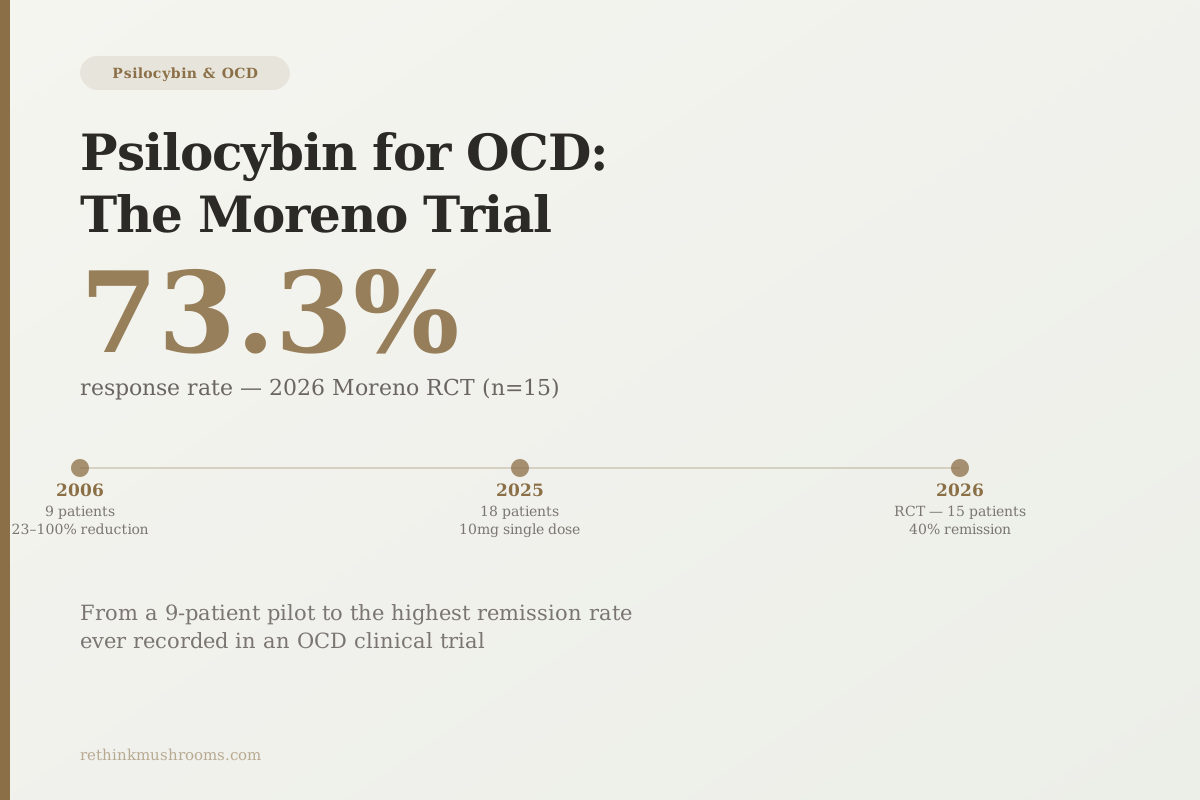
73.3% responded
After four or more weekly high-dose psilocybin sessions, 73.3% of OCD patients met the threshold for treatment response in the 2026 Moreno RCT, the most methodologically rigorous psilocybin OCD trial to date.
Moreno et al., J Psychopharmacol, 2026
40%
achieved full remission in the 2026 Moreno RCT
23–100%
Y-BOCS reduction in the 2006 pilot; all 9 patients responded
1 week
compulsion relief from a single 10mg dose in the 2025 Pellegrini trial
Moreno et al., J Psychopharmacol, 2026
 View as image ↗
In 2006, Francisco Moreno enrolled nine people with OCD in a small trial at the University of Arizona. What happened to those nine patients, and what took nearly two decades to follow up, is one of the more unusual stories in recent psychiatric research.
Every one of them improved. Their Y-BOCS scores dropped between 23% and 100% within 24 hours of each psilocybin session.[1] The Y-BOCS (Yale-Brown Obsessive-Compulsive Scale) is the standard instrument used to measure OCD severity, rating how frequently obsessions intrude and how much time compulsive rituals consume each day on a scale from 0 to 40. A 25% reduction is generally what clinicians consider clinically meaningful improvement. Eight of the nine patients cleared that bar. Six cleared 50%.
One patient entered full remission during the study and remained symptom-free for several months after it ended.[1]
This is the story of the Moreno research arc: a 2006 pilot result that warranted far more attention than it received, and a 2026 randomized controlled trial that finally tested the question at rigorous scale. For the brain circuit mechanism behind why psilocybin appears to disrupt OCD loops, see How Psilocybin Disrupts Obsessive-Compulsive Cycles. For context on psilocybin across anxiety-related conditions more broadly, see the psilocybin and anxiety overview.
Psilocybin is a Schedule I substance under US federal law. The research described here was conducted under supervised clinical conditions and does not represent an available treatment.
Key Takeaways
- In Moreno's 2006 pilot, all 9 OCD patients showed Y-BOCS reductions of 23–100% within 24 hours; 8 of 9 met the threshold for clinically meaningful improvement
- One patient from the 2006 trial entered full remission and remained symptom-free for several months after the study ended
- Pellegrini's 2025 pharmacological challenge (n=18, 10mg oral psilocybin) produced moderate-to-large reductions in compulsions specifically; obsession scores and depression scores did not change significantly
- Compulsion relief in the 2025 trial lasted up to one week from a single 10mg dose
- The 2026 Moreno RCT (n=15) found a 73.3% response rate and 40% full remission rate in the high-dose arm after four or more weekly psilocybin sessions
- Low-dose psilocybin (100 µg/kg) and active placebo (lorazepam) produced no comparable response rates in the same trial
Psilocybin in OCD: The Moreno Research Arc
The full timeline before the detail:
- 2006 — Moreno's first psilocybin OCD trial at the University of Arizona. Nine patients. All showed Y-BOCS reductions of 23–100% within 24 hours of administration. One patient entered remission lasting several months.[1]
- 2025 — Pellegrini and colleagues gave 18 OCD patients a single 10mg psilocybin dose in a pharmacological challenge design. Compulsions fell specifically; obsession scores and depression scores did not change significantly. Effects lasted up to one week.[3]
- 2026 — Moreno published the first randomized controlled trial of psilocybin for OCD. Fifteen patients, three arms, active placebo. 73.3% response rate. 40% full remission from high-dose weekly psilocybin. The most rigorous result in psilocybin OCD research to date.[2]
The 2006 Trial: All Nine Patients Improved
Moreno's 2006 study enrolled nine participants with OCD diagnoses and ran them through a crossover design: each person received very low, low, medium, and high doses of psilocybin across separate sessions in a modified double-blind protocol.[1]
The trial was small. Nine people is not a sample that can answer epidemiological questions. There was no true inert placebo. The crossover design introduced limitations the authors were transparent about.
But one feature stood out: the consistency. In clinical research, it is normal for some participants to respond and others not to. Treatment-resistant conditions like OCD are particularly heterogeneous, meaning patients with the same diagnosis often have very different underlying profiles. Across nine unrelated OCD patients with different symptom severities and histories, all nine moved in the same direction.
Eight of them showed reductions of 25% or more. Six showed reductions of 50% or more. On a condition where SRI medications (the first-line drug class for OCD, which includes SSRIs) typically produce 20–40% symptom reductions after weeks of daily dosing, a 50% reduction within 24 hours represents a very different kind of effect. The top end of the range, 100% reduction, represented complete symptom suppression during that window.
The rapid onset was one of the trial's most striking features. SRIs take four to twelve weeks to reach their therapeutic effect in OCD. A patient starting SSRI treatment has to wait months before knowing whether the medication is going to help. Psilocybin produced measurable Y-BOCS changes within hours of administration.
Durability varied across participants. Some effects lasted days. In one case, the response persisted for months after the final session, with the participant reporting sustained remission from symptoms that had been chronic.[1]
No serious adverse events were reported. The compound was well-tolerated across all dose levels in all nine participants.
The obvious follow-up question: if these results replicated in a larger controlled trial, what would they show? It took 20 years to find out.
Why the Data Sat Unacted On for 15 Years
The answer involves federal drug law more than scientific skepticism.
Psilocybin's Schedule I classification under the Controlled Substances Act requires researchers to obtain DEA registration, navigate FDA Investigational New Drug requirements, and secure institutional approval from medical centers that carry real regulatory risk for working with Schedule I compounds. During the 1990s and 2000s, few academic institutions were willing to take on that exposure.
The psychedelic research revival of the 2010s, anchored by work at Johns Hopkins, NYU, and Imperial College London on depression, addiction, and cancer-related existential anxiety, built the infrastructure that made subsequent OCD trials feasible. That work demonstrated that supervised psychedelic research could be conducted safely and produced publishable results that changed regulatory conversations. It also created templates for DEA and FDA compliance that other research groups could adapt. The cancer-related anxiety trials were among the earliest and most influential; the evidence from those studies is covered in the psilocybin and anxiety overview.
By the early 2020s, the institutional landscape had shifted enough that the Moreno group could fund and execute a proper randomized trial. Fifteen years is a long gap when the initial data is that strong. The delay wasn't scientific caution about the findings. It was regulatory architecture.
The 2025 Pellegrini Study: Compulsions Dropped. Obsessions Didn't.
In 2025, Pellegrini and colleagues published a pharmacological challenge study that added a mechanistically significant detail to the evidence base.[3] A pharmacological challenge study is a controlled design where participants receive known doses of a drug in a specific sequence, to measure dose-response effects rather than to test a treatment protocol.
The study enrolled 18 adults with OCD. The design was fixed-order: participants received 1mg of psilocybin first, a dose too low to produce any noticeable psychedelic effect that functioned as an active control, and then 10mg at a subsequent session.
The 10mg dose produced what the authors described as moderate-to-large reductions in compulsive behaviors. The effect was rapid in onset and lasted up to one week from a single dose.
What it did not change: obsession scores. Depression scores. Neither shifted significantly from baseline.
That selectivity is worth unpacking. OCD has two distinct symptom domains. Obsessions are unwanted, intrusive thoughts that cause distress and feel impossible to dismiss. Compulsions are repetitive behaviors, or mental rituals, performed to reduce the anxiety those thoughts produce. The two are linked: compulsions exist because obsessions generate unbearable anxiety, and completing the ritual temporarily reduces it. Most OCD treatments, including SSRIs, address both simultaneously. Clinicians generally expect compulsive behavior to decrease as obsessive thought content becomes less distressing.
Pellegrini's data suggests that 10mg psilocybin, in the short term, may interrupt the compulsive behavior side of the OCD loop more directly than it reduces the intrusive thought side. Whether this holds at higher doses, over longer treatment periods, or reflects a core mechanism remains an open question. The receptor-level evidence for why this distinction exists is covered in Psilocybin and 5-HT2A: The OCD Serotonin Connection.
Limitations of this study are real: the fixed dose order meant the 10mg condition always followed the 1mg condition, introducing order effects. The sample was 18 participants. Follow-up extended only one week. The compulsion-specificity finding is worth flagging clearly and needs replication before stronger conclusions are drawn.
The 2026 Moreno RCT: A 73.3% Response Rate
The 2026 trial, published in the Journal of Psychopharmacology by the same Moreno group that ran the 2006 pilot, was the first randomized controlled trial of psilocybin for OCD and the most methodologically rigorous study in this line of research.[2]
Fifteen patients with OCD were randomized to one of three conditions. The high-dose arm received psilocybin at 300 micrograms per kilogram of body weight, roughly 21 milligrams for a 70-kilogram adult. The low-dose arm received 100 micrograms per kilogram, roughly 7 milligrams. The control arm received lorazepam.
Lorazepam is a benzodiazepine, a drug class that reduces anxiety and produces noticeable sedation. The choice was deliberate: a sugar pill would let participants easily identify the non-drug arm by the complete absence of any psychoactive effect. Lorazepam produces a real pharmacological experience, making the control arm more credible and harder to identify by simple absence of effect.
Sessions were weekly. Response was formally assessed after four or more high-dose sessions, with up to eight sessions available over the trial period.
In the high-dose arm: 73.3% of patients met the criteria for treatment response, defined as a 35% or greater reduction in Y-BOCS scores. 40% of patients in the high-dose arm achieved full remission. The low-dose arm and the lorazepam arm produced no comparable response rates.
No serious adverse events were reported across any arm. The protocol was well-tolerated.
Context: SSRI response rates in OCD fall between 40% and 60% in most trials, with remission rates around 20–30%. A 73.3% response rate and 40% remission rate from a clinical trial, even a small one, are numbers the OCD treatment literature has not seen from any existing intervention.
The trial's limitations are real. Fifteen participants across three arms is a small randomized trial. The 2024 Owe-Larsson pharmacotherapy review noted that the OCD evidence base is constrained by exactly this problem: small samples and short follow-up periods across all published trials to date.[4] Results from the 2026 RCT need replication at larger scale before they can inform clinical practice. The active placebo design was sophisticated, but blinding integrity in psychedelic trials remains an ongoing methodological challenge, since participants may correctly infer their assignment from the character of their experience.
A structured comparison of all published psilocybin OCD trials is in Psilocybin OCD Clinical Trials: Current Status and Results.
How Long Do the Effects Last?
The honest answer: not fully established yet.
The 2006 Moreno data showed variable durability. Some participants had effects that lasted a day or two beyond the session. One participant's remission lasted several months. The 2006 trial wasn't designed to track long-term outcomes systematically, and the follow-up period was limited.
The 2025 Pellegrini data showed compulsion reduction lasting up to one week from a single 10mg dose. That's a meaningful duration for a single administration, but it's one week, not months.
The 2026 Moreno RCT documented outcomes across an eight-week weekly dosing window. The trial established that treatment response held during the dosing protocol. What happens after the protocol ends, whether effects persist, fade gradually, or require periodic maintenance sessions, is not answered by the current data. No long-term follow-up data from the 2026 trial has been published.
The Owe-Larsson 2024 pharmacotherapy review specifically flagged this gap: psilocybin shows therapeutic effects after single administration in OCD, but the durability evidence in OCD is more limited than in the depression literature, where follow-up studies have tracked patients for a year or more.[4]
The core unresolved question: does psilocybin produce durable remission in OCD patients from a course of treatment, or does it function more like a compound that requires ongoing sessions to sustain benefit? The preclinical research in OCD animal models, discussed in the mechanism article, suggests lasting biological changes from single exposures. Animal-to-human extrapolation in psychiatry has a poor track record, so that data informs the hypothesis without settling it.
What Comes Next: Ongoing Trials and the Regulatory Gap
Several trials are currently active or recruiting. The Yale double-blind randomized trial (NCT03356483) is the most closely watched, with a larger planned sample and a rigorously controlled design. A subsequent OCD psilocybin trial (NCT06992999) is also recruiting.
For psilocybin to become a licensed treatment for OCD in the United States, the requirements are substantial: large multi-site RCTs demonstrating safety and efficacy, successful FDA review, and likely administrative or legislative action on psilocybin's Schedule I status. None of those steps is imminent based on current regulatory trajectories.
The Owe-Larsson 2024 review described psilocybin's position in the OCD pharmacotherapy pipeline as promising, but constrained by the limited number of trials and the small patient populations studied to date.[4] That assessment remained accurate after the 2026 RCT, which produced the strongest signal yet while remaining a 15-person study. The signal is consistently pointing in one direction across independent research groups. The evidence base is not yet large enough to act on clinically.
For OCD patients looking for a broader picture of where the research stands, the Psilocybin for OCD: Breaking the Loop overview covers what the current evidence means for people who haven't responded to standard treatments. For anxiety conditions beyond OCD where the psilocybin evidence base is more extensive, see Can Psilocybin Help Chronic Anxiety?.
The Bottom Line
The Moreno research arc runs from a 2006 nine-patient pilot where every participant improved, through two decades of regulatory delay, to a 2026 randomized controlled trial producing a 73.3% response rate and 40% remission rate from high-dose weekly psilocybin. The 2025 Pellegrini study added a specific finding: compulsions respond to a single 10mg dose in ways obsessions do not, at least in the short term. The signal across independent research groups has been consistently strong. The evidence base is constrained by small samples and limited long-term follow-up, and psilocybin is not an available treatment. The 2026 RCT is the most methodologically rigorous OCD result ever recorded for any psychedelic intervention.
Frequently Asked Questions
Sources & References
- 1RTHM-00195·Moreno, Francisco A et al. (2006). “Safety, tolerability, and efficacy of psilocybin in 9 patients with obsessive-compulsive disorder..” The Journal of clinical psychiatry.Study breakdown →PubMed →↩
- 2. Source details for this reference are not yet available.
- 3RTHM-02161·Pellegrini, Luca et al. (2025). “Single-dose (10 mg) psilocybin reduces symptoms in adults with obsessive-compulsive disorder: A pharmacological challenge study..” Comprehensive psychiatry.Study breakdown →PubMed →↩
- 4RTHM-01963·Owe-Larsson, Maja et al. (2024). “Psilocybin in pharmacotherapy of obsessive-compulsive disorder..” Pharmacological reports : PR.Study breakdown →PubMed →↩