Psilocybin & Body Dysmorphic Disorder
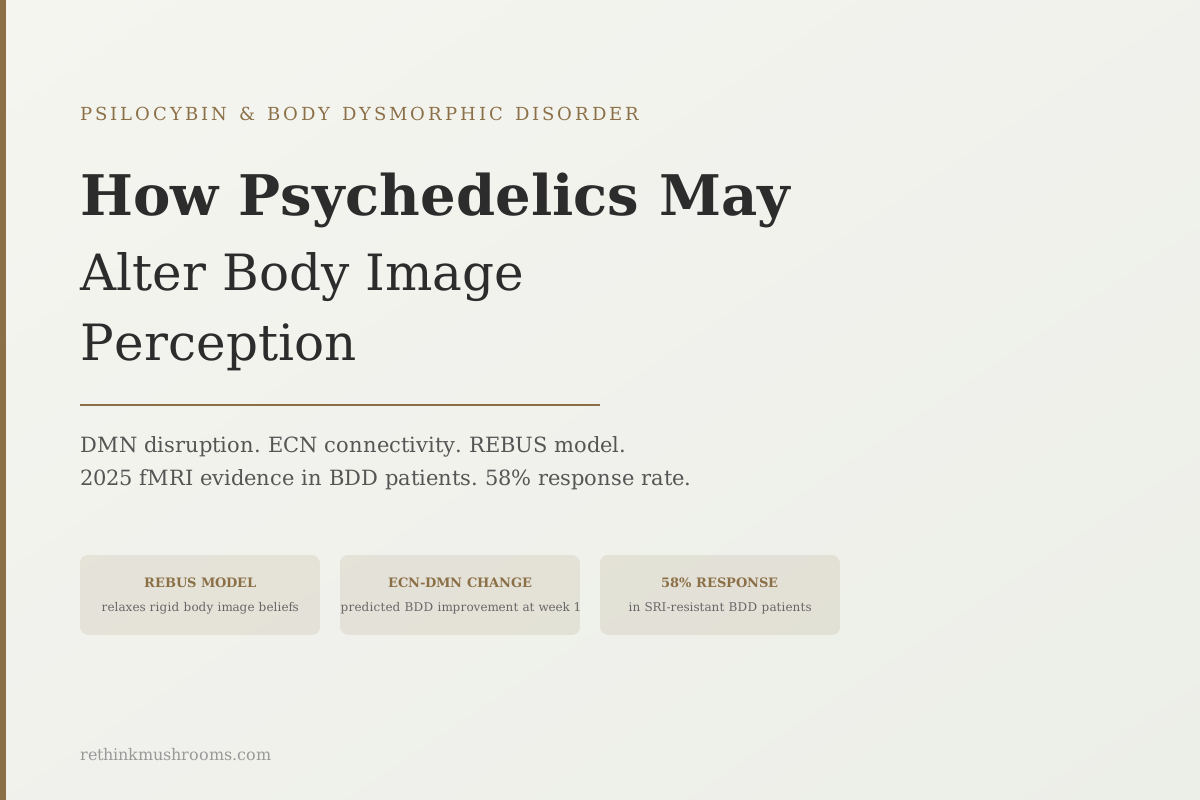
58% response rate in SRI-resistant BDD
In a 2023 pilot study of 12 adults with SRI-resistant body dysmorphic disorder, a single 25mg dose of psilocybin produced clinically significant symptom reduction in 58% of participants. A 2025 brain imaging follow-up identified Executive Control Network connectivity changes as the neural mechanism predicting improvement.
Schneier et al., J Psychiatric Research, 2023; Zhu et al., 2025
DMN disruption
overactive self-referential network suppressed by psilocybin
ECN connectivity
increased regulatory network predicted BDD symptom improvement
REBUS model
psilocybin relaxes rigid top-down beliefs including body image schemas
Schneier et al., J Psychiatric Research, 2023; Zhu et al., 2025
 View as image ↗
Body dysmorphic disorder and anorexia nervosa share a feature that makes them exceptionally difficult to treat: the distorted perception is experienced as reality. A person with BDD genuinely perceives a facial asymmetry that others cannot see. A person with anorexia genuinely perceives a body size that measurements disprove. These are not delusions in the philosophical sense; patients often know intellectually that their perception might be inaccurate. But they cannot update what they see based on that knowledge. The perception is protected from revision.
This rigidity is exactly what makes psychedelics theoretically interesting for body image disorders. Psilocybin appears to act not on the specific content of a distorted belief but on the brain's capacity to hold any belief rigidly. By temporarily reducing the stability of top-down perceptual constraints, it may create a window during which rigid body image schemas become revisable.
The evidence is early and the studies are small. But the 2023 BDD clinical pilot, the 2023 anorexia study published in Nature Medicine, and the 2025 brain imaging follow-up represent a coherent and mechanistically grounded body of work that no competitor has presented together. For the clinical evidence on the BDD pilot specifically, see Psilocybin and Body Dysmorphic Disorder: Emerging Research. For the cancer anxiety context that anchors this pillar, see Psilocybin for Cancer Patients: Reducing Existential Anxiety.
Key Takeaways
- Psilocybin may alter body image through three mechanisms: Default Mode Network disruption (suppressing self-referential negative thought loops), Executive Control Network connectivity increase (improving regulation of body-focused attention), and the REBUS model (relaxing rigid top-down perceptual beliefs)
- A 2025 fMRI study of BDD patients found increased connectivity within the Executive Control Network and between ECN, Default Mode Network, and Salience Network after a single psilocybin dose; ECN-DMN connectivity change specifically predicted symptom improvement at week 1
- The Default Mode Network is chronically overactive in BDD and OCD, driving the self-referential rumination loops that characterize both conditions; psychedelics consistently modulate this network across conditions, according to a 2023 systematic review
- The 2023 BDD pilot (n=12, 25mg psilocybin) produced a 58% response rate in SRI-resistant patients with significant reduction in BDD-YBOCS scores at weeks 1 and 12
- The 2023 anorexia nervosa pilot (n=10, 25mg, Nature Medicine) found the intervention safe and tolerable with significant reductions in concerns about weight and shape and reports of increased insight, openness, and cognitive flexibility, consistent with the REBUS model
- The mechanism evidence is based on a small cohort study and systematic reviews; no randomized controlled trial has yet tested psilocybin for body image disorders
The Mechanism Question: Why Would a Psychedelic Change Body Image?
The standard assumption about psychedelics is that they distort perception. The more interesting clinical question is whether they can correct it.
Body image disorders are characterized by perception that resists updating. Standard cognitive-behavioral therapy for BDD works by directly challenging the distorted belief and gradually reducing the behavioral responses it produces. It is effective for some patients. SSRIs reduce the intensity of obsessive preoccupation. These treatments address the symptoms but not the underlying rigidity of the perceptual system.
The hypothesis behind psilocybin research in body image disorders is different. Rather than challenging the specific belief ("your nose looks normal") or reducing the distress it produces, psilocybin may temporarily weaken the brain's capacity to maintain any belief with fixed certainty. If a body image schema is held as rigidly as a fact, and if psilocybin reduces the system's capacity for rigid belief-holding, the schema becomes briefly available for revision.
This is the REBUS model.
The REBUS Model: How Psilocybin Relaxes Rigid Beliefs
REBUS stands for Relaxed Beliefs Under Psychedelics. It is a theoretical framework proposed by neuroscientists to explain how psychedelic compounds produce such wide-ranging effects on perception, emotion, and cognition through a common mechanism.
The basic idea: the brain is a prediction machine. It constantly generates models of reality and tests them against incoming sensory data. In normal perception, the brain's top-down predictions (its priors) carry significant weight. We don't see the world as raw sensory data; we see what we expect to see, filtered through our existing models. In conditions like BDD and anorexia, some of these priors become pathologically strong. The "I look wrong" belief becomes so heavily weighted that contradictory sensory information cannot override it.
Psilocybin acts primarily at 5-HT2A receptors (serotonin-2A receptors) in the cortex, particularly in the layers of the cortex responsible for downward signaling, the feedback projections that carry predictive information from higher brain areas to sensory processing regions.[5] Activating these receptors disrupts the normal weighting of top-down priors. The brain temporarily becomes more reliant on bottom-up sensory data and less reliant on its existing models. Strong predictions become weaker. Fixed beliefs become more plastic.
In depression, this may allow patients to update a fixed belief that everything is hopeless. In PTSD, it may allow trauma memories to be reprocessed with less defensive rigidity. In BDD and anorexia, the hypothesis is that it allows rigid body image schemas to become revisable during and after the psychedelic experience.
A 2024 review of psilocybin's pharmacological role in OCD treatment confirmed that 5-HT2A agonism is the mechanism through which psilocybin produces its anti-obsessional effects, the same mechanism that makes it theoretically relevant to BDD, which the DSM-5 classifies as an OCD-related disorder.[5]
The Default Mode Network: The Brain Region Driving the Distortion
The Default Mode Network (DMN) is a collection of interconnected brain regions that become active during self-referential thought: thinking about oneself, imagining others' perspectives, mental time travel (thinking about past and future). When people are not focused on external tasks, the DMN dominates. It is, in a sense, the network of the self.
In body dysmorphic disorder and obsessive-compulsive disorder, the DMN shows chronic overactivity. This overactivity corresponds to the constant self-referential rumination that characterizes both conditions: returning again and again to the same distressing thought, unable to redirect attention away from it. The "I look wrong" loop in BDD is Default Mode Network activity that cannot be interrupted.
A 2023 systematic review of psychedelics and the Default Mode Network confirmed that across multiple conditions and multiple psychedelic compounds, psychedelics consistently reduce DMN activity during the acute session and produce changes in DMN connectivity patterns that persist beyond it.[2] This is not a coincidence or an artifact of sedation. The review found that DMN modulation is one of the most reliably observed effects of psychedelics, appearing across serotonergic, dissociative, and other compound classes.
For BDD, the implication is direct: if the disorder involves DMN hyperactivity driving self-referential rumination, and psychedelics reliably reduce DMN hyperactivity, the mechanism for a clinical effect exists. The 2025 brain imaging study tested whether this theoretical mechanism actually operates in BDD patients.
The 2025 Brain Imaging Study: What Psilocybin Does to the BDD Brain
Zhu and colleagues conducted fMRI (functional magnetic resonance imaging) scans of BDD patients before and after psilocybin administration, providing the first direct brain imaging evidence of psilocybin's effects specifically in BDD, published in 2025.[1]
The results identified changes in three neural networks:
Executive Control Network (ECN). Connectivity within the ECN increased after psilocybin. The ECN is associated with cognitive control, attention regulation, and the ability to redirect attention away from distressing stimuli. Stronger ECN connectivity is generally associated with better ability to regulate emotion and attention.
Default Mode Network (DMN). Connectivity patterns within the DMN changed following psilocybin, consistent with the disruption pattern observed in the broader psychedelics/DMN literature.
Salience Network (SN). Changes in connectivity between the Salience Network (which determines which stimuli deserve attention) and the other two networks were also observed.
The most clinically significant finding: the change in connectivity between the Executive Control Network and the Default Mode Network specifically predicted the degree of BDD symptom improvement at week 1 after psilocybin administration.[1]
In plain language: patients whose brains showed the largest increase in communication between the regulatory network (ECN) and the self-referential network (DMN) showed the most improvement in BDD symptoms. This is a mechanistic prediction; it suggests that psilocybin works for BDD not by random mood elevation but by specifically changing the relationship between the system that controls attention and the system that generates self-referential thought.
This is the missing piece in most coverage of psilocybin for body image disorders. The Schneier 2023 clinical pilot showed that symptoms improved. The Zhu 2025 imaging study shows why, at the level of brain networks.
For deeper coverage of psilocybin's functional connectivity effects across conditions, see Functional Connectivity Changes Under Psilocybin: fMRI Evidence.
The Clinical Outcome: What BDD Patients Actually Experienced
The clinical data comes from Schneier and colleagues at Columbia University, published in the Journal of Psychiatric Research in 2023.[3]
Twelve adults with moderate-to-severe BDD that had failed to respond to SRI treatment received a single 25mg oral dose of psilocybin in a controlled clinical setting with psychological support. BDD symptom severity was measured using the BDD-YBOCS (Yale-Brown Obsessive Compulsive Scale Modified for BDD) before the session and at weeks 1 and 12 afterward.
The results:
- BDD-YBOCS scores decreased significantly at both week 1 and week 12 compared to baseline
- 7 out of 12 participants (58%) were classified as responders, defined as a 30% or greater reduction in symptom severity
- No serious adverse events occurred across any participant
A 58% response rate in a population that had already failed standard treatment is notable. SRI treatment produces response rates of roughly 40-60% in treatment-naive BDD patients, and essentially zero response in SRI-resistant patients by definition. This cohort was specifically selected because they had already failed SRI treatment, making the 58% response rate in a single-dose context meaningful as a preliminary signal.
The limitations are equally clear: no control group, no placebo comparison, 12 participants. This is an open-label pilot, not a randomized controlled trial. The psychological support context (therapy before and after the session) is part of the treatment protocol and cannot be separated from the pharmacological effect. Expectancy effects in open-label psychedelic trials are substantial.
Convergent Evidence: The Anorexia Study and the Same Pattern
A parallel study published in Nature Medicine in 2023 by Peck and colleagues examined psilocybin for anorexia nervosa in 10 adult females.[4]
Anorexia and BDD are different conditions. But both involve body image distortion as a core symptom, both are partially serotonergic (SRIs show limited efficacy in both), and both involve the kind of rigid, self-referential, fact-resistant beliefs that the REBUS model predicts psilocybin would address.
The Peck 2023 results:
- The intervention was found to be safe, tolerable, and acceptable in this high-risk population (anorexia carries the highest mortality rate of any psychiatric condition)
- Participants showed significant reductions in concerns about weight and shape
- Qualitative reports consistently included "increased insight," "openness," and "cognitive flexibility"
The language of "cognitive flexibility" and "openness" directly mirrors what the REBUS model predicts: loosening of rigid top-down priors, allowing new information and perspectives to be incorporated. The fact that two studies in two different body-image conditions, using the same dose (25mg), produced the same qualitative pattern of increased cognitive flexibility alongside reduced body image distress strengthens the mechanistic hypothesis rather than being coincidental.
For the full analysis of this connection, see Psilocybin and Eating Disorders: The BDD-Anorexia Connection.
Three Mechanisms Together: How the Picture Fits
Taken together, the 2023 DMN systematic review, the 2023-2025 BDD clinical and imaging data, and the 2023 anorexia study point toward a coherent three-part mechanism:
DMN disruption. Psilocybin suppresses the chronic overactivity of the Default Mode Network that drives self-referential rumination in body image disorders. The brain's tendency to loop back to "I look wrong" is interrupted during and after the session.
ECN connectivity increase. The Executive Control Network becomes better connected, improving the brain's capacity to regulate where attention goes. Rather than the DMN pulling attention back to the body obsession, the ECN provides stronger competing regulation.
REBUS: belief rigidity reduced. The 5-HT2A agonist effect of psilocybin temporarily reduces the weight placed on established top-down predictions, including the "I look wrong" schema. During this window, the brain is more capable of revising fixed beliefs based on new experience.
These three mechanisms are complementary and mutually reinforcing. The therapy context (guided psychological support) provides new perspectives and experiences during the period when the brain is most plastic. The imaging data from Zhu 2025 shows that the ECN-DMN connectivity change, which reflects mechanisms 2 and 3 operating together, is the specific neural change that predicts clinical improvement.
The Honest Assessment
The evidence for psilocybin altering body image perception is mechanistically coherent and clinically preliminary. The 2025 imaging study makes the mechanism the most concrete it has been for any body image disorder. The clinical pilot in BDD and the Phase 1 study in anorexia are the best available clinical signals.
They are not sufficient to establish efficacy. Both studies lack control groups, making placebo effects impossible to rule out. The samples are small. The BDD study specifically selected for SRI-resistant patients, which may or may not generalize to the broader BDD population.
The most important thing missing is a randomized, placebo-controlled trial. Several are ongoing. Until those results exist, "preliminary" is the honest descriptor for this research: mechanistically promising, clinically suggestive, not established.
The Bottom Line
Psilocybin may alter body image perception through three complementary mechanisms: disruption of Default Mode Network overactivity (the self-referential rumination driver in BDD), increase in Executive Control Network connectivity (improving attention regulation), and the REBUS model (5-HT2A agonism reduces the weighting of rigid top-down perceptual priors, making fixed body image schemas temporarily revisable). The 2025 fMRI study in BDD patients confirmed that ECN-DMN connectivity change specifically predicted symptom improvement at week 1. The 2023 clinical pilot showed a 58% response rate in SRI-resistant BDD patients after a single 25mg dose, and the 2023 Nature Medicine anorexia study showed safe tolerability with qualitative reports of increased cognitive flexibility consistent with the REBUS mechanism. Both conditions are characterized by body image distortion that resists standard treatment; both show early signals of psilocybin response through a shared mechanism. All clinical evidence is from small, uncontrolled pilot studies.
Frequently Asked Questions
Sources & References
- 1RTHM-02220·Zhu, Xi et al. (2025). “Single-dose psilocybin alters resting state functional networks in patients with body dysmorphic disorder..” Psychedelics.Study breakdown →PubMed →↩
- 2. Source details for this reference are not yet available.
- 3RTHM-01783·Schneier, Franklin R et al. (2023). “Pilot study of single-dose psilocybin for serotonin reuptake inhibitor-resistant body dysmorphic disorder..” Journal of psychiatric research.Study breakdown →PubMed →↩
- 4RTHM-01762·Peck, Stephanie Knatz et al. (2023). “Psilocybin therapy for females with anorexia nervosa: a phase 1, open-label feasibility study..” Nature medicine.Study breakdown →PubMed →↩
- 5. Source details for this reference are not yet available.