Lion's Mane Mood
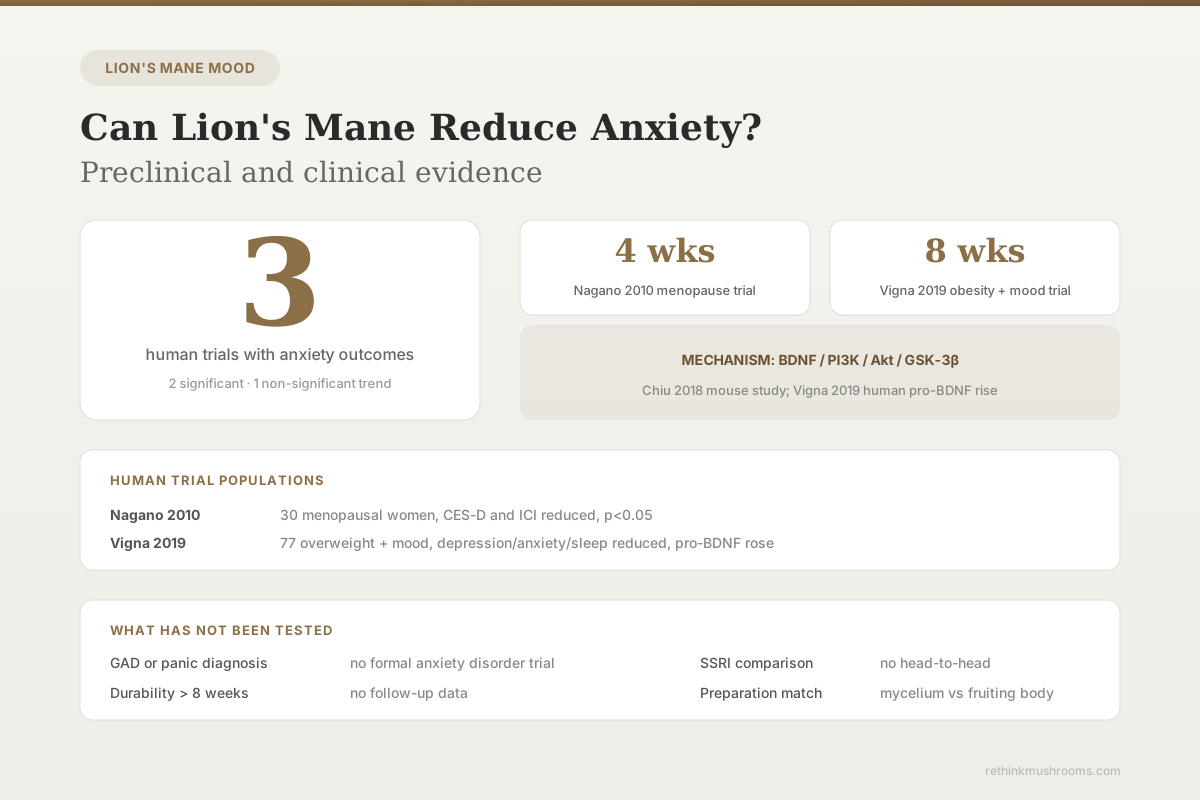
3 human trials
Nagano 2010, Vigna 2019, and Docherty 2023 have measured anxiety or subjective stress with lion's mane in humans. Two reached statistical significance; one showed a non-significant trend.
Nagano et al. 2010; Vigna et al. 2019; Docherty et al. 2023
4 weeks
duration of the Nagano menopause trial that hit significance
8 weeks
duration of the Vigna overweight/obesity trial
p = 0.051
Docherty young-adult stress trend, just short of significance
Nagano et al. 2010; Vigna et al. 2019; Docherty et al. 2023
 View as image ↗
Lion's mane gets marketed as an anxiety supplement almost as often as it gets marketed as a nootropic, but the evidence base is much smaller and much more specific than either camp usually acknowledges. Three human trials have measured anxiety or subjective stress as a named outcome, and they have tested three completely different populations: Japanese women in menopause, Italian adults with overweight or obesity and mood disturbance, and British young adults. Across those three trials, the results are two positive, one a non-significant trend. The rodent literature is larger and more mechanistically specific, pointing to BDNF signaling as the best candidate for how a mushroom would reduce anxiety-like behavior. For the broader mood picture, see Lion's Mane for Depression: Research on Mood and Mental Health.
Key Takeaways
- Nagano et al. 2010 gave 30 Japanese women in menopause 4 weeks of Hericium erinaceus cookies and reported significant reductions in the Center for Epidemiologic Studies Depression Scale (CES-D) and the Indefinite Complaints Index, with anxiety-related subscales among the items that fell[1]
- Vigna et al. 2019 tested 8 weeks of H. erinaceus in 77 patients with overweight or obesity and mood or sleep disturbance and reported significant decreases in depression, anxiety, and sleep disorder scores, along with an increase in circulating pro-BDNF[2]
- Docherty et al. 2023 tested 28 days of 600 mg lion's mane in 41 healthy young adults and found a non-significant trend toward reduced subjective stress (p = 0.051), stopping just short of conventional statistical significance[3]
- Chiu et al. 2018 showed that erinacine A-enriched Hericium erinaceus mycelium produced antidepressant-like behavioral effects in mice through BDNF, PI3K, Akt, and GSK-3β signaling, providing a specific mechanism researchers continue to cite[4]
- Every human anxiety trial has fewer than 80 participants, runs 8 weeks or less, and uses a different preparation of Hericium erinaceus, so meta-analytic pooling across them is not yet meaningful
The three human anxiety trials, in detail
Nagano 2010: menopause and indefinite complaints
Nagano and colleagues are the first team to have run a randomized, placebo-controlled trial explicitly measuring anxiety and depression scores with lion's mane.[1] Published in Biomedical Research in 2010, the trial recruited 30 women in menopause and randomized them to either cookies containing 0.5 g of Hericium erinaceus powder each or identical placebo cookies, taken three times a day for 4 weeks.
The study used the Center for Epidemiologic Studies Depression Scale (CES-D), the Indefinite Complaints Index (ICI), and the Kupperman Menopausal Index. The lion's mane group showed significantly lower scores on the CES-D and ICI compared with placebo at the end of the 4-week supplementation period. Within the ICI, the items most sensitive to improvement were those related to "indefinite and unidentifiable anxiety" and irritation. The authors framed the finding cautiously, emphasizing that the population was narrow and the duration was short, but it remains the foundational human anxiety result for Hericium erinaceus.
Vigna 2019: overweight and obesity with mood disturbance
Vigna and colleagues recruited 77 patients with overweight or obesity from an obesity clinic at the University of Milan and randomized them to either 8 weeks of H. erinaceus supplementation or placebo.[2] Entry required a diagnosis of mood disorder, sleep disorder, or binge eating disorder in addition to the weight criterion, which means the population was selected for some baseline distress.
The primary outcomes were validated scales for depression (Beck Depression Inventory), anxiety (several), and sleep. The lion's mane group showed significant decreases in depression, anxiety, and sleep disorder scores compared with placebo, and the researchers also reported an increase in circulating pro-BDNF. That pro-BDNF change did not translate to a significant difference in mature BDNF, which the authors discussed as an open mechanistic question. Like Nagano, this trial is small and single-site, but it is currently the most externally relevant clinical anxiety result for Western populations.
Docherty 2023: healthy young adults, the non-significant trend
Docherty and colleagues ran a 2023 pilot in 41 healthy adults aged 18 to 45 in the UK, with an acute arm testing a single 1.8 g dose of Hericium erinaceus and a chronic arm testing 28 days of 600 mg daily.[3] The chronic arm included subjective stress as a secondary outcome, measured via a validated questionnaire.
The result was a trend toward reduced subjective stress at 28 days with p = 0.051, just short of the conventional 0.05 threshold. The authors presented this transparently as a trend rather than a positive finding, and they noted that the study was underpowered to detect small effects. The Docherty trial is often misquoted as showing that lion's mane reduces stress in healthy adults; what it actually shows is that the direction of effect was favorable but did not reach statistical significance, and in a population that did not have baseline anxiety. For a broader look at how lion's mane is thought to act on mood-related systems, see Lion's Mane Anti-Inflammatory Cytokines: The Mood-Inflammation Link.
The mechanism evidence: BDNF, erinacine A, and the PI3K/Akt pathway
The rodent literature is where most mechanistic anxiety claims for lion's mane come from, and a single study has done more to frame this conversation than any other: Chiu et al. 2018.[4]
Chiu and colleagues fed erinacine A-enriched Hericium erinaceus mycelium to mice and tested them on standard behavioral measures, including the forced swim test and tail suspension test. The mycelium group showed antidepressant-like responses. When the team looked at signaling pathways, they found increased BDNF expression and activation of the PI3K, Akt, and GSK-3β cascade, which is the same molecular route targeted by several mainstream antidepressants. This is the mechanism most commonly invoked in review articles on lion's mane and anxiety, because BDNF deficits are implicated in both anxiety and depression and because the pathway is pharmacologically well-characterized.
Tsai-Teng et al. 2016, also using erinacine A-enriched mycelium, reported reductions in neuroinflammatory markers and amyloid plaque pathology in APPswe/PS1dE9 transgenic mice.[5] That trial was Alzheimer's-focused, but anxiety and cognitive symptoms overlap in Alzheimer's models, and the same anti-inflammatory signaling is cited in anxiety discussions.
Lai and colleagues in 2013 showed that methanolic extracts of lion's mane promoted neurite outgrowth in cultured nerve cells, supporting the general neurotrophic picture that makes a BDNF mechanism plausible.[6] Khan et al. 2013 reviewed the early literature and concluded that Hericium erinaceus had credible neurotrophic potential but that clinical translation was still preliminary, a position consistent with the limited number of human trials that had been run at that time.[7]
Why every anxiety trial has used a different population
One of the most striking features of the lion's mane anxiety literature is that no two published trials have used the same population. Nagano tested women in menopause. Vigna tested adults with overweight or obesity and pre-existing mood or sleep disorders. Docherty tested healthy young adults with no baseline distress. This is not an accident; it reflects the fact that small single-center teams have pursued different hypotheses with different funding and different clinical samples.
The result is that lion's mane has never been tested in the same population twice by independent teams, which is the minimum bar for a replication claim. A reader who wants to know whether lion's mane "works for anxiety" is really asking several different questions at once: does it reduce menopause-related affective symptoms; does it help mood and sleep in adults with obesity; does it reduce day-to-day stress in healthy people. The current evidence offers preliminary answers to the first two and a non-significant trend on the third.
The Vigna trial is arguably the most clinically interesting of the three because it used a clinical population with baseline mood symptoms, which is where you would expect any active supplement to show its largest effect. That trial also included a biomarker (pro-BDNF) that provides a mechanistic link back to the Chiu et al. animal work, strengthening the case that the human and rodent literatures are studying the same underlying biology.
The dose and duration problem
Lion's mane anxiety trials have used very different doses, and the doses do not track the endpoints in a way that would let researchers derive a minimum effective dose.
Nagano 2010 used 0.5 g of fruiting body powder three times a day (1.5 g total) and found an effect at 4 weeks. Vigna 2019 used a specific H. erinaceus extract at a proprietary dose over 8 weeks and also found an effect. Docherty 2023 used 600 mg of a standardized extract for 28 days and found only a trend. These are not comparable products. Comparing them is like comparing "green tea" across a trial that used whole leaf, a trial that used decaffeinated extract, and a trial that used purified catechin capsules.
Commercial lion's mane products are often sold at 500 mg to 1,000 mg of extract per day. That dose range sits inside the Docherty chronic protocol, which did not reach significance. The Nagano and Vigna trials used products that do not directly match most commercial supplements in either dose or form. This is one of the main reasons that systematic reviewers are conservative about lion's mane anxiety claims. For more on mechanisms beyond BDNF, see How Lion's Mane Affects Serotonin and Dopamine Pathways.
What the trials do not show
It is worth stating clearly what the current evidence does not establish.
No trial has tested lion's mane in patients with a formal diagnosis of generalized anxiety disorder, panic disorder, or social anxiety disorder. All three published trials used symptom scales in populations selected for other reasons. No trial has tested lion's mane head-to-head against an SSRI or against cognitive behavioral therapy. No trial has followed participants beyond 8 weeks, so there is no durability data. No trial has tested doses higher than what commercial products already offer. No trial has compared erinacine A-enriched mycelium (the animal mechanism leader) with fruiting body powder in a clinical anxiety population, even though that comparison is the most important one that mechanistic research suggests. The evidence base is not strong enough to rule in or rule out lion's mane for clinical anxiety, only to say that in specific populations with specific baseline symptoms, it has produced measurable effects in small trials.
How the three trials fit together
A useful way to read the current literature is as three probes into different parts of the anxiety and stress spectrum. Nagano 2010 tested a population defined by hormonal transition, where mood and anxiety symptoms are common but often poorly served by mainstream treatments. Vigna 2019 tested a population defined by metabolic and psychological comorbidity, where inflammatory markers are typically elevated and where BDNF signaling is known to be dysregulated. Docherty 2023 tested a population with no baseline pathology at all, looking for effects on everyday stress in otherwise healthy young adults. Only the two trials with some baseline distress reached significance. That is consistent with the general principle that treatments tend to show larger effects in populations with more room to improve, and it is a useful framing for interpreting anything a commercial lion's mane product claims about daily stress reduction.
The Vigna biomarker result is particularly valuable because it ties the human trial back to the animal mechanism literature. If lion's mane raises circulating pro-BDNF in people and raises BDNF expression in mice through a known signaling pathway, the biology is pulling in the same direction across species, even though the clinical effect sizes in humans are smaller. That coherence does not prove causality, but it is stronger than what is available for most supplement-anxiety claims, which typically rest on either in vitro mechanism data or rodent behavior data with no human biomarker bridge. For the menopause-specific context, see Lion's Mane and Menopause-Related Anxiety and Depression.
The Bottom Line
Three human trials have tested lion's mane with anxiety or stress outcomes. Two in clinical populations (menopausal women and adults with overweight plus mood disturbance) reached statistical significance, and one in healthy young adults produced a non-significant trend. The rodent literature points to BDNF and the PI3K/Akt/GSK-3β pathway as the most plausible mechanism. All human trials are small, short, and use different preparations, so the evidence is real but preliminary, and it has not been tested in people with a formal anxiety diagnosis.
Frequently Asked Questions
Sources & References
- 1RTHM-00194·Nagano, Mayumi et al. (2010). “Reduction of depression and anxiety by 4 weeks Hericium erinaceus intake..” Biomedical research (Tokyo.Study breakdown →PubMed →↩
- 2RTHM-00590·Vigna, Luisella et al. (2019). “Hericium erinaceus Improves Mood and Sleep Disorders in Patients Affected by Overweight or Obesity: Could Circulating Pro-BDNF and BDNF Be Potential Biomarkers?.” Evidence-based complementary and alternative medicine : eCAM.Study breakdown →PubMed →↩
- 3RTHM-00821·Docherty, Sarah et al. (2023). “The Acute and Chronic Effects of Lion's Mane Mushroom Supplementation on Cognitive Function, Stress and Mood in Young Adults: A Double-Blind, Parallel Groups, Pilot Study..” Nutrients.Study breakdown →PubMed →↩
- 4RTHM-00505·Chiu, Chun-Hung et al. (2018). “Erinacine A-Enriched Hericium erinaceus Mycelium Produces Antidepressant-Like Effects through Modulating BDNF/PI3K/Akt/GSK-3β Signaling in Mice..” International journal of molecular sciences.Study breakdown →PubMed →↩
- 5RTHM-00452·Tsai-Teng, Tzeng et al. (2016). “Erinacine A-enriched Hericium erinaceus mycelium ameliorates Alzheimer's disease-related pathologies in APPswe/PS1dE9 transgenic mice..” Journal of biomedical science.Study breakdown →PubMed →↩
- 6RTHM-00295·Lai, Puei-Lene et al. (2013). “Neurotrophic properties of the Lion's mane medicinal mushroom, Hericium erinaceus (Higher Basidiomycetes) from Malaysia..” International journal of medicinal mushrooms.Study breakdown →PubMed →↩
- 7RTHM-00293·Khan, Md Asaduzzaman et al. (2013). “Hericium erinaceus: an edible mushroom with medicinal values..” Journal of complementary & integrative medicine.Study breakdown →PubMed →↩