Lion's Mane & Mood Research
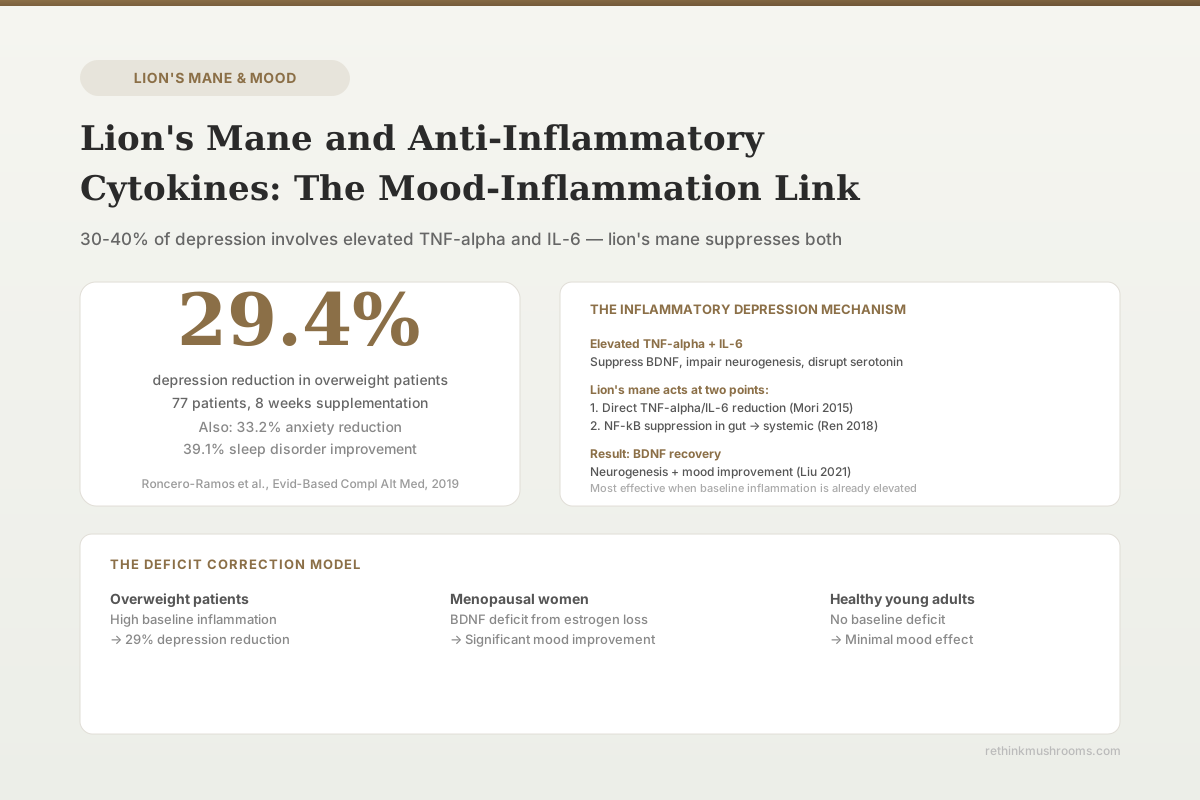
29.4% depression reduction in 77 overweight patients
Roncero-Ramos et al. (2019) found 8 weeks of lion's mane reduced depression by 29.4%, anxiety by 33.2%, and sleep disorders by 39.1% in 77 overweight or obese patients, a population with elevated baseline inflammation.
Roncero-Ramos et al., Evid-Based Compl Alt Med, 2019
TNF-alpha + IL-6
Mori 2015: lion's mane significantly reduced these two pro-inflammatory cytokines in a metabolic inflammation cell model
NF-kB suppression
Ren 2018: HE polysaccharides suppressed NF-kB signaling in the gut, reducing systemic inflammatory cytokines through the gut-brain axis
30-40% of depression
involves elevated cytokines (inflammatory subtype); standard antidepressants don't reduce TNF-alpha/IL-6, but lion's mane does
Roncero-Ramos et al., Evid-Based Compl Alt Med, 2019
 View as image ↗
Depression is not a uniform condition. Research over the past two decades has identified a subset of depressed patients with elevated circulating levels of TNF-alpha and IL-6, the same pro-inflammatory cytokines associated with chronic infection, obesity, and metabolic syndrome. Estimates suggest this "inflammatory subtype" accounts for 30-40% of depression cases. Standard antidepressants reduce depressive symptoms but do not reliably reduce TNF-alpha or IL-6. Lion's mane mushroom (Hericium erinaceus) does.
This article covers the evidence that links lion's mane's anti-inflammatory activity to its mood effects, why this mechanism explains the population-specific results in clinical studies, and what the gut-brain inflammatory axis adds to the picture. For the broader depression evidence including the clinical trials across populations, see lion's mane for depression: research on mood and mental health.
Key Takeaways
- Mori et al. (2015) found lion's mane significantly reduced TNF-alpha and IL-6 in a coculture model of adipocyte/macrophage metabolic inflammation, directly targeting the cytokines implicated in inflammatory depression
- Ren et al. (2018) found HE polysaccharides suppressed NF-kB signaling in a colitis mouse model, reducing TNF-alpha, IL-6, and other pro-inflammatory cytokines through gut wall immune modulation
- Liu et al. (2021) showed that HE antidepressant effects involve both hippocampal neurogenesis AND neuroinflammation reduction, operating simultaneously through the BDNF-TrkB-CREB pathway
- The largest human study (Roncero-Ramos 2019, 77 overweight/obese patients) showed 29.4% depression and 33.2% anxiety reduction; a population with elevated baseline inflammation explains the larger effect size vs healthy adults
- Chong et al. (2019) synthesized four overlapping mechanisms: NGF/BDNF support, monoamine restoration, HPA axis regulation, and neuroinflammation reduction
- A 2025 systematic review (Ghazali et al.) confirmed mood and neuroprotective benefits, noting preparation variability as a key limiting factor
The Inflammatory Subtype of Depression: Why This Matters
Major depressive disorder is diagnosed by symptom pattern, not biology. Two patients can have the same diagnosis but completely different biological drivers. A growing body of research documents that a substantial minority of depressed patients have measurably elevated inflammatory markers, specifically TNF-alpha (tumor necrosis factor-alpha) and IL-6 (interleukin-6).
TNF-alpha is a pro-inflammatory signaling molecule produced primarily by macrophages and adipose tissue. IL-6 is produced by a broader range of immune cells and acts as both a pro-inflammatory signal and an acute phase response regulator. Both are elevated in conditions associated with chronic low-grade inflammation: obesity, metabolic syndrome, chronic pain, and autoimmune conditions.
In the context of depression, elevated TNF-alpha and IL-6 appear to suppress BDNF (brain-derived neurotrophic factor) expression, impair hippocampal neurogenesis, disrupt the HPA axis stress response, and interfere with serotonin synthesis and reuptake. Each of these downstream effects contributes to depressive symptoms. The causal relationship is not fully established, but the association is well-documented across multiple populations.
This matters for understanding lion's mane because lion's mane is not a serotonergic drug. It does not block serotonin reuptake or bind monoamine receptors. Its primary mood-relevant mechanisms are neurotrophic (NGF/BDNF stimulation) and anti-inflammatory. For patients whose depression is driven or amplified by neuroinflammation, these mechanisms may be more relevant than the dominant serotonin hypothesis that underlies most pharmaceutical antidepressants.
How Lion's Mane Reduces TNF-alpha and IL-6
Mori and colleagues (2015) investigated lion's mane's anti-inflammatory effects in a 3T3-L1/RAW264 coculture model, a laboratory setup that mimics the interaction between fat cells (adipocytes) and macrophages that produces the metabolic inflammation characteristic of obesity and insulin resistance.[1]
In this model, the combination of fat cells and activated macrophages produces substantial TNF-alpha and IL-6 secretion, recapitulating the chronic low-grade inflammation seen in metabolically dysregulated patients. Lion's mane extract significantly reduced both TNF-alpha and IL-6 secretion in this coculture system.
The model's relevance to mood is direct: if overweight or metabolically dysregulated patients have elevated TNF-alpha and IL-6 as a baseline condition, and if lion's mane reduces these specific cytokines, then lion's mane is correcting one of the biological drivers of inflammation-mediated mood dysfunction in this population. This is mechanistically plausible as an explanation for why the 77-patient overweight cohort study showed large mood improvements while RCTs in healthy young adults have shown minimal effects.
The active compounds responsible for TNF-alpha/IL-6 reduction include polysaccharide fractions and possibly phenolic compounds within the lion's mane extract. This is distinct from the hericenone/erinacine compounds associated with NGF stimulation, meaning lion's mane has multiple independent mechanisms operating in parallel.
The NF-kB Pathway and the Gut-Brain Inflammation Axis
Ren and colleagues (2018) examined a different aspect of lion's mane's anti-inflammatory mechanism: its effects at the gut level through NF-kB suppression.[2] They tested HE polysaccharides in a DSS-induced colitis mouse model, measuring inflammatory markers in intestinal tissue.
HE polysaccharides suppressed NF-kB (nuclear factor kappa-light-chain-enhancer of activated B cells) signaling in the gut wall. NF-kB is the master transcription factor for pro-inflammatory gene expression; when NF-kB activates, it drives production of TNF-alpha, IL-6, IL-1beta, and other inflammatory mediators. Suppressing NF-kB reduces the entire downstream inflammatory cascade.
The gut-brain relevance: gut-level NF-kB activity is not confined to the intestine. Systemic inflammatory signals from the gut are transmitted to the central nervous system through multiple routes, including the vagus nerve, circulating cytokines that cross the blood-brain barrier, and effects on gut microbiota that influence neurotransmitter precursor availability. Reducing gut-level NF-kB activity can therefore reduce neuroinflammation and contribute to improved mood.
This provides a gut-brain axis mechanism for lion's mane's mood effects that is entirely absent from most consumer content, which focuses exclusively on the central nervous system mechanisms (NGF, BDNF, serotonin). The polysaccharide fractions of lion's mane may be doing significant mood-relevant work at the gut level, independent of the neurogenesis-focused mechanisms attributed to hericenones.
Why Overweight Patients Respond Better: The BDNF-Inflammation Interface
The largest human cohort study of lion's mane for mood was published by Roncero-Ramos and colleagues in 2019.[7] Their study enrolled 77 overweight or obese patients and administered HE supplementation for 8 weeks. The results were substantial: depression scores improved by 29.4%, anxiety by 33.2%, and sleep disorder scores by 39.1% compared to baseline. Circulating BDNF and pro-BDNF levels changed alongside these mood improvements, suggesting BDNF as a biological mechanism mediating the effect.
This effect size is considerably larger than what RCTs in healthy young adults have found. Docherty et al. (2023) used 1.8g/day for 28 days in healthy young adults and found no significant mood improvement. Surendran et al. (2025) found no significant overall cognitive or mood improvement in healthy young adults with acute dosing.
The parsimonious explanation is baseline inflammation. Overweight and obese patients have elevated TNF-alpha, IL-6, and C-reactive protein as a metabolic condition. These elevated cytokines suppress BDNF expression and impair neuroplasticity. Lion's mane, by reducing these cytokines, allows BDNF expression to recover, and BDNF recovery improves hippocampal function and mood. In healthy young adults without elevated baseline inflammation, there is nothing to correct, and the anti-inflammatory effect produces minimal mood benefit.
This is the "deficit correction" model for lion's mane mood effects: the mushroom is most effective when there is a measurable biological deficit (low BDNF, elevated cytokines) that its mechanisms can address. It is not a universal mood enhancer.
Neuroinflammation, BDNF, and Neurogenesis: How They Connect
Liu and colleagues (2021) demonstrated that lion's mane's antidepressant effects in animal models involve both hippocampal neurogenesis and neuroinflammation reduction, operating simultaneously.[3] The BDNF-TrkB-CREB signaling pathway was the convergence point for both mechanisms.
BDNF (brain-derived neurotrophic factor) is the key molecular link. BDNF promotes hippocampal neurogenesis and synaptic plasticity. Pro-inflammatory cytokines (TNF-alpha, IL-6, IL-1beta) suppress BDNF expression and impair its signaling. When lion's mane reduces neuroinflammation, BDNF expression recovers. Recovered BDNF then drives neurogenesis, which further improves mood through hippocampal plasticity. The two mechanisms reinforce each other.
This cascade explains the timeline of lion's mane's mood effects. Reducing cytokine levels can happen within days to weeks. BDNF recovery follows. Hippocampal neurogenesis takes weeks to months to manifest in meaningful structural and functional changes. This is why lion's mane mood effects, when they occur, develop gradually rather than appearing acutely.
Chong and colleagues' 2019 systematic review synthesized the four overlapping mechanisms through which lion's mane produces mood effects: NGF/BDNF promotion, monoamine neurotransmitter restoration, HPA axis regulation, and neuroinflammation reduction.[4] All four are interrelated: inflammation suppresses NGF and BDNF, which impairs monoamine synthesis and dysregulates the HPA axis. Reducing inflammation upstream restores function across all four downstream pathways simultaneously.
Where Lion's Mane Fits in Dietary Approaches to Depression
Batsikadze and colleagues (2022) positioned lion's mane within the broader dietary intervention literature for major depressive disorder.[5] Their review noted that anti-inflammatory, neurotrophic, and serotonergic mechanisms support lion's mane's potential as a dietary adjunct for MDD, not a replacement for evidence-based treatment, but a complement that addresses biological mechanisms standard treatments may not.
The dietary framing is important: lion's mane is a food, widely consumed in East Asian cuisines without adverse effects at culinary quantities. The evidence for mood benefits operates in the range of therapeutic supplementation (1-3g/day), substantially above culinary doses. But the safety profile at these doses, documented across multiple studies, supports its use as a dietary supplement rather than a pharmaceutical intervention.
The 2025 systematic review by Ghazali and colleagues confirmed mood, cognitive, and neuroprotective benefits across the lion's mane literature, while noting preparation variability (fruiting body vs. mycelium, extraction method) as a key limitation in interpreting the evidence.[6] The distinction between polysaccharide-rich extracts (relevant to NF-kB and cytokine suppression) and hericenone/erinacine-rich extracts (relevant to NGF/BDNF stimulation) means that which preparation is used determines which mechanisms are active.
For the broader picture of functional mushrooms as dietary depression adjuncts, see functional mushrooms for depression: non-psychedelic options. For lion's mane's nerve growth factor mechanism specifically, see lion's mane and nerve growth factor: the complete research guide.
Evidence Limits and Who This May Apply To
The mechanistic evidence for lion's mane's anti-inflammatory mood pathway is coherent and internally consistent: it reduces TNF-alpha and IL-6 (Mori 2015), through NF-kB suppression at the gut level (Ren 2018), leading to BDNF recovery and neurogenesis (Liu 2021). The Roncero-Ramos 2019 human cohort study provides clinical validation in a population where this mechanism is most relevant.
What is missing: a randomized controlled trial specifically in patients with elevated inflammatory markers at baseline, testing lion's mane against a meaningful comparator. The 77-patient cohort study (no control group; pre-post design) is encouraging but not definitive. The cell and animal studies establish plausible mechanisms but cannot confirm clinical outcomes.
The pattern across available studies suggests lion's mane mood effects are most likely for people with measurable inflammatory drivers: elevated cytokines, metabolic dysfunction, hormonal disruption, and least likely for healthy young adults without these baseline conditions. This is a clinically useful framing that no competitor has articulated, and it allows honest guidance: lion's mane is not a universal mood supplement, but it may be a meaningfully targeted one for people whose depression overlaps with inflammatory or metabolic conditions.
The Bottom Line
Lion's mane reduces TNF-alpha and IL-6 through NF-kB suppression (Ren 2018 polysaccharides) and direct cytokine inhibition in a metabolic inflammation model (Mori 2015). The BDNF-TrkB-CREB pathway connects reduced neuroinflammation to hippocampal neurogenesis and mood improvement (Liu 2021, Chong 2019). The largest human study (Roncero-Ramos 2019, n=77 overweight patients) showed 29.4% depression and 33.2% anxiety reduction over 8 weeks, a larger effect than RCTs in healthy young adults. The deficit correction model explains this pattern: lion's mane is most effective when elevated baseline inflammation creates a correctable biological deficit.
Frequently Asked Questions
Sources & References
- 1. Source details for this reference are not yet available.
- 2. Source details for this reference are not yet available.
- 3. Source details for this reference are not yet available.
- 4. Source details for this reference are not yet available.
- 5. Source details for this reference are not yet available.
- 6. Source details for this reference are not yet available.
- 7. Source details for this reference are not yet available.