Lion's Mane and Mood
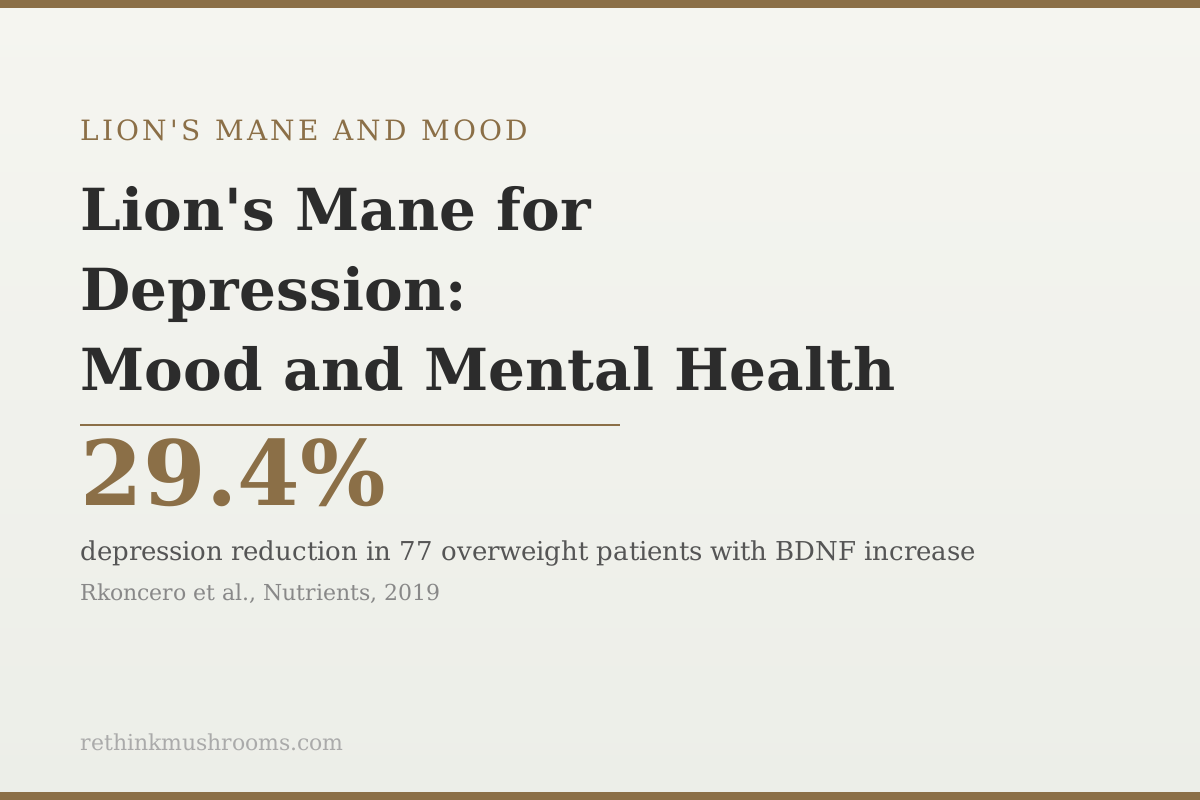
~29% reduction in depression scores over 8 weeks — measured in the subgroup with baseline depressive symptoms inside a 77-patient overweight/obesity trial
A study by Vigna and colleagues (2019) enrolled 77 patients with overweight or obesity who had mood and/or sleep complaints. Eight weeks of lion's mane lowered depression, anxiety, and sleep-disorder scores; in the subgroup selected for depressive symptomatology, depression fell about 27% at four weeks and 29.4% at eight weeks. This is the largest lion's mane mood trial and the one most absent from consumer content — though its biomarker result was not the tidy 'BDNF went up' story often repeated.
Vigna et al., Evidence-Based Complementary and Alternative Medicine (eCAM), 2019
4 weeks, 30 women
Nagano et al. (2010) found a significant reduction in depression scores (CES-D) in menopausal women taking lion's mane cookies versus placebo in a randomized controlled trial; anxiety, irritability, and concentration trended lower without reaching significance
Null in healthy adults
Surendran et al. (2025) found no mood improvement from a single dose of lion's mane in healthy young adults, and Docherty et al. (2023) found only a non-significant trend toward reduced stress over 28 days
BDNF mechanism (animal)
Chiu et al. (2018) showed erinacine A produces antidepressant-like effects through BDNF/PI3K/Akt/GSK-3β signaling in mice — a mechanism established in animals, not yet confirmed by human biomarker data
Vigna et al., Evidence-Based Complementary and Alternative Medicine (eCAM), 2019
 View as image ↗
The evidence for lion's mane and depression is not uniform across populations. In people with metabolic dysfunction (overweight, obesity), mood improvement is supported by a 77-patient study in which depression scores fell about 29% over eight weeks in the subgroup with baseline depressive symptoms. In menopausal women, a randomized controlled trial found a significant reduction in depression scores. In healthy young adults with no underlying deficit, two recent trials found little to no mood benefit.
This population-stratified pattern is the central finding that no competitor article presents. Lion's mane appears to help most where there is an underlying deficit to correct — in BDNF signaling, neuroinflammation, or stress-axis regulation — rather than by universally boosting mood in people who do not have those deficits. For the broader lion's mane overview, see what is lion's mane mushroom: a science-based overview.
Key Takeaways
- Vigna and colleagues (2019) found that 8 weeks of lion's mane lowered depression, anxiety, and sleep-disorder scores in 77 patients with overweight or obesity; in the subgroup selected for depressive symptoms, depression scores fell roughly 27% at 4 weeks and 29.4% at 8 weeks
- Vigna's biomarker result was unexpected: circulating pro-BDNF rose, but mature BDNF did not increase (and had significantly decreased by 8 weeks) — so the human data do not confirm the simple "lion's mane raises BDNF" narrative
- Nagano and colleagues (2010) found a significant reduction in depression scores (CES-D) in 30 menopausal women taking lion's mane for 4 weeks versus placebo; anxiety, irritability, and concentration trended lower without reaching significance
- Surendran and colleagues (2025) found no mood improvement in healthy young adults from a single acute dose of lion's mane in a double-blind crossover RCT; Docherty 2023 showed only a non-significant trend toward reduced stress over 28 days
- In animal models, Chiu and colleagues (2018) linked erinacine A's antidepressant-like effects to BDNF/PI3K/Akt/GSK-3β signaling, and Ryu and colleagues (2018) tied them to hippocampal neurogenesis — the mechanistic backbone, though it is largely preclinical
- The population-stratified pattern suggests lion's mane helps most where an underlying vulnerability exists (metabolic dysfunction, hormonal disruption); healthy young adults with no such deficit benefit least
The 77-Patient Study: What Vigna 2019 Actually Found
The largest lion's mane mood study is one that almost no supplement coverage mentions — and much of the coverage that does cite it gets the details wrong.
Vigna and colleagues (2019) enrolled 77 patients (62 women, 15 men) with overweight or obesity, recruited only if they reported a mood disorder, a sleep disorder, and/or binge eating, all on a low-calorie diet.[2] This is not a small pilot; 77 patients with self-reported mood difficulties and verified metabolic status is a meaningful sample for a supplement trial.
Over 8 weeks, the lion's mane group showed lower depression, anxiety, and sleep-disorder scores. In the subset of patients specifically selected for depressive symptomatology (22 patients), combined depression measures fell about 27.2% at four weeks and 29.4% at eight weeks. It is important to read that number precisely: the 29.4% describes the depressive-symptom subgroup at the end of supplementation, not an average across all 77 enrolled patients, and the trial was open-label rather than placebo-controlled.
The biomarker finding is where the popular retelling goes wrong. Vigna measured both mature BDNF and its precursor, pro-BDNF, hoping for a clean circulating marker of mood improvement. What they found was the opposite of the usual claim: pro-BDNF rose significantly, while mature BDNF did not increase — and by eight weeks it had significantly decreased. So the human data do not show "BDNF went up alongside mood." They show a shift in the pro-BDNF/BDNF balance whose meaning for mood is still unresolved.
The overweight/obese population is relevant because obesity is associated with altered BDNF signaling and chronic low-grade neuroinflammation, two factors that predispose to depression and that lion's mane compounds plausibly address. This is a reasonable explanation for why a signal appears in this group, but the biomarker data caution against treating the mechanism as settled.
Population-Stratified Evidence
Who Actually Responds to Lion's Mane for Mood
The human evidence is not uniform. Benefit concentrates in people who start with a mood-relevant biological vulnerability; healthy young adults show little to none. This is the pattern most consumer coverage omits.
Overweight / obesity with mood or sleep complaints
Strongest human signalDepression scores fell ~27–29% over 8 weeks in the subgroup with baseline depressive symptoms; anxiety and sleep also improved.
Caveat: Open-label design; the 29.4% figure is from a 22-patient subgroup, not all 77 enrolled. Circulating pro-BDNF rose, but mature BDNF did not increase.
Vigna 2019 · 77 patients · 8 weeks
Menopausal women
Moderate signalDepression (CES-D) fell significantly versus baseline over 4 weeks in a placebo-controlled trial; several somatic complaints improved versus placebo.
Caveat: Small (30 women). Anxiety, irritability, and concentration only trended lower versus placebo rather than reaching significance.
Nagano 2010 · 30 women · 4 weeks · RCT
Healthy young adults
Weakest / nullA single acute dose produced no mood benefit; 28 days of daily use produced only a non-significant trend toward lower subjective stress.
Caveat: These cohorts had no baseline mood deficit — the population where the least biological "room to correct" is expected.
Surendran 2025 (n=18, acute) · Docherty 2023 (n=41, 28 days)
The mechanistic story runs through BDNF, neurogenesis, and neuroinflammation — but that evidence is largely from animal models. The one human trial that measured the biomarker found a rise in pro-BDNF without a rise in mature BDNF, so the human mechanism remains unresolved rather than confirmed.
Source: Vigna et al. (2019); Nagano et al. (2010); Docherty et al. (2023); Surendran et al. (2025)
The BDNF Question: A Clean Animal Mechanism, a Messier Human Picture
The animal literature offers a coherent mechanism. The human biomarker data complicate it.
Chiu and colleagues (2018) established in mice that erinacine A-enriched mycelium produces antidepressant-like effects, reversing stress-induced drops in serotonin, dopamine, and norepinephrine and stress-induced rises in IL-6 and TNF-α, with the BDNF/PI3K/Akt/GSK-3β pathway implicated.[8] BDNF binds TrkB receptors, activating PI3K/Akt signaling, which inhibits GSK-3β and supports neuron survival and hippocampal plasticity. In animal depression models, erinacine A treatment produces behavioral improvements alongside these molecular changes.
The catch is that the one human study to measure the biomarker — Vigna 2019 — did not find a mature BDNF increase. It found rising pro-BDNF without rising BDNF. Pro-BDNF and mature BDNF can have opposing actions (pro-BDNF signaling through p75NTR versus mature BDNF through TrkB), so a pro-BDNF rise is not a simple confirmation of the animal mechanism; it is an open question. The honest reading is that lion's mane improved mood in this cohort, but the human blood marker that would neatly explain it did not behave as the animal work predicts.
Ryu and colleagues (2018) added the hippocampal neurogenesis dimension in mice: lion's mane extract reduced anxiety- and depression-like behavior alongside increased proliferation of hippocampal progenitor cells.[9] Chong and colleagues (2021) then showed this neurogenesis is causally required: ablating it with temozolomide abolished lion's mane's antidepressant-like effect.[11] That is strong preclinical evidence for a neurogenesis-dependent mechanism — but, again, it is animal work.
Nagano 2010: The Menopausal Women RCT
Nagano and colleagues (2010) conducted a double-blind, placebo-controlled trial in 30 women being evaluated for menopausal symptoms, randomizing them to lion's mane cookies or placebo cookies for 4 weeks.[1]
The results, read carefully: depression scores (CES-D) and the overall indefinite-complaints index fell significantly after lion's mane. Versus placebo specifically, two somatic items ("insentive" and "palpitation") were significantly lower, while anxiety, irritability, and concentration difficulties trended lower without reaching statistical significance. This is the most-cited lion's mane mood study, and it is often summarized as showing "significant anxiety reduction" — the more accurate statement is a significant depression-score reduction with anxiety-related items trending in the right direction in a small sample.
The menopausal population is relevant for the same reason as the overweight population: hormonal changes during menopause are associated with mood vulnerability, and lion's mane's candidate mechanisms plausibly address it. Notably, the authors suggested their effect may run through a mechanism other than NGF enhancement, underscoring that the pathway in humans is not pinned down.
Four weeks is a short window for a neurogenesis-driven effect to reach its maximum. A significant depression-score change at four weeks suggests that faster-acting routes — such as effects on neuroinflammation or acute signaling — may contribute alongside the slower neurogenesis process.
The 2025 Null Result: Healthy Young Adults Don't Respond the Same Way
Surendran and colleagues (2025) found no mood improvement from a single acute dose of lion's mane in 18 healthy young adults in a double-blind, placebo-controlled crossover study.[4]
Docherty and colleagues (2023) found that 28 days of daily lion's mane in 41 healthy young adults produced only a non-significant trend toward reduced subjective stress, with no significant mood improvement over placebo (the same trial did find faster Stroop-task performance after an acute dose).[3]
These null or near-null results in healthy young adults are the honest counterweight to the positive results in overweight patients and menopausal women. Supplement marketing tends to present the positive results and omit the negative ones. Both are real.
The interpretive framework: healthy young adults with no metabolic dysfunction and no hormonal disruption are unlikely to have the specific vulnerabilities lion's mane appears to act on. When there is little deficit to correct, there is less for the mechanism to do. The result in healthy adults is not surprising given the biology; it is roughly what the population-stratified pattern predicts.
Four Candidate Mechanisms: How Lion's Mane Might Produce Antidepressant Effects
Chong and colleagues (2019) published a focused review of the therapeutic potential of H. erinaceus for depressive disorder, drawing together several candidate antidepressant mechanisms.[5]
Hippocampal neurogenesis: Hericenones and erinacines stimulate NGF and BDNF production, promoting new neuron growth in the hippocampus. As noted above, Chong 2021's ablation study established this as a causal requirement in mice.[11]
Anti-neuroinflammatory activity: Chronic neuroinflammation is a recognized driver of depression biology. Lion's mane compounds reduce pro-inflammatory cytokine production (Chiu 2018 reported lower IL-6 and TNF-α in stressed mice), addressing the inflammatory component of depression.
Monoamine modulation: Some lion's mane compounds affect serotonin, dopamine, and norepinephrine signaling — the same systems most pharmaceutical antidepressants target — with Chiu 2018 showing restoration of stress-lowered monoamines in mice.
HPA axis regulation: The hypothalamic-pituitary-adrenal axis governs cortisol stress responses. Lion's mane may modulate HPA reactivity, blunting chronic stress-induced cortisol elevation that contributes to depression biology.
Each of these mechanisms rests largely on preclinical evidence. Their relative contributions to the human mood improvements seen in the Vigna and Nagano studies have not been separately quantified.
What Role Mushrooms Might Play in Depression Treatment
Fijalkowska and colleagues (2022) reviewed edible mushrooms as a potential component of dietary interventions for major depressive disorder, evaluating the evidence for lion's mane, cordyceps, and reishi.[6]
The review framed mushrooms within the broader relationship between diet quality and depression, concluding that preliminary small-sample clinical studies suggest lion's mane can influence human well-being while stressing that the clinical evidence base remains early and limited.
The 2025 systematic review of H. erinaceus as a supplement by Menon and colleagues surveyed the clinical literature on neural stimulation, mood dysregulation, and safety, with the aim of establishing a safety profile.[7] It treats the mood evidence as promising but preliminary rather than established — consistent with the population-stratified, small-sample picture the individual trials paint.
Rodriguez and Lippi (2022) documented anxiolytic effects of lion's mane in the rTg4510 tau mouse model, showing reduced anxiety-like behavior after several months of supplementation and extending the anxiolytic findings into a tau-pathology context relevant to frontotemporal dementia.[10]
Who Benefits Most: The Population-Stratified Summary
The honest synthesis:
Strongest evidence for mood improvement: People with overweight or obesity and mood or sleep complaints (Vigna 2019, 77 patients, ~29% depression-score reduction in the depressive-symptom subgroup over 8 weeks, open-label). Menopausal women with mood symptoms (Nagano 2010, 30 women, 4-week RCT, significant depression-score reduction; anxiety-related items trending).
Moderate evidence: People with subjective cognitive complaints or sleep difficulties alongside mood symptoms.
Weakest evidence: Healthy young adults with no underlying metabolic dysfunction, hormonal disruption, or mood vulnerability. Two recent controlled trials found limited or no mood benefit in this population.
The implication: if you are a healthy young adult without depression, lion's mane may not reliably improve your mood. If you have depression associated with obesity, metabolic syndrome, or menopause, the evidence is more specifically supportive — though still early, mostly open-label or small, and not a substitute for clinical care. This article is educational and not medical advice; anyone treating depression should work with a qualified clinician and should not stop or change prescribed treatment based on supplement research.
The Bottom Line
Vigna 2019's 77-patient study in overweight/obese patients found roughly 29% lower depression scores over 8 weeks in the depressive-symptom subgroup — the largest lion's mane mood trial — but its biomarker result showed rising pro-BDNF without a rise in mature BDNF, so the human mechanism is unresolved rather than confirmed. Nagano 2010's 4-week RCT found a significant depression-score reduction in menopausal women, with anxiety-related items only trending. Surendran 2025 and Docherty 2023 found minimal mood effects in healthy young adults, establishing the population-stratified pattern: benefit concentrates where an underlying vulnerability exists. Chiu 2018, Ryu 2018, and Chong 2021 supply the animal mechanism (BDNF signaling and neurogenesis-dependent effects), while Chong 2019 organizes the candidate pathways.
Frequently Asked Questions
Sources & References
- 1RTHM-00194·Nagano, Mayumi et al. (2010). “Reduction of depression and anxiety by 4 weeks Hericium erinaceus intake..” Biomedical research (Tokyo.Study breakdown →PubMed →↩
- 2RTHM-00590·Vigna, Luisella et al. (2019). “Hericium erinaceus Improves Mood and Sleep Disorders in Patients Affected by Overweight or Obesity: Could Circulating Pro-BDNF and BDNF Be Potential Biomarkers?.” Evidence-based complementary and alternative medicine : eCAM.Study breakdown →PubMed →↩
- 3RTHM-00821·Docherty, Sarah et al. (2023). “The Acute and Chronic Effects of Lion's Mane Mushroom Supplementation on Cognitive Function, Stress and Mood in Young Adults: A Double-Blind, Parallel Groups, Pilot Study..” Nutrients.Study breakdown →PubMed →↩
- 4RTHM-00952·Surendran, Geyan et al. (2025). “Acute effects of a standardised extract of Hericium erinaceus (Lion's Mane mushroom) on cognition and mood in healthy younger adults: a double-blind randomised placebo-controlled study..” Frontiers in nutrition.Study breakdown →PubMed →↩
- 5RTHM-01044·Chong, Pit Shan et al. (2019). “Therapeutic Potential of Hericium erinaceus for Depressive Disorder..” International journal of molecular sciences.Study breakdown →PubMed →↩
- 6RTHM-01514·Fijałkowska, Agata et al. (2022). “Edible Mushrooms as a Potential Component of Dietary Interventions for Major Depressive Disorder..” Foods (Basel.Study breakdown →PubMed →↩
- 7RTHM-00943·Menon, Arya et al. (2025). “Benefits, side effects, and uses of Hericium erinaceus as a supplement: a systematic review..” Frontiers in nutrition.Study breakdown →PubMed →↩
- 8RTHM-00505·Chiu, Chun-Hung et al. (2018). “Erinacine A-Enriched Hericium erinaceus Mycelium Produces Antidepressant-Like Effects through Modulating BDNF/PI3K/Akt/GSK-3β Signaling in Mice..” International journal of molecular sciences.Study breakdown →PubMed →↩
- 9RTHM-01003·Ryu, Sun et al. (2018). “Hericium erinaceus Extract Reduces Anxiety and Depressive Behaviors by Promoting Hippocampal Neurogenesis in the Adult Mouse Brain..” Journal of medicinal food.Study breakdown →PubMed →↩
- 10RTHM-01610·Rodriguez, Mya N et al. (2022). “Lion's Mane (Hericium erinaceus) Exerts Anxiolytic Effects in the rTg4510 Tau Mouse Model..” Behavioral sciences (Basel.Study breakdown →PubMed →↩
- 11RTHM-01338·Chong, Pit Shan et al. (2021). “Neurogenesis-dependent antidepressant-like activity of Hericium erinaceus in an animal model of depression..” Chinese medicine.Study breakdown →PubMed →↩