Mushrooms & Mental Health
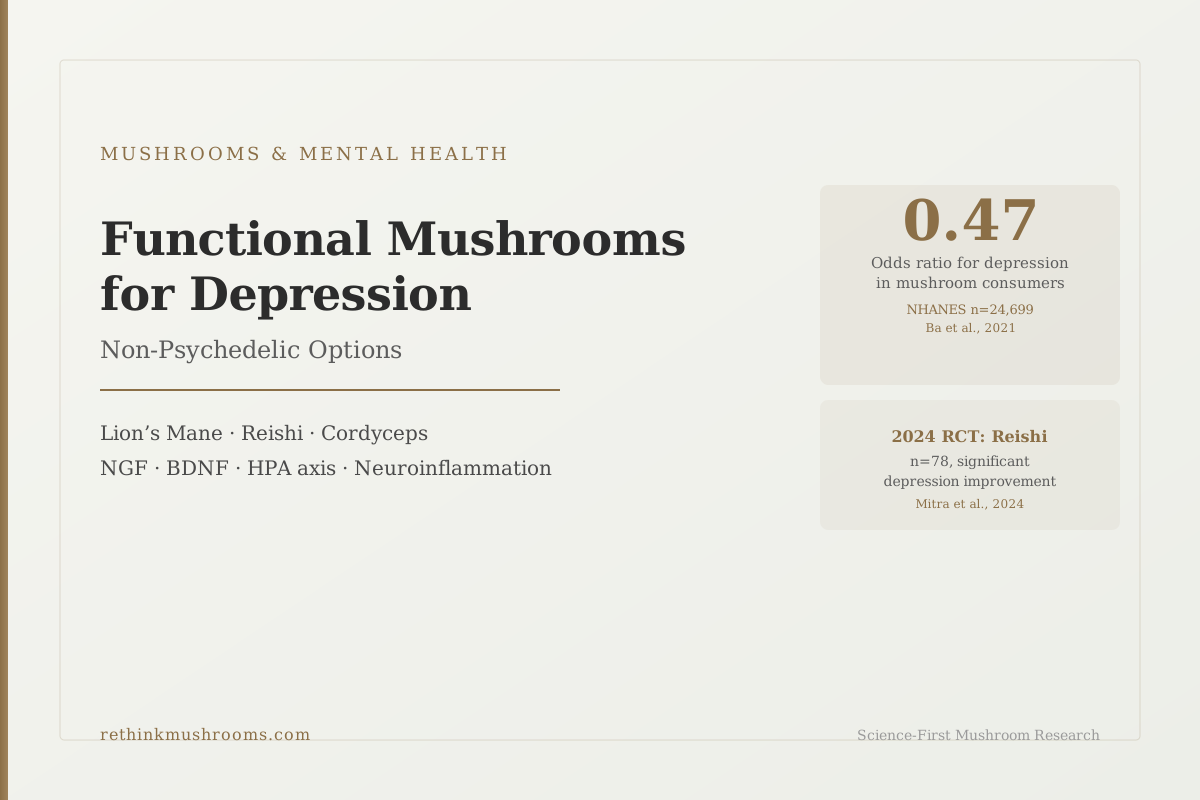
0.47 odds ratio
In a nationally representative sample of 24,699 US adults, mushroom consumers had 53% lower prevalence of depression than non-consumers, even after adjusting for diet, income, physical activity, and other confounders.
Ba et al., Journal of Affective Disorders, 2021
n=24,699
NHANES adults showing lower depression prevalence in mushroom consumers (OR=0.47, p<0.001, adjusted for major confounders)
2024 double-blind RCT
Mitra et al.: 78 female college students on 1000mg/day reishi for 30 days showed significant improvement in depression, anxiety, and vitality scores vs. placebo
4-8 weeks minimum
Acute single doses produce no mood benefit; neuroplasticity changes that drive effects require sustained supplementation (Surendran 2025, Docherty 2023)
Ba et al., Journal of Affective Disorders, 2021
 View as image ↗
In 2021, researchers analyzed dietary data from 24,699 US adults collected over a decade and found something large enough to demand explanation: people who consumed mushrooms had about half the prevalence of depression compared to people who didn't. The adjusted odds ratio was 0.47, with a confidence interval of 0.33 to 0.67, and a p-value below 0.001.[1]
That's an observational finding, not a clinical trial. People who eat mushrooms differ from people who don't in dozens of ways that could account for better mood outcomes. But OR=0.47 is large enough to be worth investigating, and the researchers controlled for diet quality, physical activity, income, smoking, alcohol, and chronic disease.
Three species have the most human trial data for non-psychedelic mood support: lion's mane (Hericium erinaceus), Reishi (Ganoderma lucidum), and, with weaker evidence, Cordyceps. None of them work through the serotonin-system disruption that psilocybin produces. They work through slower biological mechanisms: promoting nerve growth factors, modulating the immune system's influence on the brain, and regulating the hormonal stress system.
The functional mushrooms for depression data is thin but not empty. A 2024 systematic review concluded lion's mane has the strongest human evidence base for mood support.[9] A 2024 double-blind RCT in reishi that most sites haven't covered yet showed significant depression improvements in 78 college students under stress. And a 2025 null result explains why millions of people trying these mushrooms aren't seeing results: they're expecting an acute effect from something that requires weeks to work.
For how these mushrooms fit into the broader picture of stress and mood, this article is a companion to adaptogenic mushrooms for stress: how they help your body cope.
Key Takeaways
- Among 24,699 US adults in NHANES data, mushroom consumers had 53% lower depression prevalence than non-consumers (OR=0.47, adjusted for major confounders; Ba et al., J Affect Disord, 2021)
- Lion's mane has three human RCTs showing mood benefits: Vigna 2019 (n=77, 8 weeks, depression and anxiety scores improved, BDNF levels rose), Nagano 2010 (n=30, 4 weeks, HAD scores improved), and Docherty 2023 (n=41, 28 days, trend toward reduced stress p=0.051)
- Reishi's best human evidence is Mitra 2024: a double-blind RCT in 78 female college students found 1000mg/day for 30 days produced significant improvements in validated anxiety, depression, vitality, and positive well-being scores vs. placebo
- Acute single doses show no effect on mood or cognition: Surendran 2025 found zero benefit from a large single dose (equivalent to 30g fruiting body) in a double-blind trial, confirming effects require weeks of daily use
- A 2023 review identified four possible antidepressant mechanisms for medicinal mushrooms: neuroinflammation reduction, HPA axis regulation, neurogenesis via BDNF/NGF, and monoamine modulation (serotonin/dopamine)
- The 2024 systematic review concludes that while the evidence is preliminary, lion's mane has the most consistent human data; trials are small and most don't use validated primary outcome measures for depression
In a Study of 24,699 Americans, Mushroom Consumers Were Half as Likely to Be Depressed
Ba and colleagues analyzed dietary intake and depression data from the National Health and Nutrition Examination Survey, one of the most comprehensive ongoing nutrition studies in the US, covering 2005 to 2016.[1]
Depression was assessed using a validated self-report instrument (the PHQ-9). Mushroom consumption was captured in 24-hour dietary recall interviews. After excluding people with missing data, 24,699 adults were included.
The result: mushroom consumers had significantly lower prevalence of depression than non-consumers, with an adjusted odds ratio of 0.47. The adjustment controlled for age, sex, race/ethnicity, education, income, smoking, alcohol use, physical activity, body mass index, chronic disease, and overall dietary quality.
The authors offered a hypothesis: ergothioneine, a compound found almost exclusively in mushrooms, may act as a neuroprotective antioxidant. Ergothioneine has a dedicated transporter in human cells, suggesting the body considers it worth accumulating. Low ergothioneine levels have been associated with cognitive impairment in separate research. Whether ergothioneine is the operative mechanism, or whether it's one of many compounds in mushrooms that contribute, isn't established.
Observational data can't tell us that eating mushrooms caused lower depression rates. But the magnitude of the association, in a large and carefully analyzed dataset, is the kind of signal that motivates the mechanistic and clinical research covered below.
For more on daily mushroom consumption and mental health outcomes, see can daily mushroom consumption improve mental health?.
The Four Biological Pathways That Could Connect Mushrooms to Mood
A 2023 review identified four distinct antidepressant mechanisms documented in medicinal mushroom research, noting that different species appear to target different entry points in the system.[2]
Mechanism 1: Neuroinflammation reduction. Depression is associated with elevated inflammatory markers, including IL-6 and TNF-alpha. Beta-glucan polysaccharides in mushrooms can modulate the immune cells (microglia) that drive neuroinflammation. Reishi's Dectin-1 pathway, covered in the Reishi section below, is the most studied version of this mechanism.
Mechanism 2: HPA axis regulation. The HPA axis is the hormonal chain that governs the stress response: the brain's hypothalamus signals the pituitary gland, which signals the adrenal glands to produce cortisol. Chronic HPA axis overactivation is one of the most replicated biological findings in major depression. Reishi triterpenes appear to dampen this overactivation. For a dedicated look at how mushrooms interact with this system, see how mushrooms regulate the HPA axis and cortisol.
Mechanism 3: Neurogenesis via BDNF and NGF. New neuron growth in the hippocampus, the brain's memory and emotion regulation center, requires two growth factors: BDNF (brain-derived neurotrophic factor) and NGF (nerve growth factor). Both are lower in people with depression. Lion's mane contains hericenones and erinacines that stimulate NGF production. Reishi spore polysaccharides appear to upregulate BDNF specifically in the prefrontal cortex.
Mechanism 4: Monoamine modulation. Serotonin, dopamine, and norepinephrine are the neurotransmitters that conventional antidepressants target. Animal studies with lion's mane erinacine A found elevated levels of all three in the hippocampus, with 5-HT1A receptor involvement identified.
These aren't four competing theories; they're likely simultaneous, with different species having different primary contributions. Lion's mane's clearest mechanism is NGF-driven neurogenesis. Reishi's clearest mechanisms are immune modulation and HPA axis effects. Both lead to downstream effects on BDNF and monoamine systems.
Lion's Mane: What Three Human Trials Actually Measured
The strongest clinical evidence for lion's mane and depression comes from a trial by Vigna and colleagues published in 2019.[3]
Vigna enrolled 77 overweight or obese patients and randomized them to receive either 550mg of Hericium erinaceus extract per day or placebo for 8 weeks, alongside a supervised low-calorie diet. Depression, anxiety, and sleep disorder scores were measured using validated instruments. Serum BDNF was measured via blood draw at baseline and endpoint.
At 8 weeks, the lion's mane group showed significantly improved scores on depression, anxiety, and sleep disturbance relative to placebo. Serum BDNF levels increased significantly in the treatment group. The biomarker data matters because it connects the clinical outcome (better mood) to a plausible mechanism (more BDNF supporting hippocampal function) rather than leaving the improvement unexplained.
The foundational human study for lion's mane and mood is Nagano and colleagues, published in 2010.[4] Nagano enrolled 30 menopausal women and randomized them to receive either H. erinaceus cookies (0.5g/day) or placebo cookies for 4 weeks. Depression and anxiety scores on the Hospital Anxiety and Depression scale were significantly lower in the lion's mane group at 4 weeks. The dose was low (0.5g daily of the mushroom itself, incorporated into cookies), and the sample was specific to menopausal women. Generalizing cautiously to other populations is appropriate.
Docherty and colleagues completed a more recent double-blind pilot RCT in 2023, using 1.8g of H. erinaceus daily in 41 healthy adults aged 18 to 45 for 28 days.[5] The primary finding for stress was a trend toward reduction (p=0.051), which narrowly missed conventional significance. The acute mood measurements, taken 60 minutes after a single dose, showed no significant effect. This trial introduced the critical timing question that Surendran answered definitively in 2025.
For a deeper look at the NGF pathway that underlies lion's mane's mechanism, see lion's mane for depression: how NGF supports mood.
Why a Single Dose Does Nothing: The Acute Versus Chronic Problem
The most important thing to understand about functional mushrooms and depression is that they do not work acutely. This distinction explains why many people try these supplements and conclude they do nothing.
Surendran and colleagues published a 2025 double-blind RCT testing exactly this question.[6] They gave 18 healthy adults aged 18 to 35 a single dose of a standardized H. erinaceus extract (3g of a 10:1 extract, equivalent to approximately 30g of fruiting body) or placebo. Mood and cognitive function were measured across the next several hours.
The result was unambiguous: no significant effect on composite mood or cognitive function versus placebo. A large single dose of lion's mane produced nothing measurable.
The Docherty 2023 trial tells the same story from the other direction.[5] The 60-minute acute mood measurement: no effect. The 28-day chronic measurement: a trend toward reduced stress (p=0.051) that approached but narrowly missed significance.
The biological reason for this is not complicated. Lion's mane works by promoting nerve growth factor synthesis, which supports the growth of new hippocampal neurons. Neuroplasticity, the brain's ability to grow and rewire itself, operates on a timescale of weeks to months. A single dose stimulates a small amount of additional NGF. That NGF then has to travel to neurons, those neurons have to grow and integrate into existing circuits, and those new circuits have to begin influencing mood regulation. That process takes weeks of sustained NGF elevation, which requires sustained daily supplementation.
Antidepressant medications work on the same timescale. SSRIs produce no mood effect on day one. They require 4 to 6 weeks before clinical effects become apparent, for reasons related to receptor adaptation and downstream neuroplasticity that are distinct from their immediate pharmacology.
The practical implication: studies testing acute effects of lion's mane on mood will find nothing, and they do. Studies requiring 4 to 8 weeks of daily supplementation find signal. For anyone evaluating these mushrooms based on a short trial period, the null result is expected and tells you nothing about what chronic use would produce.
Reishi: The 2024 Double-Blind Trial Nobody Else Has Covered
Mitra and colleagues published a 2024 randomized, double-blind, placebo-controlled trial examining Ganoderma lucidum in 78 female college students under psychological stress.[7]
Participants received either 1000mg per day of G. lucidum or placebo for 30 days. Outcomes were measured using validated scales for anxiety, depression, vitality, and positive well-being.
At 30 days, the reishi group showed statistically significant improvements on all four outcome measures versus placebo. Anxiety scores improved. Depression scores improved. Vitality and positive well-being scores improved. The trial used a well-defined population (college women under verified psychological stress), a clinically meaningful duration, and validated scales.
This is the best human evidence for reishi and depression. It isn't widely cited in editorial content because it was published in 2024. Examine.com, Healthline, and comparable sites haven't integrated it into their reishi coverage. The NHANES signal suggested the effect should exist; the Mitra RCT is the first clean double-blind demonstration that it does.
There is an older trial with more honest caveats. Donovan and colleagues tested G. lucidum in 44 women with fibromyalgia in 2020.[8] The reishi group showed trends toward improved happiness, satisfaction, and reduced depression versus baseline. However, between-group statistical significance on primary endpoints was not reached. The trial is a weaker positive signal, not a clear null result, but it didn't establish efficacy on its own.
Reishi's proposed antidepressant mechanisms differ from lion's mane's. A preclinical study found that reishi spore polysaccharide-peptide produced antidepressant effects comparable to fluoxetine in mouse models, with BDNF upregulation specifically in the prefrontal cortex as the primary mechanism. A separate animal study identified Dectin-1 receptor activation as a pathway through which reishi polysaccharides reduce neuroinflammation and restore brain BDNF and serotonin levels.
For a detailed breakdown of the reishi depression research, including the Dectin-1 mechanism, see reishi and mood regulation: antidepressant research. For reishi's stress-specific effects and HPA axis regulation, see reishi for stress: the calming mushroom research review.
What the 2024 Systematic Review Says About the State of Evidence
A 2024 systematic review in Neuroscience and Biobehavioral Reviews examined all published evidence on mushrooms and mood or neurocognitive health across the human lifespan.[9]
The conclusions are worth stating plainly: lion's mane has the most consistent human evidence for mood and depression support among functional mushrooms. Reishi shows consistent stress-reduction effects. Most human trials in the field are small, and most use short durations that may not capture the full neuroplasticity timeline.
The review calls for larger RCTs with validated primary outcome measures for depression specifically. Most existing trials use general wellbeing questionnaires or symptom checklists rather than gold-standard depression scales like the Hamilton Depression Rating Scale or the Montgomery-Asberg Depression Rating Scale. This matters for how seriously the medical community takes the evidence.
None of this means the existing evidence is meaningless. Three human RCTs showing lion's mane affects depression and anxiety scores, with a biomarker measurement in one of them, and a double-blind reishi RCT showing significant improvements on four validated scales, is not nothing. It's a starting point for what should become a larger body of research, not a conclusion that the effect doesn't exist.
Cordyceps and Others: What the Broader Evidence Shows
Beyond lion's mane and reishi, a 2022 review by Dolan and colleagues assessed the evidence for several species in the context of major depressive disorder, including Cordyceps, Chaga, and culinary mushrooms.[10]
Cordyceps shows preclinical antidepressant-like effects through monoamine modulation, with some animal data on elevated serotonin and dopamine. Human trial data for Cordyceps and depression specifically is not available in the same form as lion's mane or reishi. The review identified ergothioneine (present across multiple edible species), beta-glucans, and neurotrophic compounds as the active compound classes most likely to account for the NHANES signal at the population level.
Chaga contains betulinic acid derivatives and ergothioneine but has not been the subject of human depression trials. Other culinary mushrooms (Shiitake, Oyster, Chanterelle) likely contribute to the NHANES population-level signal through ergothioneine content, but have not been tested in depression clinical trials.
The honest picture is that functional mushroom depression research is almost entirely concentrated in two species: lion's mane for the NGF-neurogenesis pathway, and reishi for the immune-stress pathway. Cordyceps and other species are on the mechanistic radar but have not yet produced human trial data on mood outcomes.
Comparing Lion's Mane and Reishi for Depression: Different Mechanisms, Different Populations
Given two species with distinct mechanisms, a reasonable question is which one the evidence supports more strongly, and for whom.
Lion's mane has more human RCTs: three trials, with the Vigna 2019 study providing the strongest data and a biomarker-measured outcome. The mechanism is primarily neurogenic: NGF stimulation promotes hippocampal neurogenesis, which supports mood regulation. This mechanism is likely most relevant for depression associated with cognitive symptoms, stress-related neuronal atrophy, or conditions where hippocampal integrity is compromised.
Reishi has one strong RCT (Mitra 2024) and one weaker positive trial (Donovan 2020). Its mechanisms are primarily anti-inflammatory and HPA-regulatory: reducing the neuroinflammation that drives depressive episodes, and dampening the cortisol response that keeps the stress system chronically overactivated. This mechanism is likely most relevant for depression associated with stress reactivity, anxiety-depression comorbidity, or elevated inflammatory markers.
The two mechanisms are not mutually exclusive. Neuroinflammation impairs neurogenesis; reducing it allows the NGF-driven repair that lion's mane supports. The 2024 systematic review and the Dolan 2022 review both note that the species may be complementary rather than interchangeable.
For a side-by-side analysis of the head-to-head research evidence and the mechanistic case for combining them, see lion's mane and reishi for depression: non-psychedelic mood support research.
For readers who have seen the psilocybin depression trial results and are evaluating the non-psychedelic options alongside them, the key difference is mechanism and timeline. Psilocybin produces rapid changes in serotonin receptor dynamics and default mode network connectivity. Non-psychedelic mushroom effects build over weeks through neuroplasticity pathways. For the psychedelic evidence, see psilocybin for depression: results from the largest clinical trials.
The Bottom Line
Among 24,699 US adults in national nutrition survey data, mushroom consumers had 53% lower depression prevalence than non-consumers. Clinical trials show lion's mane improving depression and anxiety scores over 4 to 8 weeks in three human RCTs, with BDNF biomarker confirmation in the strongest trial. Reishi's best evidence is a 2024 double-blind RCT in 78 college students, which showed significant improvements across depression, anxiety, vitality, and well-being scales. A 2025 null result confirms that acute single doses produce no mood benefit; effects require weeks of sustained daily use, for neuroplasticity reasons similar to those that explain the 4-to-6-week delay before antidepressants work. The evidence is preliminary but not empty, and concentrated primarily in lion's mane and reishi through distinct biological mechanisms.
Frequently Asked Questions
Sources & References
- 1. Source details for this reference are not yet available.
- 2. Source details for this reference are not yet available.
- 3. Source details for this reference are not yet available.
- 4. Source details for this reference are not yet available.
- 5. Source details for this reference are not yet available.
- 6. Source details for this reference are not yet available.
- 7. Source details for this reference are not yet available.
- 8. Source details for this reference are not yet available.
- 9. Source details for this reference are not yet available.
- 10. Source details for this reference are not yet available.
- 11. Source details for this reference are not yet available.