Mushrooms & Mental Health
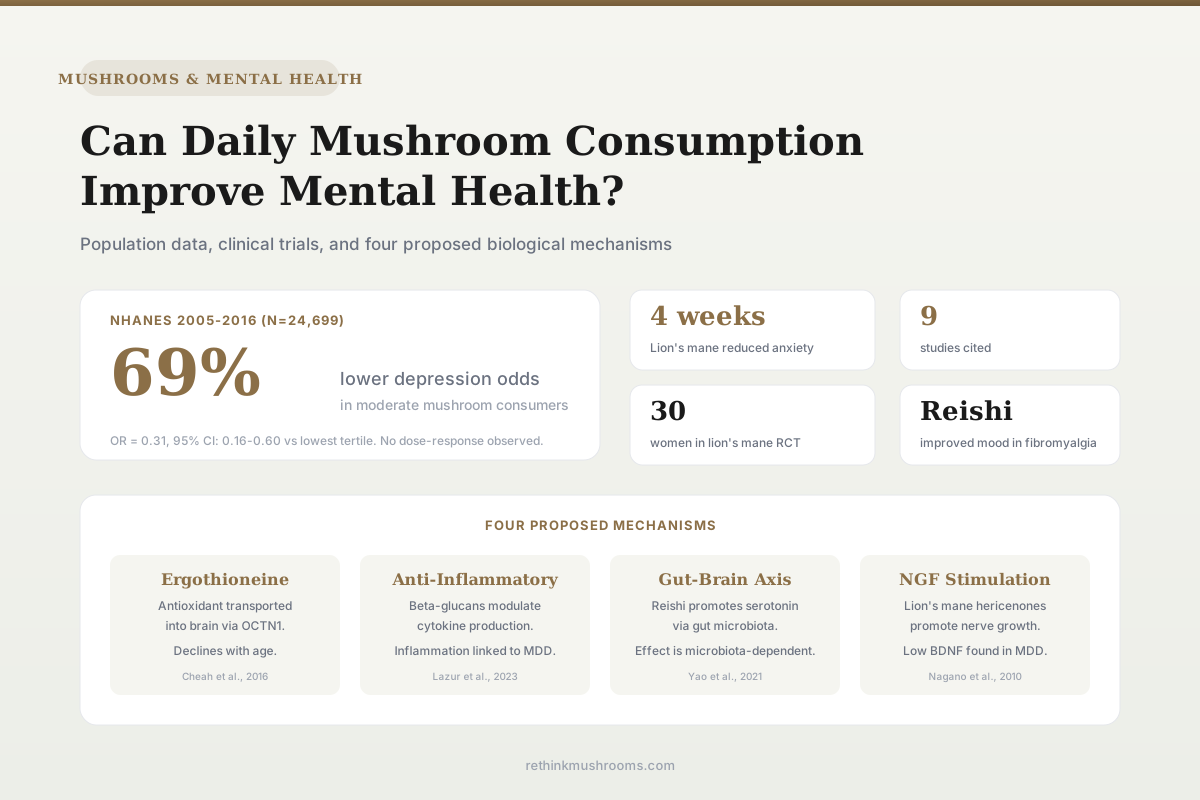
69% lower depression odds
In 24,699 US adults, moderate mushroom consumers had 69% lower odds of depression compared to the lowest intake tertile, though no dose-response relationship was observed.
Ba et al., J Affect Disord, 2021
24,699
adults in the NHANES analysis
4 weeks
for lion's mane to reduce anxiety scores
3+
proposed biological mechanisms
Ba et al., J Affect Disord, 2021
 View as image ↗
A 2021 analysis of 24,699 American adults from the National Health and Nutrition Examination Survey (NHANES) found that people who consumed mushrooms had lower odds of depression compared to non-consumers.[1] This was one of the first large-scale population studies to directly examine the relationship between regular mushroom consumption and mental health outcomes. The finding is consistent with smaller clinical trials showing that specific mushroom species, particularly lion's mane and reishi, can influence mood and anxiety scores over periods of 4-8 weeks.
The biological plausibility is supported by at least three mechanisms: mushrooms are the richest dietary source of the antioxidant ergothioneine (which declines with age and correlates with cognitive health), lion's mane contains compounds that stimulate nerve growth factor synthesis, and reishi modulates the gut-brain axis through serotonin-related pathways. None of these mechanisms have been confirmed as causal explanations for the population-level association. This article reviews what each line of evidence shows and where the gaps remain. For specific research on lion's mane and depression, see lion's mane for depression: how NGF supports mood.
Key Takeaways
- In 24,699 US adults (NHANES 2005-2016), moderate mushroom consumers (median 4.9 g/day) had 69% lower odds of depression (OR = 0.31, 95% CI: 0.16-0.60) compared to the lowest intake group, but no dose-response relationship was observed (Ba et al., 2021)
- In 30 women, 4 weeks of lion's mane cookies significantly reduced depression scores (CES-D) and indefinite complaints compared to placebo, with anxiety-related symptoms also trending lower (Nagano et al., 2010)
- A 2023 RCT found lion's mane supplementation reduced self-reported stress at 4 weeks, with improved cognitive performance sustained through 8 weeks of chronic supplementation (Docherty et al., 2023)
- Reishi supplementation improved mood and health-related quality of life in women with fibromyalgia (Pazzi et al., 2020)
- A 2024 review identified four proposed mechanisms for mushroom effects on mood: antioxidant activity (ergothioneine), anti-inflammatory pathways, gut microbiome modulation, and neurotrophic factor stimulation (Cha et al., 2024)
- Reishi extract promoted sleep in mice through a gut microbiota-dependent serotonin pathway, with effects abolished when gut bacteria were depleted (Yao et al., 2021)
The NHANES Population Data: Association Without Dose-Response
Ba et al. (2021) analyzed NHANES data from 2005-2016, using up to two days of 24-hour dietary recall to assess mushroom intake and the Patient Health Questionnaire (PHQ-9, score of 10 or higher) to define depression. Among the 24,699 participants (mean age 45.5 years), weighted depression prevalence was 5.9%, and 5.2% of participants consumed mushrooms.[1]
The striking finding was that participants in the middle tertile of mushroom intake (median 4.9 g/day, roughly a quarter of a standard serving) had 69% lower odds of depression (adjusted OR = 0.31, 95% CI: 0.16-0.60) compared to the lowest tertile. But the highest tertile (median 19.6 g/day) showed no reduction (OR = 0.91, 95% CI: 0.47-1.78). The trend test across tertiles was not significant (P = 0.42).
This absence of dose-response is a problem for causal interpretation. If mushroom compounds directly reduce depression, higher intake should produce greater benefit. The authors acknowledged this limitation and suggested it could reflect chance, residual confounding, or the possibility that very low mushroom intake serves as a marker for overall dietary quality rather than a specific therapeutic exposure.
The study could not identify which mushroom species participants consumed; NHANES dietary recall does not distinguish between button mushrooms, shiitake, oyster, or other species. Different species contain different bioactive compounds, so grouping all mushroom consumption together may obscure species-specific effects. For a broader overview of non-psychedelic mushroom options for depression, see functional mushrooms for depression: non-psychedelic options.
Lion's Mane: Direct Mood Trial Evidence
Nagano et al. (2010) conducted a randomized, double-blind, placebo-controlled trial in 30 Japanese women, investigating lion's mane (Hericium erinaceus) effects on depression, anxiety, sleep quality, and menopausal complaints. Participants consumed HE cookies or placebo cookies for 4 weeks.[2]
After 4 weeks, the CES-D depression score in the lion's mane group was lower than baseline. On the Indefinite Complaints Index, scores for "insensitive" and "palpitation" were lower in the lion's mane group than placebo, with "concentration," "irritating," and "anxious" showing non-significant trends in the same direction.
The authors noted that the mechanism appeared different from the NGF-enhancing action typically attributed to lion's mane. While hericenones and erinacines stimulate NGF synthesis, the 4-week timeline for mood improvement is faster than expected for structural neural remodeling. The mood effects may involve faster-acting pathways: anti-inflammatory effects, modulation of monoamine neurotransmitter levels, or gut-brain signaling. For research specifically on lion's mane and reishi combined for depression, see lion's mane and reishi for depression: non-psychedelic mood support research.
Docherty et al. (2023) conducted a more recent RCT examining both acute and chronic effects of lion's mane supplementation. Self-reported stress was reduced at 4 weeks, and cognitive performance improvements were sustained through 8 weeks of chronic supplementation.[3] Surendran et al. (2025) examined acute effects of a standardized lion's mane extract on cognition and mood in healthy younger adults, finding measurable changes in mood-related endpoints within hours of a single dose.[7]
Reishi: Mood Through Stress, Sleep, and the Gut-Brain Axis
Reishi (Ganoderma lucidum) approaches mental health from a different angle than lion's mane. Rather than direct neurotrophic effects, reishi's mood-relevant mechanisms operate through stress resilience, sleep quality, and gut-brain signaling.
Pazzi et al. (2020) found that reishi supplementation improved mood and health-related quality of life in women with fibromyalgia, a condition characterized by chronic pain, fatigue, and high rates of comorbid depression.[4] The mood improvement in this population could reflect direct neurochemical effects, reduced pain burden, improved sleep, or a combination.
Yao et al. (2021) provided mechanistic evidence for the sleep pathway. Reishi extract promoted sleep in mice through a gut microbiota-dependent, serotonin-involved mechanism. Administration of 25-100 mg/kg for 28 days increased 5-hydroxytryptamine (serotonin) in the hypothalamus. When gut bacteria were depleted with antibiotics, the sleep-promoting effect disappeared, confirming that intact gut microbiota were required as intermediaries.[8]
The serotonin connection is relevant because serotonin dysregulation is central to major depression. If reishi increases serotonin availability through gut-mediated pathways, it could theoretically improve both sleep and mood simultaneously. This has not been tested in a human depression trial with reishi specifically. For more on how reishi modulates mood, see reishi and mood regulation: antidepressant research.
Proposed Biological Mechanisms
Cha et al. (2024) reviewed the evidence for mushroom effects on mood and neurocognitive health across the lifespan and identified four primary mechanism categories.[5]
Antioxidant neuroprotection. Mushrooms are the highest dietary source of ergothioneine, a sulfur-containing amino acid that is actively transported into the brain via the OCTN1 transporter. Cheah et al. (2016) documented that blood ergothioneine levels decline after age 60 and correlate with cognitive decline rates.[9] Oxidative stress in the brain is implicated in both depression and cognitive decline; ergothioneine's antioxidant role could protect against both. For more on ergothioneine and cardiovascular/mortality outcomes, see blood ergothioneine levels and heart disease risk.
Anti-inflammatory pathways. Depression is increasingly recognized as having an inflammatory component, with elevated C-reactive protein, IL-6, and TNF-alpha in a subset of depressed patients. Beta-glucans and other mushroom polysaccharides modulate inflammatory cytokine production. If chronic low-grade inflammation contributes to depressive symptoms, regular mushroom consumption could reduce that inflammatory burden.
Gut microbiome modulation. Multiple mushroom species alter gut microbiota composition, increasing short-chain fatty acid-producing bacteria and improving gut barrier function. The gut-brain axis communicates through vagal nerve signaling, immune mediators, and microbial metabolites including serotonin precursors. The Yao et al. (2021) reishi-sleep study demonstrated that this pathway is functionally relevant for brain neurochemistry.
Neurotrophic factor stimulation. Lion's mane hericenones and erinacines stimulate NGF and BDNF synthesis. These neurotrophic factors support neuronal survival, synaptic plasticity, and hippocampal neurogenesis. Reduced BDNF is consistently found in depressed patients, and antidepressant drugs increase BDNF expression. Lion's mane may engage the same pathway through a dietary rather than pharmaceutical route.
Lazur et al. (2023) conducted a systematic review of these mechanisms and concluded that while preclinical evidence for each pathway is substantial, clinical trial evidence directly linking these mechanisms to mood improvement in depressed patients remains limited.[6]
What the Evidence Does Not Show
The available data supports an association between mushroom consumption and better mental health outcomes but falls short of proving causation for several reasons.
The NHANES study is cross-sectional: it captured mushroom intake and depression status at one time point. People who are already depressed may eat fewer mushrooms (reverse causation), or people who eat mushrooms may differ in other ways that protect against depression (healthy lifestyle confounding).
The lion's mane and reishi trials are small (30 subjects each), short (4-8 weeks), and use surrogate measures (depression questionnaires) rather than clinical diagnostic outcomes. The Nagano et al. study enrolled only menopausal women; generalizability to men or younger women is unknown. The Docherty et al. and Surendran et al. studies tested cognition as a primary endpoint with mood as secondary.
No randomized trial has tested daily consumption of common culinary mushrooms (button, cremini, shiitake) for depression or anxiety outcomes. The population data suggests culinary mushrooms may matter, but the clinical trials tested medicinal species (lion's mane, reishi) at supplement doses. The mechanisms may differ.
The "which mushroom" question is unresolved. If the mental health association is driven by ergothioneine, then species with the highest ergothioneine (porcini, oyster, shiitake) would be most beneficial. If driven by beta-glucans and immune modulation, the optimal species would differ. If driven by NGF stimulation, only lion's mane has demonstrated this mechanism. A daily mushroom consumption strategy for mental health would need to specify species to be actionable, and the evidence does not yet support that specificity.
There is also a selection bias issue in the population data. People who regularly eat mushrooms may differ from non-consumers in systematic ways: higher income, more varied diet, greater health consciousness, more cooking at home. These lifestyle factors are independently associated with lower depression risk. The NHANES analysis adjusted for demographic and dietary confounders, but residual confounding from unmeasured lifestyle variables cannot be fully excluded. The absence of dose-response makes this concern more pressing, because a true biological effect would typically strengthen with increasing intake.
The clinical trials with lion's mane and reishi used supplement-level doses of specific species and preparations, which is a different exposure than eating a serving of button mushrooms with dinner. Whether the bioactive compounds responsible for mood effects in clinical trials are present in culinary quantities of commonly consumed mushroom species is an open question. The answer likely depends on which mechanism is primary, and that question remains unanswered.
The Bottom Line
Population data from 24,699 US adults associates mushroom consumption with lower depression odds, though without a clear dose-response relationship. Small clinical trials show lion's mane reduces depression and anxiety scores within 4 weeks, and reishi improves mood in fibromyalgia patients. Four biological mechanisms are proposed: ergothioneine-mediated antioxidant neuroprotection, anti-inflammatory effects, gut microbiome modulation affecting serotonin pathways, and neurotrophic factor stimulation by lion's mane compounds. No large-scale clinical trial has tested daily culinary mushroom consumption specifically for depression prevention or treatment.
Frequently Asked Questions
Sources & References
- 1RTHM-00672·Ba, Djibril M et al. (2021). “Mushroom intake and depression: A population-based study using data from the US National Health and Nutrition Examination Survey (NHANES), 2005-2016..” Journal of affective disorders.Study breakdown →PubMed →↩
- 2RTHM-00194·Nagano, Mayumi et al. (2010). “Reduction of depression and anxiety by 4 weeks Hericium erinaceus intake..” Biomedical research (Tokyo.Study breakdown →PubMed →↩
- 3RTHM-00821·Docherty, Sarah et al. (2023). “The Acute and Chronic Effects of Lion's Mane Mushroom Supplementation on Cognitive Function, Stress and Mood in Young Adults: A Double-Blind, Parallel Groups, Pilot Study..” Nutrients.Study breakdown →PubMed →↩
- 4RTHM-00648·Pazzi, Francesco et al. (2020). “Ganoderma lucidum Effects on Mood and Health-Related Quality of Life in Women with Fibromyalgia..” Healthcare (Basel.Study breakdown →PubMed →↩
- 5RTHM-00868·Cha, Sara et al. (2024). “A review of the effects of mushrooms on mood and neurocognitive health across the lifespan..” Neuroscience and biobehavioral reviews.Study breakdown →PubMed →↩
- 6RTHM-00837·Lazur, Jan et al. (2023). “Discovering the Potential Mechanisms of Medicinal Mushrooms Antidepressant Activity: A Review..” Antioxidants (Basel.Study breakdown →PubMed →↩
- 7RTHM-00952·Surendran, Geyan et al. (2025). “Acute effects of a standardised extract of Hericium erinaceus (Lion's Mane mushroom) on cognition and mood in healthy younger adults: a double-blind randomised placebo-controlled study..” Frontiers in nutrition.Study breakdown →PubMed →↩
- 8RTHM-00731·Yao, Chunyan et al. (2021). “Ganoderma lucidum promotes sleep through a gut microbiota-dependent and serotonin-involved pathway in mice..” Scientific reports.Study breakdown →PubMed →↩
- 9RTHM-00420·Cheah, Irwin K et al. (2016). “Ergothioneine levels in an elderly population decrease with age and incidence of cognitive decline; a risk factor for neurodegeneration?.” Biochemical and biophysical research communications.Study breakdown →PubMed →↩