Mushrooms and Mental Health
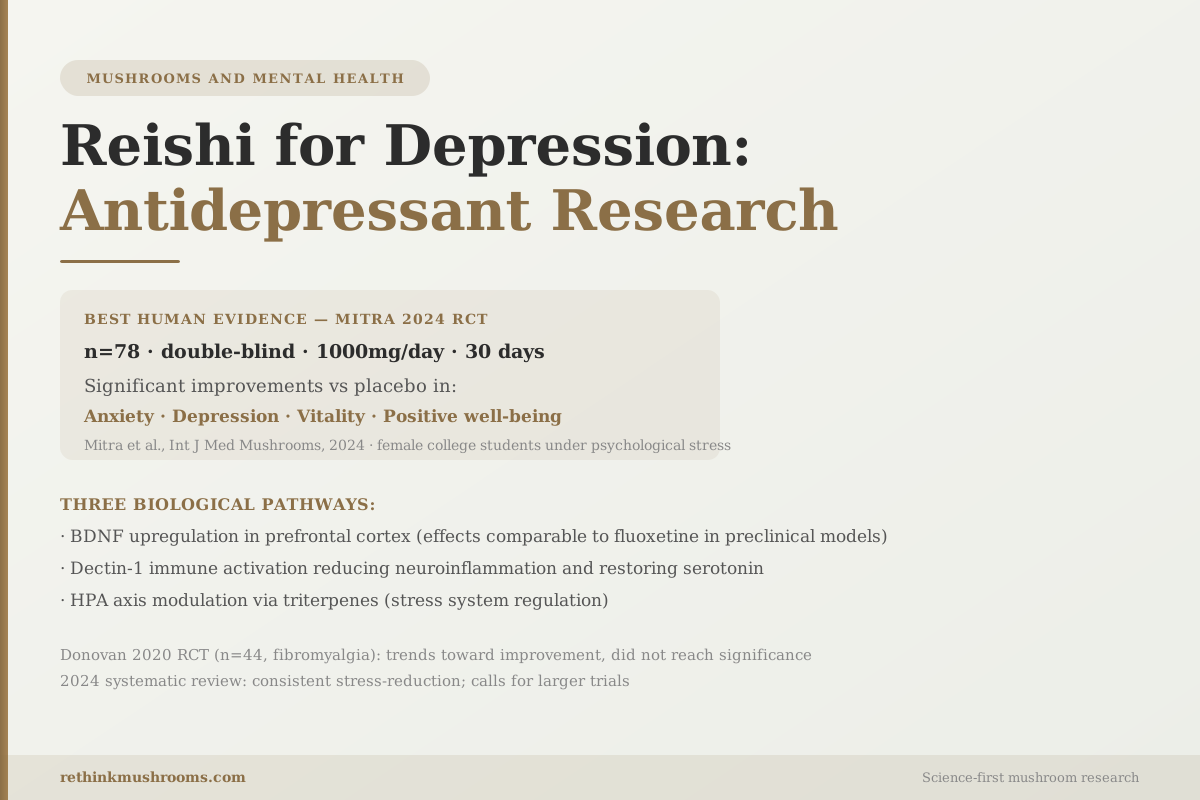
78 participants, double-blind, significant on all mood measures
The 2024 Mitra trial is the first clean randomized controlled trial of reishi in psychologically stressed adults. It showed statistically significant improvements in anxiety, depression, and vitality at 30 days.
Mitra et al., Int J Med Mushrooms, 2024
Three biological pathways
BDNF, Dectin-1/immune, and HPA axis via triterpenes
BDNF effects comparable to fluoxetine
in preclinical models (Zhao et al., 2021)
2024 systematic review
reishi shows consistent stress-reduction; larger RCTs still needed
Mitra et al., Int J Med Mushrooms, 2024
 View as image ↗
Most sites covering reishi for depression cite its adaptogenic reputation, mention GABA pathways, and stop there. They are missing a more interesting story. A 2024 randomized controlled trial of reishi in psychologically stressed college students found statistically significant improvements in anxiety, depression, and vitality scores at 30 days compared to placebo.[1] That trial exists, is double-blind, and is almost entirely absent from consumer health content.
Alongside the human trial data, three distinct biological pathways have been identified in animal models through which reishi appears to affect brain chemistry relevant to depression. One of them involves a receptor system that most discussions of reishi don't mention at all.
This article is part of the adaptogenic mushrooms for stress evidence base. For coverage of how lion's mane and reishi compare head-to-head, the article on lion's mane and reishi for depression covers both species together.
Key Takeaways
- The 2024 Mitra trial (n=78, double-blind, 30 days, 1000mg reishi per day) found statistically significant improvements in anxiety, depression, and vitality compared to placebo in psychologically stressed female college students
- Reishi appears to act on depression through at least three biological pathways: BDNF upregulation in the prefrontal cortex, immune-mediated neuroinflammation reduction via Dectin-1 receptor activation, and HPA axis modulation
- Reishi spore polysaccharide-peptide produced antidepressant effects comparable to fluoxetine in mouse depression models through BDNF upregulation specifically in the prefrontal cortex (Zhao et al., 2021)
- The Dectin-1 pathway is the least discussed: Reishi polysaccharides activate this immune receptor, reducing inflammatory cytokines and restoring depleted BDNF and serotonin levels in depressed animal models (Li et al., 2021)
- A 2020 fibromyalgia RCT (n=44) showed trends toward mood improvement in the reishi group but did not reach statistical significance on primary endpoints; an honest counterpoint to the Mitra data
- A 2024 systematic review concluded reishi shows consistent stress-reduction effects but called for larger RCTs with validated primary depression outcome measures
The Mitra 2024 Trial: Reishi Was Significant on Every Mood Measure Tested
The clearest human evidence for reishi's antidepressant effects comes from a 2024 randomized controlled trial that studied it in a population with a plausible mechanism for response: college students under documented psychological stress.[1]
Mitra and colleagues enrolled 78 female students experiencing psychological stress and randomized them to 1000mg per day of Ganoderma lucidum or placebo for 30 days. The trial was double-blind. At 30 days, the reishi group showed statistically significant improvements on validated scales measuring anxiety, depression, vitality, and positive well-being compared to the placebo group.
This trial earns the label of meaningful human evidence for several reasons. The sample size (78) is larger than many supplement studies. The population (psychologically stressed young adults) is clinically relevant: this is not a healthy volunteer study testing for effects that may not exist. The outcome measures were validated scales, not custom questionnaires. And the between-group comparison reached statistical significance, not just within-group change.
The dose used (1000mg per day of dried reishi) is on the lower end of what traditional use suggests, and the 30-day duration is relatively short for neuroplasticity mechanisms. The fact that significant effects appeared at 30 days with this dose is, if anything, more compelling than what might be expected from a slow-acting mechanism.
What makes this trial particularly useful is the population selection. Reishi's primary biological mechanisms, including HPA axis modulation and neuroinflammation reduction, are most relevant in people whose stress systems are under genuine strain. A trial in psychologically stressed students is testing the mechanism in the conditions where it would operate most strongly.
How Reishi Acts on the Depressed Brain: Three Pathways at Three Levels
The antidepressant mechanisms of reishi are more pharmacologically specific than "adaptogen" implies. A 2023 comprehensive review of medicinal mushroom antidepressant mechanisms identified four major biological pathways by which functional mushrooms affect depression-relevant brain chemistry: anti-inflammatory effects, HPA axis regulation, neurogenesis via BDNF and NGF, and monoamine modulation.[6]
Reishi specifically has documented involvement in at least three of these:
BDNF upregulation: Reishi compounds increase BDNF (brain-derived neurotrophic factor) in brain regions critical to mood regulation, particularly the prefrontal cortex. BDNF is lower in depressed patients and higher after effective antidepressant treatment, including SSRIs.
Dectin-1 mediated neuroinflammation reduction: Reishi polysaccharides activate a receptor in the immune system that reduces pro-inflammatory cytokines in the brain, which restores depleted BDNF and serotonin levels through an immune-to-brain signaling pathway.
HPA axis regulation via triterpenes: Reishi's ganoderic acid triterpenes modulate the stress-response system, reducing cortisol-related dysregulation that underlies the relationship between chronic stress and depression.
These pathways are distinct from each other and from lion's mane's primary mechanism (NGF stimulation and hippocampal neurogenesis). They suggest reishi is doing something biologically specific, not simply producing nonspecific calming effects.
The Dectin-1 Discovery: How Reishi Activates Immunity to Fight Neuroinflammation
The least-covered finding in the reishi depression literature is a 2021 study by Li and colleagues that identified Dectin-1 as a mediating mechanism for reishi's antidepressant effects.[2]
Dectin-1 is a pattern recognition receptor in the innate immune system. Its primary function is recognizing beta-glucan structures on the surface of fungal cells. Reishi polysaccharides, which are beta-glucan structures, bind to Dectin-1 and trigger an immune signaling cascade.
What Li and colleagues found is that this immune signaling cascade, when activated by reishi polysaccharides, does more than fight infection. In a chronic social defeat stress mouse model, a validated animal model for studying depression, reishi polysaccharides activated Dectin-1, which reduced pro-inflammatory cytokines in the brain. The reduction in neuroinflammation then restored depleted BDNF and serotonin levels. The result was a significant reduction in depression-like behaviors.
The Dectin-1 pathway is important because it provides a mechanistic bridge between two areas of depression research that are usually discussed separately: the neuroinflammation hypothesis of depression and the biology of functional mushrooms. There is strong evidence that elevated neuroinflammatory markers are associated with treatment-resistant depression, and moderate evidence that reducing neuroinflammation improves depressive symptoms. The Li 2021 finding connects reishi's well-established beta-glucan activity to that pathway.
This is preclinical animal research. It establishes mechanism and plausibility; it does not prove efficacy in humans. But it provides a specific, testable biological account for why reishi might affect mood that goes well beyond "it's an adaptogen."
The BDNF Finding: Reishi Spore Compounds Matched Fluoxetine Effects in Preclinical Models
A second animal model study from 2021 examined the BDNF pathway specifically. Zhao and colleagues tested Ganoderma lucidum spore polysaccharide-peptide (a specific compound extracted from reishi spores) in multiple mouse depression models.[3]
The antidepressant-like effect was comparable to fluoxetine (a common SSRI) across the behavioral tests used. The mechanism was specific to BDNF upregulation in the prefrontal cortex. Both fluoxetine and the reishi spore compound raised BDNF in this region to a similar degree, and both produced similar behavioral outcomes in the depression models.
Two aspects of this finding are worth noting carefully. First, the compound tested (spore polysaccharide-peptide) is a specific reishi extract, not the whole mushroom. Standard reishi supplements contain variable amounts of this compound depending on how the product is sourced and prepared. The preclinical efficacy may not translate identically to whole-mushroom preparations.
Second, animal models of depression have a mixed track record for predicting clinical outcomes in humans. The fluoxetine comparison is mechanistically interesting but does not prove that reishi will produce comparable human antidepressant effects to an SSRI. It establishes that the same biological target (prefrontal BDNF) can be activated by reishi compounds through a pathway that produces similar downstream effects in mouse models.
The earlier animal work by Socala and colleagues also found dose-dependent antidepressant-like effects from reishi mycelium aqueous extract in standard forced swim and tail suspension tests, without producing sedation at effective antidepressant doses.[4] The absence of sedation is clinically significant because many compounds that reduce activity in forced swim tests do so simply by sedating the animal rather than through antidepressant mechanisms. The reishi data suggests genuine antidepressant-like activity rather than motor suppression.
The Fibromyalgia RCT: Trends Without Significance, and Why That Still Matters
The only other published human RCT of reishi for mood-related outcomes used a different population: women with fibromyalgia.[5] Donovan and colleagues randomized 44 women to reishi or placebo and measured mood, quality of life, and fibromyalgia-specific symptoms.
The reishi group showed trends toward improved happiness, satisfaction, and reduced depression compared to baseline. However, between-group differences on primary endpoints did not reach statistical significance.
This is an honest counterpoint to the Mitra 2024 data. It should not be dismissed, nor should it be treated as canceling out the Mitra findings. The Donovan trial had limitations worth noting: fibromyalgia patients have a different profile of stress, pain, and mood dysregulation than psychologically stressed healthy adults. The dose, duration, and reishi preparation may also have differed. With 44 participants, the trial was underpowered to detect modest effects.
What the Donovan trial adds to the picture: reishi appears to produce mood trends in a clinical population, but the translation to statistically significant between-group differences is not guaranteed across all populations and doses. The Mitra trial found significance; the Donovan trial did not. Both results are part of the honest evidence picture.
What the Systematic Reviews Say: Evidence Status as of 2025
Two review papers published in 2022 and 2024 provide the most current synthesis of where reishi fits in the broader mushroom-depression literature.
A 2022 review by Dolan and colleagues assessed lion's mane, reishi, cordyceps, and chaga specifically for major depressive disorder.[7] The review identified ergothioneine, beta-glucans, and neurotrophic compounds as the pharmacologically active moieties most relevant to depression, and concluded that while the mechanistic rationale is strong, critical gaps in human RCTs with validated depression outcome measures remain.
A 2024 systematic review of mushrooms and mood across the lifespan concluded that reishi shows consistent stress-reduction effects across the available literature, but called for larger trials with validated primary endpoints before clinical recommendations can be made.[8]
Both reviews point in the same direction as the trial data: the mechanistic foundation for reishi's mood effects is credible and multi-pathway; the human evidence base is early but showing positive signals; larger, longer trials are the next step required.
This places reishi in a distinct evidence category from lion's mane (which has more human trial data) and from psilocybin (which has multiple large Phase 2 RCTs). For readers comparing options, the article on psilocybin for depression from the largest clinical trials covers the psychedelic-assisted evidence base, which is categorically more advanced in terms of trial scale. The article on how mushrooms regulate the HPA axis and cortisol goes deeper into the stress-response mechanism that underlies reishi's most established effects.
For the stress and calming effects specifically, the article on reishi for stress: the calming mushroom research review covers the broader stress evidence base including cortisol and sleep data.
The Bottom Line
Reishi (Ganoderma lucidum) has one clean double-blind RCT in a mood-relevant population: Mitra 2024, n=78 psychologically stressed adults, 1000mg per day for 30 days, statistically significant improvements in anxiety, depression, and vitality. The preclinical evidence identifies three biological mechanisms: BDNF upregulation in the prefrontal cortex, Dectin-1 mediated neuroinflammation reduction, and HPA axis modulation via triterpenes. A second human RCT in fibromyalgia patients (Donovan 2020, n=44) showed trends but not statistical significance. Systematic reviews from 2022 and 2024 confirm consistent stress-reduction signals but call for larger trials before clinical conclusions can be drawn.
Frequently Asked Questions
Sources & References
- 1. Source details for this reference are not yet available.
- 2. Source details for this reference are not yet available.
- 3. Source details for this reference are not yet available.
- 4. Source details for this reference are not yet available.
- 5. Source details for this reference are not yet available.
- 6. Source details for this reference are not yet available.
- 7. Source details for this reference are not yet available.
- 8. Source details for this reference are not yet available.