Mushrooms and Mental Health
OR 0.31 depression odds, mid-tertile mushroom intake
Among 24,699 US adults, those in the middle tertile of mushroom intake had markedly lower odds of depression (adjusted OR 0.31) than the lowest tertile — but the highest-intake group showed no significant difference, so the signal is suggestive, not a clean dose-response.
Ba et al., J Affect Disord, 2021
n=78 RCT
reishi's 1,000 mg arm improved anxiety, depression, vitality, and well-being scores (Mitra 2024)
n=77 RCT
lion's mane improved depression, anxiety, and sleep; pro-BDNF rose (Vigna 2019)
4-8 weeks
needed for mood effects; acute single doses show none
Ba et al., J Affect Disord, 2021
 View as image ↗
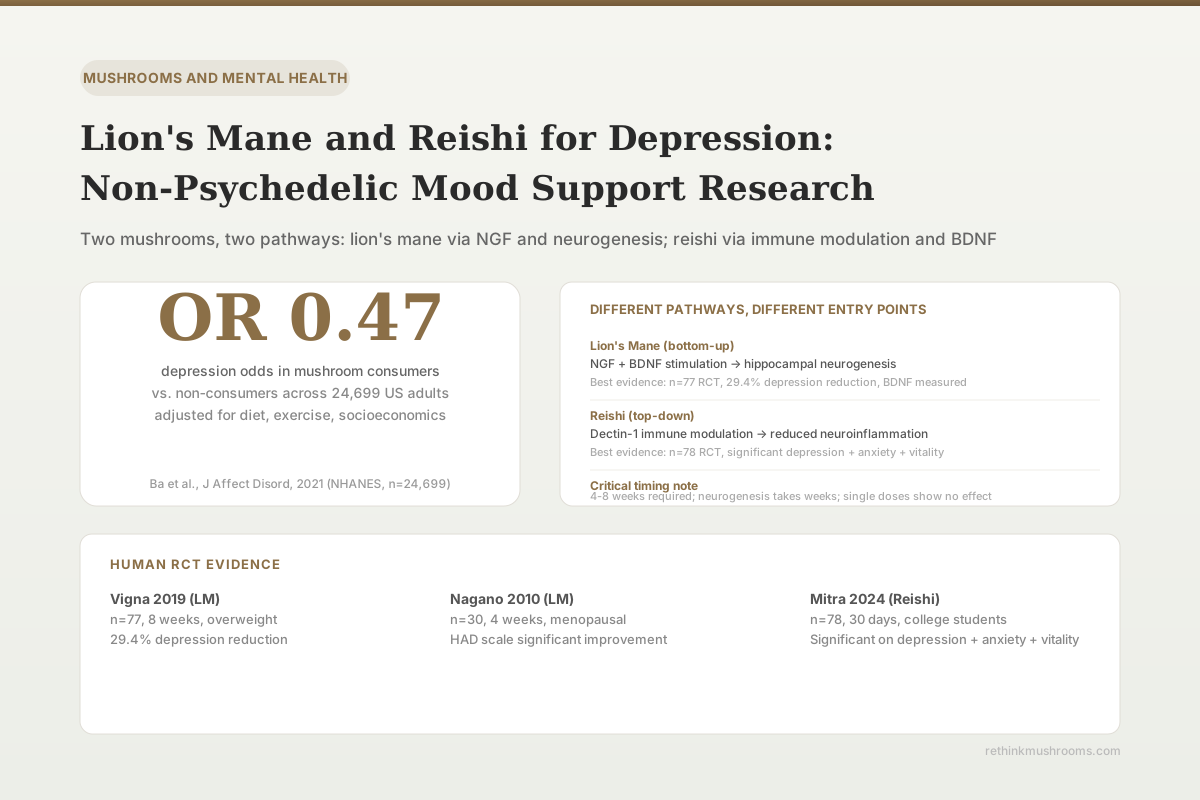
Across 24,699 American adults tracked in the National Health and Nutrition Examination Survey, people in the middle tertile of mushroom intake had markedly lower odds of depression than those in the lowest tertile, after adjusting for demographics, diet, physical activity, and socioeconomic status.[1] Notably, the highest-intake group showed no such benefit, so this is a suggestive population signal rather than a clean dose-response, and it doesn't prove causation. But it is the backdrop against which the mechanistic and clinical trial evidence for lion's mane and reishi for depression becomes more interesting.
These two mushrooms work through different biological pathways. Lion's mane targets the brain from the bottom up, stimulating growth proteins that support neuron survival and the birth of new neurons in mood-regulating brain regions. Reishi targets the brain from the top down, modulating the immune-inflammatory signals and stress hormones that drive inflammatory depression. This distinction matters for understanding what each mushroom does, which population each might benefit most, and why combining them is mechanistically coherent even if untested.
For the broader landscape of adaptogenic mushrooms and stress response, see Adaptogenic Mushrooms for Stress: How They Help Your Body Cope. For how mushrooms regulate the cortisol and stress systems specifically, see How Mushrooms Regulate the HPA Axis and Cortisol.
Key Takeaways
- Among 24,699 US adults, the middle tertile of mushroom intake had lower odds of depression (adjusted OR 0.31, 95% CI 0.16-0.60) than the lowest tertile — but the highest tertile showed no difference and there was no dose-response (Ba et al., 2021)
- In 77 overweight or obese patients, 8 weeks of lion's mane (1,500 mg/day) significantly lowered depression, anxiety, and sleep-disorder scores; circulating pro-BDNF rose while mature BDNF did not increase (Vigna et al., 2019)
- Daily lion's mane cookies lowered depression scores (CES-D) from baseline in 30 women after 4 weeks; only certain anxiety-related complaints separated significantly from placebo (Nagano et al., 2010)
- In a double-blind fitness RCT, the 1,000 mg/day reishi arm significantly improved anxiety, depression, vitality, and well-being scores in 78 sedentary female college students (Mitra et al., 2024)
- Lion's mane works bottom-up through NGF, BDNF/TrkB signaling, and hippocampal neurogenesis; reishi works top-down through Dectin-1 immune modulation and HPA-axis regulation, with prefrontal BDNF recovery
- Mood effects need 4-8 weeks; a 2023 double-blind trial found only a non-significant stress trend at 28 days (p=0.051) and no acute mood effect from single doses
A Population Signal Worth Examining
The Ba 2021 NHANES study is not a clinical trial, so it cannot establish that mushrooms cause lower depression rates.[1] People who eat mushrooms differ from non-consumers in many ways. The researchers adjusted for diet quality, physical activity, alcohol use, smoking, BMI, income, and demographics. After adjustment, the middle tertile of mushroom intake (median 4.9 g/day) had substantially lower odds of depression than the lowest tertile (adjusted OR 0.31; 95% CI 0.16-0.60). Importantly, the highest tertile (median 19.6 g/day) showed no significant association (adjusted OR 0.91; 95% CI 0.47-1.78), and the trend across tertiles was not significant (P-trend 0.42). In other words, there was no dose-response relationship, which weakens any simple "more mushrooms, less depression" reading.
The researchers noted ergothioneine as a candidate mechanism, a sulfur-containing antioxidant that mushrooms produce in abundance and that accumulates preferentially in brain tissue. But the association is with mushroom consumption broadly, not any specific species, and any number of bioactive compounds could contribute.
What the NHANES data does is set up a question worth investigating: if mushroom consumers are systematically less depressed, what mechanisms are responsible? Two mushrooms with the most clinical trial evidence for mood are lion's mane and reishi, and their mechanisms point toward two different answers.
How These Two Mushrooms Target Depression Differently
A 2023 review of medicinal mushroom antidepressant mechanisms describes several routes through which mushroom compounds may ease depressive symptoms.[2] These include anti-neuroinflammatory and antioxidant activity, effects on neurotrophin expression and neurogenesis, monoamine modulation, and the gut-brain axis. Different mushroom species emphasize different routes.
Lion's mane's primary route is neurotrophic and monoamine-based: it stimulates a growth protein called NGF (nerve growth factor) and a brain growth factor called BDNF (brain-derived neurotrophic factor), both of which drive the birth of new neurons in the hippocampus, the brain region most involved in mood and memory regulation. It also raises serotonin, dopamine, and norepinephrine in animal models. This is a bottom-up approach: the intervention starts at the cellular level with neuronal growth and repair.
Reishi's primary routes are immune and endocrine: its polysaccharides modulate the immune system through a receptor called Dectin-1, reducing the neuroinflammation that drives inflammatory depression; its triterpenes modulate the HPA axis, the stress hormone system that when chronically overactivated produces both cortisol dysregulation and depression. This is a top-down approach: the intervention starts at the immune and endocrine level, reducing the systemic conditions that suppress neuronal health.
Mechanism Map
Two Mushrooms Approach Depression From Opposite Directions
Lion's mane works from the neuron outward; reishi works from the immune and stress systems inward. Because depression is biologically heterogeneous, the two routes are partly independent — though no trial has yet tested them together.
Lion's Mane
Bottom-up · neurotrophic
Builds up from the neuron
- 1Hericenones and erinacines stimulate NGF and BDNF/TrkB signaling
- 2Drives hippocampal neurogenesis — the birth of new neurons
- 3Restores stress-lowered serotonin, dopamine, and norepinephrine
Best fit: Neuroplasticity-deficit depression
Vigna 2019 (human) · Chong 2021 · Chiu 2018 (animal)
Reishi
Top-down · immune-endocrine
Calms the system around the neuron
- 1Polysaccharides engage Dectin-1, lowering IL-1β and TNF-α
- 2Triterpenes modulate the HPA stress axis and cortisol load
- 3Reduced neuroinflammation lets prefrontal BDNF and serotonin recover
Best fit: Inflammatory / stress-driven depression
Mitra 2024 (human) · Li 2021 · Zhao 2021 (animal)
Both routes eventually raise BDNF and support mood-regulating circuits — they just enter the system at different points. That mechanistic complementarity is the rationale for pairing them, but it remains untested in any combination trial.
Source: Vigna et al. (2019); Chong et al. (2021); Chiu et al. (2018); Mitra et al. (2024); Li et al. (2021); Zhao et al. (2021)
The relevance of this distinction is that depression is not a single biological condition. The 30-40% of depression cases with elevated inflammatory markers (high TNF-alpha, high IL-6) form a distinct biological subtype that may respond differently to interventions than non-inflammatory depression does. Reishi's mechanism is particularly relevant to inflammatory depression. Lion's mane's mechanism is particularly relevant when the primary issue is neuroplasticity deficit or chronic neurogenic atrophy.
Lion's Mane: Neurogenesis and the NGF Pathway
The lion's mane depression case rests on a neurotrophic model of the disorder. A 2019 review by Chong and colleagues of Hericium erinaceus for depressive disorder highlights that its bioactive compounds promote nerve growth factor expression, and that impaired neurotrophic signaling is part of the neurogenic model of depression.[3] Lion's mane compounds, specifically hericenones from the fruiting body and erinacines from the mycelium, stimulate NGF synthesis. This places lion's mane in a plausible causal chain: supplement provides hericenones/erinacines, NGF signaling increases, neuronal health improves.
The human evidence is anchored by two RCTs, one from 2010 and one from 2019.
Nagano and colleagues in 2010 ran a double-blind, placebo-controlled trial in 30 women assessed for menopausal complaints.[4] Participants ate daily lion's mane cookies for 4 weeks. Depression scores on the CES-D (Center for Epidemiologic Studies Depression Scale) fell significantly from baseline in the lion's mane group, as did the Indefinite Complaints Index. The between-group comparison versus placebo was more modest: only certain anxiety-related complaints (such as "palpitation") reached significance, while others merely trended lower. Menopause is relevant context: estrogen decline reduces BDNF production, creating a neuroplasticity deficit that lion's mane's NGF and BDNF stimulation might specifically address.
Vigna and colleagues in 2019 tested lion's mane in a larger and more carefully biomarker-characterized trial.[5] Seventy-seven overweight or obese patients received 1,500 mg/day of lion's mane (three capsules combining mycelium and fruiting-body extract) or placebo for 8 weeks alongside a low-calorie diet. On the SCL-90, the lion's mane group showed roughly 36% lower depression scores, about 42% lower anxiety, and 39% better sleep-disorder scores after 8 weeks. The biomarker result is more nuanced than often reported: circulating pro-BDNF (the precursor) rose significantly, while mature BDNF did not increase and actually declined by week 8. This is the only lion's mane depression trial with a measured neurotrophin biomarker in humans, and it complicates any simple "lion's mane raises BDNF" story.
The animal mechanistic picture clarifies why neurogenesis is the key mechanism. Chong and colleagues in 2021 tested lion's mane in a chronic-restraint-stress mouse model and found that its antidepressant-like effects depended on hippocampal neurogenesis.[6] Treatment raised neurogenesis markers (doublecortin, nestin, BDNF, TrkB) and new-neuron formation in the dentate gyrus; when researchers blocked neurogenesis with the drug temozolomide, the antidepressant effect was completely abolished. This established causality: lion's mane's mood benefits aren't just correlated with neurogenesis; they require it.
Erinacine A-enriched lion's mane mycelium reverses stress-induced declines in serotonin, dopamine, and norepinephrine and shows antidepressant-like effects in mouse behavioral models, acting through BDNF/TrkB signaling while dampening pro-inflammatory cytokines.[7] This adds a second mechanism beyond neurogenesis: erinacines appear to influence both the neurotransmitter concentrations and the neurotrophic signaling involved in depression.
Reishi: Immune Modulation and BDNF Recovery
Reishi's human mood data was sparse until 2024, when Mitra and colleagues published a double-blind, placebo-controlled trial in 78 sedentary female college students.[8] The trial was primarily a fitness and psychophysiology study, with three arms (placebo, 500 mg, and 1,000 mg of Ganoderma lucidum daily for 30 days). Alongside gains in endurance and cardiovascular fitness, the 1,000 mg reishi arm showed significant improvement in anxiety, depression, vitality, and positive well-being scores. It is worth being precise about what this is: the most recent human RCT reporting reishi mood benefits, but in a healthy, non-depressed population and with mood as a secondary outcome, not a dedicated depression trial.
The population is still informative. These were sedentary students carrying psychological and physical strain, a context where reishi's HPA-axis and immune-modulating mechanisms are plausibly relevant, even if the study was not designed around clinical depression.
Two animal studies explain the mechanisms behind these results.
Li and colleagues in 2021 tested Ganoderma lucidum polysaccharides in a mouse model of chronic social defeat stress, a validated depression model that produces sustained neuroinflammation.[9] Reishi polysaccharides engaged a receptor called Dectin-1 on immune cells, shifting the immune system away from its pro-inflammatory state: pro-inflammatory cytokines IL-1β and TNF-α fell, the anti-inflammatory cytokine IL-10 rose, and microglial activation in the hippocampus was suppressed. This reduction in neuroinflammation was followed by restoration of hippocampal BDNF and enhanced synaptic glutamate-receptor (GluA1/GluA2) signaling, alongside significant improvement in depression-like behavior. Dectin-1 was identified as a novel antidepressant target, a mechanism not previously associated with any approved drug.
Zhao and colleagues in 2021 tested a Ganoderma lucidum spore polysaccharide-peptide (a different reishi fraction) across multiple mouse depression models, including tail-suspension, forced-swim, and chronic unpredictable mild stress.[10] It reduced depression-like behavior and reversed stress-induced declines in brain serotonin and norepinephrine. The primary mechanism was BDNF upregulation in the prefrontal cortex (with increased synapsin I and PSD95), a region critical for emotional regulation; blocking BDNF signaling with the antagonist K252a abolished the effect, confirming a BDNF-dependent route linking reishi polysaccharides to mood improvement.
The earlier human evidence for reishi was less conclusive. Pazzi and colleagues in 2020 tested Ganoderma lucidum (6 g/day for 6 weeks) in women with fibromyalgia, an inflammatory condition associated with depression and mood disorder.[11] The reishi group showed trends toward improved happiness and life satisfaction and reduced depression, but no between-group difference reached statistical significance. This trial should be noted honestly: it did not demonstrate a significant depression benefit. The fibromyalgia population, while showing elevated baseline inflammation, is a very specific and heterogeneous clinical group.
For more detail on reishi's stress and mood regulation evidence, see Reishi for Stress: The Calming Mushroom Research Review.
Why These Two Mushrooms Are Mechanistically Complementary
The case for using lion's mane and reishi together for depression is not based on any combination trial. No study has tested them together in a depression population. The case is mechanistic: they target different, partially independent drivers of depression.
Inflammatory depression (elevated TNF-alpha, IL-6, CRP) is thought to account for approximately 30-40% of depression cases. In these patients, the neuroinflammation directly suppresses BDNF, impairs neurogenesis, and disrupts serotonin metabolism. Reishi's Dectin-1 and anti-inflammatory mechanisms address this subtype most directly.
Non-inflammatory depression with neuroplasticity deficits is the more natural target for lion's mane. In this model, patients have reduced neurotrophic (NGF/BDNF) signaling, impaired hippocampal neurogenesis, and reduced synaptic plasticity. Lion's mane's hericenone and erinacine compounds address this side directly.
Since depression is heterogeneous and patients often have both inflammatory and neuroplasticity components, a combination approach targeting both mechanisms simultaneously is conceptually stronger than either alone. But "conceptually stronger" is not the same as "clinically proven." No combination trial data exists.
Fact Check
Are lion's mane and reishi a proven depression combo?
The claim
“Stacking lion's mane and reishi is a proven, natural antidepressant regimen.”
Supplement marketing extrapolating from separate single-mushroom studies
What research shows
UnsupportedEach mushroom has only small, early human trials, and no study has ever tested the two together in a depressed population.
The two mechanisms are complementary in theory, which makes the pairing reasonable to explore, but 'mechanistically coherent' is not the same as 'clinically demonstrated.'
Vigna 2019; Mitra 2024; Cha 2024 review
The comparison to psilocybin is worth acknowledging briefly: psilocybin-assisted therapy shows rapid, large antidepressant effects in treatment-resistant patients in clinical trials. The non-psychedelic mushroom evidence operates on a slower timescale through different mechanisms. For readers weighing these options, see Psilocybin for Depression: Results from the Largest Clinical Trials.
The Timing Question: Why Patience Matters
The 2023 Docherty double-blind pilot trial in 41 healthy young adults found a trend toward reduced subjective stress after 28 days of lion's mane supplementation at 1.8 grams per day (p=0.051), just missing conventional significance.[12] This mirrors the pattern from other chronic trials: effects emerge gradually over weeks, not days.
The biological reason for this timing is the mechanism itself. Neurogenesis, the birth of new neurons, takes weeks. New neurons must be born, survive, mature, and integrate into existing hippocampal circuits before they can contribute to mood regulation. This process, from neurogenesis to functional integration, takes roughly four to six weeks in animal models. Clinical trials showing effects at 4 weeks (Nagano 2010) and 8 weeks (Vigna 2019) are consistent with this timeline.
A 2024 systematic review of mushrooms and neurocognitive health across the lifespan examined 34 human studies.[13] It found that epidemiological data consistently link mushroom intake to better mood and cognition, while intervention trials, most of them on lion's mane, produced mixed but sometimes positive effects on mood in middle-aged and older adults. The reviewers stressed that most human trials are small with short durations, and called for larger studies using appropriately sensitive outcome measures.
What This Research Cannot Tell You
Several important gaps shape how the evidence should be interpreted.
The lion's mane trials are in specific populations. Vigna 2019 was in overweight patients (who have elevated baseline inflammation and thus a specific deficit that lion's mane could address). Nagano 2010 was in menopausal women (who have BDNF deficits from estrogen loss). Whether lion's mane produces the same effects in healthy young adults with no baseline deficit is less clear.
The reishi mood evidence is thin. Mitra 2024 (n=78) reported mood benefits, but as a secondary outcome in a healthy fitness cohort, not a depressed population. Pazzi 2020 found only non-significant trends in fibromyalgia patients. That is not a large or depression-specific evidence base.
No combination trial exists. The mechanistic complementarity argument is conceptually sound but experimentally unverified. Whether lion's mane and reishi together produce additive or synergistic depression benefits is unknown.
Doses vary widely across studies. Vigna 2019 used 1,500 mg/day of a lion's mane mycelium-plus-fruiting-body blend; Docherty 2023 used 1.8 g/day; Nagano 2010 used daily lion's mane cookies; Mitra 2024 used 1,000 mg/day of reishi. Whether these different doses produced different effect sizes, and what the optimal dose for each mushroom is, remains unclear.
Product form matters. Erinacines (the lion's mane compounds most directly linked to monoamine and BDNF effects) are in mycelium, not fruiting body. Hericenones (the NGF-stimulating compounds) are in fruiting body. Many commercial products use only fruiting body. What the product actually contains determines which mechanisms are relevant.
- Cell studiescompleted
Reishi peptides protect stressed neuron-like cells
- Animal modelscompleted
Neurogenesis- and BDNF-dependent effects for both mushrooms
- Small human RCTscurrent
n=30-78, specific or healthy populations, mixed outcomes
- Large depression RCTsmissing
None in diagnosed-depression populations
- Meta-analysismissing
No pooled analysis of mushrooms for clinical depression
The mechanistic and animal evidence is strong, but human data comes from a handful of small trials in specific or non-depressed populations. No large RCT or meta-analysis in diagnosed depression exists yet.
Nagano 2010; Vigna 2019; Mitra 2024; Chong 2021; Li 2021; Zhao 2021; Cha 2024
Safety
ModerateThis is research, not treatment advice
Concern
Depression is a serious medical condition. The trials here are small, mostly short, and several were in non-depressed populations. Mushroom supplements are not a substitute for evaluation and treatment, and reishi in particular can affect immune signaling and blood clotting.
What the research says
Treat lion's mane and reishi as adjuncts to discuss with a clinician, not replacements for evidence-based care. Do not stop a prescribed antidepressant to try them.
Particularly relevant for: Anyone on antidepressants, blood thinners, or immunosuppressants, or who is pregnant or breastfeeding, should consult a clinician first.
What to do
If you have symptoms of depression, seek professional evaluation; if you have thoughts of self-harm, contact emergency services or a crisis line immediately.
General clinical guidance; Cha 2024 review
The Bottom Line
Lion's mane and reishi have early human RCT evidence for mood benefits, acting through different mechanisms. Lion's mane works bottom-up through NGF stimulation and hippocampal neurogenesis; its strongest trial, in 77 overweight patients, showed roughly a third lower depression and anxiety scores over 8 weeks, though the biomarker signal was mixed (pro-BDNF rose while mature BDNF did not). Reishi's most recent evidence is the 2024 Mitra RCT (n=78 sedentary college students), where the 1,000 mg arm improved depression, anxiety, vitality, and well-being scores, but as a secondary outcome in a healthy population. The mechanistic complementarity of these two mushrooms, neurogenesis versus immune modulation, is conceptually attractive for heterogeneous depression, but no combination trial has been conducted and no large depression RCT exists. Effects require 4-8 weeks of consistent use, and none of this replaces clinical care.
Frequently Asked Questions
Sources & References
- 1RTHM-00672·Ba, Djibril M et al. (2021). “Mushroom intake and depression: A population-based study using data from the US National Health and Nutrition Examination Survey (NHANES), 2005-2016..” Journal of affective disorders.Study breakdown →PubMed →↩
- 2RTHM-00837·Lazur, Jan et al. (2023). “Discovering the Potential Mechanisms of Medicinal Mushrooms Antidepressant Activity: A Review..” Antioxidants (Basel.Study breakdown →PubMed →↩
- 3RTHM-01044·Chong, Pit Shan et al. (2019). “Therapeutic Potential of Hericium erinaceus for Depressive Disorder..” International journal of molecular sciences.Study breakdown →PubMed →↩
- 4RTHM-00194·Nagano, Mayumi et al. (2010). “Reduction of depression and anxiety by 4 weeks Hericium erinaceus intake..” Biomedical research (Tokyo.Study breakdown →PubMed →↩
- 5RTHM-00590·Vigna, Luisella et al. (2019). “Hericium erinaceus Improves Mood and Sleep Disorders in Patients Affected by Overweight or Obesity: Could Circulating Pro-BDNF and BDNF Be Potential Biomarkers?.” Evidence-based complementary and alternative medicine : eCAM.Study breakdown →PubMed →↩
- 6RTHM-01338·Chong, Pit Shan et al. (2021). “Neurogenesis-dependent antidepressant-like activity of Hericium erinaceus in an animal model of depression..” Chinese medicine.Study breakdown →PubMed →↩
- 7RTHM-00505·Chiu, Chun-Hung et al. (2018). “Erinacine A-Enriched Hericium erinaceus Mycelium Produces Antidepressant-Like Effects through Modulating BDNF/PI3K/Akt/GSK-3β Signaling in Mice..” International journal of molecular sciences.Study breakdown →PubMed →↩
- 8RTHM-00895·Mitra, Sudeep et al. (2024). “Efficacy of Lingzhi or Reishi Medicinal Mushroom Ganoderma lucidum (Agaricomycetes) Supplementation on Psychological Stress and Selective Fitness Profile Parameters in Female College Students in West Bengal, India..” International journal of medicinal mushrooms.Study breakdown →PubMed →↩
- 9RTHM-01386·Li, Haoran et al. (2021). “Ganoderma lucidum polysaccharides ameliorated depression-like behaviors in the chronic social defeat stress depression model via modulation of Dectin-1 and the innate immune system..” Brain research bulletin.Study breakdown →PubMed →↩
- 10RTHM-01473·Zhao, Shuang et al. (2021). “Antidepressant-like effect of Ganoderma lucidum spore polysaccharide-peptide mediated by upregulation of prefrontal cortex brain-derived neurotrophic factor..” Applied microbiology and biotechnology.Study breakdown →PubMed →↩
- 11RTHM-00648·Pazzi, Francesco et al. (2020). “Ganoderma lucidum Effects on Mood and Health-Related Quality of Life in Women with Fibromyalgia..” Healthcare (Basel.Study breakdown →PubMed →↩
- 12RTHM-00821·Docherty, Sarah et al. (2023). “The Acute and Chronic Effects of Lion's Mane Mushroom Supplementation on Cognitive Function, Stress and Mood in Young Adults: A Double-Blind, Parallel Groups, Pilot Study..” Nutrients.Study breakdown →PubMed →↩
- 13RTHM-00868·Cha, Sara et al. (2024). “A review of the effects of mushrooms on mood and neurocognitive health across the lifespan..” Neuroscience and biobehavioral reviews.Study breakdown →PubMed →↩