Mushrooms & Mental Health (Non-Psychedelic)
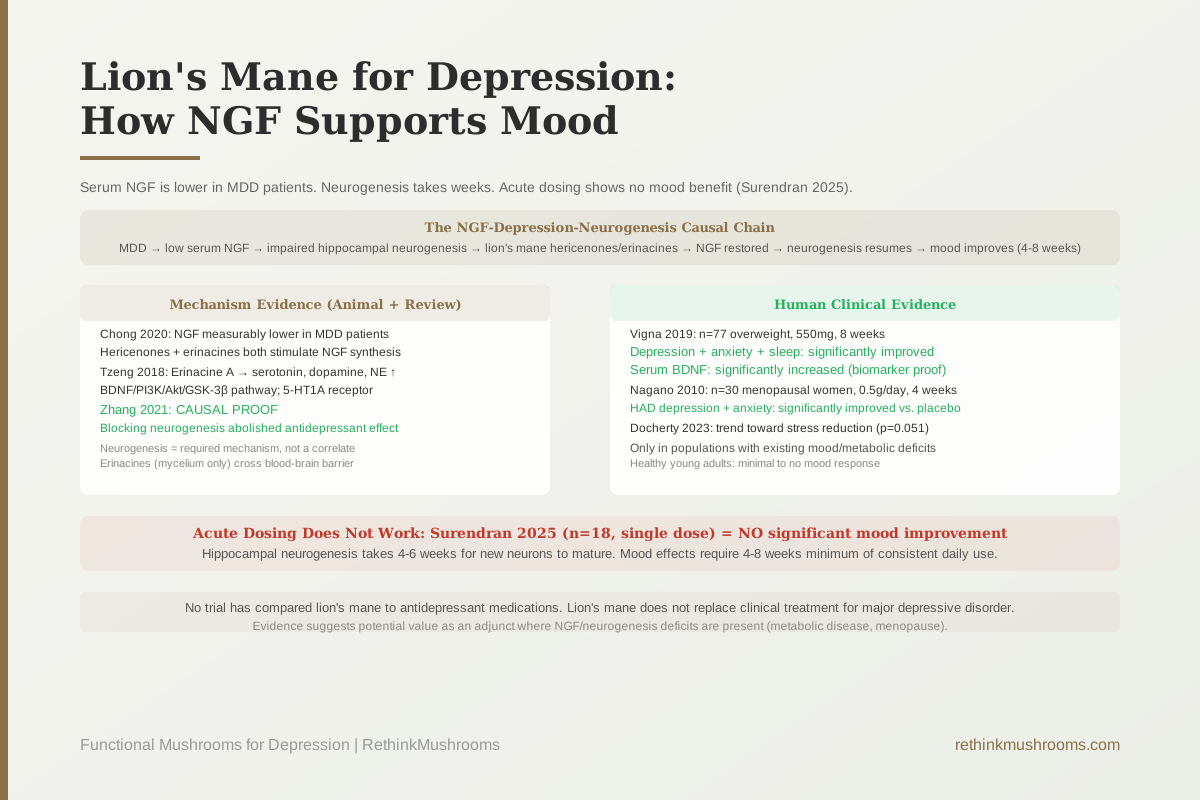
Serum NGF is significantly lower in major depressive disorder patients; lion's mane hericenones and erinacines directly stimulate NGF synthesis (Chong 2020)
Chong and colleagues reviewed the evidence linking NGF deficiency to major depressive disorder and identified hericenones from the fruiting body and erinacines from the mycelium as the compounds responsible for NGF stimulation. The mechanism runs through hippocampal neurogenesis, which takes weeks to produce behavioral changes.
Chong et al., International Journal of Molecular Sciences, 2020
neurogenesis required
Zhang 2021: blocking hippocampal neurogenesis pharmacologically abolished lion's mane's antidepressant effect in mice, establishing causality not just correlation
acute dosing fails
Surendran 2025: single-dose lion's mane showed NO significant mood improvement vs placebo in 18 healthy young adults; neuroplasticity changes require weeks, not hours
BDNF measured
Vigna 2019 (n=77): serum BDNF levels increased significantly after 8 weeks of HE supplementation alongside significant mood improvement
Chong et al., International Journal of Molecular Sciences, 2020
 View as image ↗
The phrase "lion's mane for depression" appears constantly in supplement content, usually accompanied by vague references to brain health or some version of "it promotes nerve growth factor." What is missing from most of this content is the actual mechanism, honest clinical evidence including the null results, and the single most important practical insight: the neuroplasticity pathway through which lion's mane affects mood takes weeks to produce measurable changes. Expecting mood benefits within hours of taking it is expecting the wrong thing from the wrong mechanism.
Serum NGF (nerve growth factor) is measurably and significantly lower in patients with major depressive disorder compared to healthy controls. This is documented, not speculative. Lion's mane contains two compound classes that directly stimulate NGF synthesis: hericenones from the fruiting body and erinacines from the mycelium. The link between these observations runs through hippocampal neurogenesis, the production of new neurons in the brain region most involved in mood regulation.
For the broader overview of mushrooms and mental health, see Adaptogenic Mushrooms for Stress: How They Help Your Body Cope. For the full NGF evidence base, see Lion's Mane and Nerve Growth Factor: The Complete Research Guide.
Key Takeaways
- Chong and colleagues (International Journal of Molecular Sciences, 2020) reviewed evidence showing that serum NGF is significantly lower in major depressive disorder patients; hericenones from lion's mane fruiting body and erinacines from mycelium both stimulate NGF synthesis; the review proposes the NGF pathway as a central mechanism for the antidepressant effects of lion's mane
- Tzeng and colleagues (Journal of Agricultural and Food Chemistry, 2018) found that erinacine A-enriched mycelium elevated serotonin, dopamine, and norepinephrine in the hippocampus of mice, with antidepressant-like effects in forced swim and tail suspension tests; the 5-HT1A receptor was identified as part of the mechanism
- Zhang and colleagues (Behavioural Brain Research, 2021) found that H. erinaceus extract reduced depressive-like behaviors in mice through hippocampal neurogenesis; pharmacologically blocking neurogenesis with temozolomide abolished the antidepressant effect entirely, establishing neurogenesis as a necessary mechanism rather than a byproduct
- Vigna and colleagues (Evidence-Based Complementary and Alternative Medicine, 2019) conducted the largest human trial: 77 overweight/obese patients given 550mg HE plus a low-calorie diet for 8 weeks showed significantly improved depression, anxiety, and sleep disorder scores, with measurable increases in serum BDNF levels
- Nagano and colleagues (Biomedical Research, 2010) conducted the foundational human RCT: 30 menopausal women on lion's mane cookies (0.5g/day) for 4 weeks showed significantly reduced depression and anxiety on the HAD scale versus placebo
- Surendran and colleagues (Frontiers in Nutrition, 2025) found NO significant mood improvement from a single acute dose of lion's mane in 18 healthy young adults; combined with Docherty 2023 (only a trend toward stress reduction at 28 days, p=0.051), the evidence strongly suggests that chronic use of multiple weeks is required for mood effects to manifest, not acute dosing
NGF and Depression: The Biological Connection
Nerve growth factor is not primarily a supplement marketing concept. It is a protein with a well-documented role in the survival and maintenance of specific neurons, including the cholinergic neurons in the basal forebrain that are central to mood, memory, and cognitive function.
The link between NGF and depression has been investigated in clinical research. A review by Chong and colleagues published in the International Journal of Molecular Sciences in 2020 synthesized evidence showing that serum NGF levels are significantly lower in patients with major depressive disorder compared to healthy controls.[1]
Lower NGF has specific downstream consequences relevant to mood. NGF is required for the maintenance of hippocampal neurons and for the process of hippocampal neurogenesis, the ongoing production of new neurons in the hippocampal dentate gyrus. The hippocampus is the brain region most consistently implicated in depression: it shows reduced volume in people with depression, its neurons show reduced dendritic branching, and neurogenesis in this region is suppressed by chronic stress. Both standard antidepressants (SSRIs) and effective psychotherapy are associated with restored hippocampal neurogenesis in animal models.
If NGF is lower in depression, and NGF supports the neurogenesis and neuronal maintenance that is impaired in depression, then a compound that restores NGF is addressing a specific biological deficit rather than producing a vague general brain support effect.
The Chong 2020 review identified both compound classes in lion's mane as capable of NGF stimulation: hericenones from the fruiting body, which act primarily on peripheral NGF pathways and through the JNK/c-Jun signaling mechanism in brain glial cells, and erinacines from the mycelium, which cross the blood-brain barrier and stimulate NGF production centrally in the hippocampus and cortex.
The Monoamine Connection: Serotonin, Dopamine, and Norepinephrine
Depressive disorders are not solely explained by neurotrophin deficiency. The monoamine neurotransmitters (serotonin, dopamine, and norepinephrine) are also consistently abnormal in depression, and their restoration is the target of the most widely used antidepressant medications.
Tzeng and colleagues published a 2018 study in the Journal of Agricultural and Food Chemistry specifically testing whether erinacine A-enriched mycelium affects monoamine levels.[2]
The findings: in mice subjected to chronic stress protocols that deplete monoamine levels, erinacine A-enriched mycelium treatment elevated serotonin, dopamine, and norepinephrine in the hippocampus. The antidepressant-like behavioral effects were confirmed with standard tests (forced swim test and tail suspension test, the primary behavioral depression models in rodents). The study identified involvement of the 5-HT1A receptor, one of the serotonin receptors targeted by antidepressant and anxiolytic medications.
The mechanism connecting these observations: erinacine A activates BDNF synthesis via the PI3K/Akt/GSK-3 beta pathway, and BDNF upregulation drives the monoamine restoration. This is a different entry point into the monoamine system than SSRIs (which block serotonin reuptake) but arrives at some of the same downstream neurochemical outcomes.
The practical distinction: erinacines are found exclusively in the mycelium, not the fruiting body. Products made from fruiting body alone will not contain erinacine A at meaningful concentrations.
Hippocampal Neurogenesis: The Structural Mechanism Confirmed by Causal Experiment
Understanding how lion's mane affects mood ultimately comes down to hippocampal neurogenesis. The neurogenesis story moved from correlation to confirmed causality in a 2021 study by Zhang and colleagues published in Behavioural Brain Research.[3]
The researchers used a standard animal depression model and found, as previous studies had, that H. erinaceus extract reduced depressive-like behaviors. The novel step was using temozolomide, a pharmacological agent that specifically blocks hippocampal neurogenesis, to test whether neurogenesis was necessary for the antidepressant effect or merely a correlate.
When neurogenesis was pharmacologically blocked, the antidepressant-like effect of lion's mane extract disappeared. The animals treated with both lion's mane and the neurogenesis blocker showed depressive behavior equivalent to untreated depressed controls. This established that hippocampal neurogenesis is not merely associated with lion's mane's mood effects: it is a required mechanistic step.
This matters for understanding the timeline. Hippocampal neurogenesis takes weeks to produce new neurons that integrate into functional circuits. New neurons born in the dentate gyrus take approximately 4-6 weeks to mature sufficiently to contribute to hippocampal function. This biological timeline explains why lion's mane's antidepressant effects in animal studies and human trials develop over weeks, and why expecting mood benefits from an acute single dose misunderstands the mechanism entirely.
For the deeper neurogenesis evidence, see Neurogenesis and Lion's Mane: Evidence for New Brain Cell Growth.
The Human Clinical Evidence: Two RCTs, Two Populations
Two randomized controlled trials have tested lion's mane for mood outcomes in humans, using different populations and different forms.
Vigna and colleagues published the largest human study in Evidence-Based Complementary and Alternative Medicine in 2019.[4] The study enrolled 77 overweight or obese patients and randomized them to 550mg of H. erinaceus plus a low-calorie diet or the diet alone as control. After 8 weeks, the lion's mane group showed significantly improved scores on depression, anxiety, and sleep disorder measures compared to the diet-alone group. Critically, serum BDNF levels increased significantly in the treatment group, providing a biomarker measurement linking the supplementation to the expected neurotrophic pathway.
The Vigna 2019 study is important for several reasons. The sample size of 77 is larger than most lion's mane mood trials. The BDNF measurement provides biological validation of the proposed mechanism in humans. The population (overweight/obese, metabolically stressed) represents a group where baseline inflammatory and neurotrophic deficits are more pronounced, which may explain the larger effect sizes compared to healthy adult populations.
Nagano and colleagues published the foundational human RCT in Biomedical Research in 2010: 30 menopausal women randomized to lion's mane cookies (0.5g/day) or placebo cookies for 4 weeks.[5] The lion's mane group showed significantly reduced scores on the Hospital Anxiety and Depression Scale versus placebo. This remains the only clinical trial specifically in a menopausal population, and menopausal women represent a group where NGF and BDNF are reduced by estrogen withdrawal.
Why Acute Dosing Fails: The Most Important Practical Insight
The most useful clinical insight in the lion's mane depression literature is the one most consumer content ignores: acute, single-dose use does not produce mood improvements. The mechanism requires weeks, not hours.
Surendran and colleagues published a 2025 double-blind randomized placebo-controlled trial in Frontiers in Nutrition testing a single acute dose of H. erinaceus in 18 healthy young adults aged 18-35.[7] No significant effect on composite mood or cognitive function was detected versus placebo.
Docherty and colleagues published a 2023 double-blind pilot RCT in Nutrients in 41 healthy adults aged 18-45, testing 1.8g/day for 28 days.[6] There was a trend toward reduced subjective stress at 28 days (p=0.051), which fell just short of statistical significance. This is a marginal result in healthy young adults without baseline mood deficits over 4 weeks.
Together, these studies clarify the population and timeline profile:
- Healthy young adults without mood deficits show minimal to no mood response to lion's mane, even over 4 weeks
- Populations with existing mood, metabolic, or hormonal deficits (overweight patients, menopausal women) show larger effects
- Single-dose or acute use produces no measurable mood changes
- The 4-8 week minimum timeline seen in positive trials is consistent with the neurogenesis mechanism (weeks for new neurons to mature)
For readers asking "why isn't lion's mane working for my depression?": if it has been less than 4 weeks or if it is being taken intermittently, the biological mechanism has not had sufficient time to operate.
The Four Mechanisms: Where NGF Fits in the Bigger Picture
A 2023 review published in a peer-reviewed pharmacology journal identified four overlapping antidepressant mechanisms by which medicinal mushrooms act.[8] Lion's mane's NGF stimulation is one of these four, with distinct evidence supporting each:
- Anti-inflammatory pathway: reducing IL-6, TNF-alpha, and other pro-inflammatory cytokines that are elevated in depression and drive neuroinflammation
- HPA axis regulation: reducing cortisol and corticotropin-releasing hormone (CRH), normalizing the stress-response system that is chronically overactivated in depression
- Neurogenesis via BDNF and NGF: the primary lion's mane pathway; restored neurotrophins drive hippocampal neurogenesis, reversing the structural brain changes associated with depression
- Monoamine modulation: serotonin, dopamine, and norepinephrine restoration, as demonstrated in the erinacine A study (Tzeng 2018)
Lion's mane has the clearest evidence for pathways 3 and 4. The anti-inflammatory and HPA axis pathways are more characteristic of reishi (Ganoderma lucidum). Different species target different entry points into the biological mechanisms underlying depression.
A 2024 systematic review in Neuroscience and Biobehavioral Reviews confirmed that lion's mane has the strongest human evidence among medicinal mushrooms for mood and depression support, while also noting that most human trials are small and of short duration, and that larger trials with validated primary depression outcome measures are needed.[9]
What the Evidence Does and Doesn't Establish
What the research shows:
- Serum NGF is significantly lower in MDD patients, and lion's mane compounds specifically stimulate NGF synthesis through identified pathways (Chong 2020)
- Erinacine A from mycelium restores hippocampal serotonin, dopamine, and norepinephrine in stressed animals via BDNF/PI3K/Akt signaling (Tzeng 2018)
- Hippocampal neurogenesis is a causally necessary mechanism for lion's mane antidepressant effects: pharmacological blockade abolishes the effect (Zhang 2021)
- Two human RCTs show significant mood improvements in specific populations: overweight/obese adults over 8 weeks with BDNF biomarker validation (Vigna 2019) and menopausal women over 4 weeks (Nagano 2010)
What the evidence does not establish:
- Efficacy for major depressive disorder as a clinical diagnosis in a properly controlled RCT
- Any comparison with standard antidepressant medications for treating depression
- That lion's mane replaces or substitutes for antidepressants in any clinical population
- Mood benefits from acute or short-term supplementation in healthy young adults without existing mood deficits
The honest framing for someone with depression considering lion's mane: The biological rationale is specific and coherent. The human evidence is positive but limited to small trials in specific populations (overweight, menopausal). The mechanism requires consistent chronic use of 4-8 weeks minimum. People with depression should not substitute lion's mane for clinical treatment; it may be useful as an adjunct where the mechanism is relevant (existing NGF or BDNF deficits, inflammatory depression, stress-driven low neurogenesis).
For the hericenone compound mechanism, see Hericenones and NGF Synthesis: How Lion's Mane Stimulates Nerve Growth. For the comparison between lion's mane and reishi for mood, see Lion's Mane and Reishi for Depression: Non-Psychedelic Mood Support Research.
The Bottom Line
Serum NGF is significantly lower in major depressive disorder patients, and lion's mane hericenones and erinacines both stimulate NGF synthesis (Chong 2020). Erinacine A-enriched mycelium restored hippocampal monoamines (serotonin, dopamine, norepinephrine) via BDNF/PI3K/Akt in stressed mice (Tzeng 2018), and hippocampal neurogenesis was established as causally necessary for the antidepressant effect (Zhang 2021, neurogenesis blockade abolished the effect). Two human RCTs show significant mood improvements: Vigna 2019 (n=77 overweight patients, 8 weeks, BDNF measured) and Nagano 2010 (n=30 menopausal women, 4 weeks). Acute single-dose use shows no mood benefit (Surendran 2025 null, Docherty 2023 trend only at 28 days). The mechanism requires 4-8 weeks of consistent use.
Frequently Asked Questions
Sources & References
- 1. Source details for this reference are not yet available.
- 2. Source details for this reference are not yet available.
- 3. Source details for this reference are not yet available.
- 4. Source details for this reference are not yet available.
- 5. Source details for this reference are not yet available.
- 6. Source details for this reference are not yet available.
- 7. Source details for this reference are not yet available.
- 8. Source details for this reference are not yet available.
- 9. Source details for this reference are not yet available.