Lion's Mane & Mood
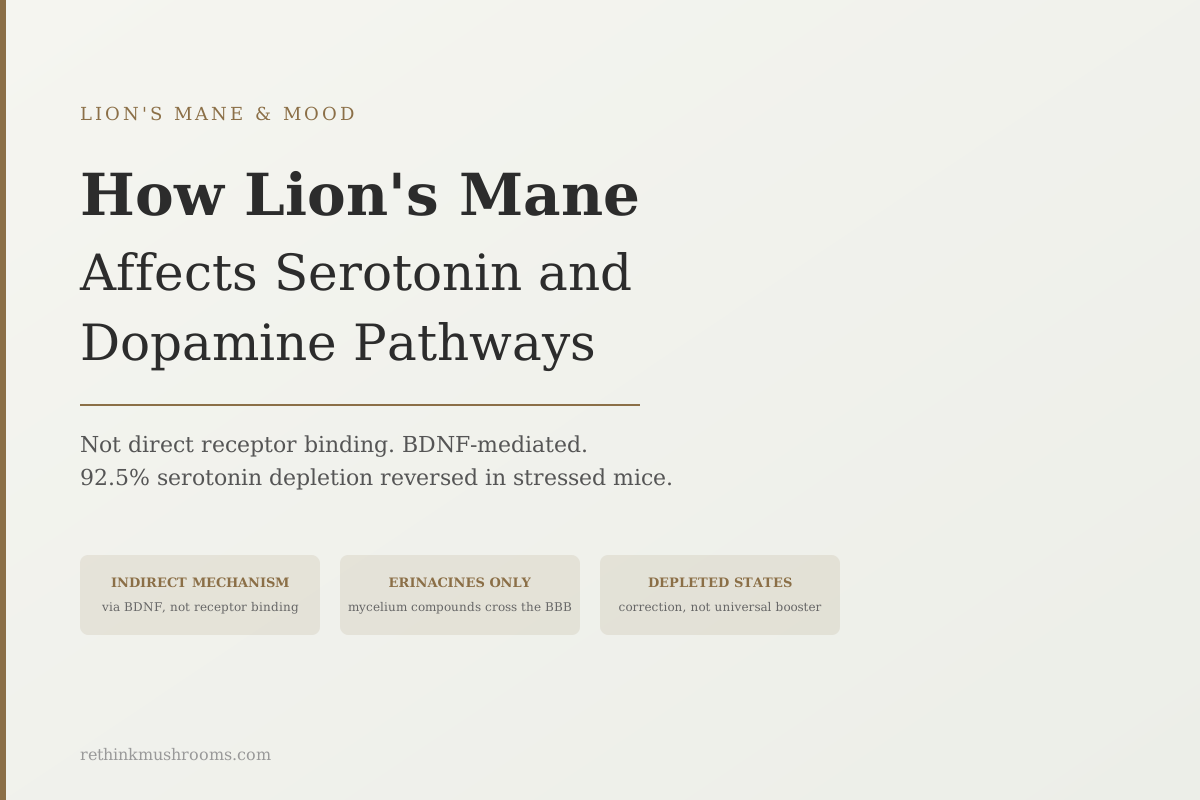
92.5% serotonin depletion reversed
In restraint-stressed mice with measurably depleted serotonin, erinacine A-enriched Hericium erinaceus mycelium reversed 5-HT depletion by 81.6% at medium dose and 92.5% at high dose, with dopamine and norepinephrine also restored via the BDNF/PI3K/Akt/GSK-3β signaling pathway.
Chiu et al., International Journal of Molecular Sciences, 2018
Indirect
works via BDNF, not direct receptor binding like SSRIs
Erinacines
the mycelium compounds that cross the BBB and drive this effect
Depleted states
effect strongest when monoamines are already low
Chiu et al., International Journal of Molecular Sciences, 2018
 View as image ↗
"Does lion's mane increase serotonin?" is one of the most commonly searched questions about this mushroom. The answer requires more than a yes or no, because it depends entirely on what you mean by "increase" and whether your serotonin is already where it should be.
Lion's mane contains compounds (specifically erinacine A, found only in the mycelium) that restore depleted serotonin, dopamine, and norepinephrine in animal models of depression. The restoration happens not by binding to serotonin receptors (the way SSRIs work), but by upregulating BDNF, a protein that supports neurotransmitter production and neuronal function. In states of acute stress where monoamine levels have measurably dropped, erinacine A brings them back. In healthy brains where monoamines are not depleted, the effect appears weaker or absent.
This distinction matters both for understanding the mechanism and for evaluating what lion's mane supplements can realistically do. For the broader overview of lion's mane, see What Is Lion's Mane Mushroom? A Science-Based Overview. For the compounds that make this possible, see Erinacines: The Compounds That Cross the Blood-Brain Barrier.
Key Takeaways
- Erinacine A from lion's mane mycelium restored depleted serotonin by 81.6% at medium dose and 92.5% at high dose in restraint-stressed mice, with dopamine and norepinephrine also recovering via BDNF/PI3K/Akt/GSK-3β signaling
- The effect is indirect: lion's mane does not bind serotonin or dopamine receptors like SSRIs. It upregulates BDNF, which supports monoamine neurotransmitter production and neuronal resilience
- Erinacines (mycelium compounds) are responsible for this monoamine restoration; they cross the blood-brain barrier, which fruiting body hericenones do not reliably do
- A 2023 discovery found that hericerin derivatives from lion's mane simultaneously activate all four neurotrophins (NGF, BDNF, NT-3, NT-4/5) via ERK1/2 signaling, a pan-neurotrophic effect beyond what NGF or BDNF alone would explain
- Hippocampal neurogenesis (the growth of new brain cells) has been confirmed as a necessary mechanism for lion's mane's antidepressant-like effects in animal models, with neurogenesis blockade abolishing the effect
- A 2023 double-blind RCT in healthy young adults showed a trend toward stress reduction but no significant mood improvement, consistent with the pattern that the effect is strongest in depleted or dysregulated states
What "Increasing Serotonin" Actually Means Here
SSRIs (selective serotonin reuptake inhibitors) work by blocking the reuptake of serotonin at synapses, keeping more of it available in the gap between neurons. They work regardless of whether serotonin levels are low to begin with. They directly manipulate the serotonin system by occupying reuptake transporters.
Lion's mane does not do this. No compound in lion's mane has been shown to bind serotonin or dopamine receptors or block reuptake transporters. If someone tells you lion's mane "works like a natural SSRI," that is mechanistically inaccurate.
What lion's mane does instead is support the upstream conditions that allow monoamine systems to function properly. The primary upstream mechanism is BDNF (brain-derived neurotrophic factor), a protein that supports the survival, growth, and function of neurons, including the neurons that produce and use serotonin and dopamine. When BDNF is depleted (as it is in chronic stress, depression, and metabolic dysfunction), serotonin systems become less efficient. When BDNF is restored or upregulated, monoamine function tends to follow.
The practical implication: lion's mane is more accurately described as supporting the neurochemical infrastructure that serotonin and dopamine depend on, rather than directly controlling the amount of serotonin or dopamine available. The effect is most pronounced when that infrastructure has been compromised.
A 2019 comprehensive review by Chong and colleagues in the International Journal of Molecular Sciences identified four overlapping mechanisms through which lion's mane affects mood: NGF and BDNF promotion, monoamine neurotransmitter restoration, HPA axis regulation, and neuroinflammation reduction.[5] These are not competing explanations. They are parallel pathways that converge on improved mood regulation.
The Study That Established the Numbers: Chiu 2018
The most specific data on lion's mane and monoamine restoration comes from Chiu and colleagues, published in the International Journal of Molecular Sciences in 2018.[1]
The researchers used a restraint stress model in mice, a method for inducing reliable, measurable serotonin depletion. Restraint stress suppresses 5-hydroxytryptamine (serotonin), dopamine, and norepinephrine in brain tissue. The researchers then treated stressed mice with erinacine A-enriched Hericium erinaceus mycelium at low, medium, and high doses.
The results:
- At medium dose, serotonin depletion was reversed by 81.6%
- At high dose, serotonin depletion was reversed by 92.5%
- Dopamine and norepinephrine levels also improved significantly
The molecular mechanism ran through BDNF and its downstream signaling: BDNF upregulation activated PI3K, which activated Akt, which phosphorylated and inactivated GSK-3beta. GSK-3beta, when active, promotes neuronal death and impairs monoamine synthesis. Inactivating it has the opposite effect. The BDNF/PI3K/Akt/GSK-3beta cascade is the same pathway implicated in the antidepressant effects of ketamine and some antidepressant drugs.[1]
Two critical details from this study:
First, the active compound is erinacine A, which is found in the mycelium, not the fruiting body. A supplement made from lion's mane fruiting body extract would not contain erinacine A and would not reproduce this mechanism.
Second, the model involves stressed mice with measurably depleted monoamines. These animals are starting from a deficit. The 81-92% restoration figures describe recovery from depletion, not elevation above baseline.
The Parallel Pathway: Hippocampal Neurogenesis
Running alongside the monoamine restoration pathway is a second mechanism: the promotion of hippocampal neurogenesis, the growth of new neurons in the hippocampus.
The hippocampus is the brain region most involved in memory formation and one of the regions most affected by depression. In chronic stress and depression, hippocampal volume decreases, partly because neurogenesis is suppressed. Antidepressants, physical exercise, and certain natural compounds can reverse this suppression.
Ryu and colleagues demonstrated in 2018, published in the Journal of Medicinal Food, that lion's mane extract reduces anxiety and depressive behaviors in mice by promoting hippocampal neurogenesis.[2] The key finding in that study was the causal confirmation: when the researchers pharmacologically blocked neurogenesis (using a cytostatic drug that prevents cell division), the antidepressant and anxiolytic effects of lion's mane disappeared. This moves neurogenesis from a correlate to a necessary mechanism.
Liu and colleagues confirmed and extended this in 2021, published in the Journal of Medicinal Food.[3] Their animal model found that lion's mane exerts antidepressant-like effects through the BDNF/TrkB/CREB signaling pathway, with hippocampal neurogenesis and reduced neuroinflammation both contributing. The BDNF-TrkB-CREB pathway is the canonical pro-neurogenesis cascade. BDNF binds TrkB (its receptor), which activates CREB (a transcription factor that turns on genes needed for neuronal growth and survival).
The significance: BDNF is the convergence point between the monoamine restoration pathway and the neurogenesis pathway. Erinacine A upregulates BDNF, and BDNF then drives both monoamine recovery and hippocampal neurogenesis in parallel. Both effects reinforce each other, which partly explains why the mood data across multiple animal models shows a consistent pattern even when different outcome measures are used.
The Pan-Neurotrophic Discovery: It Is Not Just Serotonin and BDNF
A 2023 finding changed the mechanistic picture in a way most coverage has not yet caught up with.
Martínez-Mármol and colleagues demonstrated in the Journal of Neurochemistry that hericerin derivatives from lion's mane fruiting body activate a pan-neurotrophic pathway in hippocampal neurons, simultaneously upregulating all four major neurotrophins: NGF, BDNF, NT-3, and NT-4/5.[4] The mechanism runs through ERK1/2 (extracellular signal-regulated kinases), independently of TrkB, the canonical BDNF receptor. This ERK1/2 pathway is the same signaling system activated by each of the four neurotrophins independently, but hericerins triggered it without needing any single neurotrophin as the upstream signal.
In plain language: the fruiting body compounds (hericerins) stimulate the brain's own neurons to activate the complete neurotrophic support system, not just one part of it. Mice fed hericene A showed enhanced spatial memory, confirming that this pathway produces functional brain effects, not just molecular signals.[4]
This finding expands the mechanism picture considerably. The earlier understanding was: erinacines (mycelium) stimulate NGF and BDNF, which support monoamines and neurogenesis. The Martínez-Mármol 2023 data adds: hericerins (fruiting body) also activate the complete neurotrophic signaling system through a different molecular route that doesn't depend on any single neurotrophin. Both mechanisms can operate simultaneously in a product that combines fruiting body and mycelium.
For the full story on hericenone mechanisms, see Hericenones and NGF Synthesis: How Lion's Mane Stimulates Nerve Growth.
Why Erinacines vs. Hericenones Matters for This Effect
The Chiu 2018 monoamine restoration data (81.6-92.5% serotonin reversal) used erinacine A-enriched mycelium specifically. Erinacines are the mycelium compounds. They cross the blood-brain barrier by passive diffusion due to their small molecular weight and lipophilic structure.
Hericenones are the fruiting body compounds. They have significant peripheral NGF stimulation activity and the pan-neurotrophic ERK1/2 effects identified by Martínez-Mármol in 2023. Their access to the central nervous system is less established than erinacines.
For the specific monoamine restoration mechanism (BDNF/PI3K/Akt/GSK-3beta → serotonin/dopamine/norepinephrine recovery), erinacines are the documented active compounds. This means that a lion's mane supplement made only from fruiting body extract would not contain erinacines and would not reproduce the specific Chiu 2018 finding. It might still have mood-relevant effects through hericenone pan-neurotrophic pathways, but those effects would have a different mechanistic basis.
The practical question for anyone evaluating lion's mane supplements for mood: does the product label specify mycelium extract or erinacine-enriched mycelium? If the product is fruiting body only, the monoamine restoration mechanism is not in play.
The Honest Caveat: When Does This Effect Actually Appear?
The animal data from Chiu 2018, Ryu 2018, and Liu 2021 all demonstrate the serotonin/dopamine and neurogenesis effects in stressed or diseased models. These are animals with measurable monoamine deficits or disrupted neurogenesis. The effect is restoration or correction, not universal elevation.
Docherty and colleagues tested lion's mane in healthy young adults (18-45 years old, no depression diagnosis) in a 2023 double-blind pilot RCT published in Nutrients.[7] Participants received 1.8g lion's mane daily for 28 days. A single dose improved Stroop task speed (a cognitive-stress measure), and there was a trend toward reduced self-reported stress at 28 days. But there was no significant overall mood improvement in this healthy, non-depleted population.
This is not a failure of the compound; it is consistent with the mechanism. BDNF-mediated monoamine restoration is most relevant when BDNF is low and monoamines are depleted. In healthy young adults without baseline deficits, there is less to correct.
The 2025 systematic review by Ghazali and colleagues confirmed the overall pattern: lion's mane shows cognitive and neuroprotective benefits across the literature, but preparation variability and population differences are key limitations in interpreting the evidence.[6]
The "who responds" picture emerging from the complete dataset: people with metabolic dysfunction, chronic stress, hormonal disruption, or measurable mood symptoms show larger effects than healthy young adults without baseline deficits. The monoamine restoration mechanism explains this pattern; it is a correction mechanism, not a universal mood booster.
For the evidence on lion's mane in populations with existing mood symptoms, see Lion's Mane for Depression: Research on Mood and Mental Health and Can Lion's Mane Reduce Anxiety? Preclinical and Clinical Evidence.
For the anti-inflammatory angle that explains WHY metabolic dysfunction creates the vulnerability, see Lion's Mane and Anti-Inflammatory Cytokines: The Mood-Inflammation Link.
The Bottom Line
Lion's mane affects serotonin and dopamine pathways indirectly, through BDNF upregulation rather than direct receptor binding. Erinacine A (a mycelium compound that crosses the blood-brain barrier) restored depleted serotonin by 81.6-92.5% in stressed mice via BDNF/PI3K/Akt/GSK-3beta signaling, with dopamine and norepinephrine also recovering. Hippocampal neurogenesis is a parallel mechanism confirmed as causally necessary in animal models. The 2023 Martínez-Mármol finding adds that hericerin derivatives from the fruiting body simultaneously activate all four major neurotrophins via ERK1/2, expanding the mechanistic picture beyond BDNF alone. The effect is strongest in depleted states. A 2023 double-blind RCT in healthy young adults showed cognitive-stress crossover effects but no robust mood improvement, consistent with the correction-mechanism framing. Erinacine A (mycelium) drives the monoamine restoration pathway; hericenones (fruiting body) drive the pan-neurotrophic pathway; both mechanisms can operate together in full-spectrum products.
Frequently Asked Questions
Sources & References
- 1. Source details for this reference are not yet available.
- 2. Source details for this reference are not yet available.
- 3. Source details for this reference are not yet available.
- 4. Source details for this reference are not yet available.
- 5. Source details for this reference are not yet available.
- 6. Source details for this reference are not yet available.
- 7. Source details for this reference are not yet available.