Lion's Mane (Hericium erinaceus)
4 weeks of lion's mane fruiting body extract significantly reduced depression, irritability, and anxiety in menopausal women (Nagano 2010)
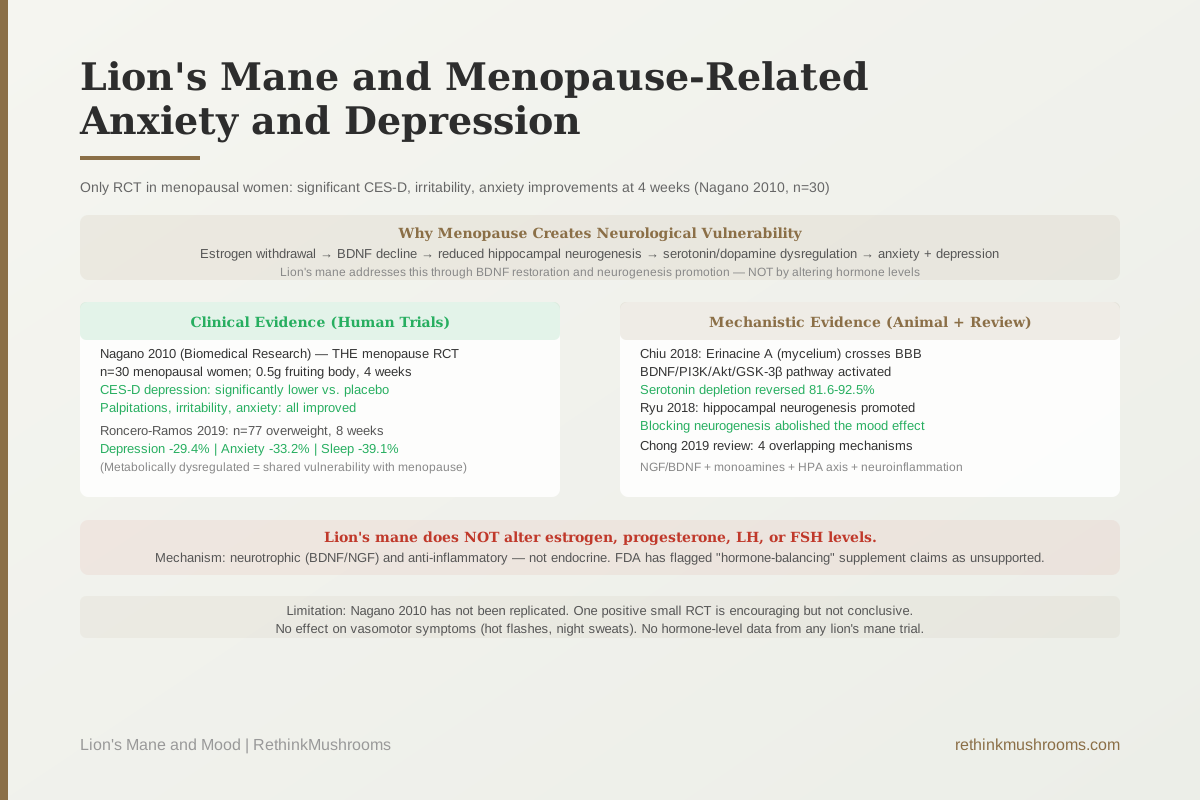
Nagano and colleagues conducted the only randomized controlled trial of lion's mane specifically in menopausal women: 30 women on HE cookies for 4 weeks showed significantly lower CES-D depression scores and reduced irritability, palpitations, and anxiety versus placebo.
Nagano et al., Biomedical Research, 2010
30 menopausal women
Nagano 2010: the only published RCT testing lion's mane for menopause-related mood symptoms; n=30, 4-week double-blind design
BDNF decline
estrogen withdrawal reduces BDNF and NGF expression: the neurochemical vulnerability lion's mane directly addresses through its neurotrophic compounds
not hormonal
lion's mane does not alter estrogen, progesterone, or LH levels; the mechanism is neurotrophic and anti-inflammatory, not endocrine
Nagano et al., Biomedical Research, 2010
 View as image ↗
Menopause is not just a hormonal transition. It is a neurological one. The steep decline in estrogen that defines perimenopause and menopause alters brain chemistry in ways that directly increase vulnerability to anxiety, depression, and cognitive changes. The mood symptoms women experience during this transition are not entirely explained by the psychosocial stress of menopause: they have a biological basis in the brain's neurotrophic factor systems.
Lion's mane menopause anxiety depression is a specific research area with one human clinical trial: a 2010 randomized controlled trial by Nagano and colleagues in 30 menopausal Japanese women that found significant reductions in depression, irritability, and anxiety after 4 weeks on lion's mane cookies versus placebo. This is a small study, and it is the foundation of what the evidence shows.
The more interesting question is why it worked. The answer is not that lion's mane adjusts hormone levels. The mechanism runs through the same neurotrophic pathways that estrogen normally supports: specifically BDNF and NGF production, hippocampal neurogenesis, and anti-inflammatory protection of mood-regulating brain circuits. Understanding this mechanism explains who is most likely to benefit and what a realistic expectation looks like.
For the broader overview of lion's mane research, see What Is Lion's Mane Mushroom? A Science-Based Overview. For the general depression and anxiety evidence landscape, see Lion's Mane for Depression: Research on Mood and Mental Health and Can Lion's Mane Reduce Anxiety? Preclinical and Clinical Evidence.
Key Takeaways
- Nagano and colleagues (Biomedical Research, 2010) conducted a double-blind RCT in 30 menopausal women and found that 4 weeks of Hericium erinaceus fruiting body powder (0.5g in cookies, given 3x daily) significantly reduced CES-D depression scores and Indefinite Complaints Index scores, with specific improvements in palpitations, irritability, and anxiety, compared to placebo
- Estrogen withdrawal during menopause reduces BDNF (brain-derived neurotrophic factor) and NGF (nerve growth factor) expression in the brain: these are the same neurotrophic factors that lion's mane stimulates through its hericenone and erinacine compounds
- Chiu and colleagues (International Journal of Molecular Sciences, 2018) found that erinacine A from lion's mane mycelium restored depleted serotonin, dopamine, and norepinephrine in stressed mice through BDNF/PI3K/Akt/GSK-3 beta signaling, identifying the specific molecular pathway relevant to estrogen-withdrawal-driven neurotransmitter depletion
- Ryu and colleagues (Journal of Medicinal Food, 2018) found that HE extract reduced anxiety and depressive behaviors in mice by promoting hippocampal neurogenesis, and that blocking neurogenesis abolished the effect: estrogen also supports hippocampal neurogenesis, so menopause represents a state of reduced neurogenic capacity that lion's mane may partially compensate
- Roncero-Ramos and colleagues (Evidence-Based Complementary and Alternative Medicine, 2019) found in 77 overweight/obese patients that 8 weeks of HE supplementation produced 29.4% reduction in depression, 33.2% reduction in anxiety, and 39.1% reduction in sleep disorders: overweight and postmenopausal populations often share the same inflammatory and metabolic disruptions that explain the larger effect sizes
- Lion's mane does not alter estrogen, progesterone, LH, or FSH levels and should not be described as "hormone-balancing": the mechanism is neurotrophic and anti-inflammatory, not endocrine
Why Menopause Creates Neurological Vulnerability
Estrogen is not primarily a reproductive hormone in the brain. It functions as a neuroprotective and neurotrophic agent in multiple brain regions, particularly the hippocampus and prefrontal cortex. It promotes BDNF expression, supports synaptic plasticity, regulates serotonin and dopamine turnover, and maintains hippocampal neurogenesis.
When estrogen levels fall sharply during perimenopause and menopause, BDNF expression falls with them. BDNF is the primary neurotrophic factor that supports the survival, growth, and maintenance of neurons in mood-regulating circuits. Low BDNF is consistently found in people with major depression and anxiety disorders: it is not merely a correlate but a contributing mechanism.
The practical consequence: the mood symptoms that many women experience during menopause (anxiety, irritability, depressive episodes, brain fog) have a neurochemical basis in this BDNF decline, not just in the life-stage stress of menopause. Women who enter perimenopause with lower baseline BDNF or with other biological risk factors (metabolic syndrome, sleep disruption, chronic stress) are more vulnerable.
This is exactly the vulnerability that lion's mane's neurotrophic mechanisms address. The compound is not adding estrogen or mimicking it. It is supporting the same downstream neurotrophic pathways that estrogen normally maintains.
The RCT That Started the Conversation: Nagano 2010
Nagano and colleagues published a double-blind, placebo-controlled RCT in Biomedical Research in 2010 that remains the only published clinical trial of lion's mane specifically in menopausal women.[1]
The design: 30 Japanese women in menopause were randomized to either HE cookies (containing 0.5g of Hericium erinaceus fruiting body powder, consumed as 4 cookies 3 times daily) or placebo cookies for 4 weeks. Mood and symptom outcomes were measured with validated scales: the Center for Epidemiologic Studies Depression Scale (CES-D) for depression and the Indefinite Complaints Index (ICI) for somatic and psychological symptoms characteristic of menopause.
After 4 weeks, the HE group showed significantly lower CES-D depression scores and ICI scores than the placebo group. Specific symptom items improved in the HE group: palpitations, irritability, and anxiety. The ICI covers common menopausal complaints that overlap with mood: the fact that palpitations improved alongside anxiety suggests both somatic and psychological components responded.
What the study does not tell us: the dose was low (2g/day of fruiting body powder in cookie form), the trial was short (4 weeks), and the sample was small (30 women). Whether longer treatment, higher doses, or different preparation forms produce stronger effects is not known.
The study is also 15 years old. No replication trial in menopausal women has been published. One positive small RCT, without replication, is encouraging but not conclusive.
The BDNF Pathway: Why Erinacines Are Relevant for Mood
The most direct mechanistic evidence for how lion's mane affects monoamine neurotransmitters comes from a 2018 study by Chiu and colleagues in the International Journal of Molecular Sciences.[2]
The researchers tested erinacine A, a diterpenoid compound from lion's mane mycelium, in a mouse model of restraint-induced depression (chronic stress that depletes serotonin, dopamine, and norepinephrine). Erinacine A is notable because it crosses the blood-brain barrier, unlike many plant compounds that cannot reach the brain directly.
The findings: erinacine A at medium doses (250mg/kg) reversed serotonin depletion by 81.6%. At high doses (400mg/kg), the reversal reached 92.5%. Dopamine and norepinephrine were also restored. The mechanism ran through the BDNF/PI3K/Akt/GSK-3 beta signaling cascade: erinacine A increased BDNF expression, which then activated the downstream kinase pathway that supports monoamine synthesis and synaptic function.
The relevance to menopause: estrogen withdrawal depletes the BDNF expression that normally supports serotonin and dopamine tone in the prefrontal cortex and hippocampus. Erinacine A activates the same BDNF pathway through a different entry point, potentially compensating for the estrogen-dependent input that is reduced during menopause.
The critical practical note: erinacine A is found in mycelium, not fruiting body. The Nagano 2010 trial used fruiting body powder. The mechanism identified in Chiu 2018 involves a different source fraction. Whether the fruiting body compounds (hericenones) that drove the Nagano results work through the same pathway or a different one (likely NGF stimulation rather than direct BDNF via erinacine A) is an important distinction that the available evidence does not fully resolve.
Hippocampal Neurogenesis: A Second Mechanism Connected to Estrogen
A 2018 study by Ryu and colleagues in the Journal of Medicinal Food identified a second mechanism that is independently relevant to menopause.[3]
The researchers found that HE extract reduced anxiety and depressive behaviors in mice by promoting hippocampal neurogenesis, the production of new neurons in the hippocampus. The study included a critical experimental control: when neurogenesis was pharmacologically blocked, the anxiolytic and antidepressant effects of lion's mane disappeared. This established neurogenesis as a necessary mechanism, not merely an associated finding.
Estrogen is one of the primary regulators of hippocampal neurogenesis. During reproductive years, estrogen cycles promote neurogenesis rhythmically. After menopause, the sustained low estrogen state reduces neurogenic activity. This decline is associated with both the memory and mood changes common during menopause.
An agent that promotes hippocampal neurogenesis through a non-hormonal pathway could partially compensate for the neurogenic decline associated with estrogen withdrawal. Lion's mane appears to do this through NGF and BDNF stimulation.
The Adjacent Human Evidence: Overweight Adults and BDNF Biomarkers
A 2019 cohort study by Roncero-Ramos and colleagues in Evidence-Based Complementary and Alternative Medicine provides the largest human mood dataset for lion's mane, though not specifically in menopausal women.[5]
Seventy-seven overweight or obese patients took HE supplementation for 8 weeks. Depression scores dropped by 29.4%, anxiety by 33.2%, and sleep disorder scores by 39.1% compared to baseline. The researchers also tracked BDNF and pro-BDNF biomarkers in blood, finding changes consistent with conversion of the precursor (pro-BDNF) to the mature active form (BDNF).
The relevance to menopause is the population overlap. Postmenopausal women disproportionately experience weight gain and metabolic changes. Both overweight/metabolically dysregulated states and estrogen withdrawal are characterized by elevated chronic inflammation, reduced BDNF, and disrupted neurotransmitter tone. These shared biological features may explain why lion's mane shows larger effect sizes in both populations compared to healthy young adults without these deficits.
A 2019 systematic review by Chong and colleagues in the International Journal of Molecular Sciences identified four overlapping mechanisms behind HE's antidepressant effects: NGF and BDNF promotion, monoamine neurotransmitter restoration, HPA axis regulation, and neuroinflammation reduction.[4] The HPA axis point is specifically relevant to menopause: the HPA axis, which regulates cortisol production and stress responses, is disrupted by estrogen withdrawal, contributing to the heightened anxiety many women experience.
Does Lion's Mane Affect Hormones?
This is the question that separates evidence-based framing from marketing language.
Lion's mane does not alter estrogen, progesterone, luteinizing hormone (LH), or follicle-stimulating hormone (FSH) levels. It is not a phytoestrogen. It does not bind to estrogen receptors. The US FDA has flagged supplement companies that make "hormone-balancing" claims for lion's mane without evidence.
What it does is support the downstream neurological systems that estrogen normally maintains: BDNF and NGF expression, hippocampal neurogenesis, monoamine neurotransmitter tone, and anti-inflammatory protection of neural tissue. This is a meaningful biological distinction. The mechanism is neurotrophic and anti-inflammatory, not endocrine.
For menopausal women, this means lion's mane is not a substitute for hormone therapy in managing the primary hormonal symptoms of menopause (vasomotor symptoms, urogenital atrophy). It is potentially addressing the neurological consequences of the hormonal change rather than the hormonal change itself.
What the Evidence Does and Doesn't Establish
What the research shows:
- A double-blind RCT in 30 menopausal women found significant mood improvements after 4 weeks of lion's mane fruiting body powder, including reduced CES-D depression scores, reduced irritability, reduced palpitations, and reduced anxiety (Nagano 2010)
- The neurochemical mechanism involves BDNF and NGF promotion, monoamine neurotransmitter restoration in stressed neural circuits (Chiu 2018), and hippocampal neurogenesis (Ryu 2018): all three are directly impacted by estrogen withdrawal
- A 77-person human cohort shows large mood effect sizes in metabolically dysregulated adults (29.4% depression, 33.2% anxiety reduction), a population that shares neurochemical vulnerabilities with postmenopausal women
- The four-mechanism framework (NGF/BDNF, monoamines, HPA axis, neuroinflammation) provides a coherent biological rationale for why menopausal women specifically might respond to lion's mane
What the evidence does not establish:
- The optimal dose for menopause-related mood symptoms (the Nagano trial used 0.5g fruiting body powder 3x daily; whether higher doses produce larger effects is unknown)
- Whether fruiting body or mycelium preparations produce different mood outcomes for menopausal women
- Any replicated controlled trial in menopausal women beyond the single Nagano 2010 study
- Any effect on vasomotor symptoms (hot flashes, night sweats) or other primary menopause symptoms
- Any hormone-level changes from lion's mane supplementation
For the compound-level explanation of how hericenones and erinacines drive these neurotrophic effects, see Hericenones and NGF Synthesis: How Lion's Mane Stimulates Nerve Growth and Erinacines: The Compounds That Cross the Blood-Brain Barrier. For how lion's mane affects serotonin and dopamine specifically, see How Lion's Mane Affects Serotonin and Dopamine Pathways.
The Bottom Line
The only human RCT testing lion's mane specifically in menopausal women (Nagano 2010, n=30) found significant reductions in CES-D depression scores, irritability, palpitations, and anxiety after 4 weeks of fruiting body powder versus placebo. The mechanism is neurotrophic, not hormonal: estrogen withdrawal reduces BDNF and NGF, which lion's mane compounds restore through erinacine A (BDNF/PI3K/Akt pathway, Chiu 2018) and hippocampal neurogenesis promotion (Ryu 2018). A 77-person cohort in metabolically dysregulated adults showed 29.4% depression and 33.2% anxiety reductions, suggesting the effect is strongest when neurochemical deficits are present. Lion's mane does not alter hormone levels.
Frequently Asked Questions
Sources & References
- 1. Source details for this reference are not yet available.
- 2. Source details for this reference are not yet available.
- 3. Source details for this reference are not yet available.
- 4. Source details for this reference are not yet available.
- 5. Source details for this reference are not yet available.