Psilocybin for Treatment-Resistant Depression
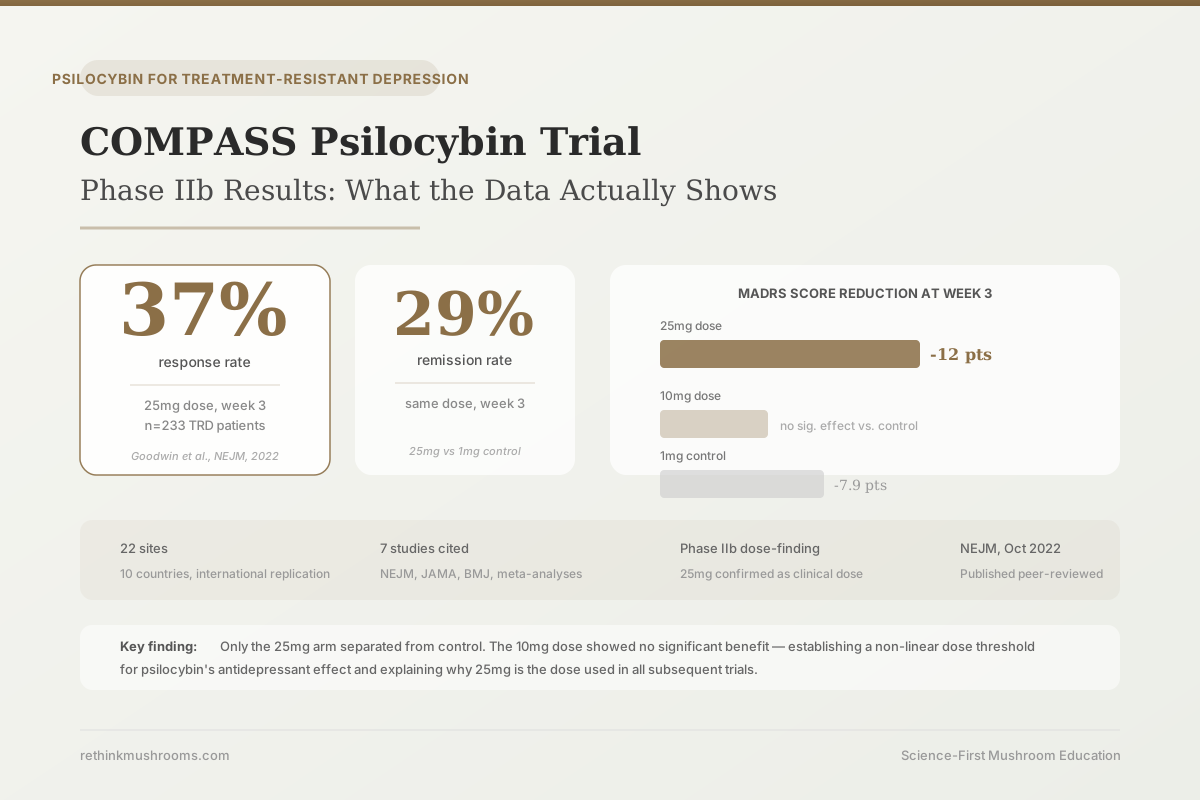
37% response rate
A single 25mg dose of synthetic psilocybin produced a clinical response in 37% of treatment-resistant depression patients at week 3 in the COMPASS Pathways Phase IIb trial. Against the 1mg control, that came to a 6.6-point advantage on the MADRS depression scale.
Goodwin et al., New England Journal of Medicine, 2022
233
TRD patients enrolled across 22 sites in 10 countries
29%
achieved remission at week 3 on the 25mg dose
NEJM
published in the New England Journal of Medicine, October 2022
Goodwin et al., New England Journal of Medicine, 2022
 View as image ↗
In October 2022, the New England Journal of Medicine published results from the largest controlled trial of psilocybin for treatment-resistant depression (TRD) to that point. The trial was run by the biopharmaceutical company COMPASS Pathways across 22 sites in 10 countries, enrolling 233 people who had tried and failed at least two antidepressants. A single dose of synthetic psilocybin was administered under clinical supervision. Three weeks later, 37% of those who received the highest dose had responded. For a population that has, by definition, not gotten better on standard medication, that number was a meaningful signal.
But the full picture is more complex than the headlines captured. One of the three dose arms showed no benefit at all over the control. Response rates in the effective dose group declined sharply from their week-3 peak. And Phase IIb is a dose-finding trial, not the definitive proof of efficacy that Phase III provides. Understanding what those results establish, and where the gaps remain, matters as much as knowing the headline numbers. This article covers both. For context on how psilocybin fits into the broader landscape of TRD treatments, see Psilocybin for Treatment-Resistant Depression: When Nothing Else Works and the complete guide to psilocybin for major depression.
If you only read one thing
A single 25mg dose of psilocybin beat a 1mg control by 6.6 MADRS points at three weeks in 233 treatment-resistant patients, and the 10mg dose did not beat it at all. That is a real but modest signal from a dose-finding trial: the benefit faded substantially by week 12, suicidal ideation appeared in every dose group including the control, and the two Phase 3 trials that followed report their results against a looser response threshold than Phase IIb used.
Key Takeaways
- A single 25mg dose of synthetic psilocybin produced a 37% response rate and 29% remission rate at 3 weeks in the COMPASS Phase IIb trial (n=233). MADRS scores fell 12.0 points from baseline on 25mg versus 5.4 points on the 1mg control, a between-group difference of 6.6 points (95% CI −10.2 to −2.9, P<0.001) (Goodwin et al., NEJM, 2022)
- The 10mg dose did not separate from the 1mg control: a difference of just 2.5 points (95% CI −6.2 to 1.2, P=0.18). The antidepressant effect in this single-dose model appears at 25mg and not below it
- A dose-response meta-analysis of 7 trials and 489 participants calculated a 95% effective dose of 24.68 mg/70kg for primary depression, independently converging on roughly the 25mg mark (Perez et al., European Neuropsychopharmacology, 2023)
- Benefit attenuated over time: 37% responded at week 3 but only 20% met the sustained-response criterion at week 12. A 52-week observational follow-up found the median time to a depressive event was 92 days on 25mg versus 62 days on 1mg, and most participants had recorded a depressive event by week 12 (Goodwin et al., J Clin Psychiatry, 2025)
- Suicidal ideation or intentional self-injury occurred in every dose group including the 1mg control, which is common in treatment-resistant depression trials. Three non-responders in the 25mg arm reported suicidal behaviour at least a month after dosing, and no group showed mean worsening of suicidal ideation scores (Goodwin et al., NEJM, 2022)
- An independent trial in JAMA using a lighter-touch therapy protocol found a 12.3-point MADRS advantage over placebo at day 43, though in major depressive disorder rather than treatment-resistant depression (Raison et al., 2023)
- Baseline fMRI brain connectivity predicted psilocybin response with roughly 90% accuracy in a small sample, but generalisation to a second dataset was only borderline significant (Copa et al., 2024)
What COMPASS Actually Tested: COMP360, Not Mushrooms, Across 233 TRD Patients
Psilocybin occurs naturally in over 200 fungal species. What COMPASS Pathways administered to trial participants was a synthetic version, manufactured under pharmaceutical-grade quality controls and given the trade name COMP360. The active molecule is chemically identical to naturally-occurring psilocybin: the body converts both forms to psilocin, which acts on serotonin receptors in the brain. The distinction is regulatory and manufacturing-quality, not biochemical.
To qualify for the trial, participants had to have treatment-resistant depression: failing to adequately respond to at least two different antidepressant medications at appropriate doses for appropriate durations. This eligibility criterion matters for interpreting the results. The people in this trial were not experiencing a first depressive episode and trying a novel treatment out of curiosity. They had already tried standard care and it had not worked.
The trial ran across 22 sites in 10 countries. That geographic spread was intentional. A trial that produces compelling results in one country's clinical culture carries less weight than one that replicates across diverse settings, healthcare systems, and patient populations.
Participants were randomly assigned to one of three doses: 1mg (the active control, n=79), 10mg (n=75), or 25mg (n=79). A completely inactive placebo was not used because a genuine hallucinogenic dose is too easy to identify: anyone who received it would know they were not in the placebo arm, collapsing the blinding. The 1mg dose was chosen because it produces minimal perceptual effects while still providing an active compound. The primary endpoint was change in MADRS score at three weeks. Mean baseline MADRS was 32 or 33 in every group, placing participants in the severe range.[1]
Each participant received structured psychological support before, during, and after the session from trained therapists. The protocol was not a full psychotherapy course. The focus was preparation, in-session containment, and immediate post-session integration.
COMPASS Phase IIb Trial at a Glance
| Feature | Detail |
|---|---|
| Drug | COMP360 (synthetic psilocybin, pharmaceutical grade) |
| Participants | 233 adults with treatment-resistant depression |
| Sites | 22 sites across 10 countries |
| Design | Randomized, double-blind, three-arm dose comparison |
| Dose arms | 1mg (active control, n=79), 10mg (n=75), 25mg (n=79) |
| Baseline MADRS | 32–33 in each group |
| Primary endpoint | MADRS score change at week 3 |
| 25mg MADRS change | −12.0 points from baseline |
| 10mg MADRS change | −7.9 points from baseline |
| 1mg MADRS change | −5.4 points from baseline |
| 25mg vs 1mg difference | −6.6 points (95% CI −10.2 to −2.9), P<0.001 |
| 10mg vs 1mg difference | −2.5 points (95% CI −6.2 to 1.2), P=0.18 |
| 25mg response rate | 37% at week 3 |
| 25mg remission rate | 29% at week 3 |
| Adverse events | 179 of 233 participants (77%) |
| Follow-up | 12 weeks |
| Published | New England Journal of Medicine, October 2022 |
The 25mg Result: 37% Responded, and Why the Control Group Is What Makes That Number Real
The 25mg arm produced a statistically significant reduction in MADRS scores compared to the 1mg control at three weeks.[1] Least-squares mean changes from baseline to week 3 were −12.0 points for 25mg, −7.9 for 10mg, and −5.4 for the 1mg control.
The number that matters is the gap between the 25mg arm and the control: −6.6 points (95% CI −10.2 to −2.9, P<0.001). That difference is the drug's contribution, separated from everything else.
Goodwin et al. (2022) · New England Journal of Medicine
- Population
- 233 adults with treatment-resistant depression (failed ≥2 antidepressants), baseline MADRS 32–33, across 22 sites in 10 countries
- Intervention
- A single supervised dose of COMP360 synthetic psilocybin at 25mg (n=79) or 10mg (n=75), with psychological support
- Comparator
- 1mg COMP360 active control (n=79)
- Finding
- At week 3, MADRS fell 12.0 points on 25mg versus 5.4 on the 1mg control, a difference of 6.6 points (95% CI −10.2 to −2.9, P<0.001). 37% responded and 29% remitted on 25mg. The 10mg arm did not separate from control (−2.5 points, P=0.18).
positive A genuine dose-finding result, not proof of efficacy. Benefit attenuated by week 12 and adverse events occurred in 77% of all participants.
Goodwin GM et al., N Engl J Med, 2022;387(18):1637–1648 (RTHM-01524)
Expressed in response and remission terms: 37% of the 25mg group were clinical responders at week 3, meaning at least a 50% reduction in symptom severity from where they started. 29% were in remission, meaning MADRS scores fell to 10 or below. The trial's own authors described the week-3 response and remission figures as "generally supportive" of the primary result, while explicitly noting that sustained response at 12 weeks was not.[1]
For a population that had failed at least two antidepressants before entering the trial, double-digit response rates from a single session constitute a meaningful signal, not proof of efficacy at scale, but a clear direction to follow.
The MADRS captures specific features of depression: sadness, inner tension, sleep, appetite, concentration, the ability to feel. A 12-point shift means measurable changes across those domains. Whether that constitutes clinically meaningful relief depends on where someone started and where they landed. For some participants, it was remission. For others, it was partial improvement. The trial reports the average; the patient experience is a distribution.
For a deeper look at the mechanistic reasons psilocybin reaches patients that SSRIs cannot, see How Psilocybin Helps When Antidepressants Fail.
The 10mg Arm Didn't Work, and What That Tells Us About Psilocybin's Dose Curve
This finding largely disappeared from media coverage of the trial. It is among the most instructive parts of the data.
The 10mg arm showed no statistically significant separation from the 1mg control group at week 3. The difference was −2.5 MADRS points, with a 95% confidence interval running from −6.2 to 1.2 and a P value of 0.18.[1] Because that interval crosses zero, the trial cannot rule out that 10mg does nothing at all relative to control. In statistical terms, the 10mg dose failed to demonstrate efficacy.
The 10 mg Result
A Step, Not a Slope
Depression scores three weeks after a single dose, in the one trial that tested 1 mg, 10 mg and 25 mg inside the same protocol. Longer bars are better. What matters is not the bar — it is whether the interval beside it clears zero.
Difference vs 1 mg control: -6.6 points (95% CI -10.2 to -2.9), P<0.001. Interval excludes zero.
Difference vs 1 mg control: -2.5 points (95% CI -6.2 to 1.2), P=0.18. Interval crosses zero — not statistically significant.
Baseline MADRS was 32 or 33 in every group; this arm anchors the comparison.
MADRS is the Montgomery–Åsberg Depression Rating Scale, scored 0–60, where higher means more severe. The diamond marks the point estimate of each contrast and the bar its 95% confidence interval; the vertical line is zero, meaning “no difference from control.” Adverse events occurred in 179 of 233 participants (77%), and suicidal ideation or behaviour or self-injury was recorded in all three dose groups, including the 1 mg control. This is a single phase 2 trial in treatment-resistant depression, not a general finding about psilocybin in healthy people.
Source: Goodwin et al. 2022 (N Engl J Med 387:1637–1648). A separate network meta-analysis pooling three RCTs (389 patients) independently ranked 25 mg first with a SUCRA value of 92.25% — Swieczkowski et al. 2025 (Psychiatry Res 344:116337).
In this dose range, the antidepressant effect doesn't scale smoothly with dose, at least in a single-session model. Going from 1mg to 10mg added little that the trial could distinguish from noise. Going from 10mg to 25mg added a lot. One interpretation: psilocybin's antidepressant effect may depend on producing a full psychedelic experience, and 10mg may not reliably cross that threshold in most people. Another: the effect may depend on activating enough of a specific serotonin receptor type, and 10mg may not consistently reach the required activation level. That receptor type is called 5-HT2A, and it is psilocin's primary target in the brain. The trial design does not resolve which explanation is correct, but the practical implication is the same: at doses below the full experiential range, the antidepressant signal is absent.
A 2023 dose-response meta-analysis in European Neuropsychopharmacology approached the same question from the other direction.[2] Perez and colleagues pooled seven double-blind randomized fixed-dose trials covering 489 participants and modelled the dose-response curve with restricted cubic splines. For primary depression, they calculated a 95% effective dose of 24.68 mg per 70kg of body weight, landing almost exactly on the 25mg mark that COMPASS had arrived at empirically. For secondary depression, depression occurring alongside another condition such as cancer, the equivalent figure was far lower at 8.92 mg/70kg. Two independent methods converging on roughly 25mg for primary depression is a stronger argument than either alone. The same analysis also found dose-dependent increases in side effects including physical discomfort, blood pressure elevation, nausea and headache, so the dose that maximises benefit is not free of cost.
It would be wrong, though, to say the 10mg dose has been abandoned. When COMPASS ran its second Phase 3 trial, COMP006, it included a 10mg arm with 142 participants alongside 25mg and 1mg arms, testing whether repeated dosing changes the picture that a single 10mg dose produced in Phase IIb.
The Durability Problem: Why Effects Peak at Week 3 and What Happens Next
The COMPASS trial tracked participants for 12 weeks. The encouraging finding: effects were still measurable at week 12, meaning psilocybin's impact did not disappear within days of the session. The more complicated finding: the benefit attenuated substantially. 37% of the 25mg group were responders at week 3, but only 20% met the trial's sustained-response criterion at week 12.[1]
A 52-week observational follow-up study, COMP004, published in the Journal of Clinical Psychiatry in 2025, extended the picture considerably.[8] Across all 233 original participants, the median time to a prespecified depressive event was 92 days for the 25mg group, 83 days for 10mg, and 62 days for 1mg. The 25mg dose did buy more time than the control. But two caveats sit alongside that headline: the gap between 25mg and 10mg was only nine days, and the majority of participants in every group had already recorded a depressive event by week 12.
This is the durability question that follows nearly every psilocybin depression study. A single session produces a measurable effect. That effect persists for weeks to a few months. But it is not permanent, and the benefit attenuates. Whether that matters clinically depends on context: a patient who achieves three months of relief from one session faces a very different calculation than one who achieves three weeks.
A 2024 study published in Med tested whether repeated dosing could improve on this picture.[3] Rosenblat and colleagues ran a small feasibility trial in a deliberately complex population: 30 adults with treatment-resistant depression in the context of major depressive or bipolar II disorder, including patients with baseline suicidality and significant comorbidity, the kinds of patients most psilocybin trials exclude. Participants were randomized to immediate treatment or a waitlist, and received one, two, or three 25mg sessions. The immediate-treatment arm showed greater MADRS reductions than the waitlist period, with a large effect size (Hedges' g = 1.07, P<0.01), and repeated doses were associated with further reductions compared to baseline.
That is a genuinely encouraging direction, but its weight should be read carefully. With 30 participants, a waitlist rather than a placebo comparator, and an explicit aim of establishing feasibility rather than efficacy, this study cannot establish that repeated dosing outperforms a single dose. No arm in the trial received a single dose for comparison. What it establishes is that repeat dosing in a complex population is feasible and safe enough to justify larger trials. For the full evidence on this question, see Do You Need Multiple Psilocybin Sessions for Lasting Depression Relief?
Phase IIb vs. Phase III: What "Dose-Finding Trial" Means, and Where the Phase 3 Data Lands
Phase IIb trials serve a specific and limited purpose in drug development: they compare dose levels in the target patient population, look for an efficacy signal sufficient to justify a larger trial, and generate the data needed to design Phase III. They are not designed to provide definitive proof of efficacy. Phase III trials, which enroll larger numbers of patients over longer periods, are designed for that.
COMPASS's Phase IIb established that 25mg COMP360 produces a statistically significant antidepressant effect in TRD patients, strong enough to publish in the New England Journal of Medicine. But 233 patients across 12 weeks of follow-up is the beginning of the evidence base, not its conclusion.
An independent test of the single-dose psilocybin effect was published in JAMA in 2023 by a separate research group sponsored by the Usona Institute.[4] Raison and colleagues randomized 104 participants across 11 US sites to a single 25mg dose of psilocybin or a 100mg niacin placebo, with psychological support in both arms but a lighter-touch therapy accompaniment than most previous psilocybin trials. The psilocybin group showed a 12.3-point greater MADRS reduction than placebo at day 43, the primary endpoint (95% CI −17.5 to −7.2, P<0.001), with the advantage already present at day 8. There were no serious treatment-emergent adverse events, though psilocybin was associated with higher rates of overall and severe adverse events.
One scope distinction matters here and is often lost: Raison's participants had major depressive disorder, not treatment-resistant depression. They were a less refractory population than COMPASS enrolled, so this is a convergent result rather than a strict replication of the COMPASS finding. What it does support is that the antidepressant effect appears in a protocol with less intensive psychotherapy, suggesting the drug itself, not solely the therapy wrapped around it, is driving the effect. That has implications for how scalable a future clinical model might be.
Two Phase 3 readouts have since arrived. In June 2025, COMPASS announced that COMP005, a 258-participant trial across 32 US sites, met its primary endpoint: a mean MADRS difference of −3.6 points versus placebo at week 6 (95% CI −5.7 to −1.5, P<0.001). In February 2026, COMP006 followed, with 581 dosed participants across North America and Europe randomized to 25mg, 10mg, or 1mg. Its 25mg arm beat the 1mg arm by −3.8 MADRS points at week 6 (95% CI −5.8 to −1.8, P<0.001).
COMP360 MADRS Effect Size, Trial by Trial
The Phase 3 effect landed smaller than Phase 2b
Placebo-adjusted difference in MADRS total score (points). All three primary endpoints were met at P<0.001; a larger negative number means a bigger antidepressant advantage over control.
Goodwin 2022 · NEJM
−6.625 mg vs 1 mg, week 3 · n = 233
Set the 25 mg dose carried into Phase 3
COMP005 · 2025
−3.625 mg vs placebo, week 6 · n = 258
First Phase 3 efficacy readout for any classical psychedelic
COMP006 · Feb 2026
−3.825 mg vs 1 mg, week 6 · n = 581 dosed
39% of the 25 mg arm reached a ≥25% MADRS reduction
Sources: Goodwin et al., NEJM (2022); Compass Pathways COMP005 readout (2025) and COMP006 readout (17 February 2026). Phase 3 figures are from company announcements pending peer-reviewed publication.
Neither Phase 3 result had been published in a peer-reviewed journal at the time of writing. They are announced trial outcomes with the analyses reported by the sponsor, not journal-reviewed publications, and the evidentiary weight shifts when peer review arrives.
Two features of the Phase 3 data deserve attention. The first is that the effect sizes are smaller than Phase IIb's: −3.6 and −3.8 points, against −6.6 in Phase IIb. The second is subtler and easier to miss.
The 39% in COMP006 looks like an improvement on the 37% from Phase 2b. It is not a like-for-like comparison: Phase 2b counted patients whose depression scores fell by at least half, while both Phase 3 trials count patients whose scores fell by at least a quarter. Compass has not disclosed remission rates at the primary endpoint for either Phase 3 trial, so the strictest measure of benefit is currently available only from Phase 2b, where it was 29% at week 3.
Sources: Goodwin et al., New England Journal of Medicine, 2022 (RTHM-01524) for the Phase 2b figures; Compass Pathways trial announcements of 23 June 2025 (COMP005) and 17 February 2026 (COMP006) for the Phase 3 figures. Neither Phase 3 trial had been published in a peer-reviewed journal at the time of writing.
Reading the evidence
ModeratePhase 3 response rates use a different threshold than Phase IIb
Concern
Phase IIb reported a 37% response rate using the standard antidepressant definition of response, a 50% or greater reduction in MADRS. Both Phase 3 trials report a 'clinically meaningful reduction' that COMPASS defines as a 25% or greater reduction: 25% of the 25mg arm in COMP005 and 39% in COMP006. Placed side by side, the 39% looks like an improvement on the 37%. It is measured against a threshold half as demanding.
What the research says
Compare like with like. The only figures on this page measured against the standard 50% threshold are Phase IIb's 37% at week 3 and 20% sustained at week 12. Remission rates at the primary endpoint have not been disclosed for either Phase 3 trial.
Particularly relevant for: Anyone comparing psilocybin's response rates to those of other antidepressant treatments
What to do
When you see a psilocybin response rate quoted, check which MADRS reduction threshold it uses before comparing it to anything else.
Goodwin et al., NEJM, 2022 (RTHM-01524); COMPASS Pathways trial announcements, 23 June 2025 and 17 February 2026
If the Phase 3 results are confirmed in peer review and followed by a regulatory filing, an FDA decision would plausibly follow in the late 2020s, though no filing date has been confirmed. Australia took a different route in 2023: rather than approving psilocybin as a registered medicine, the Therapeutic Goods Administration rescheduled it from Schedule 9 (prohibited) to Schedule 8 (controlled) effective 1 July 2023, allowing psychiatrists who become Authorised Prescribers, with human research ethics committee approval, to prescribe it for treatment-resistant depression in supervised settings. Psilocybin remains an unapproved therapeutic good there; what changed is the access pathway, not its regulatory approval status.
For a full comparison of how psilocybin stacks up against existing TRD treatments including ECT, ketamine, and MAOIs, see Treatment-Resistant Depression and Psilocybin: A New Paradigm.
A BMJ systematic review and meta-analysis published in 2024 pooled the psilocybin depression literature and found a statistically significant antidepressant effect.[5] Metaxa and Clarke analysed 436 participants from seven of nine included studies and reported a moderate pooled effect size (Hedges' g = 0.66, 95% CI 0.46 to 0.86, P<0.001). Their caveats are as important as the headline. All included studies carried a moderate risk of bias, and the overall certainty of evidence was rated moderate under GRADE. Effects were significantly larger in patients with secondary depression, when symptoms were measured with self-report rather than clinician-rated scales, and in participants who had used psychedelics before. The authors concluded that further research is needed specifically to disentangle expectancy effects, the possibility that people who know they received a psychedelic report feeling better partly because they expected to.
For the full regulatory context, see Phase III Psilocybin Trials: What's Running Right Now. For a complete tracker of all major psilocybin depression trials, see Every Major Psilocybin Depression Trial: A Complete Guide.
The Safety Data: What the Trial Recorded and What a Full Meta-Analysis Confirms
The COMPASS trial reported adverse events at each dose level. Adverse events occurred in 179 of 233 participants overall (77%), and included headache, nausea and dizziness.[1] Over the full 12 weeks, the rate was 84% in the 25mg arm, 75% in the 10mg arm, and 72% in the 1mg control. Most session-day effects resolve within hours.
The suicidality data is the part most often reported inaccurately, and it deserves precision.
Safety
CriticalSuicidal ideation and self-injury occurred in every dose group, including the control
Concern
Suicidal ideation and intentional self-injury were recorded across all three dose groups in the COMPASS Phase IIb trial, not only in the 25mg arm. Three non-responders in the 25mg group reported suicidal behaviour, in each case at least a month after dosing. Treatment-resistant depression carries a high baseline risk of suicidal ideation, so events in a trial of this population are expected and are not by themselves evidence of drug-induced harm.
What the research says
No dose group showed mean worsening of suicidal ideation scores. Causality was not established for any individual event, and the events concentrated among patients whose depression had not responded. Regulators will require larger safety datasets to resolve the question, and the Phase 3 programme's data safety monitoring board has since reported no clinically meaningful imbalance in suicidality between arms.
Particularly relevant for: People with treatment-resistant depression, who carry elevated baseline suicide risk regardless of treatment
What to do
Treat psilocybin as a supervised clinical intervention with structured follow-up, not a single-session fix. Risk did not end when the session did; the reported events occurred weeks later.
Goodwin GM et al., N Engl J Med, 2022;387(18):1637–1648 (RTHM-01524); COMPASS Pathways DSMB statement, June 2025
A 2024 systematic review and meta-analysis in JAMA Network Open provided the broader safety picture for acute effects.[6] Yerubandi and colleagues pooled six randomized double-blind trials covering 528 participants treated for depression or anxiety. Compared with control conditions, therapeutic-dose psilocybin significantly increased the risk of nausea (relative risk 8.85, 95% CI 5.68–13.79), dizziness (RR 5.81, 95% CI 1.02–33.03), elevated blood pressure (RR 2.29, 95% CI 1.15–4.53), anxiety (RR 2.27, 95% CI 1.11–4.64), and headache (RR 1.99, 95% CI 1.06–3.74). Psilocybin was not associated with increased risk of paranoia or transient thought disorder. The authors concluded that the acute adverse effect profile appeared tolerable and that effects resolved within 48 hours, while calling for future studies to more actively evaluate how these effects should be managed.
Two limits on that reassurance are worth stating plainly. First, this meta-analysis examined acute adverse effects; it was not designed to establish the absence of longer-term harms. Second, the safety record it describes applies to a highly controlled context: participants screened to exclude personal or family history of psychosis or bipolar I disorder, trained support present throughout, and a prepared setting. How this profile extends outside that context is not answered by clinical trial data.
Predicting Who Responds: The Brain Scan Study That Could Reshape Future Trials
COMPASS Phase IIb, like most clinical trials, reports average effects across a mixed population. The trial-average outcome, 37% responding on the 25mg dose, is a useful statistic at the population level. For a clinician deciding whether to offer psilocybin to a specific patient, it is not enough. A patient who has failed five antidepressants and is weighing another attempt wants to know whether they are likely to respond, not what happened to the average TRD patient in a trial.
A 2024 study published in the Journal of Affective Disorders moved toward answering that question.[7] Copa and colleagues applied a machine learning pipeline to resting-state fMRI scans collected before treatment, measuring how different brain regions were communicating with each other before any dose was given. Connectivity in the visual, default mode and executive networks predicted early symptom improvement, while salience network connectivity predicted responders up to 24 weeks after treatment with an accuracy of approximately 0.9.
The limits are substantial and the authors state them directly. The primary sample was 16 patients receiving psilocybin monotherapy for treatment-resistant depression, with generalisation tested in a separate sample of 22 patients from a psilocybin versus escitalopram trial. Generalisation performance was only borderline significant. Neither dataset included a placebo arm, which limits how specific these predictions are to psilocybin rather than to recovery in general.
- Mechanistic and imaging groundworkcompleted
Psilocin acts at 5-HT2A receptors; psilocybin measurably alters network connectivity
- Small predictive-modelling samplescurrent
Copa 2024: n=16 primary, n=22 generalisation sample, accuracy ≈0.9 for salience network
- Prospective validation in a large independent cohortmissing
No trial has yet enrolled patients based on a baseline fMRI prediction and tested whether it holds
- Pooled evidence across imaging cohortsmissing
Not possible until multiple comparable datasets exist
Baseline brain connectivity predicting psilocybin response is a promising research signal, not a clinical tool. It rests on tens of patients rather than thousands, generalised only borderline-significantly to a second dataset, and has never been tested prospectively. fMRI prescreening is also expensive and unevenly available.
Copa D et al., J Affect Disord, 2024;353:60–69 (RTHM-01877)
The clinical application is still years away from routine practice. But the research direction points toward a future where the decision to try psilocybin is informed by something more than trial and error. For more on what predicts lasting response, see Sustained Remission After Psilocybin: What Predicts It?
There are also questions COMPASS Phase IIb was not built to answer. Long-term safety beyond 12 weeks remains uncharacterized at scale. The optimal structure of the support component, how much therapy, what kind, and how long, is unresolved. Re-dosing intervals for patients who respond but relapse are not established. And the populations who should not receive psilocybin (those with bipolar I disorder or active psychosis were excluded from COMPASS by protocol) represent a boundary that future research needs to define carefully.
This article describes clinical trial results and is not medical advice. Psilocybin remains a controlled substance in most jurisdictions and the trials described here administered it under medical supervision with screening, preparation and follow-up. Anyone considering treatment for depression should speak with a qualified clinician, and anyone experiencing suicidal thoughts should seek immediate professional help.
The Bottom Line
The COMPASS Phase IIb trial produced the most rigorous controlled evidence to date for psilocybin in treatment-resistant depression: 233 patients, 22 sites, 10 countries, a single 25mg dose, and a 6.6-point MADRS advantage over the 1mg control at three weeks that no lower dose could replicate. The 10mg arm's failure to separate from control, the fall from 37% response at week 3 to 20% sustained response at week 12, and suicidal ideation recorded across every dose group are the honest limitations the data reveals. A convergent JAMA trial in major depression, a moderate BMJ meta-analytic effect tempered by expectancy concerns, and two Phase 3 readouts reporting smaller effects against a looser response threshold all sit alongside the original result. The trial established the signal. What the field now builds on it will determine whether that signal becomes a standard of care.
Frequently Asked Questions
Sources & References
- 1RTHM-00761·Goodwin, Guy M et al. (2022). “Single-Dose Psilocybin for a Treatment-Resistant Episode of Major Depression..” The New England journal of medicine.Study breakdown →PubMed →↩
- 2RTHM-01764·Perez, Natacha et al. (2023). “Psilocybin-assisted therapy for depression: A systematic review and dose-response meta-analysis of human studies..” European neuropsychopharmacology : the journal of the European College of Neuropsychopharmacology.Study breakdown →PubMed →↩
- 3RTHM-01977·Rosenblat, Joshua D et al. (2024). “Psilocybin-assisted psychotherapy for treatment resistant depression: A randomized clinical trial evaluating repeated doses of psilocybin..” Med (New York.Study breakdown →PubMed →↩
- 4RTHM-00848·Raison, Charles L et al. (2023). “Single-Dose Psilocybin Treatment for Major Depressive Disorder: A Randomized Clinical Trial..” JAMA.Study breakdown →PubMed →↩
- 5RTHM-01948·Metaxa, Athina-Marina et al. (2024). “Efficacy of psilocybin for treating symptoms of depression: systematic review and meta-analysis..” BMJ (Clinical research ed.).Study breakdown →PubMed →↩
- 6RTHM-02030·Yerubandi, Akhila et al. (2024). “Acute Adverse Effects of Therapeutic Doses of Psilocybin: A Systematic Review and Meta-Analysis..” JAMA network open.Study breakdown →PubMed →↩
- 7RTHM-00872·Copa, Débora et al. (2024). “Predicting the outcome of psilocybin treatment for depression from baseline fMRI functional connectivity..” Journal of affective disorders.Study breakdown →PubMed →↩
- 8RTHM-00926·Goodwin, Guy M et al. (2025). “Results From a Long-Term Observational Follow-Up Study of a Single Dose of Psilocybin for a Treatment-Resistant Episode of Major Depressive Disorder..” The Journal of clinical psychiatry.Study breakdown →PubMed →↩