Psilocybin & Depression
1–2 month FDA review
In April 2026 the FDA awarded Compass Pathways a Commissioner's National Priority Voucher for COMP360 psilocybin, compressing a normally 10-to-12-month review into one to two months — ten weeks after administration officials had vetoed the agency's plan to do exactly that.
Compass Pathways release, 24 April 2026; FDA CNPV pilot program
Two positive Phase 3 readouts
COMP005 (MADRS −3.6 vs placebo at week 6, p<0.001) and COMP006 (MADRS −3.8 vs 1 mg at week 6, p<0.001). Both announced by press release; neither has been published in a peer-reviewed journal as of July 2026
The peer-reviewed one missed
EPISODE, the independent German trial often described as Phase 3, is registered and published as Phase 2b — and it did not meet its primary endpoint (Mertens et al., JAMA Psychiatry, 2026)
Zero approvals, still
134 registered psilocybin trials across 54 indications had produced no marketing approval anywhere at the time of the last full audit (Norring & Spigarelli, 2024). Australia's 2023 rescheduling is access, not approval
Compass Pathways release, 24 April 2026; FDA CNPV pilot program
 View as image ↗
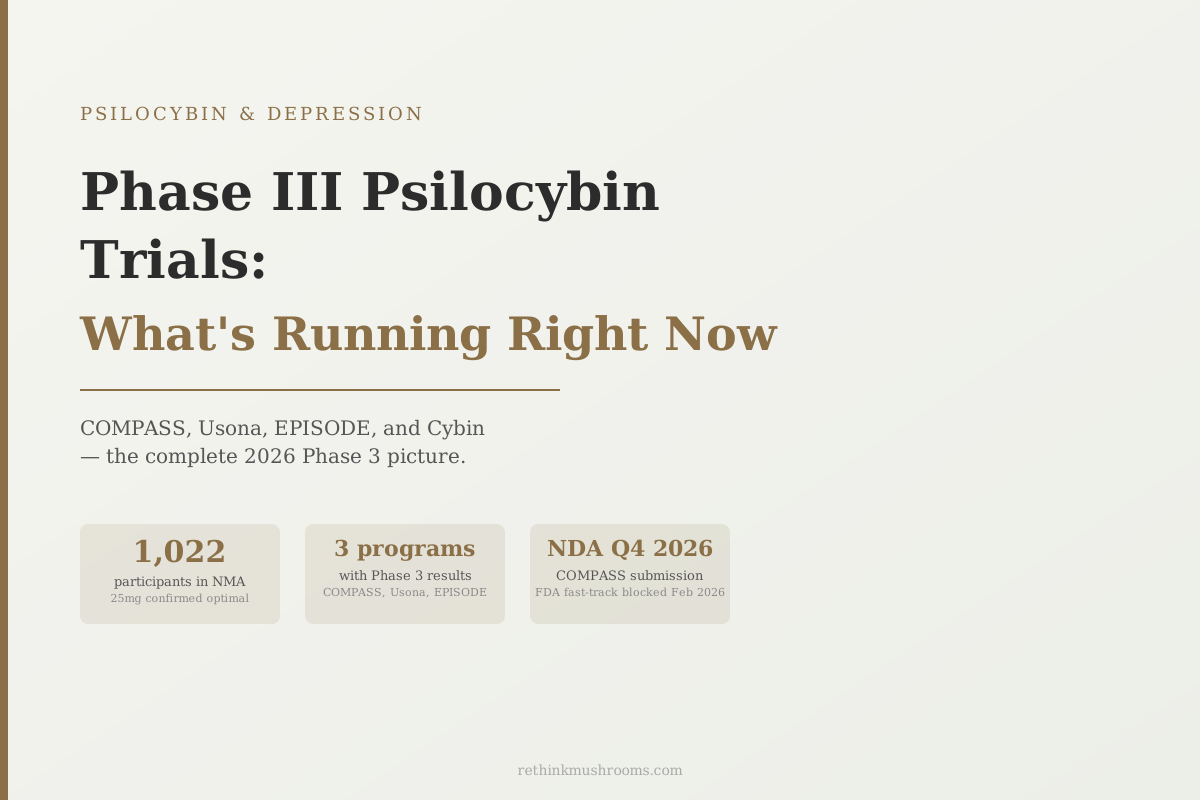
Four psilocybin or psilocybin-analog programs have reached Phase 3 as of July 2026, and the gap between what has been announced and what has been published is the single most important thing to understand about all of them.
Compass Pathways has reported positive results from two Phase 3 trials, COMP005 and COMP006. Neither has been peer-reviewed. Usona Institute's uAspire trial has closed enrollment and is awaiting a readout. Cybin's PARADIGM program, testing a chemically modified psilocybin analog, is enrolling. And the EPISODE trial — the one study in this space that has been peer-reviewed, in JAMA Psychiatry — is routinely misdescribed as a Phase 3 confirmation when it is neither Phase 3 nor a confirmation.
This article covers each program's design and reported results, corrects several claims that circulate widely, and lays out the regulatory situation, which reversed twice in 2026.
For the broader history of psilocybin depression trials, including every major published RCT with endpoint numbers, see Psilocybin for Major Depression: The Clinical Evidence.
Key Takeaways
- Compass Pathways reported positive Phase 3 results from COMP005 (258 dosed, single 25mg dose, MADRS −3.6 vs placebo at week 6, p<0.001, June 2025) and COMP006 (581 dosed, two 25mg doses, MADRS −3.8 vs 1mg at week 6, p<0.001, 39% reaching a ≥25% MADRS reduction, February 2026). Both remain press-release-only; no peer-reviewed publication exists as of July 2026
- EPISODE, the independent German trial, is registered and published as Phase 2b, not Phase 3, and it missed its primary endpoint: response rates were 17.0% for 25mg vs 10.6% for active placebo (adjusted OR 1.73, 95% CI 0.53–6.23, P=.19). The authors describe it as an inconclusive trial (Mertens et al., JAMA Psychiatry, 2026)
- Usona Institute's uAspire (PSIL301, NCT06308653) launched March 2024 and completed enrollment at 238 participants; it is listed as active, not recruiting. It tests 25mg, 5mg and inactive placebo in MDD using a minimal-support model
- Cybin's deuterated analog CYB003 received Breakthrough Therapy Designation in March 2024, and the Phase 3 PARADIGM program was initiated in November 2024 — not, as often reported, in 2025–2026
- The most-cited dose-response network meta-analysis pooled three RCTs and 389 patients — not the 10 trials and 1,022 participants frequently attributed to it — and ranked 25mg highest by SUCRA (92.25%) (Swieczkowski et al., Psychiatry Research, 2025)
- US policy reversed twice in 2026: administration officials vetoed the FDA's fast-track plan on 4 February, then an 18 April executive order and 24 April national priority vouchers put COMP360 on a 1–2 month review clock, with Compass targeting a Q4 2026 NDA completion
Phase 3 Psilocybin Programs
Who is actually in Phase 3 — and what has been reported
Phase designation and enrollment are taken from each trial’s ClinicalTrials.gov record. EPISODE is included because it is frequently described as a Phase 3 trial; it is registered and published as Phase 2b.
| Program | Phase | Participants | Status | Reported result |
|---|---|---|---|---|
| COMP005Compass PathwaysNCT05624268 | Phase 3 | 255 enrolled / 258 dosed | Endpoint metNot peer-reviewed | MADRS −3.6 vs placebo at week 6, p<0.001 |
| COMP006Compass PathwaysNCT05711940 | Phase 3 | 572 enrolled / 581 dosed | Endpoint metNot peer-reviewed | MADRS −3.8 vs 1 mg at week 6, p<0.001; 39% reached ≥25% reduction |
| uAspire (PSIL301)Usona InstituteNCT06308653 | Phase 3 | 238 (enrollment closed) | Awaiting readoutNot peer-reviewed | 25 mg vs 5 mg vs inactive placebo in MDD — no topline yet |
| PARADIGM (CYB003)CybinAPPROACH / EMBRACE / EXTEND | Phase 3 | Enrolling | Awaiting readoutNot peer-reviewed | Deuterated analog, adjunctive MDD — initiated Nov 2024 |
| EPISODEIndependent (Germany)NCT04670081 | Phase 2b | 144 randomized | Endpoint missedPeer-reviewed | Response 17.0% vs 10.6%, OR 1.73 (0.53–6.23), P=.19 — inconclusive |
The only fully peer-reviewed trial in this table is the one that missed its primary endpoint. The two trials with positive results have been announced by press release only.
Compass Pathways COMP360: Two Positive Readouts, Zero Publications
The Compass Phase 3 program rests on a published Phase 2b foundation, and that foundation is worth getting right, because its numbers are frequently garbled.
The COMP360 Phase 2b trial, reported by Goodwin and colleagues (2022) in the New England Journal of Medicine, randomized 233 patients with treatment-resistant depression (TRD) to a single dose of 25mg, 10mg, or 1mg psilocybin alongside psychological support.[1] At week 3, least-squares mean MADRS changes from baseline were −12.0 for 25mg, −7.9 for 10mg, and −5.4 for 1mg. The difference between the 25mg and 1mg groups was −6.6 points (95% CI −10.2 to −2.9; P<0.001), while the 10mg-versus-1mg difference was not significant. Remission at week 3 in the 25mg group was 29.1%. Adverse events occurred in 77% of participants, and suicidal ideation or self-injurious behavior was reported in all three dose groups.
That trial established the 25mg dose, the MADRS primary endpoint, and the low-dose active-control design that Compass carried into Phase 3.
Goodwin et al. (2022) · New England Journal of Medicine
- Population
- 233 adults with treatment-resistant depression
- Intervention
- Single dose of COMP360 psilocybin, 25mg or 10mg, with psychological support
- Comparator
- 1mg psilocybin (active control)
- Finding
- Week-3 MADRS change: −12.0 (25mg), −7.9 (10mg), −5.4 (1mg). 25mg vs 1mg difference −6.6 points (95% CI −10.2 to −2.9), P<0.001. 10mg did not separate from control. Remission 29.1% in the 25mg arm.
positive A genuine dose-response signal in a hard-to-treat population, and still the largest published psilocybin trial. But adverse events were common (77%), and suicidal ideation appeared in every arm including control.
Goodwin et al. (2022), N Engl J Med, PMID 36322843
A 52-week observational follow-up (Goodwin and colleagues, 2025) reported durability data from 66 participants who entered the COMP 004 extension from the Phase 2b trial and a small open-label study.[9] Median time to a prespecified depressive event was 92 days for the 25mg group, 83 days for 10mg, and 62 days for 1mg. This is a real but modest durability signal, and it is worth being precise about what it shows: across the full Phase 2b cohort, the majority of participants in every arm — including 25mg — experienced a depressive event by week 12.
Kirlic and colleagues (2025) published the standardized psychological support model used across COMP360 trials, describing the therapist training, mentoring, and fidelity-assessment programs built to keep delivery consistent.[8] Because the support model is co-administered with the drug, it has to be specified for regulatory purposes — which is part of why this program took years to standardize.
COMP005 (announced June 2025). Compass reported that COMP005, a randomized double-blind placebo-controlled trial that dosed 258 participants with TRD across 32 US sites, met its primary endpoint: a MADRS difference of −3.6 versus placebo at week 6 (p<0.001). Note the timepoint — this trial's primary endpoint is week 6, not the week 3 used in Phase 2b.
COMP006 (announced 17 February 2026). COMP006 dosed 581 participants and compared two fixed 25mg doses, given three weeks apart, against a 1mg active control. The reported MADRS difference at week 6 was −3.8 (95% CI −5.8 to −1.8; p<0.001), with 39% of the 25mg arm achieving a clinically meaningful (≥25%) MADRS reduction. On 7 July 2026, Compass reported that this benefit was maintained through at least week 26, and that nearly 30% of responders went on to achieve remission after retreatment in the trial's second part.
COMP360 MADRS Effect Size, Trial by Trial
The Phase 3 effect landed smaller than Phase 2b
Placebo-adjusted difference in MADRS total score (points). All three primary endpoints were met at P<0.001; a larger negative number means a bigger antidepressant advantage over control.
Goodwin 2022 · NEJM
−6.625 mg vs 1 mg, week 3 · n = 233
Set the 25 mg dose carried into Phase 3
COMP005 · 2025
−3.625 mg vs placebo, week 6 · n = 258
First Phase 3 efficacy readout for any classical psychedelic
COMP006 · Feb 2026
−3.825 mg vs 1 mg, week 6 · n = 581 dosed
39% of the 25 mg arm reached a ≥25% MADRS reduction
Sources: Goodwin et al., NEJM (2022); Compass Pathways COMP005 readout (2025) and COMP006 readout (17 February 2026). Phase 3 figures are from company announcements pending peer-reviewed publication.
Two things deserve emphasis. First, the Phase 3 effect sizes (−3.6 and −3.8 MADRS points) are substantially smaller than the Phase 2b difference (−6.6) — an unsurprising pattern as trials get larger and more rigorously controlled, but one that has drawn commentary about clinical meaningfulness. Second, none of these Phase 3 numbers have been through peer review. Everything above comes from company announcements. Compass expects to complete a rolling NDA submission in Q4 2026.
Usona Institute uAspire: Enrollment Closed, Awaiting Readout
Usona Institute is the nonprofit running the other FDA-facing psilocybin program, and its design differs from Compass's on two dimensions: a broader patient population (MDD generally, rather than TRD specifically) and a lighter support model.
The Phase 2 foundation is Raison and colleagues (2023), published in JAMA, which randomized 104 adults with MDD to a single 25mg dose of psilocybin or a 100mg niacin comparator, each with psychological support.[2] Psilocybin produced a MADRS mean difference of −12.3 points (95% CI −17.5 to −7.2; P<.001) at the day-43 primary endpoint, and −12.0 at day 8. More participants on psilocybin achieved sustained response; the trial did not show a significant difference in sustained remission. Adverse events were more common with psilocybin, though none were serious.
The Phase 3 trial, uAspire (PSIL301, NCT06308653), began in March 2024 and tests 25mg, 5mg, and inactive placebo. It enrolled 238 participants and is listed on ClinicalTrials.gov as active but no longer recruiting — enrollment has closed, and no topline result has been reported. Usona holds Breakthrough Therapy Designation for psilocybin in MDD, granted in 2019, the counterpart to the designation Compass received for TRD in 2018.
The design difference matters for what any approval would look like. If both programs succeed, they would likely support different labels — Compass for TRD with a structured therapy protocol, Usona for broader MDD with minimal support — and therefore very different prescribing contexts and very different costs to deliver.
For a direct program comparison, see COMP360 vs. Usona: Comparing the Two FDA Track Psilocybin Programs.
EPISODE: The Peer-Reviewed Trial That Missed
EPISODE is the study most likely to be described to you incorrectly, so it is worth walking through carefully.
Mertens and colleagues published EPISODE in JAMA Psychiatry in 2026.[12] It is an independent, investigator-led, two-centre German trial in treatment-resistant depression, triple-blinded and active-placebo-controlled, and it is genuinely valuable precisely because it was not run by a company with a product to launch.
It is also, per its own registration (NCT04670081) and its own publication, a Phase 2b trial — not Phase 3.
And it did not meet its primary endpoint. 144 participants were randomized and 142 analyzed across three conditions: psilocybin 25mg (n=47), psilocybin 5mg (n=48), and nicotinamide 100mg as active placebo (n=47), with two doses six weeks apart embedded in psychotherapeutic sessions. Response — defined as a ≥50% reduction on the HAMD-17 at week 6, before the second dose — was 17.0% for 25mg, 12.5% for 5mg, and 10.6% for nicotinamide. The first hierarchical comparison, 25mg versus nicotinamide, produced an adjusted odds ratio of 1.73 (95% CI 0.53–6.23; P=.19), which was not significant, so no further formal testing was performed. The authors' own summary calls it "an inconclusive trial."
Secondary analyses of mean symptom change offered exploratory evidence of a clinically meaningful effect, and the authors are careful to say the results "add to the existing evidence." But exploratory secondary signals after a missed primary endpoint are hypothesis-generating, not confirmatory. Safety signals were also reported: suicidal ideation on dosing days was higher with 25mg (4% vs 1–2%), and two serious adverse reactions followed 25mg dosing, including one case of hallucinogen persisting perception disorder.
Fact Check
Was EPISODE independent confirmation of the Compass results?
The claim
“EPISODE is the only peer-reviewed Phase 3 psilocybin trial, and it independently replicated the COMP360 findings.”
EPISODE is genuinely the only peer-reviewed late-stage trial in this space, and it is genuinely independent — so coverage tends to assume it also confirmed the commercial results.
What research shows
UnsupportedEPISODE is registered and published as Phase 2b, and it missed its primary endpoint. Response was 17.0% on 25mg vs 10.6% on active placebo, adjusted OR 1.73 (95% CI 0.53–6.23), P=.19. The authors describe the trial as inconclusive.
This does not mean psilocybin failed. EPISODE used a harder endpoint (≥50% HAMD-17 response) at a single pre-second-dose timepoint, with an active placebo and a modest sample. It is a real result that should temper confidence, not a refutation.
Mertens et al. (2026), JAMA Psychiatry, PMID 41848690; ClinicalTrials.gov NCT04670081
The honest reading: the only fully peer-reviewed late-stage trial of psilocybin for TRD did not produce a statistically significant primary result, while the two trials reporting clear positive results have not yet been reviewed by anyone outside the sponsor. That is an uncomfortable position for a field on the verge of a regulatory decision, and it is the single most important fact in this article.
Cybin CYB003: A Chemically Modified Analog
Cybin is developing CYB003, a deuterated form of psilocybin. Deuteration replaces specific hydrogen atoms with deuterium, a heavier hydrogen isotope, to alter how quickly the body metabolizes the molecule. The aim is more predictable pharmacokinetics and a potentially shorter or more consistent session.
CYB003 received FDA Breakthrough Therapy Designation in March 2024 for adjunctive use in MDD — meaning alongside, not instead of, existing antidepressants. Phase 2 data reported 75% remission at four months among participants receiving two 16mg doses. The Phase 3 PARADIGM program was initiated in November 2024 and comprises three pivotal studies (APPROACH, EMBRACE and EXTEND); APPROACH was the first to begin, with topline results expected in 2026.
CYB003 is not psilocybin, though it acts on the same 5-HT2A receptor. If approved, it would be a distinct product from Compass's or Usona's psilocybin, with its own dose, label, and session length. The deuterated-analog strategy is also a route around the patent landscape surrounding naturally occurring psilocybin, which is part of why several companies are pursuing it.
The Evidence Base Underneath the Phase 3 Designs
The Phase 3 programs did not arrive from nowhere, but the supporting literature is smaller and more mixed than its summaries suggest.
Swieczkowski and colleagues (2025) published a dose-response network meta-analysis in Psychiatry Research examining psilocybin for MDD.[10] From 5,419 search results, three RCTs involving 389 patients met inclusion criteria. Psilocybin significantly reduced symptoms versus placebo at day 8 (MD −7.42; 95% CI −10.07 to −4.78; p<0.001) and day 15 (MD −9.55; 95% CI −12.44 to −6.65; p<0.001), with no significant effect at day 2. Ranked by SUCRA, 25mg was the most effective dose at 92.25%, ahead of 10mg and 0.215 mg/kg. Nausea was substantially more common with psilocybin (RR 8.35; p<0.001).
This analysis is often described as pooling 10 trials and over 1,000 participants. It does not. Three trials and 389 patients is a thin base for a dose recommendation, and the ranking of 25mg rests on a SUCRA probability, not a head-to-head significance test.
Yao and colleagues (2024) conducted a broader systematic review and meta-analysis of psychedelics across mental disorders, including 126 articles.[6] Among the four compounds examined, psilocybin showed the largest therapeutic effect (Hedges' g = −1.49; 95% CI −1.67 to −1.30), ahead of ayahuasca, MDMA and LSD. Headache was the most common adverse event.
Rosenblat and colleagues (2024) tested repeated fixed 25mg doses of psilocybin-assisted psychotherapy in a deliberately complex population — TRD in major depressive or bipolar II disorder, including participants with baseline suicidality and significant comorbidity.[4] Thirty participants were randomized to immediate treatment or waitlist; the immediate-treatment arm showed a large effect at the week-2 primary endpoint (Hedges' g = 1.07; p<0.01), and repeated doses were associated with further reductions. This is a feasibility trial, not a confirmatory one, but it is the clearest signal that repeat dosing adds benefit.
Two small open-label studies extend the evidence into the most refractory populations. Aaronson and colleagues (2025) treated 12 patients with severe TRD — insufficient benefit from at least five prior treatments — with a single 25mg dose, finding MADRS changes of −15.8 at week 3 and −17.2 at week 12; participants with comorbid PTSD showed significantly less benefit.[5] Ellis and colleagues (2025) ran the first open-label pilot in US military Veterans with severe TRD, where 15 participants received 25mg: 60% met response and 53% met remission criteria at week 3, falling to 47% and 40% at 12 weeks.[7] Both are uncontrolled and unblinded, and open-label psychedelic studies are especially vulnerable to expectancy effects.
- Mechanism & Early-Phase Workcompleted
5-HT2A agonism, plasticity and network effects characterized across a large preclinical and Phase 1 literature
- Phase 2 Randomized Trialscompleted
Goodwin 2022 (n=233, NEJM) and Raison 2023 (n=104, JAMA) both positive on their primary endpoints
- Independent Phase 2b Replicationcurrent
EPISODE (n=144, JAMA Psychiatry 2026) missed its primary endpoint; exploratory secondary signals only
- Phase 3 Results Announcedcurrent
COMP005 and COMP006 both reported positive by press release; uAspire and PARADIGM awaiting readout
- Phase 3 Results Peer-Reviewedmissing
No Phase 3 psilocybin trial has been published in a peer-reviewed journal as of July 2026
- Regulatory Approvalmissing
No marketing approval anywhere. Compass NDA completion targeted for Q4 2026 under a national priority voucher
The field has strong Phase 2 evidence and two announced Phase 3 successes, but the peer-reviewed record stops before Phase 3 — and the one independent late-stage trial that has been published missed its endpoint. The decisive evidence exists; almost none of it has been examined outside the companies that generated it.
Goodwin 2022; Raison 2023; Mertens 2026; Compass Pathways releases 2025–2026
The Regulatory Picture: Two Reversals in One Year
Norring and Spigarelli (2024) documented the defining paradox of this field: at the time of their audit, 134 psilocybin trials were registered on ClinicalTrials.gov across 54 indications, with zero marketing approvals anywhere in the world.[3] They concluded the bottleneck was not evidence quality but structural: Schedule I status, the infrastructure demands of therapy-assisted treatment, and regulatory-pathway uncertainty.
2026 tested that conclusion twice, in opposite directions.
On 4 February 2026, administration officials vetoed the FDA's plan to grant Compass's psilocybin a Commissioner's National Priority Voucher. Of ten drugs the agency put forward for the program, Compass's was the only one struck. Existing Breakthrough Therapy Designations were untouched and no trials stopped, but the signal was unmistakable.
Ten weeks later it inverted. An 18 April 2026 executive order directed the FDA to fast-track psychedelic reviews for mental health indications, naming psilocybin and ibogaine and allocating $50 million toward access. On 24 April 2026, the FDA awarded national priority vouchers to three psychedelic programs: Compass (COMP360 for TRD), Usona (psilocybin for MDD), and Transcend Therapeutics (methylone for PTSD). The voucher compresses review from roughly 10–12 months to one to two months after filing. Compass was simultaneously granted a rolling NDA review.
US Psilocybin Policy, 2026
Ten weeks from veto to priority voucher
The regulatory picture reversed twice in 2026. Coverage written in February describes a very different situation from the one that holds now.
- 4 Feb 2026Slows approval
Fast-track plan vetoed
Administration officials struck Compass’s psilocybin from the FDA’s list of drugs slated for a national priority voucher. Of the ten drugs the agency put forward, it was the only one cut.
- 18 Apr 2026Speeds approval
Executive order reverses course
An executive order directed the FDA to fast-track psychedelic reviews for mental health indications, naming psilocybin and ibogaine and allocating $50 million toward access.
- 24 Apr 2026Speeds approval
Vouchers awarded
The FDA awarded Commissioner’s National Priority Vouchers to Compass (COMP360 for TRD), Usona (psilocybin for MDD) and Transcend (methylone for PTSD). The voucher compresses review from roughly 10–12 months to 1–2. Compass was also granted a rolling NDA review.
- 7 Jul 2026Evidence update
Six-month durability reported
Compass reported that the COMP006 week-6 benefit was maintained through at least week 26, and reiterated that it expects to complete its NDA submission in Q4 2026.
A voucher shortens the review clock. It does not lower the evidence bar — approval still depends on what the FDA makes of data that remains, so far, unpublished.
Australia offers the closest thing to a preview. Dutton and colleagues (2026) examined the clinical landscape following Australia's 2023 rescheduling of psilocybin to Schedule 8 for TRD — the first national framework permitting psychiatrists to prescribe it.[11] Their assessment identifies limited prescriber access, the absence of any product listed on the Australian Register of Therapeutic Goods, no standardized training pathway, and significant cost barriers, alongside ethical questions around informed consent, cultural safety, and therapeutic fidelity. Their recommendations centre on national training accreditation and fidelity monitoring.
The lesson is that approval is the start of the problem, not the end of it. A country that cleared the regulatory hurdle three years ago still lacks the infrastructure to deliver the treatment at scale.
For the full regulatory picture including the historical Breakthrough Therapy Designations and current FDA status, see Psilocybin's Path to FDA Approval for Depression: Where Things Stand.
For the legal context of Schedule I and its interaction with the approval pathway, see Psilocybin and Schedule I: The Legal History and Path to Rescheduling.
How to read this article
ModerateThis is a research summary, not medical advice
Concern
Every trial described here administered psilocybin in a controlled clinical setting, with medical screening, participant tapering off other psychiatric medications, and trained personnel present through sessions lasting six to eight hours. Adverse events were common even under those conditions — 77% in the Phase 2b trial — and suicidal ideation and serious adverse reactions were reported in the trial literature, including in control arms. Psilocybin remains a Schedule I substance in the United States outside of authorized research and state-regulated programs.
What the research says
Nothing here is a recommendation to obtain or use psilocybin. The purpose of this article is to describe what the trials have and have not shown, and to distinguish announced results from peer-reviewed ones.
Particularly relevant for: People with a personal or family history of psychosis or bipolar disorder, people taking serotonergic medications, and anyone with significant cardiovascular disease were excluded from most of these trials for safety reasons.
What to do
If you are living with treatment-resistant depression, discuss options — including participation in a registered clinical trial — with a psychiatrist.
Goodwin et al. (2022); Mertens et al. (2026); Norring & Spigarelli (2024)
The Bottom Line
As of July 2026, Compass Pathways has announced positive results from two Phase 3 trials — COMP005 (258 dosed, MADRS −3.6 vs placebo at week 6) and COMP006 (581 dosed, MADRS −3.8 vs 1mg at week 6, with durability through week 26) — but neither has been peer-reviewed. Usona's uAspire Phase 3 trial has closed enrollment at 238 participants and awaits a readout. Cybin's PARADIGM program for its deuterated analog CYB003, initiated in November 2024, is ongoing. The EPISODE trial, widely described as a peer-reviewed Phase 3 confirmation, is in fact a Phase 2b trial that missed its primary endpoint. US policy reversed twice in 2026: a February veto of the FDA's fast-track plan was followed in April by an executive order and a national priority voucher that compresses COMP360's review to one to two months, with Compass targeting a Q4 2026 NDA completion. The decisive evidence exists — but almost none of it has been examined outside the companies that produced it.
Frequently Asked Questions
Sources & References
- 1RTHM-00761·Goodwin, Guy M et al. (2022). “Single-Dose Psilocybin for a Treatment-Resistant Episode of Major Depression..” The New England journal of medicine.Study breakdown →PubMed →↩
- 2RTHM-00848·Raison, Charles L et al. (2023). “Single-Dose Psilocybin Treatment for Major Depressive Disorder: A Randomized Clinical Trial..” JAMA.Study breakdown →PubMed →↩
- 3RTHM-01959·Norring, Sarah A et al. (2024). “The Promise of Therapeutic Psilocybin: An Evaluation of the 134 Clinical Trials, 54 Potential Indications, and 0 Marketing Approvals on ClinicalTrials.gov..” Drug design.Study breakdown →PubMed →↩
- 4RTHM-01977·Rosenblat, Joshua D et al. (2024). “Psilocybin-assisted psychotherapy for treatment resistant depression: A randomized clinical trial evaluating repeated doses of psilocybin..” Med (New York.Study breakdown →PubMed →↩
- 5RTHM-02043·Aaronson, Scott T et al. (2025). “Single-Dose Psilocybin for Depression With Severe Treatment Resistance: An Open-Label Trial..” The American journal of psychiatry.Study breakdown →PubMed →↩
- 6RTHM-02028·Yao, Yuan et al. (2024). “Efficacy and safety of psychedelics for the treatment of mental disorders: A systematic review and meta-analysis..” Psychiatry research.Study breakdown →PubMed →↩
- 7RTHM-00923·Ellis, Sara et al. (2025). “Single-dose psilocybin for U.S. military Veterans with severe treatment-resistant depression - A first-in-kind open-label pilot study..” Journal of affective disorders.Study breakdown →PubMed →↩
- 8RTHM-00930·Kirlić, Namik et al. (2025). “Compass Psychological Support Model for COMP360 Psilocybin Treatment of Serious Mental Health Conditions..” The American journal of psychiatry.Study breakdown →PubMed →↩
- 9RTHM-00926·Goodwin, Guy M et al. (2025). “Results From a Long-Term Observational Follow-Up Study of a Single Dose of Psilocybin for a Treatment-Resistant Episode of Major Depressive Disorder..” The Journal of clinical psychiatry.Study breakdown →PubMed →↩
- 10RTHM-02191·Swieczkowski, Damian et al. (2025). “Efficacy and safety of psilocybin in the treatment of Major Depressive Disorder (MDD): A dose-response network meta-analysis of randomized placebo-controlled clinical trials..” Psychiatry research.Study breakdown →PubMed →↩
- 11RTHM-00958·Dutton, Megan et al. (2026). “Psilocybin in the real world: Regulatory, ethical, and operational challenges in Australia's clinical landscape..” The Australian and New Zealand journal of psychiatry.Study breakdown →PubMed →↩
- 12RTHM-02237·Mertens, Lea J et al. (2026). “Efficacy and Safety of Psilocybin in Treatment-Resistant Major Depression: The EPISODE Randomized Clinical Trial..” JAMA psychiatry.Study breakdown →PubMed →↩