Clinical Trial Landscape
2 Programs on the FDA track
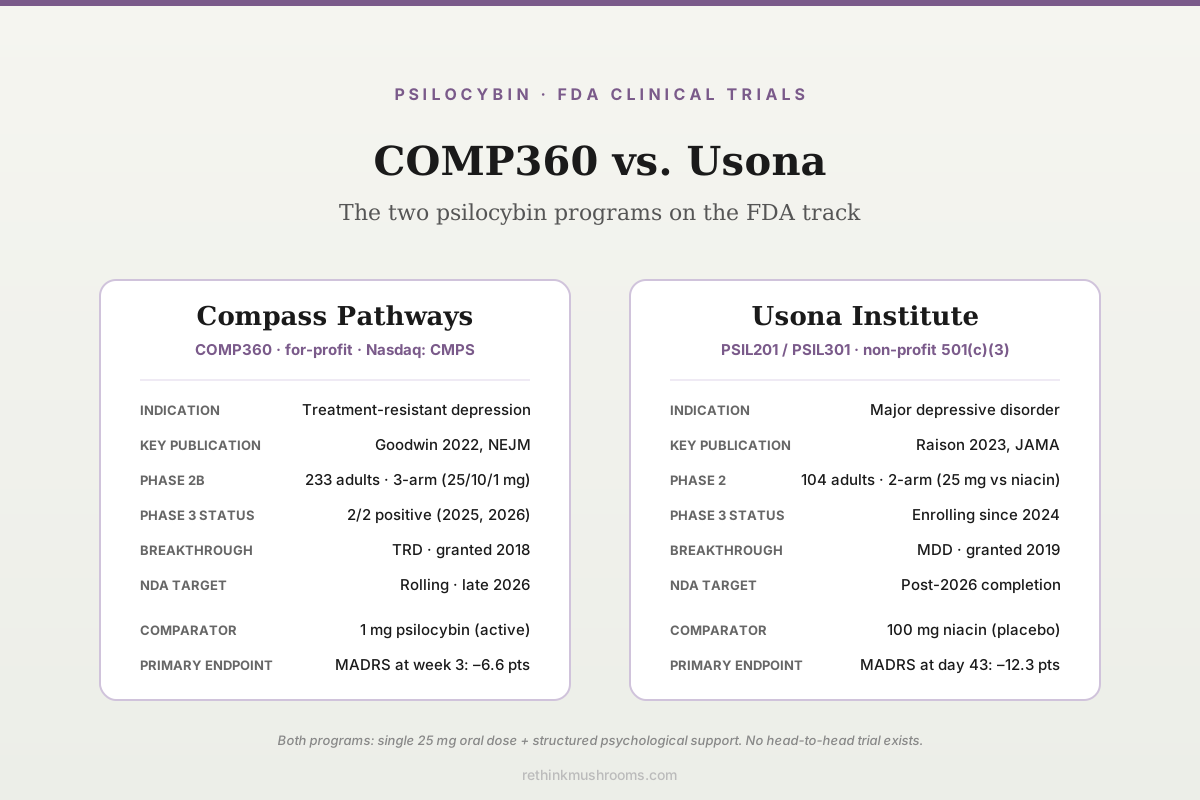
Compass Pathways (COMP360) targets treatment-resistant depression and reached Phase 3 primary-endpoint success in 2025 and 2026. Usona Institute (PSIL201/PSIL301) targets the broader major depressive disorder indication and published its Phase 2 in JAMA in 2023.
Goodwin et al., NEJM, 2022; Raison et al., JAMA, 2023
COMP360 → TRD
for-profit, TRD indication
Usona → MDD
nonprofit, broader MDD indication
Breakthrough ×2
FDA granted designation to both
Goodwin et al., NEJM, 2022; Raison et al., JAMA, 2023
 View as image ↗
Two psilocybin programs are advancing through FDA-registration-quality trials in the United States. Compass Pathways' COMP360 is a synthetic crystalline psilocybin formulation developed by a for-profit biotech, targeting treatment-resistant depression (TRD). Usona Institute's psilocybin program (PSIL201 in Phase 2, PSIL301 in Phase 3) is developed by a non-profit medicinal chemistry institute, targeting the broader major depressive disorder (MDD) indication. Both programs hold FDA Breakthrough Therapy designations, and each has published a peer-reviewed, placebo-controlled, single-dose trial in a top-tier journal.[1][2] This article compares them directly on the dimensions that matter for FDA approval: trial design, dosing, patient population, comparators, effect size, safety, and regulatory status.
For the wider regulatory landscape, see psilocybin's path to FDA approval for depression: where things stand, phase III psilocybin trials: what's running right now, every major psilocybin depression trial: a complete guide, and every active psilocybin clinical trial for depression: a 2026 tracker.
Key Takeaways
- Goodwin et al. (2022) published the COMP360 Phase 2b dose-ranging trial in the New England Journal of Medicine: 233 adults with TRD randomised to 25 mg, 10 mg, or 1 mg psilocybin plus psychological support
- The Goodwin trial found a significantly greater MADRS reduction at three weeks with 25 mg versus 1 mg (mean difference −6.6 points; P<0.001), establishing the 25 mg dose as the Phase 3 candidate
- Raison et al. (2023) published the Usona PSIL201 Phase 2 trial in JAMA: 104 adults with MDD randomised to a single 25 mg dose of psilocybin versus 100 mg niacin as active placebo
- The Raison trial found a −12.3 point greater MADRS reduction versus niacin at day 43, with sustained functional improvement on the Sheehan Disability Scale
- Compass Pathways reported primary-endpoint success in its first Phase 3 trial (COMP005, 2025) and its second Phase 3 trial (COMP006, 2026), supporting a planned 2026 rolling NDA submission
- Usona's Phase 3 trial (PSIL301, NCT06308653) launched in 2024 targeting approximately 240 MDD adults, with estimated completion April 2026
- Both programs hold FDA Breakthrough Therapy Designation: Compass granted in 2018 for TRD, Usona granted in 2019 for MDD
The Two Programs In One Line
COMP360 is a proprietary synthetic crystalline psilocybin formulation, developed by Compass Pathways as a drug product with Phase 2b and Phase 3 trials specifically designed for FDA registration in treatment-resistant depression. The definitional feature of TRD in the Compass program is at least two failed prior adequate antidepressant trials in the current episode.[1]
Usona Institute is a 501(c)(3) non-profit medicinal chemistry institute that manufactures its own Good Manufacturing Practice-grade psilocybin (open-source, non-proprietary in design) and runs its PSIL201 (Phase 2) and PSIL301 (Phase 3) trials targeting the broader MDD indication. MDD does not require prior antidepressant failure, so the Usona target population is substantially larger than the Compass target population.[2]
The result is two parallel regulatory tracks with different commercial, legal and access implications. The scientific overlap (single-dose 25 mg psilocybin with structured psychological support) is deliberate: both groups converged on the same dose from the accumulated Phase 1 and Phase 2 evidence.
Trial Designs Compared
The two published registration-quality trials stand up to side-by-side comparison.
| Dimension | COMP360 (Goodwin 2022) | Usona PSIL201 (Raison 2023) |
|---|---|---|
| Published | NEJM, 2022 | JAMA, 2023 |
| Phase | 2b | 2 |
| Indication | TRD (≥2 failed prior Rx) | MDD (any severity) |
| Sample size | 233 adults | 104 adults |
| Design | 3-arm dose-finding, randomised, double-blind | 2-arm, randomised, double-blind |
| Arms | 25 mg, 10 mg, 1 mg psilocybin | 25 mg psilocybin, 100 mg niacin |
| Comparator | Lowest dose (1 mg) as active control | Niacin 100 mg as active placebo |
| Primary endpoint | Change in MADRS at week 3 | Change in MADRS at week 6 (day 43) |
| Psychological support | Yes, structured protocol | Yes, structured protocol |
| Funding | Compass Pathways | Usona Institute (non-profit) |
The key design divergence is the comparator. Compass used 1 mg psilocybin as the active control, a dose low enough to produce minimal subjective effects but still detectable physiologically, while Usona used 100 mg niacin, which produces flushing sensations intended to mask blinding without any serotonergic activity. Each choice has tradeoffs. The 1 mg psilocybin arm preserves pharmacological class at a sub-therapeutic dose; the niacin arm is pharmacologically inert but may be easier for participants to distinguish from active dose, an unblinding risk noted in the Raison discussion.[2]
FDA-Track Programs
Two Programs, Two Tracks, One Dose
The two psilocybin programs furthest along the FDA registration track, compared on the dimensions that determine approval. Both converged on a single 25 mg dose with structured psychological support — but differ on indication, comparator, and corporate structure.
COMP360
Compass Pathways
Usona PSIL
Usona Institute
Between-group MADRS separation (published primary endpoint)
COMP360 (Goodwin 2022)
−6.6 MADRS pts25 mg vs 1 mg psilocybin · TRD · week 3
Usona PSIL201 (Raison 2023)
−12.3 MADRS pts25 mg vs 100 mg niacin · MDD · day 43
These two separations are shown on the same axis for scale, not as a head-to-head result. Different populations (TRD vs MDD), comparators (1 mg psilocybin vs 100 mg niacin), and timepoints (week 3 vs day 43) mean the larger Usona figure does not establish a more effective drug — only that both cleared their primary endpoints at clinically meaningful magnitudes.
Sources: Goodwin et al. (2022), NEJM [ref 1]; Raison et al. (2023), JAMA [ref 2]. Phase 3 status and regulatory dates from the article body.
What The Trials Actually Found
COMP360 (Goodwin 2022)
At week 3 after a single dose, the Montgomery-Åsberg Depression Rating Scale (MADRS) fell 12 points from baseline in the 25 mg arm versus 5.4 points in the 1 mg arm, a between-group difference of 6.6 points (95% CI, 10.2 to 2.9; P<0.001).[1] The 10 mg arm did not significantly separate from the 1 mg arm at the primary endpoint. The response and remission rates at week 3 were 36.7% and 29.1% with 25 mg, versus 17.7% and 7.6% with 1 mg. Durability to week 12 narrowed considerably, with sustained response in 20% of the 25 mg arm. Adverse events occurred in 77% of the 25 mg arm (vs 66% of the 1 mg arm), with headache, nausea, and transient dysphoria the most common; suicidal ideation and self-injurious behaviour were reported across arms.
Usona PSIL201 (Raison 2023)
At day 43 (six weeks after a single dose), the MADRS fell by approximately 19 points from baseline in the psilocybin arm versus 6.8 points in the niacin arm, a between-group difference of about 12.3 points (95% CI, -17.5 to -7.2; P<0.001).[2] Sustained response at day 43 occurred in 41.8% of the psilocybin arm versus 11.3% of niacin. The Sheehan Disability Scale, a functional measure, improved by 4.07 points with psilocybin versus 1.76 points with niacin. No serious treatment-emergent adverse events were reported in the psilocybin arm.
Apples vs. oranges vs. a few apples
Direct numeric comparison between the two trials is not straightforward, because the populations, comparators, and timepoints differ. TRD patients in Goodwin had more severe, harder-to-treat illness than the MDD population in Raison, and a 1 mg psilocybin control is not the same as a 100 mg niacin control. Both trials produced statistically significant separation on the MADRS primary endpoint at clinically meaningful magnitudes. Both are consistent with the broader psilocybin depression literature, including the Carhart-Harris and colleagues (2021) trial comparing psilocybin with escitalopram in MDD, which found comparable depression reductions in both arms but a larger separation on secondary measures favouring psilocybin.[3]
Indication Strategy: TRD vs. MDD
The Compass choice to pursue TRD first is a regulatory and commercial decision. TRD is a smaller population than broader MDD, but it is a population with documented unmet need, which supports Breakthrough Therapy Designation and a faster path through the FDA. An approved TRD label can later expand to broader MDD through subsequent trials. Compass received Breakthrough Therapy Designation for TRD in October 2018.
The Usona choice to pursue MDD targets the larger addressable population from the outset. MDD does not require prior antidepressant failure, so a positive Phase 3 could support a label that reaches a substantially wider patient group immediately. Usona received Breakthrough Therapy Designation for MDD in November 2019. The Raison 2023 Phase 2 enrolled adults with DSM-5 MDD of at least 60 days duration, without the prior-treatment-failure filter.[2]
Commercial Structure: For-Profit vs. Non-Profit
Compass Pathways is a publicly traded for-profit biotech (Nasdaq: CMPS). COMP360 is a proprietary formulation with associated intellectual property intended to support commercial pricing and market exclusivity under FDA approval. The commercial model mirrors standard CNS drug development.
Usona Institute is a 501(c)(3) non-profit. Its psilocybin is manufactured to GMP standards and produced without a primary commercial patent strategy, with the explicit intent that approval should not concentrate intellectual-property control of psilocybin in a single for-profit entity. If Usona achieves approval, the pricing and access implications are very different from a standard biotech approval, though the extent to which a non-profit approval could practically restrain generic-style pricing by downstream manufacturers has not yet been tested.
For context on the broader therapeutic value of psilocybin in depression and related indications, see the complementary trial literature. Davis and colleagues (2021) ran a randomised trial of psilocybin-assisted therapy for MDD at Johns Hopkins, independent of Compass and Usona, and reported rapid large-magnitude reductions in depression scores.[4] Griffiths and colleagues (2016) and Ross and colleagues (2016) reported the foundational trials in cancer-related depression and anxiety that built the modern clinical psilocybin evidence base.[5][6] Goel and colleagues (2022) reviewed the therapeutic-effects literature across indications.[7]
Phase 3 Status As Of April 2026
COMP360 reached a significant regulatory milestone in 2025 and 2026. The first Phase 3 trial in TRD (COMP005) met its primary endpoint in mid-2025, and the second (COMP006) met its primary endpoint in February 2026. Compass has stated a planned rolling New Drug Application submission with the FDA in late 2026, which, if accepted, could position COMP360 for an FDA approval decision in 2027. That timeline would make COMP360 the first classical psychedelic approved by the FDA for a psychiatric indication.
Usona's PSIL301 Phase 3 trial (ClinicalTrials.gov NCT06308653) launched enrolment in March 2024, targeting approximately 240 MDD adults randomised to 25 mg psilocybin, 5 mg psilocybin or placebo. Estimated completion is April 2026. Topline results had not been reported at the time this article was written. A positive PSIL301 would set up a rolling NDA for MDD on a timeline likely one to two years behind COMP360.
Safety Profiles So Far
Both published trials reported adverse event patterns consistent with the broader psilocybin clinical literature. Acute dose-day effects (headache, nausea, transient anxiety, elevated blood pressure) were common and self-limiting. No drug-related serious adverse events were reported in the Usona Phase 2 psilocybin arm.[2] The Compass Phase 2b reported suicidal ideation and self-injurious behaviour across all dose arms, including the 1 mg control, reflecting the high baseline risk profile of the TRD population rather than a clear dose-related signal.[1] Both programs have identified and published safety signals consistent with psychiatric trial expectations.
Contraindications and risks in vulnerable populations remain important boundaries. Meshkat and colleagues (2025) tested psilocybin-assisted therapy for bipolar II TRD and reported manageable safety, but case reports of mania and psychosis after psilocybin use in bipolar disorder have appeared in the broader literature, reinforcing the exclusion of bipolar I from both Compass and Usona protocols.[8]
Where The Programs Differ Most: Psychological Support Protocols
Both programs deliver psilocybin with structured psychological support, but the support frameworks differ in detail. Compass uses a proprietary therapist-training protocol that emphasises preparation, in-session monitoring, and integration sessions, with therapists trained through Compass-certified programs. Usona uses a set of trained facilitator pairs with a more academic orientation and open-access training materials. Both programs require two-therapist attendance during the dosing session and multiple preparation and integration hours around the single-dose event.
The implication for regulatory approval is that the FDA will be asked to approve not only the drug substance but a drug-plus-setting-plus-facilitator package. How the agency chooses to characterise the non-drug components in labelling and Risk Evaluation and Mitigation Strategies will partly determine which health systems can actually deliver the treatment after approval. Aaronson and colleagues (2024) demonstrated the structured-therapy approach in bipolar II TRD at a research centre outside both Compass and Usona, contributing to the evidence that psilocybin-plus-therapy effects are reproducible across programs.[9]
Limitations Of The Current Evidence
Several limitations apply to both programs.
Blinding is imperfect. Participants receiving 25 mg psilocybin usually know they received an active dose, regardless of whether the control is 1 mg psilocybin or 100 mg niacin. Unblinding introduces expectancy bias into patient-reported outcomes like MADRS. Both Goodwin 2022 and Raison 2023 acknowledged this limitation explicitly.[1][2]
Durability is modest. In Goodwin 2022, sustained response at week 12 was reached by only about 20% of 25 mg patients, suggesting the durable benefit from a single dose is smaller than the acute benefit. Long-term (6-12 month) outcome data remain limited, and the real-world question of whether repeat dosing is needed, and at what interval, has not been answered in Phase 3.
Population generalisability is bounded. Compass trials excluded patients with bipolar disorder, active psychosis or substantial substance use, and Usona did the same. The trial populations are more protected than the real-world patients who will receive psilocybin under an FDA label.
Therapy is a co-intervention. The published effect sizes include the drug and the structured psychological support. Separating the contribution of each is not possible in the existing trial designs and may never be ethically separable.
Finally, the two programs have not been tested head-to-head. There is no direct comparative-effectiveness trial of COMP360 versus PSIL301. Any claim that one program is "more effective" than the other rests on between-study comparison across different populations and comparators, which is not a valid statistical comparison.
What The Evidence Actually Establishes
- Both COMP360 (Goodwin 2022, NEJM) and Usona PSIL201 (Raison 2023, JAMA) produced statistically significant single-dose MADRS reductions versus active controls in randomised, double-blind, placebo-controlled trials
- Compass is targeting TRD; Usona is targeting the broader MDD indication, a larger addressable population but regulated under the same FDA Breakthrough Therapy pathway
- Compass reached two positive Phase 3 primary endpoints in 2025 and 2026 and is on a path toward a 2026 rolling NDA submission
- Usona began its Phase 3 in 2024 with estimated completion in April 2026
- Commercial structure differs: Compass is for-profit, Usona is a non-profit; the pricing and access implications of each approval would differ
- Safety signals in both programs are consistent with broader psilocybin clinical trial literature, with no unexpected class effects to date
The Bottom Line
COMP360 (Compass Pathways) and Usona's PSIL program are the two psilocybin programs furthest along the FDA approval track. Goodwin et al. (2022, NEJM) established COMP360's Phase 2b efficacy in TRD; Raison et al. (2023, JAMA) established Usona's Phase 2 efficacy in MDD. Compass is now Phase 3 positive (2025 and 2026) and targeting a 2026 NDA; Usona is still mid-Phase 3. The programs differ most meaningfully in indication (TRD vs MDD) and corporate structure (for-profit vs non-profit).
Frequently Asked Questions
Sources & References
- 1RTHM-00761·Goodwin, Guy M et al. (2022). “Single-Dose Psilocybin for a Treatment-Resistant Episode of Major Depression..” The New England journal of medicine.Study breakdown →PubMed →↩
- 2RTHM-00848·Raison, Charles L et al. (2023). “Single-Dose Psilocybin Treatment for Major Depressive Disorder: A Randomized Clinical Trial..” JAMA.Study breakdown →PubMed →↩
- 3RTHM-00675·Carhart-Harris, Robin et al. (2021). “Trial of Psilocybin versus Escitalopram for Depression..” The New England journal of medicine.Study breakdown →PubMed →↩
- 4RTHM-00682·Davis, Alan K et al. (2021). “Effects of Psilocybin-Assisted Therapy on Major Depressive Disorder: A Randomized Clinical Trial..” JAMA psychiatry.Study breakdown →PubMed →↩
- 5RTHM-00426·Griffiths, Roland R et al. (2016). “Psilocybin produces substantial and sustained decreases in depression and anxiety in patients with life-threatening cancer: A randomized double-blind trial..” Journal of psychopharmacology (Oxford.Study breakdown →PubMed →↩
- 6RTHM-00445·Ross, Stephen et al. (2016). “Rapid and sustained symptom reduction following psilocybin treatment for anxiety and depression in patients with life-threatening cancer: a randomized controlled trial..” Journal of psychopharmacology (Oxford.Study breakdown →PubMed →↩
- 7RTHM-00760·Goel, Dev B et al. (2022). “Potential Therapeutic Effects of Psilocybin: A Systematic Review..” Cureus.Study breakdown →PubMed →↩
- 8RTHM-00944·Meshkat, Shakila et al. (2025). “Psilocybin-Assisted Psychotherapy for Treatment-Resistant Depression in Bipolar II Disorder..” Psychedelic medicine (New Rochelle.Study breakdown →PubMed →↩
- 9RTHM-00863·Aaronson, Scott T et al. (2024). “Single-Dose Synthetic Psilocybin With Psychotherapy for Treatment-Resistant Bipolar Type II Major Depressive Episodes: A Nonrandomized Open-Label Trial..” JAMA psychiatry.Study breakdown →PubMed →↩