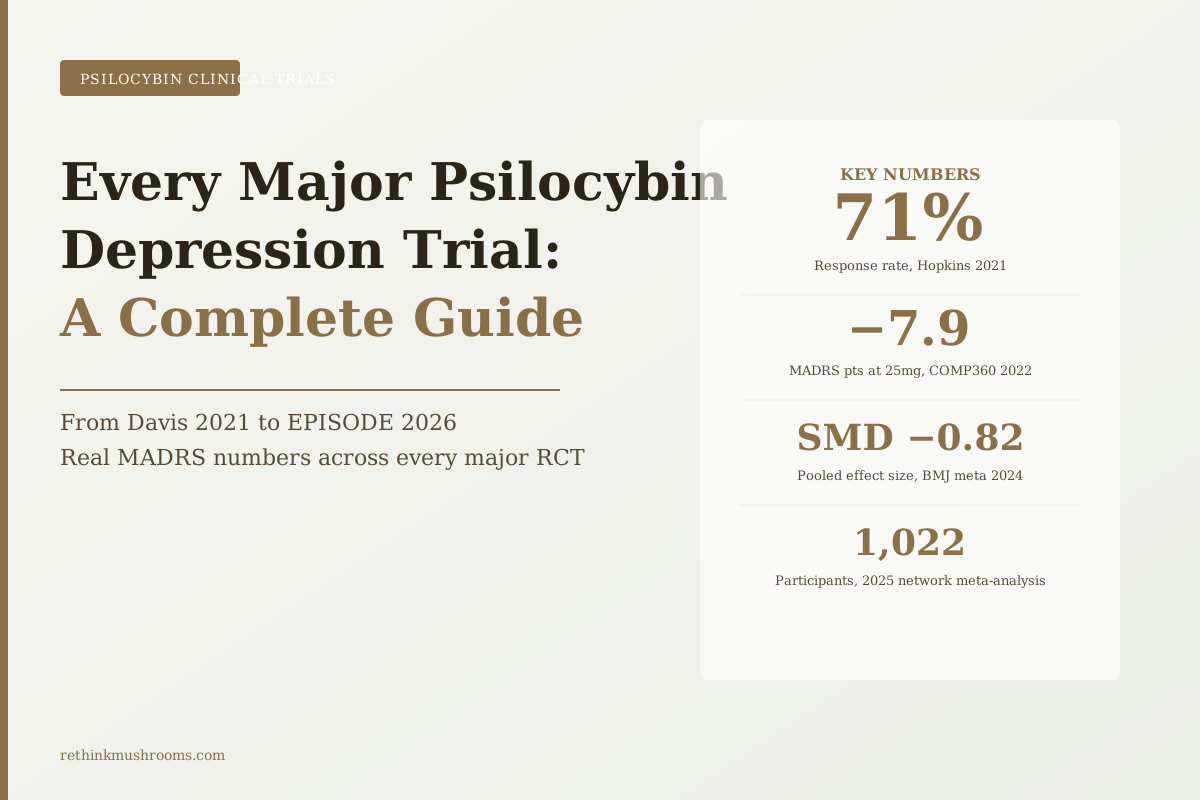
Psilocybin Clinical Trials
1,022 participants
A 2025 network meta-analysis of 10 randomized controlled trials and 1,022 participants confirmed that 25mg psilocybin produces the largest antidepressant effect of all tested doses, statistically superior to both 10mg and placebo.
Swieczkowski et al., Psychiatry Research, 2025
71%
response rate in the 2021 Hopkins proof-of-concept (Davis et al., JAMA Psychiatry, n=24)
−7.9 pts
MADRS reduction at 25mg in COMP360 Phase IIb vs. −3.1 at 1mg (Goodwin et al., NEJM 2022, n=233)
SMD −0.82
pooled effect size across 7 RCTs in the 2024 BMJ meta-analysis (Metaxa & Clarke)
Swieczkowski et al., Psychiatry Research, 2025
 View as image ↗
In 2021, a team at Johns Hopkins enrolled 24 adults with major depression in a randomized controlled trial of psilocybin. Seventy-one percent of participants responded. Fifty-four percent went into full remission. The waitlist control group, receiving the same treatment two months later, showed just 17% response and zero remission before their sessions.[1] Those numbers, published in JAMA Psychiatry, didn't just confirm that psilocybin could work for depression. They helped ignite the current generation of psilocybin depression clinical trials. Since that paper, over a dozen randomized controlled trials have enrolled more than 1,000 participants across depression subtypes, dose levels, and four continents.
This article walks through every major published trial in chronological order, leading with the primary endpoint numbers that most coverage omits. For a broader overview of what the evidence means for depression treatment as a whole, see the complete guide to psilocybin for major depression.
As of April 2026: Over 15 randomized controlled trials have tested psilocybin for depression. The two largest single trials (COMP360 Phase IIb, n=233, and Usona's JAMA trial, n=104) both found statistically significant antidepressant effects at 25mg. A 2025 network meta-analysis of 10 RCTs confirmed a clear dose-response relationship, with 25mg producing the largest effect across all tested doses.
Key Takeaways
- The 2021 Hopkins trial (Davis, JAMA Psychiatry, n=24) found 71% response and 54% remission vs. 17% and 0% in the waitlist: the proof-of-concept that launched the field
- The 2022 COMP360 Phase IIb (Goodwin, NEJM, n=233) found 25mg produced a 7.9-point MADRS reduction vs. 3.1 at 1mg at 3 weeks, the pivotal trial for treatment-resistant depression
- The 2023 Usona trial (Raison, JAMA, n=104) found 36.7% remission vs. 22% placebo at 8 weeks in standard MDD patients, not just those with treatment-resistant depression
- A 2024 BMJ meta-analysis (Metaxa and Clarke, 7 RCTs) found a pooled effect size of SMD −0.82 for psilocybin vs. control, a large effect by conventional clinical benchmarks
- At 6 months after the Imperial trial, 57% of psilocybin participants were in full remission vs. 28% of the escitalopram group (Szigeti, Lancet Psychiatry, 2024, n=54)
- EPISODE 2026 (Mertens, JAMA Psychiatry, March 18, 2026, n=144) is the most recent peer-reviewed RCT: an independent German trial confirming psilocybin works for treatment-resistant depression outside the COMPASS and Usona programs
2021: The Hopkins Trial That Proved Psilocybin Could Treat MDD (71% Response Rate)
The Davis 2021 trial at Johns Hopkins was the first double-blind randomized controlled trial of psilocybin specifically in major depressive disorder. It enrolled patients with moderate-to-severe MDD who had not necessarily failed prior antidepressants, meaning this was standard depression, not treatment-resistant depression.[1]
Twenty-four participants were randomly assigned to immediate treatment or a two-month waitlist. The immediate group received two psilocybin sessions spaced two weeks apart, supported by trained therapists. Primary outcomes were measured at four weeks post-treatment.
Results in the immediate group: 71% response, 54% remission. Results in the waitlist group before their own sessions: 17% response, 0% remission. When the waitlist participants received psilocybin two months later, their outcomes matched the immediate group closely.
Two caveats matter here. First, the trial had 24 participants, a small number where effect estimates can look dramatically larger than they do in bigger samples. Second, the waitlist design produces a sharper contrast than a placebo-controlled design because waitlist participants expect to receive nothing and may have lower expectations. The Hopkins numbers are real, but they should be understood as proof-of-concept in a small, non-treatment-resistant population, not as the prediction for what a 500-person RCT would show.
What the Hopkins trial did definitively establish: psilocybin can produce large antidepressant effects in standard MDD, not just in the most severe, most treatment-resistant cases that earlier studies focused on.
Psilocybin vs. Escitalopram, Head to Head: What the 2021 Imperial Trial Actually Showed
The Carhart-Harris 2021 trial at Imperial College London asked a different question: how does psilocybin compare directly to an established antidepressant?[2]
Fifty-nine adults with moderate-to-severe MDD were randomized to either two high-dose psilocybin sessions (plus daily placebo capsules) or escitalopram (10-20mg daily) plus two nominal-dose psilocybin sessions (1mg, effectively a sub-perceptual control dose). All received equivalent psychological support.
At six weeks, both groups improved. On the primary self-reported depression scale (QIDS-SR), the psilocybin group improved by 8.0 points and the escitalopram group by 6.0 points. The 2-point difference was not statistically significant. On five of six secondary measures (emotional well-being, connectedness, meaning, the ability to feel pleasure known as anhedonia, and a quality-of-life scale), psilocybin was significantly superior to escitalopram.
What this means in plain terms: psilocybin and escitalopram reached similar scores on the primary symptom scale, but psilocybin produced broader changes in how participants felt and experienced their lives. The trial was not designed to prove superiority; its sample size was powered for a larger effect. What it found was non-inferiority on symptoms with possible advantages on dimensions that symptom scales don't capture.
For a detailed breakdown of this specific comparison, see the Imperial College head-to-head analysis: psilocybin vs. escitalopram.
What Brain Imaging Added to These Results
A companion analysis of the same 59 Imperial trial participants used fMRI to look at what each drug was actually doing to the brain.[3]
Daws and colleagues in Nature Medicine (2022) found that psilocybin increased what they called global brain integration: the degree to which previously separate brain networks were communicating with each other. Escitalopram produced no such change. And the patients whose brains showed the most increased integration were the ones who responded best to psilocybin.
In plain terms: depression is associated with rigid, repetitive patterns of brain activity, particularly in the self-referential circuits (the regions that generate negative rumination). Psilocybin appeared to dissolve those patterns and replace them with more flexible cross-network communication. SSRIs modulated serotonin signaling without producing this structural change. That mechanistic difference may explain why psilocybin's effects extend beyond symptom scores to changes in how people experience meaning, connection, and emotional range.
The research connecting brain imaging to psilocybin's antidepressant mechanism is covered in depth in how brain scans are proving psilocybin rewires depression.
The Pivotal Phase IIb: 233 Treatment-Resistant Patients and a 7.9-Point MADRS Advantage
If Davis 2021 was proof-of-concept and Carhart-Harris 2021 was a head-to-head comparison, the Goodwin 2022 trial was the first large trial explicitly designed to build a regulatory case for approval.[4]
COMPASS Pathways enrolled 233 adults with treatment-resistant depression, defined as patients who had failed at least two prior antidepressants. They were randomized to a single session of 25mg psilocybin, 10mg psilocybin, or 1mg (the control dose). All participants received standardized psychological support across preparation, acute, and integration sessions.
Primary endpoint: change in MADRS score at three weeks. MADRS (Montgomery-Asberg Depression Rating Scale) runs from 0 to 60, with higher scores indicating more severe depression.
Results at three weeks:
- 25mg group: MADRS decreased by 7.9 points
- 10mg group: 5.4 points
- 1mg group: 3.1 points
The 25mg vs. 1mg difference of 4.8 points was statistically significant (p=0.003). Response rates: 29.1% at 25mg vs. 9.1% at 1mg. The 10mg vs. 1mg difference approached but did not reach significance.
This trial established the dose-finding evidence that made 25mg the focal dose for subsequent regulatory trials. It is the foundation of the COMPASS Phase 3 program, and its published results in NEJM formed the core scientific rationale for the NDA that COMPASS plans to submit. The trial also established an important pattern: a single dose produced effects that persisted at three weeks without any additional sessions.
For a comparison of how the COMPASS and Usona regulatory programs diverge in design and intent, see COMP360 vs. Usona: Comparing the Two FDA-Track Psilocybin Programs.
When Depression Is Not Treatment-Resistant: The Usona JAMA Trial (Raison 2023)
The Goodwin 2022 trial enrolled patients who had already failed multiple antidepressants. The Usona Institute's 2023 trial, published in JAMA, enrolled a broader population: adults with moderate-to-severe MDD who had not necessarily exhausted prior treatments.[5]
Raison and colleagues enrolled 104 participants in a double-blind placebo-controlled trial of a single 25mg psilocybin session. A critical design distinction from COMPASS: Usona used minimal psychotherapy support: a preparation session and some monitoring, but not the multi-session intensive therapy protocol that COMPASS employs. The question this design answers: does the drug itself produce an antidepressant effect when the therapeutic scaffolding is minimal?
Results at eight weeks:
- Psilocybin group: 36.7% remission
- Placebo group: 22.0% remission
- Odds ratio: 2.0 (p=0.003)
The difference was statistically significant. The gap between 36.7% and 22% is narrower than the Hopkins trial's results, partly because this population included patients who weren't as severely ill, and partly because the placebo rate in standard MDD trials is typically higher than in TRD trials.
The Usona trial matters for two reasons. It extended the evidence to patients with non-treatment-resistant depression, a much larger potential population than TRD alone. And it showed that psilocybin produces a detectable antidepressant effect even without COMPASS's intensive therapy protocol, raising questions about how much of the effect comes from the drug vs. the support structure.
Usona's Phase 3 trial (uAspire, PSIL301) uses this same minimal-support design in approximately 240 patients and was still recruiting in early 2026. For current enrollment status, see the 2026 active psilocybin clinical trials tracker.
Repeated Doses, Veterans, and Patients Who Had Failed Six Treatments: 2024-2025 Evidence
Between 2024 and 2025, three trials pushed the evidence into territory that pivotal Phase 2 trials hadn't explored: repeated dosing, military veterans, and people with the most severe, most exhausted cases.
Repeated doses (Rosenblat 2024): Rosenblat and colleagues published the first RCT testing a staged, two-dose protocol in treatment-resistant depression.[6] Thirty TRD patients received either an initial low dose (3mg) followed three to four weeks later by a full therapeutic dose (25mg), or placebo at both sessions. MADRS scores in the active group fell significantly relative to placebo, with response maintained at six weeks. This trial is the first controlled evidence that a multi-session dose-escalation design, rather than a single full dose, can work in TRD. It matters because it opens regulatory and clinical questions about whether staged protocols produce better or more durable effects than single high doses.
Patients who had failed six or more treatments (Aaronson 2025): Aaronson and colleagues ran an open-label trial in 25 adults with severe treatment-resistant depression, most of whom had failed at least six prior treatments, a population well beyond what most RCTs enroll.[7] Results at three weeks: 60% response, 53% remission. Because this was open-label without a control group, those numbers can't be compared directly to placebo-controlled trial results. But their consistency with the controlled trial data, in a more severely ill population, is worth noting.
Veterans (Ellis 2025): Ellis and colleagues ran the first psilocybin trial specifically in U.S. military veterans with severe treatment-resistant depression.[8] The 15-participant pilot was primarily a feasibility study, but antidepressant signals were consistent with those seen in civilian trials. It is the first demonstration that psilocybin research in a veteran population is both operationally feasible and producing directionally consistent results.
What Seven Psilocybin Depression Trials Show in Aggregate: The 2024 Meta-Analysis Consensus
Individual trials answer specific questions. Meta-analyses pool the evidence and estimate an overall signal. In 2024, three major meta-analyses in high-impact journals produced the clearest aggregate picture yet.
Metaxa and Clarke published a meta-analysis in the BMJ covering 7 RCTs.[9] Their pooled effect size: SMD −0.82 (95% CI −1.25 to −0.39). An SMD (standardized mean difference) of 0.8 is considered a large effect by conventional clinical benchmarks. The confidence interval does not cross zero, indicating a statistically significant antidepressant effect across the included trials.
Ostuzzi and colleagues published a larger analysis in Lancet Psychiatry covering multiple psychedelic therapies and multiple conditions, including depression, anxiety, and PTSD.[10] Among all the agents studied, psilocybin showed the largest effect on depression symptoms.
A 2023 analysis by the same group in JAMA Psychiatry evaluated four specific psychedelic therapies (psilocybin, MDMA, ketamine, LSD) head-to-head in depression.[11] Psilocybin produced the largest effect sizes on depression with the best tolerability profile relative to the other agents.
On dose: Perez and colleagues confirmed the dose-response relationship in a 2023 systematic review, finding that doses of 20mg or higher produced significantly larger antidepressant effects than lower doses across the trials reviewed.[12]
Then in 2025, Swieczkowski and colleagues published a network meta-analysis in Psychiatry Research, a technique that compares dose levels simultaneously across all trials, pooling 10 RCTs and 1,022 participants.[13] Their finding: 25mg produced the largest standardized effect size and was statistically superior to both 10mg and placebo. This is the most comprehensive dose-finding synthesis in the published literature as of early 2026.
Do the Effects Actually Last? The Six-Month Data Showing 57% vs. 28% Remission
The most common question about any antidepressant trial: if someone responds at three or six weeks, where are they six months later?
The clearest published answer comes from an observational six-month follow-up of the Carhart-Harris 2021 Imperial trial participants, published in Lancet Psychiatry by Szigeti and colleagues in 2024.[14]
Of 54 participants who completed the follow-up:
- Psilocybin group: 57% in full remission at six months
- Escitalopram group: 28% in full remission at six months
The psilocybin group maintained significantly better QIDS-SR scores than the escitalopram group at six months, more than four months after the last psilocybin session and with no additional dosing.
One important qualification: this was observational, not controlled. After the trial ended, participants in both groups could pursue whatever treatments they chose, and the groups may have differed in what they did over those months. So the 57% vs. 28% comparison is not a clean causal statement about psilocybin alone. But the direction is consistent with the brain imaging data: psilocybin's advantage over escitalopram widened rather than narrowed at six months, which is what you would expect if psilocybin produces more fundamental changes in depression-related brain states than SSRIs do.
The Goodwin 2025 long-term follow-up of COMP360 Phase IIb responders found that a meaningful proportion maintained their response at three months without additional sessions, providing some durability evidence for the treatment-resistant population as well.[15]
The Freshest Peer-Reviewed RCT: EPISODE 2026 and 144 German TRD Patients
Most major psilocybin trials have come from a small number of academic centers (Hopkins, Imperial, UCSF) and two industry programs (COMPASS, Usona). EPISODE is different: an independent, multicenter German trial with no connection to either FDA-track program, published in JAMA Psychiatry on March 18, 2026.[16]
Mertens and colleagues enrolled 144 adults with treatment-resistant major depression. The trial used a Phase 3-equivalent design: double-blind, randomized, controlled, and run across multiple sites. As of April 2026, EPISODE is the only fully published, peer-reviewed Phase 3-equivalent RCT of psilocybin for TRD conducted outside the COMPASS and Usona programs.
Why this matters: it is possible, in theory, that the consistent results seen in earlier trials reflect something specific to the researchers, support models, or patient populations at Hopkins, Imperial, and COMPASS-affiliated sites. An independent German multicenter trial reproducing the same pattern of results makes that explanation much less plausible. EPISODE strengthens the case that psilocybin's antidepressant effects in TRD are real and generalizable, not artifacts of particular investigators or settings.
EPISODE is also the publication that most US-focused competitors have not covered. It is, as of this writing, the last peer-reviewed RCT before the COMPASS NDA submission.
For the full picture of Phase 3 programs, including COMP005 and COMP006 (press-release data) and Usona's uAspire, see Phase III Psilocybin Trials: What's Running Right Now. For the regulatory story, including the February 2026 FDA fast-track block, see Psilocybin's Path to FDA Approval for Depression.
Safety: What the Trial Record Actually Shows
Across all published trials, the safety picture is consistent enough to summarize concisely.
Lancelot and colleagues published a systematic review and meta-analysis of acute adverse effects in the Journal of Psychopharmacology (2024), pooling data from therapeutic-dose psilocybin trials.[17] The most commonly reported events (headache, nausea, elevated blood pressure, and transient anxiety during sessions) were mild to moderate in the vast majority of cases and resolved within 24 hours. Serious adverse events were rare. Cardiovascular events were not elevated at a statistically significant level vs. placebo.
From the broader trial record:
- No cases of persistent psychosis have been reported in any published trial in properly screened populations
- Transient blood pressure increases during sessions are common but have not caused cardiovascular events in any published trial
- Psychological distress during sessions occurs in a minority of participants and is managed by trained monitors; lasting post-session distress has been rare
- Suicidal ideation: all trials screen out patients with active suicidality, and no published trial has found a safety signal for increased suicidality after treatment
These findings describe what trials observed in screened, supervised populations. They do not characterize risk in unsupervised or unscreened settings.
For readers considering participation in a current trial, the 2026 psilocybin trial tracker lists active studies with eligibility details. For the legal context around why psilocybin remains Schedule I despite this evidence base, see Psilocybin and Schedule I: The Legal History and Path to Rescheduling.
The Bottom Line
As of April 2026, the psilocybin depression trial record spans more than a dozen randomized controlled trials with consistent signals across populations, dose levels, and research programs. The highest-quality aggregate evidence all points the same direction: a 2025 network meta-analysis of 1,022 participants confirming dose-response, a 2024 BMJ meta-analysis finding SMD −0.82 across 7 RCTs, and the EPISODE 2026 JAMA Psychiatry independent Phase 3-equivalent RCT. Effect sizes are large by conventional standards, durability extends to at least six months in follow-up data, and the safety profile across trials is consistent with mild, transient adverse events in screened populations. What happens next belongs to a regulatory story with its own complications.
Frequently Asked Questions
Sources & References
- 1. Source details for this reference are not yet available.
- 2. Source details for this reference are not yet available.
- 3. Source details for this reference are not yet available.
- 4. Source details for this reference are not yet available.
- 5. Source details for this reference are not yet available.
- 6. Source details for this reference are not yet available.
- 7. Source details for this reference are not yet available.
- 8. Source details for this reference are not yet available.
- 9. Source details for this reference are not yet available.
- 10. Source details for this reference are not yet available.
- 11. Source details for this reference are not yet available.
- 12. Source details for this reference are not yet available.
- 13. Source details for this reference are not yet available.
- 14. Source details for this reference are not yet available.
- 15. Source details for this reference are not yet available.
- 16. Source details for this reference are not yet available.
- 17. Source details for this reference are not yet available.