Psilocybin Entropic Brain Theory & REBUS Model
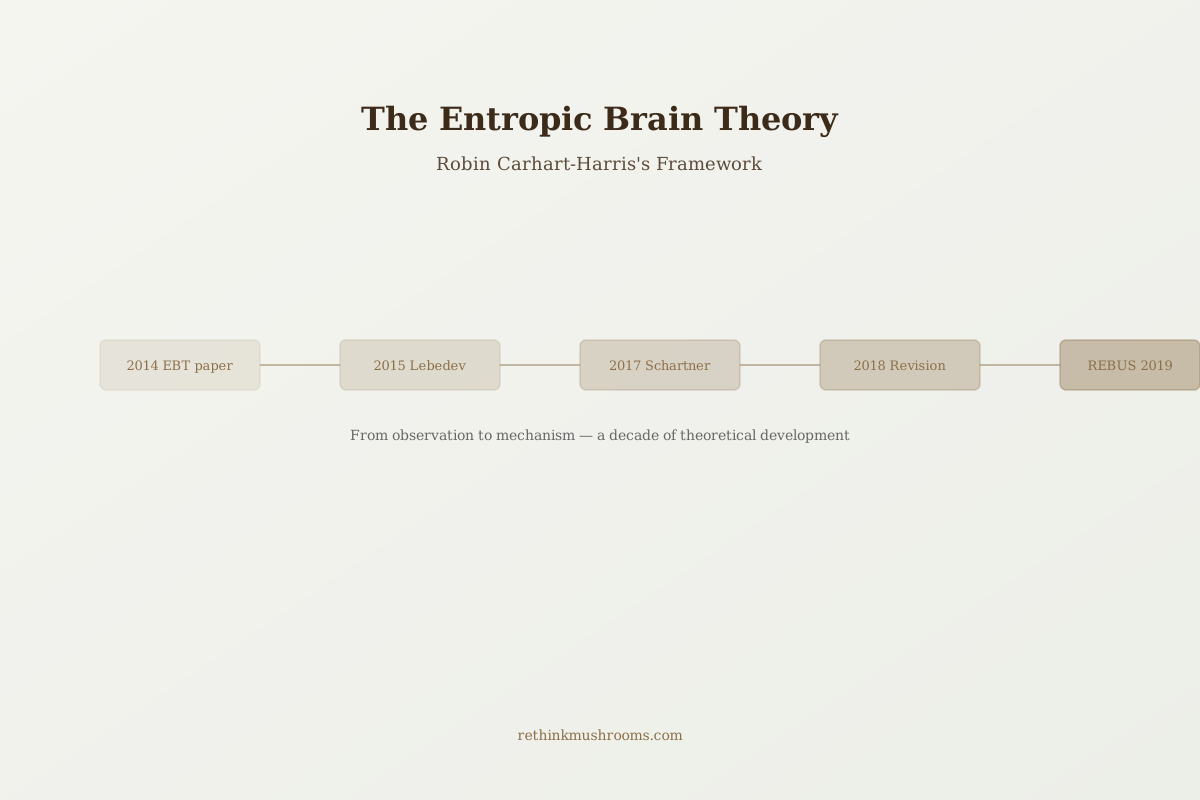
2014, when a theory changed neuroscience
Robin Carhart-Harris published the entropic brain theory in 2014, proposing that brain entropy indexes the richness of conscious experience and that psychiatry's most rigid disorders reflect its absence.
Carhart-Harris et al., Frontiers in Human Neuroscience, 2014
2017
first direct MEG entropy measurement confirmed the core prediction
Ego dissolution
correlated with entropy increase and DMN quieting (Lebedev 2015)
2018 revision
bridged entropy data to the REBUS predictive coding model
Carhart-Harris et al., Frontiers in Human Neuroscience, 2014
 View as image ↗
Every scientific theory starts with a pattern that someone notices before they can explain it. For Robin Carhart-Harris, the pattern was in fMRI scans: when participants received psilocybin, the brain's default mode network went quiet, signal variance increased in unexpected ways, and patterns of neural activity became less predictable. Most researchers would have noted these changes and moved on to measuring something else. Carhart-Harris developed a theory about what they meant.
The entropic brain theory, published in Frontiers in Human Neuroscience in 2014, proposed that brain entropy (the unpredictability and variety of neural activity patterns) is not an arbitrary measure but indexes something fundamental about conscious experience. High entropy corresponds to richer, more varied conscious states. Low entropy corresponds to rigid, constrained states. And some of the most prevalent psychiatric disorders, the theory proposed, are disorders of abnormally low entropy: brains that have lost access to the range of states that flexible, adaptive mental life requires. This article traces the intellectual development of that idea, from the neuroimaging observations that prompted it through the empirical tests that have since evaluated it.
Key Takeaways
- The entropic brain theory (EBT) proposes that brain entropy (the unpredictability of neural activity) indexes conscious richness; depression, OCD, and addiction are sub-critical (low-entropy) states; psychosis is super-critical (excessive entropy) (Carhart-Harris et al., Frontiers in Human Neuroscience, 2014)
- Ego dissolution scores under psilocybin correlated directly with brain entropy (BOLD signal diversity) and with deactivation of the posterior cingulate cortex and medial prefrontal cortex, the primary generators of the self-referential narrative (Lebedev et al., Human Brain Mapping, 2015)
- Schartner et al. (Scientific Reports, 2017) provided the first direct MEG measurement of neural entropy under psychedelics: psilocybin, ketamine, and LSD all significantly increased spontaneous signal diversity, dose-dependently and correlated with subjective experience ratings
- The 2018 revision of EBT provided more specific entropy measures, proposed new clinical studies, and explicitly connected the framework to predictive coding theory, bridging EBT toward the 2019 REBUS model (Carhart-Harris, Neuropharmacology, 2018)
- EBT is a theory about the relationship between information-theoretic properties of brain signals and the subjective and clinical features of consciousness. It is not a claim that chaos is desirable, but that a specific entropy range is associated with optimal mental flexibility
- Rankaduwa and Owen (2023) documented ongoing peer debates about whether entropy is the right measure of conscious richness and whether psychedelic states constitute genuinely different or genuinely "higher" forms of consciousness
What Entropy Means When Applied to the Brain
Before the theory, the definition. "Entropy" in the context of the entropic brain theory does not mean disorder in a vague sense. It has a specific information-theoretic meaning: the degree to which the next state of a system is unpredictable given the current state.
Applied to brain signals, entropy measures how varied the brain's activity patterns are across time. A brain with high entropy visits many different combinations of active regions and connection patterns. A brain with low entropy cycles through a narrow, repeating repertoire. The technical measurement can be done several ways (signal diversity in fMRI or MEG data, Lempel-Ziv complexity of EEG recordings, or measures of functional connectivity variability), and all operationalize the same underlying question: how much variety does this brain's activity show?
The claim that entropy indexes conscious richness was the theoretical leap Carhart-Harris made in 2014. The observation was that psilocybin neuroimaging data showed unusual patterns of signal variance in high-level brain networks: more variety, less predictability. The inference was that this wasn't noise but a window into something about the nature of altered states that standard neuroscience had not fully formalized.
Carhart-Harris's Starting Point: What Early psilocybin fMRI Studies Revealed
The path to the 2014 paper began with the first neuroimaging work on psilocybin conducted at Imperial College London. When psilocybin was administered to healthy participants in fMRI scanners, researchers expected the drug to increase brain activity, since it produces vivid and expansive subjective effects and the common assumption was that more activity would be visible. Instead, they found the opposite: key brain hubs decreased in activity. The default mode network (DMN), particularly the medial prefrontal cortex and posterior cingulate cortex, became quieter.
This was counterintuitive enough to prompt serious theoretical attention. The DMN is associated with self-referential thought, mind-wandering, and the maintenance of a stable narrative sense of self. Its suppression under psilocybin correlated with the intensity of ego dissolution, the experience of boundaries between self and world dissolving. Something about disrupting the brain's primary self-referential system produced the most significant features of the psychedelic experience.
The signal variance data added another dimension: although the DMN quieted, spontaneous signal diversity increased in other networks. The brain as a whole was not quieter under psilocybin. It was differently organized: its activity patterns became less predictable, more varied. These observations needed a theoretical frame, and entropy provided one. For the DMN story in depth, see Psilocybin and the Default Mode Network: How It Quiets the Ego.
The 2014 Theory: Primary States, Secondary States, and Criticality
The 2014 EBT paper proposed a taxonomy of conscious states organized around entropy.[1]
At one end of the spectrum: primary states. These are states of relatively unfiltered, high-entropy consciousness: dreaming, psychedelic experiences, early infancy. In primary states, experience is less organized by the top-down, prediction-driven filtering that characterizes adult waking life. More of the brain's raw signal reaches conscious experience directly, producing the vividness, strangeness, and emotional intensity of these states.
At the other end: secondary states. Normal adult waking consciousness is a secondary state: organized, reality-tested, shaped by a strong predictive model of the world that has been built from years of experience. Secondary states are more ordered, more efficient, and lower in entropy. The self-as-narrator is primary here, editing experience before it reaches the threshold of attention.
At the extreme of each end, the theory placed pathological states. Psychosis occupies the super-critical extreme: too much entropy, too much unfiltered bottom-up signal, producing the fragmented, delusion-prone experience of acute psychotic states. Depression, OCD, and addiction occupy the sub-critical extreme: too little entropy, a brain locked into rigid patterns, unable to access the range of states that adaptive living requires.
The theory's key clinical prediction: sub-critical conditions should benefit from temporary entropy increase, because the therapeutic window requires the brain to escape its own low-variety loops. Psychedelics, the theory proposed, achieve this by temporarily pushing the brain toward and past the critical point. The therapeutic question was whether returning from that high-entropy state would leave the brain in a more flexible configuration than it occupied before.
The First Direct Measurement: Schartner's MEG Study
The 2014 theory was built on fMRI data from which entropy was inferred indirectly. Three years later, Schartner et al. measured brain entropy directly.[3]
Using magnetoencephalography (MEG), which captures the magnetic fields generated by neural currents at millisecond resolution, Schartner's team measured "signal diversity" (a direct quantification of the variety of brain signal patterns across time) in participants who received psilocybin, ketamine, LSD, or a control condition.
All three drugs increased signal diversity significantly compared to control. The increases were dose-dependent: stronger pharmacological effects corresponded to greater signal diversity. Subjective experience ratings correlated with the signal diversity measurements, establishing a link between the brain-level measure and the internal state the participant reported.
The cross-drug finding was theoretically significant. Psilocybin acts primarily through serotonin 2A receptors. Ketamine acts through NMDA glutamate receptors. LSD acts through both. Three compounds with distinct receptor pharmacology produced the same directional change in brain entropy. This suggests that entropy increase is a property of the altered conscious state they produce, not an artifact of any particular drug's chemistry.
This was the first direct empirical confirmation of EBT's central prediction: psychedelic states are genuinely high-entropy brain states, and that entropy is measurable with standard brain scanning technology. For the full detail on how entropy is measured and what it predicts clinically, see How Psilocybin Increases Brain Entropy (And Why That's Good).
When Ego Dissolves, Entropy Rises: The Lebedev 2015 Findings
Lebedev et al. (2015) made the EBT framework personal.[2]
Rather than simply measuring brain entropy under psilocybin and reporting the increase, Lebedev's team correlated entropy measures with ego dissolution scores: standardized ratings of the degree to which participants felt the boundary between self and world dissolving during the psilocybin experience.
The results showed that ego dissolution scores correlated with higher brain entropy, measured as BOLD signal diversity in fMRI data. They also correlated with deactivation of the posterior cingulate cortex (PCC) and medial prefrontal cortex (mPFC), the two regions most consistently associated with self-referential thought and the sense of being a bounded, continuous self.
This triad (entropy increase, DMN quieting, ego dissolution) provides a mechanistic sketch of what the psychedelic experience is at the neural level. When the brain enters a higher-entropy state, the self-generating machinery of the DMN becomes less dominant. What participants experience as ego dissolution is the subjective correlate of this shift in brain organization. The experience is not simply a drug effect with no structure; it is a coherent alteration in the relationship between brain entropy and self-referential processing.
The clinical implication is that ego dissolution, which multiple studies have associated with therapeutic outcomes, may work through the same entropy-increasing mechanism that the EBT describes. Making the self less certain, even temporarily, appears to be part of what allows the belief revision and associative flexibility that psilocybin therapy is trying to achieve.
The 2018 Revision: Refining the Framework Toward Mechanism
The 2018 Neuropharmacology paper was not a major overhaul of EBT but a refinement that pointed toward its next development.[4]
Carhart-Harris provided more specific entropy measures appropriate for different types of clinical studies, proposed experimental designs that could test EBT predictions more rigorously, and began explicitly connecting the framework to the predictive coding literature. The latter connection was the most important development: by formalizing that entropy could be interpreted in terms of the precision weighting of top-down predictions, the 2018 paper created the conceptual bridge to what would become the REBUS model one year later.
EBT as stated in 2014 described what happened (entropy increases under psychedelics) and offered an account of why this was therapeutically relevant (sub-critical conditions need entropy increase). What it did not fully specify was the mechanism: how exactly does entropy increase produce the therapeutic effects? The 2018 revision pointed toward predictive coding as the answer. REBUS completed that answer in 2019 by specifying the receptor-level mechanism (5-HT2A precision-weighting reduction) and the cognitive-level consequence (relaxed beliefs, anarchic brain).
For the full account of REBUS, see REBUS Model: How Psilocybin Relaxes the Brain's Beliefs.
What the Theory Predicts, and Where the Evidence Stands
EBT generates specific, testable predictions. Reviewing them against the current evidence is useful.
Prediction 1: Psychiatric conditions associated with rigid, repetitive behavior (depression, OCD, addiction) will show lower brain entropy than healthy controls. Evidence: Largely consistent: resting-state fMRI studies of depression consistently show reduced functional connectivity variability in the DMN and other networks, consistent with sub-criticality. The direct entropy measurement in psychiatric populations is less thorough than the psychedelic measurement, but the neuroimaging patterns are consistent.
Prediction 2: Psychedelics will increase brain entropy in a dose-dependent fashion. Evidence: Confirmed directly by Schartner et al. (2017) using MEG signal diversity.
Prediction 3: Entropy increase will correlate with therapeutic outcomes. Evidence: Supported by Siegel et al. (2024), where entropy at 1-2 hours predicted one-month well-being, and by Zeifman et al. (2025), where session entropy correlated with belief revision at four weeks. The correlation is consistent but not yet causally established.
Prediction 4: Psychosis will show excessive entropy / super-critical brain states. Evidence: Less thoroughly tested. Some neuroimaging studies of acute psychosis show increased signal variability, consistent with EBT. But psychosis is heterogeneous and the data are less clean than the depression evidence.
The theory has made predictions and several of them have been confirmed. This is not trivially true of all theoretical frameworks in psychiatry.
The Academic Debates: Where EBT Is Challenged
Rankaduwa and Owen (2023) documented ongoing debates within academic neuroscience about the entropic brain framework.[5]
One debate concerns the value claim embedded in the primary/secondary consciousness distinction. EBT implies that psychedelic states represent "higher" or richer consciousness, with more entropy indexing more experience. Critics argue that this value loading is not warranted by the data: psychedelic states may be qualitatively different rather than quantitatively richer, and that calling them "higher" smuggles in a philosophical commitment that the empirical measures cannot establish.
A second debate concerns the entropy measure itself. Different methods of quantifying entropy (signal diversity, Lempel-Ziv complexity, permutation entropy) produce related but not identical results. The question of which measure best captures what is therapeutically significant remains open.
A third debate concerns the taxonomy of altered states. EBT treats the continuum from sub-critical to super-critical as a single axis. Critics argue that psychedelic states, dream states, meditative states, and psychotic states are not well captured by a single entropy dimension; a richer taxonomy is needed that accounts for the specific quality of the alteration, not just its degree of disorder.
These are not objections from outside science. They are the normal process of a theoretical framework being tested, refined, and challenged by peers who take it seriously enough to engage with it rigorously. For how this theoretical work has been applied clinically, see Entropy and Mental Health: Why a More Flexible Brain Is Healthier and The Entropic Brain: How Psilocybin Increases Neural Disorder to Heal.
The Bottom Line
The entropic brain theory (Carhart-Harris et al., 2014) proposed that brain entropy (the unpredictability of neural activity) indexes conscious richness, and that sub-critical (low-entropy) states underlie depression, OCD, and addiction. The theory developed from fMRI observations of unusual signal variance under psilocybin. Direct empirical support arrived in 2017 (Schartner: MEG signal diversity increased under psilocybin, ketamine, and LSD) and 2015 (Lebedev: ego dissolution correlated with entropy and DMN deactivation). The 2018 revision bridged EBT to predictive coding, setting up the 2019 REBUS model. Ongoing debates, documented by Rankaduwa and Owen (2023), address whether entropy is the right measure of conscious richness and whether the primary/secondary consciousness distinction is value-neutral.
Frequently Asked Questions
Sources & References
- 1RTHM-00579·Carhart-Harris, Robin L et al. (2014). “The entropic brain: a theory of conscious states informed by neuroimaging research with psychedelic drugs..” Frontiers in human neuroscience.Study breakdown →PubMed →↩
- 2RTHM-00706·Lebedev, Alexander V et al. (2015). “Finding the self by losing the self: Neural correlates of ego-dissolution under psilocybin..” Human brain mapping.Study breakdown →PubMed →↩
- 3RTHM-00489·Schartner, Michael M et al. (2017). “Increased spontaneous MEG signal diversity for psychoactive doses of ketamine, LSD and psilocybin..” Scientific reports.Study breakdown →PubMed →↩
- 4RTHM-00943·Carhart-Harris, Robin L (2018). “The entropic brain - revisited..” Neuropharmacology.Study breakdown →PubMed →↩
- 5RTHM-01773·Rankaduwa, Sidath et al. (2023). “Psychedelics, entropic brain theory, and the taxonomy of conscious states: a summary of debates and perspectives..” Neuroscience of consciousness.Study breakdown →PubMed →↩