Psilocybin & the Default Mode Network
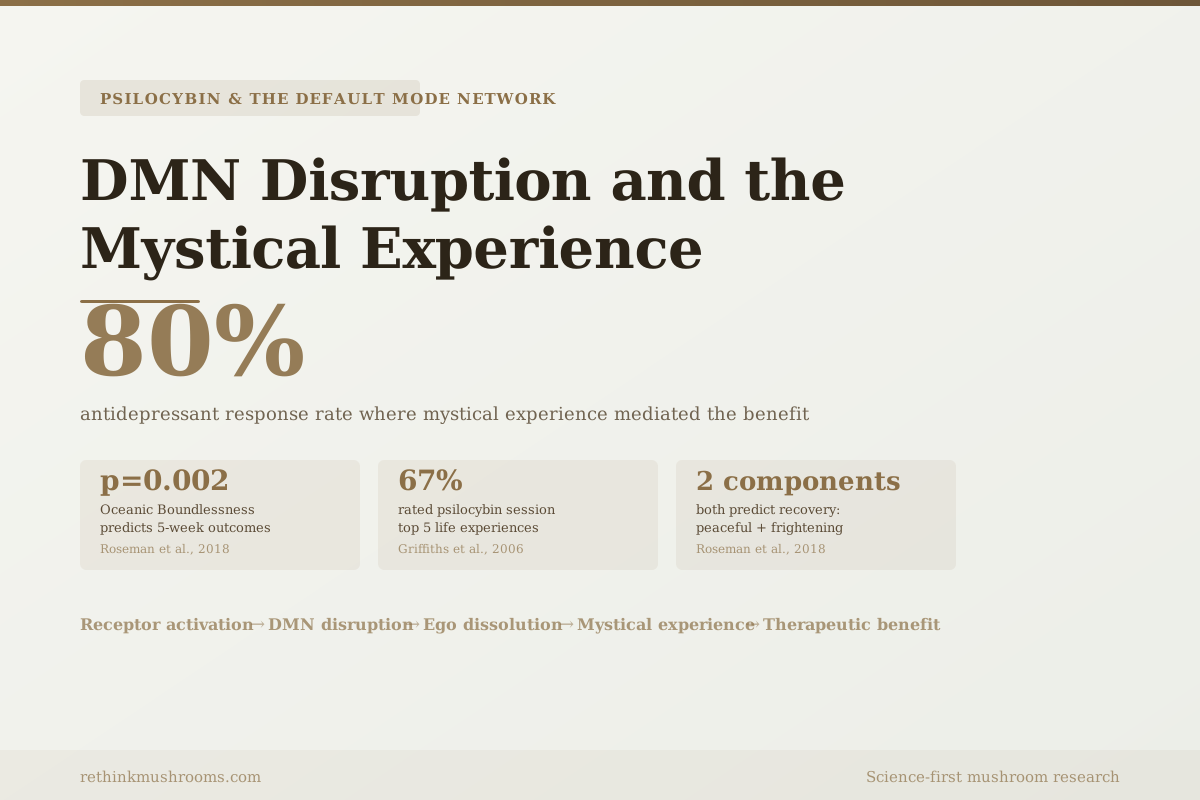
80%
In a randomized controlled trial of cancer patients, 80% showed meaningful antidepressant response at 6-month follow-up. Mediation analysis showed the psilocybin-occasioned mystical experience statistically explained the benefit.
Griffiths RR et al., J Psychopharmacology, 2016
p=0.002
statistical significance with which Oceanic Boundlessness predicted 5-week depression outcomes in treatment-resistant depression (Roseman et al., 2018)
67%
rated the psilocybin session among the five most spiritually significant experiences of their lives at 14-month follow-up (Griffiths et al., 2008)
2 components
of mystical experience that both independently predict antidepressant outcomes: the peaceful and the frightening (Roseman et al., 2018)
Griffiths RR et al., J Psychopharmacology, 2016
 View as image ↗
Psilocybin's disruption of the default mode network, specifically the uncoupling of the brain's two main self-referential regions, correlates with mystical experiences including ego dissolution, unity, and sacredness. The depth of that disruption during the session statistically predicts long-term antidepressant outcomes. This is the therapeutic mediator hypothesis: not that mystical experience happens alongside psilocybin therapy, but that it is the mechanism by which psilocybin therapy works.
The evidence behind this hypothesis is more robust than is widely appreciated, spanning a 2006 foundational RCT through 2019 controlled trials with fMRI, and it changes how psilocybin therapy is understood at the mechanistic level. This article is part of our series on psilocybin and the default mode network.
Key Takeaways
- In the first double-blind psilocybin RCT (n=36), 61% had a complete mystical-type experience; at 14-month follow-up, 67% rated the session among the five most spiritually significant experiences of their lives and 64% reported increased wellbeing or life satisfaction (Griffiths et al., 2006; 14-month follow-up 2008)
- Oceanic Boundlessness, the positive boundary-dissolving mystical component, predicted 5-week depression outcomes at p=0.002; Dread of Ego Dissolution, the frightening component, also predicted outcomes at p=0.003 (Roseman et al., 2018, n=20)
- Pre-session 5-HT2A receptor binding statistically predicts the intensity and time course of the mystical experience. The receptor that triggers DMN disruption also shapes how the experience unfolds (Stenbæk et al., 2021, n=16)
- In a 2016 RCT of cancer patients (n=51), psilocybin-occasioned mystical experience statistically mediated the antidepressant benefit. The mystical state explained the therapeutic effect, not just correlated with it (Griffiths et al.)
- In a double-blind RCT (n=38), the depth of mPFC-PCC decoupling during ego dissolution predicted positive psychosocial functioning four months later (Smigielski et al., NeuroImage, 2019)
- The frightening aspects of ego dissolution do not reduce therapeutic benefit. They predict it, suggesting real encounter with self-dissolution may be necessary, not something to minimize
The 2006 RCT That Put Mystical Experience on Scientific Ground
Before 2006, the claim that psilocybin reliably occasions complete mystical-type experiences was treated by mainstream science roughly the same way the experiences themselves were treated: interesting, anecdotal, and untestable. Griffiths and colleagues changed that.
Their 2006 double-blind study enrolled 36 hallucinogen-naïve adults who reported regular religious or spiritual activity.[1] Across counterbalanced sessions, volunteers received a high dose of psilocybin (30 mg/70 kg) and methylphenidate as an active comparison compound, conducted under comfortable, supportive conditions. Mystical experience was assessed using the Mystical Experience Questionnaire, a validated instrument measuring features including unity with everything, sacredness, profound positive mood, transcendence of time and space, and paradoxicality (the sense that the experience contains contradictions that are nevertheless true).
Psilocybin produced significantly higher scores on the mystical experience measure than methylphenidate. More specifically: 61% of participants in the psilocybin group had complete mystical-type experiences as defined by the questionnaire criteria.[1] This was replicable, not occasional.
A 14-month follow-up of the same cohort sharpened the picture.[8] 64% of participants reported the experience had increased their wellbeing or life satisfaction, 58% rated it among the five most personally meaningful experiences of their lives, and 67% rated it among the five most spiritually significant, comparable in how they described it to the birth of a child or the death of a parent. The follow-up also showed that the mystical experience scored on the session day, more than any other measure of personality, affect, or quality of life, was what statistically carried these long-term ratings forward.
The lasting wellbeing increase in volunteers who weren't being treated for anything was the first signal. The mystical experience was not just profoundly felt and then forgotten. It was correlated with lasting positive change in people who had no clinical need to improve. This suggested the mystical experience itself was doing something. Not just the psilocybin, not just the therapeutic context, but the specific quality of the experience that was being occasioned.
The therapeutic mediator hypothesis was born here: if mystical experience reliably occurs and reliably predicts lasting wellbeing, perhaps mystical experience is not the byproduct of some other mechanism. Perhaps it is the mechanism.
Oceanic Boundlessness and Dread: The Two Components That Both Predict Outcomes
The mystical experience is not a single undifferentiated state. Researchers measuring it have found it decomposes into distinct dimensions, two of which turn out to have the most direct relationship to therapeutic outcomes.
Oceanic Boundlessness (OBN) captures the positive, expansive component: dissolution of the boundary between self and world, a sense of unity with everything, profound meaningfulness, bliss, and sacredness. When people describe their psilocybin experience as having permanently changed their relationship to existence, they're typically describing high OBN states.
Dread of Ego Dissolution (DED) captures the frightening component: anxiety, loss of control, a sense of impending annihilation, terror at the identity-dissolving aspects of the experience. In popular accounts of psychedelic therapy, DED is often presented as the thing to minimize, the bad trip element that requires management, support, and ideally prevention.
What the research data shows is that both components matter therapeutically. And understanding why both matter changes the clinical picture considerably.
The Roseman Finding: Even the Frightening Component Predicts Recovery
In 2018, Roseman and colleagues examined 20 patients with treatment-resistant depression who received psilocybin in a clinical research context.[2] The goal was to test whether the quality of the acute psychedelic experience predicted depression outcomes at five weeks.
The OBN result was direct: Oceanic Boundlessness scores predicted better 5-week depression outcomes at p=0.002.[2] The more completely the patient entered the positive mystical state, the more likely they were to show depression recovery five weeks later. This is the positive version of the therapeutic mediator hypothesis working exactly as expected.
The DED result was more surprising. Dread of Ego Dissolution scores also predicted better outcomes, in the same direction, at p=0.003.[2] Patients who experienced the most frightening, identity-dissolving aspects of the session were also more likely to show depression recovery. The frightening component did not reduce efficacy. It predicted it.
Importantly, OBN was specifically predictive relative to other dimensions of the acute experience. Other perceptual alterations measured during the session (visual changes, bodily sensations, time distortion) did not show the same predictive relationship with outcomes. It wasn't a matter of "having an intense experience" in general. The specific mystical and ego-dissolution dimensions, both the expansive and the terrifying, were what predicted recovery.
One interpretation of the DED finding: the therapeutic benefit may require actual encounter with ego dissolution, including its frightening aspects, rather than just pleasant altered states. A comfortable altered experience with intact sense of self may produce fewer lasting benefits than a confronting one where the sense of identity temporarily collapses. This is not a universal claim. Individual responses vary substantially. But as a population-level predictor, the data points in this direction.
Roseman, Nutt & Carhart-Harris (2017) · Frontiers in Pharmacology
- Population
- 20 patients with treatment-resistant depression (open-label psilocybin, 10 mg + 25 mg sessions)
- Intervention
- Quality of the 25 mg acute experience (Altered States of Consciousness questionnaire) measured against 5-week depression outcomes (QIDS-SR)
- Finding
- Oceanic Boundlessness, the positive mystical dimension, predicted better 5-week outcomes at p=0.002, and Dread of Ego Dissolution, the frightening dimension, also predicted better outcomes at p=0.003. General perceptual alterations did not. The challenging part of the experience predicted recovery rather than undermining it.
positive Small open-label sample (n=20); a predictor of outcome, not a controlled test of causation.
Roseman, Nutt & Carhart-Harris, Front Pharmacol, 2017 (epub Jan 2018)
The Neurobiological Chain: From Receptor Activation to Mystical State
For the therapeutic mediator hypothesis to be mechanistically coherent, there needs to be a causal chain from pharmacology to phenomenology to outcome. That chain is now substantially filled in.
The 5-HT2A serotonin receptor is the primary site of psilocybin's action. It's densely expressed in the brain's self-referential regions, particularly the medial prefrontal cortex and posterior cingulate cortex, the two principal hubs of the default mode network. Psilocybin's active metabolite, psilocin, activates these receptors, and that activation triggers desynchronization of the DMN.
In a 2021 PET study, Stenbæk and colleagues measured neocortical 5-HT2A receptor binding in 16 healthy participants before any drug administration, then gave them psilocybin and assessed the mystical experience with the Mystical Experience Questionnaire.[3] Baseline receptor binding significantly predicted both the temporal profile of the experience and its mystical intensity. Individual differences in the very receptor system psilocybin acts on, measured before anyone took the drug, statistically forecast how the session would unfold.
The direction of that relationship is worth stating carefully, because it is more interesting than a simple "more receptors, bigger experience" story. Stenbæk found that higher neocortical 5-HT2A binding was associated with a lower total mystical experience score, alongside a shorter peak plateau and a longer return to ordinary consciousness. The relationship is real and statistically significant; it is just not linear in the intuitive direction. What the study establishes is the link itself: baseline receptor biology shapes the depth and shape of the mystical state. Why the association runs the way it does, likely involving receptor occupancy dynamics rather than raw availability, remains an open mechanistic question.
This closes the first link in causal terms: individual receptor biology helps determine how the mystical experience unfolds, and the mystical experience in turn predicts outcomes.
The full chain is: 5-HT2A activation leads to DMN desynchronization, which leads to ego dissolution, which at sufficient depth becomes full mystical experience. Each link is supported by independent evidence. Stenbæk provides the receptor-to-experience link. The fMRI literature provides the receptor-activation-to-DMN-disruption link. And the Roseman, Smigielski, and Griffiths data provide the mystical-experience-to-outcomes link.
The chain matters because it makes the mystical experience testable and, in principle, modifiable. If individual receptor biology helps set experience depth, and experience depth predicts outcomes, then receptor-level differences are one reason the same therapeutic protocol produces highly variable outcomes at fixed doses. They create variance in mystical experience quality, which propagates into variance in outcomes.
What the Brain Looks Like During Mystical Experience: The fMRI Picture
The subjective features of mystical experience, including boundary dissolution, unity, and sacredness, correspond to specific brain connectivity changes documented in neuroimaging studies.
Carhart-Harris and colleagues' foundational 2012 fMRI study (n=30) established the core finding: psilocybin causes significant decreases in functional coupling between the medial prefrontal cortex and the posterior cingulate cortex, the self-referential circuit that maintains the continuous sense of personal identity.[4] The magnitude of this decoupling directly predicted subjective experience intensity, creating a dose-response relationship within the network itself.
Lebedev and colleagues' 2015 study (n=15) mapped the full ego dissolution neural signature and found it involves three simultaneous network disruptions, not just DMN decoupling: the medial temporal lobe loses its connection to high-level cortical areas, the salience network fragments, and interhemispheric communication decreases.[5]
These three disruptions correspond to specific features of the mystical experience. The MTL disconnection interrupts autobiographical memory processing. The continuous "this is my story" narrative collapses. The salience network fragmentation eliminates the self-other distinction. The category of "self-relevant" dissolves. The interhemispheric disruption alters spatial and perceptual processing. Together they produce what participants describe as the dissolution of the boundary between self and world.
The mPFC-PCC decoupling, the core of the ego dissolution signature, connects to the Smigielski 2019 RCT (n=38): the extent of that decoupling during the session predicted positive psychosocial wellbeing four months later in a double-blind design.[6] This provides the neurobiological link between the brain event and the lasting benefit, not just between the subjective experience and the outcome.
For a deeper look at the ego dissolution neural correlates, see our article on psilocybin ego dissolution and brain changes.
Griffiths 2016: Mystical Experience as Formal Statistical Mediator
The therapeutic mediator hypothesis moves from correlation to mechanism when mystical experience is tested as a formal statistical mediator, meaning a variable that statistically explains the relationship between treatment and outcome.
Griffiths and colleagues' 2016 RCT enrolled 51 patients with life-threatening cancer diagnoses who were experiencing depression and anxiety about their illness and prognosis.[7] Participants were randomly assigned to high-dose or low-dose psilocybin in a crossover design. The primary results: high-dose psilocybin produced large decreases in clinician- and self-rated depression and anxiety, and at 6-month follow-up about 80% of participants still showed clinically significant improvement relative to the placebo-like low-dose condition.
Those are clinical effectiveness numbers. The mechanistic finding was what made this study more than another efficacy demonstration.
The research team ran formal mediation analyses asking: does the psilocybin-occasioned mystical experience statistically explain the antidepressant benefit? The answer was yes. Mystical experience scores significantly mediated the antidepressant effect.[7] Participants who had more complete mystical experiences during their session showed better outcomes, and this relationship statistically accounted for a meaningful share of the psilocybin advantage over the low-dose condition.
Mediation analysis is a specific statistical test. It asks not whether two things correlate but whether one variable explains why another variable predicts an outcome. The Griffiths 2016 result is saying: mystical experience is not just riding along with psilocybin's antidepressant effect. It is the variable that statistically explains the effect. (As with any mediation analysis in a modestly sized trial, this identifies a statistical pathway rather than definitively proving causation.)
This finding has a direct implication for the default mode network and depression story: if mystical experience mediates antidepressant benefit, and mystical experience requires sufficient DMN disruption, then DMN disruption is not merely a correlate of the therapeutic benefit. It's on the causal pathway.
Why Mystical Experience Quality May Be the Active Ingredient
The therapeutic mediator hypothesis, supported across the Griffiths 2006, Roseman 2018, Smigielski 2019, and Griffiths 2016 data, reframes what psilocybin therapy is doing at the mechanistic level.
- Mechanism / receptor studiescompleted
PET (Stenbæk 2021) links baseline 5-HT2A binding to mystical-experience intensity; fMRI (Carhart-Harris 2012, Lebedev 2015) maps DMN decoupling to ego dissolution.
- Small clinical trials with mediation/predictioncompleted
Roseman 2017 (n=20 TRD) and Smigielski 2019 (n=38) show acute experience quality and mPFC-PCC decoupling predict later outcomes.
- RCT with formal mediation analysiscurrent
Griffiths 2016 (n=51 cancer patients) is the strongest single test: mystical-type experience formally mediated the antidepressant effect of dose.
- Systematic review / meta-analysismissing
A 2022 systematic review supports the association but notes methodological limits; no quantitative meta-analysis of mediation yet establishes causation.
The hypothesis is supported by converging mechanism studies, several outcome-prediction trials, and one formal mediation RCT. It is not yet settled at the meta-analytic level, and mediation analysis cannot by itself prove causation.
Stenbæk 2021; Carhart-Harris 2012; Lebedev 2015; Roseman 2017; Smigielski 2019; Griffiths 2016
SSRIs modulate serotonin availability chronically. The antidepressant effect builds over weeks of daily dosing through slow molecular and synaptic changes. Psilocybin's mechanism is different in kind: one acute event, four to six hours long, produces a neurological disruption that initiates lasting reorganization. The mystical experience data suggests the specific quality of that acute event determines how much reorganization occurs.
The practical implication is clinical: if depth of mystical experience predicts outcomes, then the conditions that facilitate deeper ego dissolution during the session are therapeutically relevant. Preparatory practices, setting, careful dose calibration, and in-session support that allows rather than interrupts the frightening aspects of ego dissolution. All of these become relevant not as comfort measures but as potential determinants of the primary therapeutic variable.
This is a substantial departure from a model in which psilocybin is simply dosed, waited for, and then followed up. It's a model in which the quality of what happens during the session is the treatment, and everything else is context that either supports or undermines that quality.
Context for this research
ModerateThis is mechanistic research, not a how-to for self-treatment
Concern
The trials described here delivered psilocybin in controlled clinical settings with screening, preparation, and trained in-session support. The same ego-dissolution intensity that predicts benefit (including the frightening 'Dread of Ego Dissolution' dimension) can be destabilizing without that container, and psilocybin remains a Schedule I substance in most jurisdictions.
What the research says
The mediator findings describe how supervised psilocybin therapy appears to work, not a protocol anyone should attempt independently. Psilocybin can be contraindicated for people with personal or family histories of psychotic or bipolar disorders and can interact with serotonergic medications.
Particularly relevant for: Anyone considering psychedelics for a mental-health condition
What to do
Treat this as educational science reporting, not medical advice. Decisions about psilocybin should involve a qualified clinician and, where available, a regulated or research setting.
Griffiths 2016; Roseman 2017; general clinical-trial safety practice
For the broader picture of how psilocybin reshapes brain networks in ways that persist after the mystical state ends, see our articles on what happens when the DMN goes offline and psilocybin and neuroplasticity.
The Bottom Line
Psilocybin's disruption of the default mode network produces mystical experiences that appear to be more than experiential byproducts of therapy. They are the statistical mechanism connecting psilocybin to antidepressant outcomes. The evidence chain runs from baseline 5-HT2A receptor binding predicting mystical experience intensity (Stenbæk 2021), through both the positive and frightening components of ego dissolution predicting recovery (Roseman 2018), to formal mediation analysis showing mystical experience explains the therapeutic benefit (Griffiths 2016). The depth of the DMN disruption and the completeness of ego dissolution appear to be the active therapeutic variables.
Frequently Asked Questions
Sources & References
- 1RTHM-00096·Griffiths, R R et al. (2006). “Psilocybin can occasion mystical-type experiences having substantial and sustained personal meaning and spiritual significance..” Psychopharmacology.Study breakdown →PubMed →↩
- 2RTHM-00907·Roseman, Leor et al. (2017). “Quality of Acute Psychedelic Experience Predicts Therapeutic Efficacy of Psilocybin for Treatment-Resistant Depression..” Frontiers in pharmacology.Study breakdown →PubMed →↩
- 3RTHM-00720·Stenbæk, Dea Siggaard et al. (2021). “Brain serotonin 2A receptor binding predicts subjective temporal and mystical effects of psilocybin in healthy humans..” Journal of psychopharmacology (Oxford.Study breakdown →PubMed →↩
- 4RTHM-00245·Carhart-Harris, Robin L et al. (2012). “Neural correlates of the psychedelic state as determined by fMRI studies with psilocybin..” Proceedings of the National Academy of Sciences of the United States of America.Study breakdown →PubMed →↩
- 5RTHM-00706·Lebedev, Alexander V et al. (2015). “Finding the self by losing the self: Neural correlates of ego-dissolution under psilocybin..” Human brain mapping.Study breakdown →PubMed →↩
- 6RTHM-01123·Smigielski, Lukasz et al. (2019). “Psilocybin-assisted mindfulness training modulates self-consciousness and brain default mode network connectivity with lasting effects..” NeuroImage.Study breakdown →PubMed →↩
- 7RTHM-00426·Griffiths, Roland R et al. (2016). “Psilocybin produces substantial and sustained decreases in depression and anxiety in patients with life-threatening cancer: A randomized double-blind trial..” Journal of psychopharmacology (Oxford.Study breakdown →PubMed →↩
- 8RTHM-00250·Griffiths, Roland R et al. (2008). “Mystical-type experiences occasioned by psilocybin mediate the attribution of personal meaning and spiritual significance 14 months later..” Journal of Psychopharmacology.Study breakdown →PubMed →↩