Psilocybin & Structural Neuroplasticity
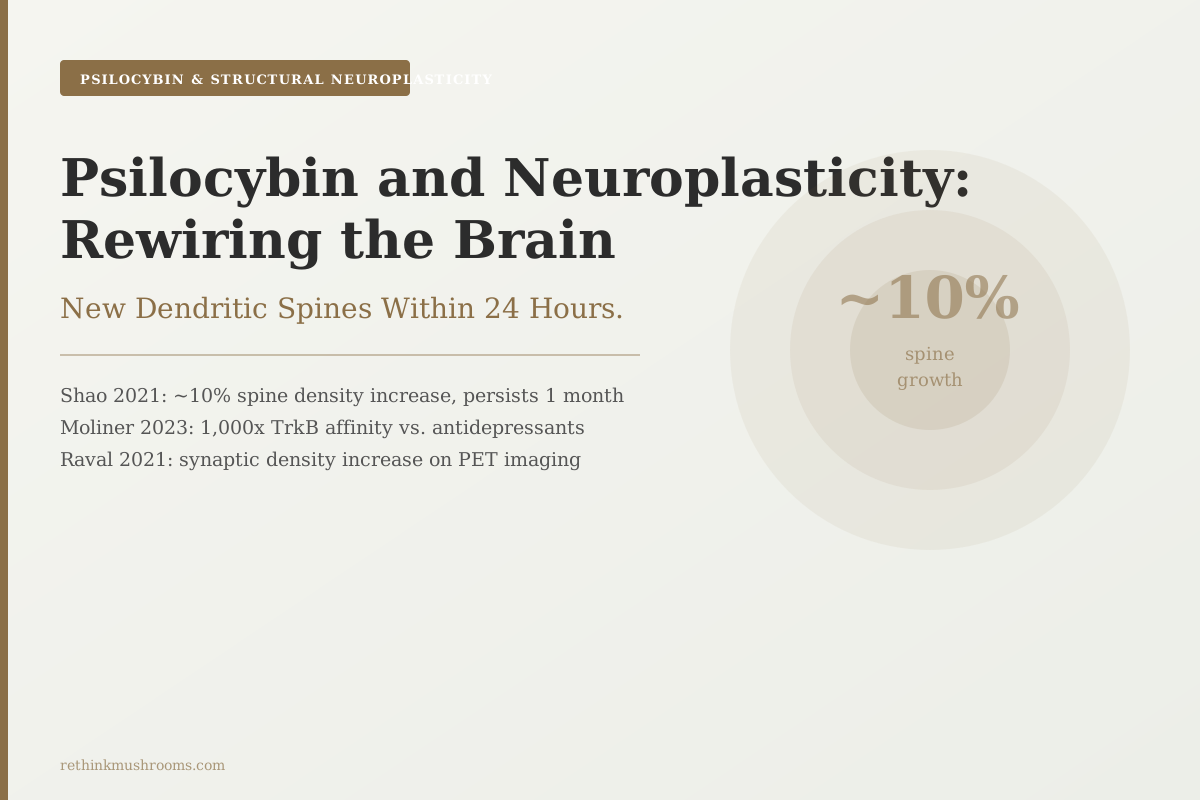
~10% spine density increase
A 2021 Yale study used a transparent window sealed over a mouse skull to watch psilocybin grow new dendritic spines on living neurons within 24 hours. The new structures were still present one month later.
Shao LX et al., Neuron, 2021
24 hours
time to observe new dendritic spine growth after a single psilocybin dose
1 month
persistence of new spines in the mouse frontal cortex
1,000x
higher TrkB receptor affinity of psychedelics vs. conventional antidepressants
Shao LX et al., Neuron, 2021
 View as image ↗
In 2021, neuroscientists at Yale sealed a transparent window over a mouse's skull and watched its brain respond to a single dose of psilocybin. Using a technique that sends laser light through the window to image individual neurons, they could observe the branching extensions of brain cells in real time. Within 24 hours, new structures appeared on the neuron branches: small protrusions called dendritic spines, the tiny structures that form the receiving end of brain synapses. Spine density in the frontal cortex increased by approximately 10%. The new spines were still there a month later.[1]
That study became the most concrete direct evidence that psilocybin produces neuroplasticity at a structural level. Not just changes in how the brain's signals are organized, but actual new physical growth. This piece is part of a broader series on the neuroscience of psilocybin, covering how psilocybin affects brain structure, connectivity, and the self.
Key Takeaways
- A 2021 Yale study (Shao et al., Neuron) used in vivo two-photon microscopy to directly observe new dendritic spine growth in mouse frontal cortex within 24 hours of a single psilocybin dose, with spines persisting for at least 1 month
- Ly et al. (Cell Reports, 2018) established that classic psychedelics promote neurite growth, dendritic spine growth, and synapse formation through TrkB, mTOR, and 5-HT2A signaling pathways, coining the term "psychoplastogens"
- A 2023 Nature Neuroscience study found that psychedelics bind directly to TrkB, the brain's main growth factor receptor, at roughly 1,000 times higher affinity than conventional antidepressants — separating the structural plasticity effects from the psychedelic experience
- Raval et al. (2021) used PET imaging in pig brains to detect increased synaptic density after psilocybin, providing the first in vivo whole-brain imaging evidence using methodology comparable to human PET studies
- Depression is associated with dendritic spine loss in the prefrontal cortex; psilocybin's spine-growing effects occur in exactly the same region, suggesting a mechanistic explanation for its antidepressant properties
- The structural plasticity evidence (spine formation within 24 hours, persistence for weeks) provides a biological rationale for why integration therapy in the days following a dose may produce more lasting change
Functional vs. Structural Neuroplasticity: What Psilocybin Research Actually Changed
"Neuroplasticity" is often used as though it describes a single phenomenon. It doesn't.
Functional neuroplasticity refers to changes in how strongly neurons communicate with each other. When a synapse gets used repeatedly, it becomes more efficient at passing signals. This is how learning and memory work at the cellular level. The connections themselves don't multiply; they strengthen. Functional changes can happen quickly and, depending on circumstances, can also reverse.
Structural neuroplasticity refers to actual physical changes in brain architecture. New dendritic spines grow on existing neurons. New synapses form between neurons that weren't connected before. Neurites, the branching extensions of neurons, extend into new territory. These are not changes in signal strength. They are changes in the brain's physical wiring.
The distinction matters because structural changes are generally more durable. A dendritic spine that formed, survived the normal pruning process, and became part of an active synaptic circuit represents a more lasting kind of change than a strengthened synapse. When psilocybin researchers talk about "rewiring the brain," the structural evidence is what makes that phrase more than a metaphor.
Before 2018, the neuroplasticity conversation around psychedelics was almost entirely functional: psychedelics changed connectivity patterns, altered how brain networks communicated, disrupted default patterns of thought. These are real and important functional effects. What the past five years have added is structural evidence — direct observation of new physical growth that the brain builds in response to psilocybin.
The Studies That Documented New Physical Brain Structure After Psilocybin
In 2018, Ly and colleagues in David Olson's lab at UC Davis published what became the foundational study of psychedelic structural neuroplasticity.[2] They tested several classic psychedelics, including LSD, DMT, and DOI (a psilocybin-adjacent compound), and documented three forms of structural growth.
First, neuritogenesis: the growth of new neurite branches, the extensions that reach out from the neuron cell body. Second, spinogenesis: the growth of new dendritic spines on those branches. Third, synaptogenesis: the formation of new complete synaptic connections between neurons. All three forms of growth were produced by the psychedelics they tested, both in isolated cell cultures and in living animals.
That paper coined the term "psychoplastogens" — substances that promote this kind of structural plasticity in the brain. The signaling pathways identified were TrkB, mTOR (the cell's master regulator of growth), and 5-HT2A (the main psychedelic receptor). All three pathways work together to drive the structural changes.
Shao and colleagues at Yale then took the structural evidence a decisive step further.[1] In vivo two-photon microscopy uses a laser to image individual neurons through a transparent window implanted in the skull. The technique provides a view of living brain tissue at the resolution of individual dendritic spines, a feat not possible with standard brain imaging. Shao's team watched as new spines appeared on layer 5 pyramidal neurons in the mouse medial frontal cortex within 24 hours of psilocybin administration. Spine density increased by approximately 10% and spine size increased as well. At the one-month imaging session, the new spines were still present. Psilocybin also reduced the stress-induced behavioral deficits the mice had been given before the experiment.
The quantitative data from Shao 2021 is the most specific and concrete evidence in the structural neuroplasticity field: a defined brain region, a defined cell type, a defined dose, a defined timeline, and a defined persistence. It gives the field something to point to.
Raval and colleagues added a third piece of evidence using a different method.[4] They used PET (positron emission tomography) brain imaging in pigs to measure synaptic density after a single psilocybin dose. The PET tracer they used, called SV2A, marks a protein found only at synaptic terminals. More SV2A signal means more synapses. The pig brain experiment found increased SV2A signal after psilocybin, confirming the synaptic density increase in a living brain using whole-organ imaging. This is significant because SV2A PET is the same methodology used in human brain imaging studies, bridging the gap between mouse experiments and what could eventually be measured in people.
For a focused look at the dendritic spine evidence and the two-photon microscopy technique, see How Psilocybin Grows New Dendritic Spines. For the synaptogenesis evidence specifically, see Psilocybin and Synaptogenesis: Creating New Neural Connections.
The 2023 Discovery That Separated the Trip From the Brain Changes
A 2023 study in Nature Neuroscience changed the mechanistic story for psychedelic neuroplasticity.
Moliner and colleagues in Eero Castrén's lab at the University of Helsinki showed that LSD and psilocin (the active form of psilocybin in the body) bind directly to TrkB, the receptor for BDNF.[3]
BDNF stands for Brain-Derived Neurotrophic Factor. It is the brain's primary growth and maintenance molecule. When BDNF binds to TrkB, it triggers a cascade of cellular events: neurons survive better, synapses form more readily, dendritic spines grow. The brain becomes more structurally plastic. Virtually all known effective antidepressants eventually increase BDNF signaling in some way, which is why researchers have connected neuroplasticity and antidepressant action for decades.
What Moliner found was this: psychedelics bind to TrkB at roughly 1,000 times higher affinity than conventional antidepressants bind it. Not a minor secondary interaction. A primary, high-affinity binding.
The binding site was also unexpected. It is located on the transmembrane domain of TrkB dimers (pairs of TrkB receptors sitting in the cell membrane), not the usual BDNF binding site on the outer surface of the receptor. This means psychedelics activate TrkB through a different physical mechanism than BDNF itself.
The crucial implication: the neuroplastic effects of psychedelics are partly independent of 5-HT2A. The psychedelic experience, the subjective effects of the trip, flow primarily through 5-HT2A receptor activation. The structural plasticity, the new dendritic spines and synaptic connections, appear to flow significantly through TrkB activation. These are two separate mechanisms working in parallel.
This has a practical consequence that researchers are beginning to explore: compounds could potentially be designed that bind TrkB with high affinity and produce structural neuroplasticity without activating 5-HT2A and producing a psychedelic experience at all. Psychoplastogens that don't cause a trip. The Moliner 2023 paper is the scientific foundation for that possibility.
For more on the 5-HT2A receptor mechanism that drives the psychedelic experience itself, see How 5-HT2A Agonism Creates the Psychedelic Experience.
Why Psilocybin's Structural Effects May Specifically Reverse Depression's Damage
The structural neuroplasticity findings are particularly interesting for depression research because depression has a structural signature in the brain.
Under chronic stress, the prefrontal cortex (the region responsible for executive function, flexible thinking, and regulating emotional responses) loses dendritic spines. Stress hormones, particularly chronically elevated cortisol, activate molecular pathways that prune back synaptic connections. The neurons are still there, but they become less connected. The brain's capacity for cognitive flexibility and self-regulation decreases along with the spine count.
This prefrontal spine loss appears to underlie some of the cognitive symptoms of depression: difficulty concentrating, rigid negative thought patterns, reduced ability to generate or test new perspectives. The brain is literally less wired for flexible thinking than it was before the stress-induced pruning.
Shao 2021 found that psilocybin grew new dendritic spines in the mouse medial frontal cortex, which is functionally analogous to the human prefrontal cortex.[1] The growth occurred in exactly the region and cell type where depression-related spine loss happens. The same study showed psilocybin reversed stress-induced behavioral deficits in the treated mice.
The TrkB/BDNF pathway identified by Moliner 2023 provides a molecular explanation for why the effect persists.[3] BDNF normally supports neuron health and spine maintenance. Under depression and chronic stress, BDNF levels in the prefrontal cortex drop. When psilocybin activates TrkB directly, it may effectively substitute for the missing BDNF signal, giving the prefrontal neurons the growth signal they stopped receiving, and enabling the spine regrowth that stress pruning had prevented.
This is a mechanistic hypothesis, not a clinical conclusion. The human data on structural neuroplasticity from psilocybin is not yet at the same level as the animal evidence. But the animal and cellular evidence is specific enough that researchers take it seriously as a component of psilocybin's antidepressant mechanism alongside the psychological and functional connectivity effects.
For a complementary perspective on how psilocybin changes functional connectivity patterns in the brain, see Functional Connectivity Changes Under Psilocybin: fMRI Evidence.
The Plasticity Window: Why the Days After a Dose May Matter as Much as the Dose Itself
The dendritic spine data raises a practical question. New spines form within 24 hours of a psilocybin dose, but a newly grown spine is not automatically a permanent fixture. It needs to be incorporated into active neural circuits to be maintained. Spines that are not used tend to be pruned back by the brain's normal maintenance process.
This creates a window of opportunity.
When structural plasticity is elevated, the brain is in a state where new learning, new behavioral patterns, and new ways of thinking can more readily be incorporated into actual physical structure. The therapeutic implications are significant: if new synaptic connections form most readily in the 24 to 72 hours after a psilocybin dose, and if those connections persist for weeks, then what happens during that window matters for which changes become lasting.
This is the mechanistic rationale behind integration therapy: therapeutic work, new behavioral practices, and intentional learning done in the days and weeks following a psilocybin session may produce more lasting change than the same work done months later, because the brain's structural machinery for encoding new patterns is temporarily running at higher capacity.
The Shao 2021 data shows new spines at 24 hours and still present at one month.[1] The Moliner 2023 TrkB mechanism explains why: sustained TrkB activation keeps BDNF signaling elevated long after psilocybin itself has cleared from the body, providing the molecular support to maintain the new structures.[3] The plasticity window is not just a few hours of acute drug effect. It is a days-to-weeks period of structurally elevated opportunity.
The honest limitation: the precise timing of this window in humans is not fully established. Mouse data gives us the spine formation timeline. Human cognitive flexibility data shows enhanced flexibility for at least four weeks after a dose in some studies. But direct imaging of structural plasticity in humans, at the resolution of individual dendritic spines, is not yet technically feasible with existing tools.
For a dedicated look at what is known about the plasticity window timeline and its therapeutic significance, see The Plasticity Window: How Long Psilocybin Keeps the Brain Flexible.
For more on the quantitative details of the Shao 2021 study and the two-photon imaging method, see Psilocybin and Dendritic Spine Growth: Structural Neuroplasticity in 24 Hours.
The Bottom Line
The past five years of research have produced the most concrete evidence yet that psilocybin produces structural neuroplasticity: actual physical changes in brain wiring, not just shifts in connectivity patterns. Shao 2021 documented a 10% dendritic spine density increase in 24 hours, persisting for a month. Moliner 2023 found that psychedelics bind the brain's main growth factor receptor at 1,000 times higher affinity than conventional antidepressants, through a mechanism separate from the psychedelic experience itself. All structural evidence is preclinical. The human data on structural changes is still emerging, but the animal and cellular findings are specific and reproducible enough that the field is taking them seriously as part of the mechanism for psilocybin's therapeutic effects.
Frequently Asked Questions
Sources & References
- 1RTHM-01434·Shao, Ling-Xiao et al. (2021). “Psilocybin induces rapid and persistent growth of dendritic spines in frontal cortex in vivo..” Neuron.Study breakdown →PubMed →↩
- 2RTHM-00983·Ly, Calvin et al. (2018). “Psychedelics Promote Structural and Functional Neural Plasticity..” Cell reports.Study breakdown →PubMed →↩
- 3RTHM-01756·Moliner, Rafael et al. (2023). “Psychedelics promote plasticity by directly binding to BDNF receptor TrkB..” Nature neuroscience.Study breakdown →PubMed →↩
- 4. Source details for this reference are not yet available.