Psilocybin Neuroscience
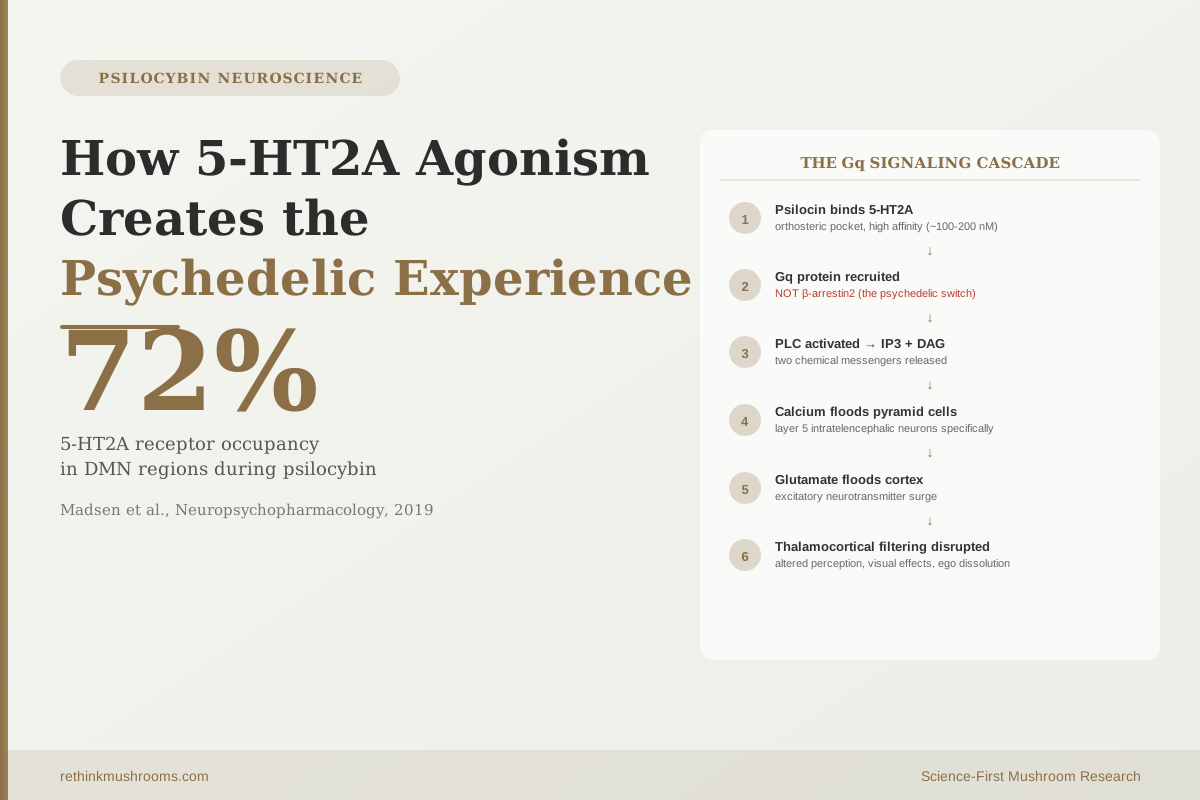
72% receptor occupancy
PET scanning showed psilocybin caused up to 72% 5-HT2A receptor occupancy in default mode network regions, and subjective experience intensity correlated directly with that occupancy.
Madsen et al., Neuropsychopharmacology, 2019
Gq, not β-arrestin
the specific signaling protein that determines whether a drug is psychedelic
Layer 5 neurons
specific cortical cell subtype required for lasting psychedelic effects
2 receptor pools
surface and intracellular 5-HT2A produce distinct effects in the same brain
Madsen et al., Neuropsychopharmacology, 2019
 View as image ↗
The 5-HT2A receptor is a serotonin receptor. The brain has other serotonin receptors. Psilocin activates several of them. But only one, the 5-HT2A receptor, is responsible for the visual, perceptual, and ego-dissolving effects that define the classic psychedelic experience.
Why this receptor? Why not the others?
The answer has two parts. The first is about which signaling protein the receptor recruits after psilocin binds. The second is about where in the cell and which neurons respond. Both answers have only become clear in the last few years.
A 2019 PET study by Madsen and colleagues scanned the brains of eight healthy volunteers who received single oral doses of psilocybin ranging from 3 to 30 mg. PET imaging measures radiotracer binding in living tissue, allowing receptor occupancy to be quantified in real time. The result: psilocybin caused dose-related 5-HT2A occupancy of up to 72% in default mode network regions. The subjective intensity of each person's psychedelic experience correlated directly with how much of the receptor was occupied.[3]
That dose-effect correlation is the direct evidence that 5-HT2A occupancy is what causes the psychedelic experience, not merely accompanying it.
For the broader relationship between 5-HT2A receptors and psilocybin pharmacology, see the companion article on psilocybin and 5-HT2A receptors: the gateway to psychedelic effects. For context on how these receptor changes affect brain network activity, see the pillar article on psilocybin and the default mode network.
Key Takeaways
- 5-HT2A receptor occupancy correlates directly with psychedelic experience intensity in a dose-dependent PET study (n=8 healthy volunteers); up to 72% occupancy observed in default mode network regions (Madsen et al., 2019)
- Gq protein coupling, not β-arrestin2 recruitment, is the molecular determinant of psychedelic versus non-psychedelic 5-HT2A agonism; disrupting Gq-PLC signaling eliminates psychedelic-like effects while preserving other 5-HT2A drug actions (Wallach et al., Nature Communications, 2023)
- Cryo-EM at near-atomic resolution reveals exactly how psilocin inserts into the 5-HT2A orthosteric binding pocket and stabilizes the Gq-coupling conformation (Kim et al., Cell, 2020)
- Not all cortical pyramidal neurons respond equally: lasting behavioral and structural effects of psilocybin depend specifically on layer 5 intratelencephalic pyramidal neurons expressing 5-HT2A, not all pyramidal cells (Shao et al., bioRxiv preprint, 2024)
- A separate pool of 5-HT2A receptors located inside the cell (not on the surface) drives structural neuroplasticity; this effect persists after the drug has cleared; blocking intracellular trafficking eliminated neuroplasticity without affecting the acute trip (Vargas et al., Science, 2023)
- Repeated 5-HT2A activation via psychedelics produces rapid tolerance (tachyphylaxis) specific to the Gq pathway; non-psychedelic 5-HT2A agonists do not produce the same cross-tolerance (de la Fuente Revenga et al., ACS Chemical Neuroscience, 2022)
The Six-Step Cascade: How Receptor Binding Becomes Altered Perception
How 5-HT2A agonism produces the psychedelic state can be described as a sequential chain of events. Each step follows from the one before it:
Mechanism · 5-HT2A → Perception
How Receptor Binding Becomes Altered Perception
Six sequential steps turn a molecule fitting a receptor into a change in conscious experience. Each step follows from the one before it.
Psilocin enters the binding pocket
5-HT2A receptorThe active metabolite docks in the orthosteric pocket where serotonin normally binds; affinity is high (~100–200 nM).
Binding affinity: ~100–200 nM
The receptor recruits Gq — not β-arrestin2
Gq proteinThe active conformation couples to Gq on the inner membrane. Gq coupling, not β-arrestin2 recruitment, is what makes the drug psychedelic.
Molecular switch: Gq efficacy predicts psychedelic potential
Gq activates phospholipase C (PLC)
PLC enzymeActivated Gq turns on PLC, which cleaves a membrane lipid into two chemical messengers.
PLC → IP3 + DAG
Calcium floods the cell
Ca²⁺ releaseIP3 releases calcium from internal stores; DAG activates protein kinase C. The calcium surge makes neurons fire more readily.
IP3 → intracellular Ca²⁺ · DAG → PKC
Layer 5 pyramidal neurons fire
CortexDeep cortical pyramidal neurons fire faster, flooding connected regions with glutamate — the brain’s primary excitatory signal.
Glutamate surge across long-range circuits
Thalamocortical filtering is disrupted
ThalamusThe glutamate surge overwhelms the thalamus’s sensory gatekeeping, letting normally-suppressed signals reach awareness.
Altered & expanded perception
Source: Nichols (2016); López-Giménez & González-Maeso (2018); Wallach et al. (2023); Shao et al. (2024)
View as image ↗-
Psilocin enters the binding pocket. The active metabolite of psilocybin, psilocin, binds the 5-HT2A receptor at a site deep within the receptor protein where serotonin itself normally docks. Psilocin's binding affinity for this site is high (approximately 100-200 nM), comparable to serotonin's own affinity.[1]
-
The receptor activates Gq. When psilocin binds, the receptor shifts into an active conformation that recruits a molecular relay protein called Gq (pronounced "gee-queue") on the inner surface of the cell membrane. Gq is the protein that transmits the binding signal into the cell's interior.
-
Gq activates an enzyme. The activated Gq protein turns on an enzyme inside the cell called phospholipase C (PLC). This enzyme then cleaves a membrane lipid into two chemical messengers: inositol trisphosphate (IP3) and diacylglycerol (DAG).[2]
-
Calcium floods the cell. IP3 triggers the release of calcium from the cell's internal storage compartments. This surge of intracellular calcium is the electrical signal that makes a neuron fire more readily. DAG simultaneously activates protein kinase C, amplifying the signal.
-
Pyramidal neurons fire more. 5-HT2A receptors are concentrated on deep cortical pyramidal neurons, a class of large, long-range excitatory brain cells. The calcium-driven activation of these cells increases their firing rate, flooding connected brain regions with glutamate, the brain's primary excitatory chemical.
-
Thalamocortical filtering is disrupted. The thalamus normally acts as a sensory gatekeeper, filtering and compressing incoming signals before they reach the cortex. The glutamate surge from activated pyramidal neurons bypasses and overwhelms this filtering, allowing sensory signals that are normally suppressed to reach conscious awareness. This is the cellular basis of altered and expanded perception.
The Molecular Switch: Why Gq Specifically Determines Whether a Drug Is Psychedelic
The Gq cascade described above is not unique to psychedelics. Many drugs activate 5-HT2A receptors. Most of them are not psychedelic. The receptor is also activated by everyday compounds including serotonin itself. Understanding why only some activations create a psychedelic experience required identifying what is different about how psychedelics bind.
The key distinction was demonstrated by Wallach and colleagues in a 2023 study published in Nature Communications. They tested which downstream signaling pathway determines psychedelic potential.
The 5-HT2A receptor can signal through two different proteins after activation: Gq (which drives the cascade described above) and β-arrestin2 (a different relay protein that drives separate cellular processes). A drug that activates the receptor but preferentially recruits β-arrestin2 rather than Gq is called a "biased agonist": it uses the same receptor but triggers a different downstream message.
Wallach's finding: Gq coupling efficiency predicted psychedelic potential; β-arrestin2 recruitment did not. When the Gq-PLC signaling pathway was disrupted, psychedelic-like behavior disappeared. When β-arrestin2 was disrupted, psychedelic behavior was unchanged.[5]
This is the molecular switch. Psilocin is a strong Gq agonist. A drug that activates 5-HT2A strongly but is biased toward β-arrestin2 rather than Gq will not produce a psychedelic experience, even if it occupies the same receptor at the same percentage. This explains something that confused researchers for decades: why some 5-HT2A agonists used in psychiatry produce no psychedelic effects despite binding the same receptor.
A 2025 review by Drewko and colleagues synthesized this insight further: there appears to be a minimum threshold of Gq-pathway activation that must be reached to produce psychedelic effects. Below that threshold, 5-HT2A activation may still produce neuroplasticity and antidepressant-like effects through separate pathways (including intracellular receptors and downstream mTOR/AMPA signaling) without the perceptual experience.[9]
The Cryo-EM View: What Psilocin Looks Like Inside the Receptor at Atomic Resolution
In 2020, Kim and colleagues published a cryo-electron microscopy structure of the 5-HT2A receptor bound to psilocin and coupled to an active Gq protein. Cryo-EM creates near-atomic-resolution images of molecular structures by freezing samples and bombarding them with electrons, allowing researchers to see how individual atoms are arranged.
The structure revealed exactly how psilocin sits inside the receptor's orthosteric binding pocket (the cave-like region deep within the receptor protein where serotonin also docks). Psilocin's hydroxytryptamine core occupies the same position as serotonin. Its additional methyl groups project into the pocket in a way that stabilizes the receptor in the Gq-coupling active conformation rather than an inactive or β-arrestin-biased conformation.[4]
This structural data provides an atomic-level explanation for why psilocin is a full Gq agonist. The molecule fits the binding pocket in a way that holds the receptor open in the specific shape that couples most efficiently to Gq. This is not an accident of chemistry: it is why psilocin, despite being chemically similar to serotonin, produces effects serotonin never does.
Cell-Type Specificity: Why Not All 5-HT2A Receptors Do the Same Thing
5-HT2A receptors are found throughout the brain. They are expressed on many cell types. If all 5-HT2A receptor activation produced psychedelic effects, the drug's actions would be diffuse and disorganized in a way that does not match the coherent, reproducible quality of the psychedelic experience.
A 2024 preprint by Shao and colleagues addressed this specificity question directly. The research tested whether 5-HT2A expression in all cortical pyramidal neurons was required for psilocybin's lasting effects, or only in specific cell subtypes.
The finding: lasting behavioral and structural effects of psilocybin depended specifically on 5-HT2A expression in a subset called layer 5 intratelencephalic (IT) pyramidal neurons. These are a specific population of large pyramidal cells in the deep cortical layer that project laterally to other cortical regions. Selectively eliminating 5-HT2A from these cells, while leaving it intact on all other pyramidal neurons, prevented psilocybin's lasting effects without eliminating the acute response.[6]
This finding is significant on two levels. First, it explains why psilocybin's effects are region-selective rather than globally uniform across the whole brain. Layer 5 IT neurons are not uniformly distributed. They have higher concentrations in certain association cortices, particularly the prefrontal and posterior regions most affected during psychedelic states. Second, it explains why dendritic remodeling after psilocybin is not a brain-wide phenomenon but appears in specific circuits.
The Shao 2024 work is a preprint and requires independent replication to be considered established, but it provides the most specific cellular account yet of where the psychedelic signal is concentrated.
The Tolerance Problem: Why Repeated Doses Feel Different
Gq activation is a powerful cellular event. The cell's response to repeated strong Gq stimulation is predictable: it reduces its own sensitivity. This is called receptor desensitization.
De la Fuente Revenga and colleagues demonstrated in 2022 that repeated psychedelic 5-HT2A activation produces rapid tolerance, or tachyphylaxis: a progressively diminishing response to the same dose. This tolerance extended to other psychedelic 5-HT2A agonists (cross-tolerance), meaning that if you became tolerant to psilocybin, other psychedelic compounds also lost potency.
The mechanistic specificity: tolerance developed to the psychedelic (Gq-mediated) component but not to the effects of non-psychedelic 5-HT2A agonists.[7] This directly supports the Wallach 2023 finding: the Gq pathway is the specific target of the desensitization response, because it is the Gq pathway that the cell needs to limit under repeated intense stimulation.
For practical use, this tolerance mechanism explains why consecutive sessions of psilocybin-assisted therapy are typically spaced weeks apart rather than days apart. The Gq pathway needs time to resensitize before the full pharmacological response is available again. For more on how receptor density changes over time and what this means for therapy sessions, see the companion article on 5-HT2A receptor density and psilocybin response.
The Intracellular Discovery: How the Receptor Drives Lasting Change After the Drug Clears
The most unexpected finding in recent 5-HT2A pharmacology came from Vargas and colleagues in a 2023 paper published in Science. The research began from a simple observation: psilocybin produces structural neuroplasticity (new dendritic spine growth) that persists long after the drug has been fully metabolized and cleared from the body. The acute trip lasts 4-6 hours. The new spines persist for weeks.
If the drug is gone and the trip is over, what is still driving the cellular changes?
Vargas discovered a second population of 5-HT2A receptors that most research had overlooked. In addition to the well-characterized surface receptors that create the acute psychedelic response, there is a pool of 5-HT2A receptors located intracellularly, specifically in the Golgi apparatus and endoplasmic reticulum inside the cell. Psilocin, being a small lipophilic molecule, can cross the cell membrane and reach these internal receptors.
This intracellular activation persists longer than surface receptor activation. It drives the machinery of structural plasticity (spinogenesis, the growth of tiny connective protrusions on dendrites) through mechanisms separate from the Gq cascade that creates the perceptual experience. When the researchers blocked intracellular receptor trafficking, psilocybin's neuroplastic effects were eliminated. The acute trip was unchanged.[8]
This discovery separates the psychedelic experience mechanistically from the structural brain changes. They share the same receptor molecule, but they occur in different compartments of the cell, through different downstream pathways, on different timescales.
The structural changes are what make psilocybin potentially therapeutic. The intracellular receptor is the mechanism that makes them. And that mechanism is active after the drug experience has completely ended.
For what these structural changes look like anatomically, the planned article on psilocybin and dendritic spine growth covers the spinogenesis findings in detail. For how the receptor activity described here eventually changes brain network function, see the article on functional connectivity changes under psilocybin: fMRI evidence. For how 5-HT2A activation interacts with secondary serotonin receptors during the psychedelic state, see beyond 5-HT2A: other serotonin receptors psilocybin activates and beyond 5-HT2A: secondary receptor targets of psilocin.
The Bottom Line
5-HT2A agonism creates the psychedelic experience through a specific chain: psilocin binds the receptor, recruits the Gq protein, activates PLC, generates IP3 and DAG, floods pyramidal neurons with calcium, increases glutamate release, and disrupts thalamocortical sensory filtering. The decisive molecular detail is Gq specificity: only Gq coupling, not β-arrestin2 recruitment, produces psychedelic effects. Cryo-EM at near-atomic resolution explains structurally why psilocin achieves this coupling. Lasting neuroplasticity is driven not by the surface receptor but by a separate intracellular receptor pool that remains active after the drug clears, making the trip and the therapeutic structural changes mechanistically distinct.
Frequently Asked Questions
Sources & References
- 1RTHM-00439·Nichols, David E (2016). “Psychedelics..” Pharmacological reviews.Study breakdown →PubMed →↩
- 2RTHM-00980·López-Giménez, Juan F et al. (2018). “Hallucinogens and Serotonin 5-HT2A Receptor-Mediated Signaling Pathways..” Current topics in behavioral neurosciences.Study breakdown →PubMed →↩
- 3RTHM-00578·Madsen, Martin K et al. (2019). “Psychedelic effects of psilocybin correlate with serotonin 2A receptor occupancy and plasma psilocin levels..” Neuropsychopharmacology : official publication of the American College of Neuropsychopharmacology.Study breakdown →PubMed →↩
- 4RTHM-01219·Kim, Kuglae et al. (2020). “Structure of a Hallucinogen-Activated Gq-Coupled 5-HT2A Serotonin Receptor..” Cell.Study breakdown →PubMed →↩
- 5RTHM-01814·Wallach, Jason et al. (2023). “Identification of 5-HT2A receptor signaling pathways associated with psychedelic potential..” Nature communications.Study breakdown →PubMed →↩
- 6RTHM-00906·Shao, Ling-Xiao et al. (2024). “Pyramidal cell types and 5-HT2A receptors are essential for psilocybin's lasting drug action..” bioRxiv : the preprint server for biology.Study breakdown →PubMed →↩
- 7RTHM-01502·de la Fuente Revenga, Mario et al. (2022). “Tolerance and Cross-Tolerance among Psychedelic and Nonpsychedelic 5-HT2A Receptor Agonists in Mice..” ACS chemical neuroscience.Study breakdown →PubMed →↩
- 8RTHM-01813·Vargas, Maxemiliano V et al. (2023). “Psychedelics promote neuroplasticity through the activation of intracellular 5-HT2A receptors..” Science (New York.Study breakdown →PubMed →↩
- 9RTHM-02078·Drewko, Adam J et al. (2025). “Above the threshold, beyond the trip: the role of the 5-HT2A receptor in psychedelic-induced neuroplasticity and antidepressant effects..” Molecular psychiatry.Study breakdown →PubMed →↩