Psilocybin & 5-HT2A Receptors
107 nM Ki
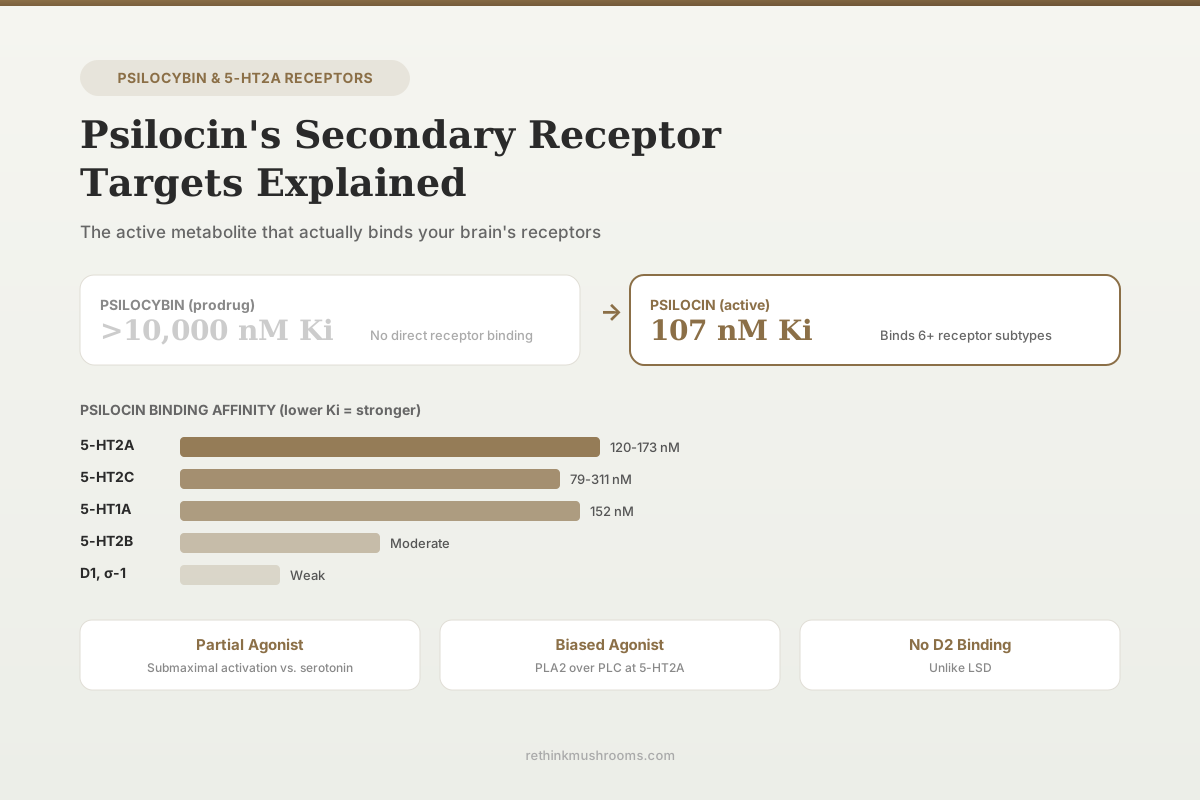
Psilocin's binding affinity at the 5-HT2A receptor is approximately 107 nM, while psilocybin itself has a Ki over 10,000 nM, confirming psilocin as the pharmacologically active molecule.
Erkizia-Santamaria et al., Biomedicine & Pharmacotherapy, 2022
Prodrug
psilocybin is inactive at receptors
Partial Agonist
not full agonist like serotonin
Biased
activates PLA2 over PLC at 5-HT2A
Erkizia-Santamaria et al., Biomedicine & Pharmacotherapy, 2022
 View as image ↗
Psilocybin is a prodrug. It has virtually no receptor binding activity on its own (Ki over 10,000 nM at 5-HT2A). After oral ingestion, alkaline phosphatase in the intestinal mucosa and liver strips the phosphate group, converting it to psilocin (4-hydroxy-N,N-dimethyltryptamine), which is the molecule that actually enters the brain and binds to receptors.[1] Hasler et al. (1997) established the pharmacokinetic profile: after oral psilocybin, plasma psilocin peaks at approximately 80-105 minutes, with an elimination half-life of approximately 2.5 hours.[2]
This distinction matters because discussions of "psilocybin's receptor pharmacology" are actually about psilocin's receptor pharmacology. The binding profile of psilocin extends well beyond 5-HT2A, encompassing multiple serotonin receptor subtypes and several non-serotonergic targets. For a broader overview of how these receptors shape the psychedelic experience, see beyond 5-HT2A: other serotonin receptors psilocybin activates.
Key Takeaways
- Psilocybin has a Ki over 10,000 nM at 5-HT2A; psilocin's Ki is approximately 107-173 nM, confirming psilocin as the active compound (Erkizia-Santamaria et al., 2022)
- Psilocin's binding affinities at 5-HT2A, 5-HT2C, and 5-HT1A are in the same nanomolar range (120-173, 79-311, and 152 nM respectively), making it a non-selective serotonin agonist (Erkizia-Santamaria et al., 2022)
- Psilocin acts as a partial agonist at 5-HT2A, activating phospholipase A2 rather than phospholipase C like serotonin, demonstrating functional selectivity (biased agonism)
- Norpsilocin, differing from psilocin by one methyl group, retains 5-HT2A binding in vitro but fails to produce psychedelic effects in vivo due to poor CNS penetration (Sherwood et al., 2024)
- Psilocin also shows low-to-moderate affinity for dopamine D1, 5-HT1B, 5-HT1D, 5-HT5A, 5-HT6, 5-HT7, and sigma receptors, but with less consistency across studies
- After a single dose, 5-HT2A receptor density drops 15-50% within 24 hours but returns to baseline by day 7, while synaptic density increases persist at 9.24% at day 7 (Raval et al., 2021)
The Full Binding Landscape
High-Affinity Serotonin Targets
Erkizia-Santamaria et al. (2022) performed competition binding studies using radiolabeled ligands in human and mouse brain tissue to establish psilocin's affinity across the three principal serotonin receptor subtypes. The Ki values were: 5-HT2A (120-173 nM), 5-HT2C (79-311 nM), and 5-HT1A (152-146 nM).[1]
These values are striking because they show roughly equivalent affinity across all three subtypes. Unlike LSD, which shows more pronounced selectivity differences across receptor subtypes, psilocin is essentially a pan-serotonin agonist within the 5-HT1A/2A/2C family. The pharmacological consequences of this non-selectivity play out in distinct physiological compartments: 5-HT2A activation in cortical pyramidal neurons produces perceptual distortion, 5-HT1A activation in the raphe nuclei and hippocampus modulates anxiety and body temperature, and 5-HT2C activation in the ventral tegmental area modulates dopamine release.
Moderate-Affinity Serotonin Targets
Ray (2010) published a comprehensive "receptorome" analysis mapping psilocin's binding across a broader panel of targets. Beyond the high-affinity triad, psilocin showed binding at 5-HT1B, 5-HT1D, 5-HT2B, 5-HT5A, 5-HT6, and 5-HT7 receptors, though with lower and more variable affinities. The 5-HT2B interaction is relevant for cardiac safety: chronic 5-HT2B agonism drives cardiac valve fibrosis, the mechanism behind fenfluramine-induced valvulopathy. Rouaud et al. (2024) specifically examined this risk in the context of psychedelic microdosing regimens.[3]
The 5-HT1D receptor, while less studied in the psychedelic context, is the target of triptans (sumatriptan, rizatriptan) used for migraine treatment. Psilocin's 5-HT1D binding may be relevant to anecdotal reports of psilocybin alleviating cluster headaches, though this hypothesis has not been rigorously tested. For more on the primary 5-HT2A mechanism, see psilocybin and 5-HT2A receptors: the gateway to psychedelic effects.
Non-Serotonergic Targets
The receptorome data also reveal weak interactions with dopamine D1 receptors, sigma-1 receptors, and the serotonin transporter (SERT). Unlike LSD, psilocin shows no meaningful affinity for dopamine D2 receptors. This distinction has concrete functional implications: D2 activation contributes to LSD's stimulant-like properties, its capacity to produce euphoria through mesolimbic dopamine enhancement, and its considerably longer duration of action (8-12 hours vs. psilocin's 4-6 hours). None of these D2-mediated effects characterize the psilocin experience.
The sigma-1 receptor interaction, while at relatively weak affinity, warrants attention. Sigma-1 is an endoplasmic reticulum chaperone protein implicated in neuroplasticity, neuroprotection, calcium signaling, and the modulation of NMDA receptor function. DMT (N,N-dimethyltryptamine), a close structural relative of psilocin, has a more established sigma-1 interaction. Whether psilocin's sigma-1 binding contributes to its effects at physiologically relevant concentrations remains an open question, but it represents a potential non-serotonergic mechanism that could partially account for observations not easily explained by serotonin receptor pharmacology alone.
Psilocin also shows weak binding at the serotonin transporter (SERT), the molecular target of SSRIs. This interaction raises the question of whether psilocin produces a mild serotonin reuptake inhibition effect in addition to its direct receptor agonism. The affinity is far weaker than clinical SSRIs, but even modest SERT occupancy could elevate synaptic serotonin levels, creating an indirect amplification of psilocin's direct receptor effects.
Functional Selectivity and Biased Agonism
Psilocin does not simply turn on every receptor it binds. It acts as a partial agonist at 5-HT2A, meaning it produces submaximal activation compared to serotonin (a full agonist). More critically, psilocin displays biased agonism: it preferentially activates phospholipase A2 (PLA2) signaling over phospholipase C (PLC) signaling at the 5-HT2A receptor. Serotonin, by contrast, primarily activates PLC.
This distinction matters because PLC and PLA2 activation trigger different downstream cascades. PLC signaling generates inositol trisphosphate (IP3) and diacylglycerol (DAG), leading to calcium release and protein kinase C activation. PLA2 signaling releases arachidonic acid, which feeds into eicosanoid pathways involved in inflammation and synaptic plasticity. The biased agonism means psilocin is not a serotonin substitute; it shifts the cell's signaling toward a distinct functional output.
Sherwood et al. (2024) demonstrated how small structural changes alter this pharmacological profile. Norpsilocin, lacking one N-methyl group compared to psilocin, retains 5-HT2A binding in vitro with similar potency. But in vivo, norpsilocin produces no psychedelic-like head-twitch response in mice. The explanation is not pharmacodynamic (the receptor interaction is intact) but pharmacokinetic: norpsilocin's reduced lipophilicity prevents adequate CNS penetration. Adding a single carbon to the N-alkyl chain (N-ethyl instead of N-methyl) restored full psilocin-like activity (ED50 = 1.4 mg/kg).[4] For context on related tryptamine alkaloids that may also contribute to the pharmacological profile, see baeocystin and norbaeocystin: psilocybin's lesser-known relatives.
Receptor Occupancy in the Human Brain
Madsen et al. (2019) provided the first quantification of psilocin's actual receptor occupancy in living humans using PET imaging with the 5-HT2A agonist radioligand [11C]Cimbi-36. Oral psilocybin doses of 3-30 mg produced dose-dependent 5-HT2A occupancies reaching 72%. Subjective psychedelic intensity tracked both occupancy levels and plasma psilocin concentrations, conforming to a single-site binding model.[5]
This study measured only 5-HT2A occupancy; no PET data exist for psilocin's occupancy at 5-HT1A, 5-HT2C, or other receptor subtypes in humans. Given the similar Ki values, simultaneous engagement of multiple receptor subtypes at therapeutic doses is highly likely, but the relative occupancy at each subtype remains unmeasured. This gap is a major limitation in understanding which receptors contribute to specific aspects of the experience.
The challenge is technical: PET imaging requires specific radioligands for each receptor subtype, and not all subtypes have well-validated agonist tracers suitable for human use. Developing and validating a PET protocol for each of psilocin's targets, then running multi-tracer studies in the same participants, represents a substantial methodological undertaking that no group has yet completed. In the meantime, the relative receptor contributions must be inferred from in vitro binding data combined with pharmacological blocking studies in animals.
Stenbæk et al. (2021) extended this work by examining whether baseline 5-HT2A density predicts the subjective response. Using pre-drug PET scans in 16 participants, they found that lower neocortical 5-HT2A binding predicted longer peak plateau duration and higher mystical experience scores.[6] The interpretation: individuals with fewer available 5-HT2A receptors may achieve higher fractional occupancy at a given dose, or the relative contribution of secondary receptors (5-HT1A, 5-HT2C) may be amplified when 5-HT2A density is lower. For detailed analysis of how 5-HT2A density shapes individual responses, see 5-HT2A receptor density and psilocybin response.
Post-Acute Receptor Dynamics
Raval et al. (2021) mapped what happens to receptors after psilocin exposure using autoradiography in pig brains. One day after a single IV dose (0.08 mg/kg), hippocampal 5-HT2A density decreased 15-50% depending on the radioligand used. Prefrontal cortex 5-HT2A density also decreased. Simultaneously, synaptic vesicle protein 2A (SV2A) density, a marker of synaptic terminals, increased by 4.42% in the hippocampus.[7]
By day seven, the 5-HT2A downregulation had resolved to baseline, but the SV2A increase persisted and had actually grown: 9.24% in the hippocampus and 6.10% in the prefrontal cortex. This temporal dissociation is pharmacologically important. It means the lasting structural changes (more synaptic terminals, more dendritic spines) outlast the receptor changes.
Shao et al. (2024) confirmed that 5-HT2A activation is required to initiate these structural changes. Using targeted 5-HT2A knockout in mouse medial frontal cortex, they abolished both the dendritic spine growth and the stress-related behavioral improvements produced by psilocybin. The drug increased spine density in both pyramidal tract (PT) and intratelencephalic (IT) neurons, but only PT neurons were functionally required for the behavioral effects.[8] For more on how 5-HT2A creates the acute psychedelic experience, see how 5-HT2A agonism creates the psychedelic experience.
Open Questions in Psilocin Pharmacology
The most pressing gaps:
Missing occupancy data. PET studies have measured psilocin's 5-HT2A occupancy in humans but not its occupancy at 5-HT1A, 5-HT2C, or 5-HT1B. Without these measurements, the relative contribution of each receptor to the therapeutic and experiential effects remains modeled from in vitro binding data rather than measured in vivo.
Biased agonism implications. Psilocin's preference for PLA2 over PLC signaling at 5-HT2A is established, but how this bias maps onto therapeutic outcomes versus subjective effects is unknown. Non-hallucinogenic psychedelic analogues being developed by pharmaceutical companies may have different bias profiles, which could either preserve or eliminate the therapeutic mechanism.
Entourage pharmacology. Whole mushroom preparations contain psilocybin, psilocin, baeocystin, norbaeocystin, and in some species aeruginascin. Jensen et al. (2006) identified aeruginascin as structurally related to the 5-HT3 agonist bufotenidine.[9] Whether these co-occurring compounds modify psilocin's receptor pharmacology through competitive binding, allosteric modulation, or independent receptor engagement remains untested in controlled studies.
Individual variation. The Stenbæk et al. (2021) finding that baseline 5-HT2A density predicts the experience implies that receptor expression patterns, which vary by genetics, age, and antidepressant history, could shift the relative weight of secondary targets in any given individual. Someone with lower 5-HT2A expression who takes psilocybin will still engage 5-HT1A and 5-HT2C to the same degree, but with less 5-HT2A-mediated competition for attention-shaping signaling. This could produce qualitatively different experiences. Personalizing dose or preparation based on receptor phenotype is not yet feasible but represents a logical direction for the field as neuroimaging tools improve and costs decrease.
The Bottom Line
Psilocin, not psilocybin, is the molecule that interacts with brain receptors. It binds 5-HT2A, 5-HT2C, and 5-HT1A with similar nanomolar affinity, making it a non-selective serotonin partial agonist with biased signaling at 5-HT2A. Moderate-affinity targets include 5-HT2B, 5-HT1B, 5-HT1D, and sigma receptors. No human PET data exist for occupancy at receptors other than 5-HT2A, leaving the functional contribution of secondary targets inferred rather than measured.
Frequently Asked Questions
Sources & References
- 1RTHM-00757·Erkizia-Santamaría, I et al. (2022). “Serotonin 5-HT2A, 5-HT2c and 5-HT1A receptor involvement in the acute effects of psilocybin in mice. In vitro pharmacological profile and modulation of thermoregulation and head-twich response..” Biomedicine & pharmacotherapy = Biomedecine & pharmacotherapie.Study breakdown →PubMed →↩
- 2RTHM-00021·Hasler, F et al. (1997). “Determination of psilocin and 4-hydroxyindole-3-acetic acid in plasma by HPLC-ECD and pharmacokinetic profiles of oral and intravenous psilocybin in man..” Pharmaceutica acta Helvetiae.Study breakdown →PubMed →↩
- 3RTHM-00903·Rouaud, Antonin et al. (2024). “Microdosing psychedelics and the risk of cardiac fibrosis and valvulopathy: Comparison to known cardiotoxins..” Journal of psychopharmacology (Oxford.Study breakdown →PubMed →↩
- 4RTHM-00908·Sherwood, Alexander M et al. (2024). “Psychedelic-like Activity of Norpsilocin Analogues..” ACS chemical neuroscience.Study breakdown →PubMed →↩
- 5RTHM-00578·Madsen, Martin K et al. (2019). “Psychedelic effects of psilocybin correlate with serotonin 2A receptor occupancy and plasma psilocin levels..” Neuropsychopharmacology : official publication of the American College of Neuropsychopharmacology.Study breakdown →PubMed →↩
- 6RTHM-00720·Stenbæk, Dea Siggaard et al. (2021). “Brain serotonin 2A receptor binding predicts subjective temporal and mystical effects of psilocybin in healthy humans..” Journal of psychopharmacology (Oxford.Study breakdown →PubMed →↩
- 7RTHM-00714·Raval, Nakul Ravi et al. (2021). “A Single Dose of Psilocybin Increases Synaptic Density and Decreases 5-HT2A Receptor Density in the Pig Brain..” International journal of molecular sciences.Study breakdown →PubMed →↩
- 8RTHM-00906·Shao, Ling-Xiao et al. (2024). “Pyramidal cell types and 5-HT2A receptors are essential for psilocybin's lasting drug action..” bioRxiv : the preprint server for biology.Study breakdown →PubMed →↩
- 9RTHM-00101·Jensen, Niels et al. (2006). “Aeruginascin, a trimethylammonium analogue of psilocybin from the hallucinogenic mushroom Inocybe aeruginascens..” Planta medica.Study breakdown →PubMed →↩