Psilocybin & 5-HT2A Receptors
72% peak occupancy
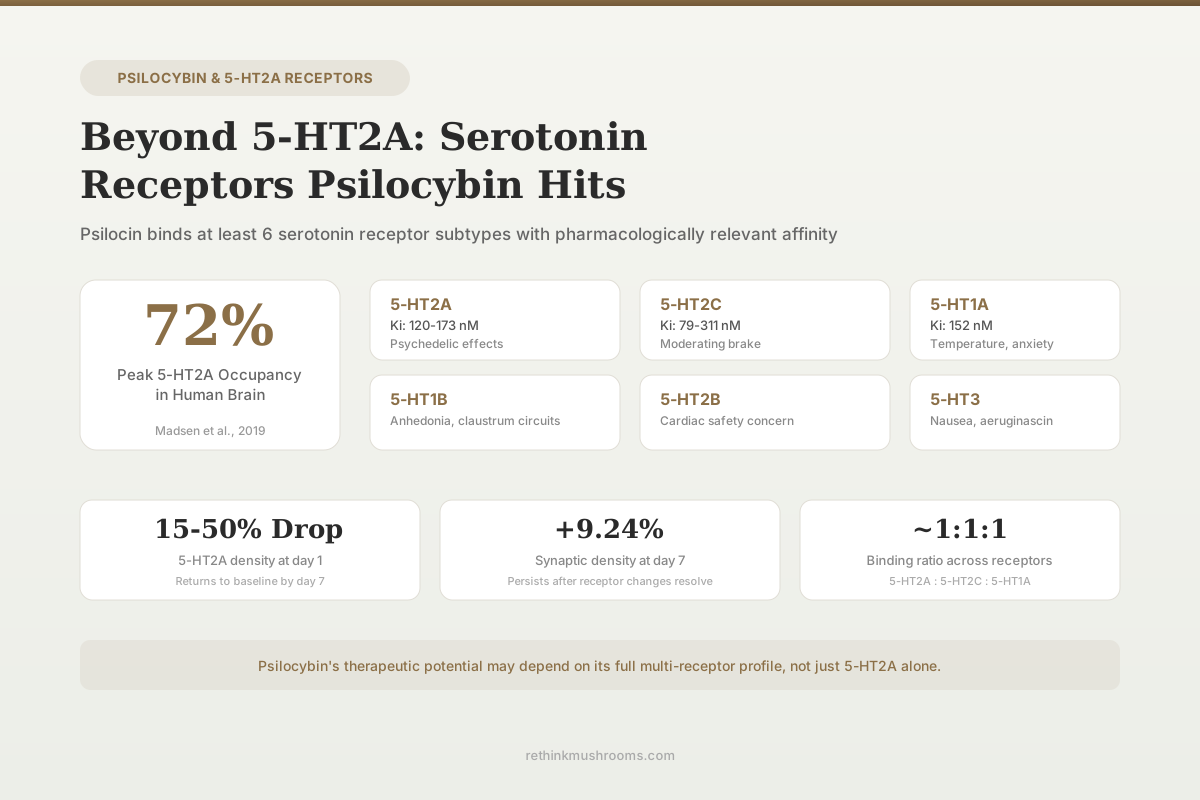
Psilocybin produces dose-related 5-HT2A receptor occupancy up to 72% in the human brain, but psilocin also binds 5-HT1A and 5-HT2C with comparable affinity.
Madsen et al., Neuropsychopharmacology, 2019
120-173 nM
psilocin Ki at 5-HT2A
79-311 nM
psilocin Ki at 5-HT2C
152 nM
psilocin Ki at 5-HT1A
Madsen et al., Neuropsychopharmacology, 2019
 View as image ↗
Psilocybin's psychedelic effects are driven by 5-HT2A receptor activation. That much is established. But psilocin, the active metabolite that actually reaches the brain after psilocybin is dephosphorylated in the gut, does not bind exclusively to 5-HT2A. It hits at least six serotonin receptor subtypes with pharmacologically relevant affinity.[1] This polypharmacology is not a minor footnote. It shapes the temperature changes, anxiety modulation, cardiovascular risks, and potentially the therapeutic effects that distinguish psilocybin from more selective 5-HT2A agonists. For a detailed look at how 5-HT2A density affects individual responses, see our article on 5-HT2A receptor density and psilocybin response.
Understanding which receptors psilocin activates, at what concentrations, and with what functional consequences is essential for interpreting both the psychedelic experience and psilocybin's clinical potential. The picture that emerges from recent pharmacology research is considerably more complex than "psilocybin activates 5-HT2A."
Key Takeaways
- Psilocin binds 5-HT2A (Ki: 120-173 nM), 5-HT2C (Ki: 79-311 nM), and 5-HT1A (Ki: 152 nM) with overlapping affinity ranges in human brain tissue (Erkizia-Santamaria et al., 2022)
- Psilocybin produces dose-related 5-HT2A occupancy up to 72% in human PET imaging, with psychedelic intensity correlating directly with occupancy levels (Madsen et al., 2019)
- The 5-HT2C antagonist SB242084 increased psilocybin's head-twitch response in mice, suggesting 5-HT2C acts as a brake on 5-HT2A-mediated effects (Erkizia-Santamaria et al., 2022)
- The 5-HT1A antagonist WAY100635 reversed psilocybin-induced hypothermia and caused hyperthermia, demonstrating 5-HT1A mediates temperature regulation independent of 5-HT2A (Erkizia-Santamaria et al., 2022)
- A single psilocybin dose decreased hippocampal 5-HT2A density by 15-50% at day one, returning to baseline by day seven, while synaptic density increased 9.24% in hippocampus and persisted at day seven (Raval et al., 2021)
- Aeruginascin, a natural analogue found in some psilocybin mushrooms, is structurally related to bufotenidine, a potent 5-HT3 receptor agonist (Jensen et al., 2006)
Psilocin's Multi-Receptor Binding Profile
Erkizia-Santamaria et al. (2022) conducted competition binding studies with psilocin in both human and mouse brain tissue, providing the clearest picture of psilocin's receptor affinity spectrum. The inhibition constants (Ki values) show overlapping ranges across three major serotonin receptor subtypes: 5-HT2A (Ki: 120-173 nM), 5-HT2C (Ki: 79-311 nM), and 5-HT1A (Ki: 152-146 nM).[1]
These numbers mean psilocin does not strongly prefer 5-HT2A over 5-HT1A or 5-HT2C. The selectivity ratio is roughly 1:1:1 at the binding level. What makes 5-HT2A dominant for the psychedelic experience is not binding affinity but downstream signal transduction: 5-HT2A agonism activates specific intracellular cascades (phospholipase C, beta-arrestin recruitment) that produce the characteristic perceptual and cognitive effects. The 5-HT2A antagonist MDL11939 at 1 mg/kg completely suppressed psilocybin's head-twitch response in mice, confirming that this specific behavioral proxy for psychedelic activity requires 5-HT2A activation.[1]
Madsen et al. (2019) provided the first human PET data on psilocybin's 5-HT2A occupancy. Using the agonist radioligand [11C]Cimbi-36, they measured dose-related occupancies reaching 72% at the highest psilocybin doses (3-30 mg oral). Subjective psychedelic intensity correlated with both 5-HT2A occupancy and plasma psilocin levels, conforming to a single-site binding model.[2] For more on how 5-HT2A agonism produces the psychedelic state, see how 5-HT2A agonism creates the psychedelic experience.
5-HT1A: Temperature Regulation and the Anxiolytic Component
The 5-HT1A receptor is the best-characterized secondary target. Erkizia-Santamaria et al. (2022) demonstrated that psilocybin produced biphasic temperature effects in mice: low doses (0.125 mg/kg) caused a slight temperature increase (Emax = 0.67 degrees C), while higher doses (over 1 mg/kg) caused a decrease (Emax = -1.31 degrees C). Pre-treatment with the selective 5-HT1A antagonist WAY100635 reversed the hypothermia and caused hyperthermia (Emax = 0.94 degrees C), demonstrating that the cooling effect is 5-HT1A-mediated, not 5-HT2A-mediated.[1]
This finding has implications beyond thermoregulation. 5-HT1A receptors are densely expressed in the raphe nuclei, hippocampus, and prefrontal cortex. The 5-HT1A receptor is the target of buspirone (an anxiolytic) and is implicated in the regulation of anxiety, mood, and stress response. Cameron et al. (2023), reviewing non-5-HT2A targets in their Journal of Neuroscience symposium paper, noted that 5-HT1A activation may contribute to the anxiolytic component of the psilocybin experience, operating through distinct circuits from the 5-HT2A-mediated perceptual effects.
Stenbæk et al. (2021) found that baseline 5-HT2A receptor density in the neocortex predicted aspects of the psilocybin experience: individuals with lower 5-HT2A binding had longer peak plateau durations and higher mystical experience scores.[3] While this study focused on 5-HT2A, it underscores that the balance between receptor subtypes shapes individual responses. If 5-HT2A is lower, the relative contribution of 5-HT1A activation to the overall experience increases.
5-HT2C: The Opposing Brake
The 5-HT2C receptor acts as a functional counterweight to 5-HT2A in the psilocybin response. Erkizia-Santamaria et al. (2022) showed that the 5-HT2C antagonist SB242084 at 0.1 mg/kg increased the head-twitch response elicited by psilocybin at 3 mg/kg.[1] In other words, blocking 5-HT2C enhanced the 5-HT2A-mediated behavioral response.
This suggests a model where psilocin simultaneously activates both 5-HT2A (excitatory, pro-psychedelic) and 5-HT2C (inhibitory, moderating). At higher psilocybin doses, 5-HT2C engagement may partially cap the psychedelic intensity, which could explain the bell-shaped dose-response curve observed at 3 mg/kg in the same study, where HTR counts were lower than the 1 mg/kg peak (9.00 vs. 17.07 counts).
The 5-HT2C receptor is also implicated in appetite regulation, impulsivity, and mesolimbic dopamine release modulation. Lorcaserin, a selective 5-HT2C agonist, was approved (and later withdrawn for other reasons) as an anti-obesity drug. The 5-HT2C receptor sits at the intersection of serotonin and dopamine signaling: its activation in the ventral tegmental area inhibits dopamine release in the nucleus accumbens. During a psilocybin session, simultaneous 5-HT2A excitation and 5-HT2C-mediated dopamine dampening may produce the paradoxical combination of vivid perceptual amplification with reduced reward-seeking behavior.
The interplay between 5-HT2A and 5-HT2C is also relevant for understanding the dose-response relationship. At lower psilocybin doses, 5-HT2A agonism may dominate because the excitatory signaling cascade amplifies small receptor occupancy changes. At higher doses, 5-HT2C engagement increases proportionally and begins to moderate the response, potentially explaining why very high doses do not always produce proportionally more intense subjective effects. For deeper analysis of the secondary receptor landscape specific to psilocin, see beyond 5-HT2A: secondary receptor targets of psilocin.
5-HT2B: The Cardiac Safety Concern
The 5-HT2B receptor deserves attention not for therapeutic potential but for safety. Chronic activation of 5-HT2B receptors is associated with cardiac valvulopathy, the mechanism by which fenfluramine (fen-phen) and ergot-derived drugs like methysergide caused heart valve damage. Rouaud et al. (2024) examined the risk of cardiac fibrosis and valvulopathy from microdosing psychedelics, comparing known cardiotoxins with the 5-HT2B binding profile of psilocin.[4]
The concern is largely theoretical for infrequent use. A single psilocybin session exposes cardiac 5-HT2B receptors to psilocin for approximately 4-6 hours. The drugs that caused clinical valvulopathy (fenfluramine, pergolide) were taken daily for months or years. The risk calculus changes substantially for microdosing regimens, where repeated low-dose exposure could accumulate cardiac effects over time. For a dedicated analysis of this risk profile, see our article on 5-HT2B and cardiac valvulopathy: is long-term psilocybin use safe?.
5-HT1B: Anxiety Reduction and Cortical Circuit Modulation
Research published in 2025 identified 5-HT1B as a functionally important target for psilocybin's behavioral effects. The 5-HT1B receptor mediates some of psilocybin's acute and persisting behavioral effects in mice, particularly decreased anhedonia and reduced anxiety-like behavior. Serotonin and psilocybin activate 5-HT1B receptors on anterior cingulate cortex inputs to suppress signaling to parietal association cortex-projecting claustrum neurons.
This circuit-level finding positions 5-HT1B as a potential contributor to the sustained mood improvements reported after psilocybin sessions. The claustrum, a thin sheet of neurons interconnecting cortical areas, has been hypothesized to play a role in conscious awareness and sensory integration. Psilocybin's suppression of claustrum output through 5-HT1B activation could contribute to the dissolution of rigid thought patterns reported during psychedelic experiences.
Aeruginascin and the 5-HT3 Connection
Not all serotonin receptor interactions come from psilocin itself. Jensen et al. (2006) identified aeruginascin in Inocybe aeruginascens as a quaternary ammonium compound (N,N,N-trimethyl-4-phosphoryloxytryptamine) structurally related to bufotenidine, a potent 5-HT3 receptor agonist.[5] Aeruginascin has since been detected in some Psilocybe species as well.
The 5-HT3 receptor is unique among serotonin receptors: it is a ligand-gated ion channel rather than a G-protein-coupled receptor. 5-HT3 activation produces rapid excitatory effects and is involved in nausea, anxiety, and gastrointestinal motility. Whether aeruginascin reaches 5-HT3 receptors in the brain at relevant concentrations is unknown, but its presence adds another pharmacological variable to the "entourage" of compounds in whole mushroom preparations versus purified psilocybin. For more on related tryptamine alkaloids, see baeocystin and norbaeocystin: psilocybin's lesser-known relatives.
Receptor Downregulation and Structural Plasticity
The secondary receptor story extends beyond acute binding to post-acute changes in receptor density. Raval et al. (2021) used autoradiography in pigs to measure changes after a single intravenous psilocybin dose (0.08 mg/kg). One day after injection, hippocampal 5-HT2A receptor density decreased by 15.21% to 50.19% (depending on the radioligand used), while synaptic vesicle protein 2A (SV2A, a marker of synaptic density) increased by 4.42%.[6]
By day seven, the 5-HT2A changes had reversed, but SV2A density remained elevated at 9.24% in the hippocampus and 6.10% in the prefrontal cortex. This temporal dissociation, where receptor downregulation resolves but structural changes persist, suggests that the lasting effects of psilocybin may not depend on sustained receptor changes.
Shao et al. (2024) confirmed that 5-HT2A is essential for psilocybin's lasting drug action using targeted receptor knockout in mice. In the medial frontal cortex, psilocybin increased dendritic spine density in both pyramidal tract (PT) and intratelencephalic (IT) neurons, but only PT neurons were required for behavioral improvements. Targeted 5-HT2A knockout abolished both the structural plasticity and the behavioral effects.[7]
Sherwood et al. (2024) demonstrated that norpsilocin, which differs from psilocin by a single methyl group, retains 5-HT2A binding in vitro but fails to produce psychedelic effects in vivo due to poor CNS bioavailability. Their norpsilocin analogues interacted with multiple serotonin receptor subtypes and sigma receptors, highlighting the broader binding landscape of tryptamine psychedelics.[8]
Why This Matters for Drug Development
The multi-receptor binding profile of psilocin creates a fundamental question for psychedelic drug development: are the non-5-HT2A effects therapeutic, neutral, or detrimental? If 5-HT1A activation contributes to anxiolysis and 5-HT1B activation drives sustained mood improvement, then more selective 5-HT2A agonists might lose therapeutic efficacy even if they retain psychedelic properties. If 5-HT2C acts as a natural safety brake on excessive 5-HT2A stimulation, removing that brake in a "cleaner" compound could increase adverse effects.
Several pharmaceutical companies are developing non-hallucinogenic psychedelic analogues that attempt to separate 5-HT2A-mediated neuroplasticity from the subjective psychedelic experience. This approach assumes that the therapeutic mechanism can be isolated from the polypharmacological profile. Whether that assumption holds is one of the central open questions in psychedelic medicine.
Vargas et al. (2023) demonstrated in Science that psychedelics promote neuroplasticity through activation of intracellular 5-HT2A receptors, not just surface receptors. This finding adds another layer of complexity: the same receptor can produce different cellular outcomes depending on whether it is activated at the cell surface (triggering G-protein signaling and the psychedelic experience) or intracellularly (triggering neuroplastic changes that may underlie therapeutic effects). If intracellular 5-HT2A activation is sufficient for neuroplasticity, compounds that permeate cell membranes efficiently might produce therapeutic effects without the full psychedelic response, but they would still miss the potential contributions of 5-HT1A, 5-HT2C, and 5-HT1B to the overall clinical outcome. For context on 5-HT2A's role as the primary gateway, see psilocybin and 5-HT2A receptors: the gateway to psychedelic effects.
The Bottom Line
Psilocin binds 5-HT1A, 5-HT2C, 5-HT1B, and other serotonin receptors with affinities comparable to its 5-HT2A binding. These secondary targets mediate temperature regulation, moderate psychedelic intensity, modulate anxiety, and raise cardiac safety questions for chronic use. The therapeutic implications of this multi-receptor profile are unresolved, and they represent a central challenge for developing next-generation psychedelic compounds.
Frequently Asked Questions
Sources & References
- 1RTHM-00757·Erkizia-Santamaría, I et al. (2022). “Serotonin 5-HT2A, 5-HT2c and 5-HT1A receptor involvement in the acute effects of psilocybin in mice. In vitro pharmacological profile and modulation of thermoregulation and head-twich response..” Biomedicine & pharmacotherapy = Biomedecine & pharmacotherapie.Study breakdown →PubMed →↩
- 2RTHM-00578·Madsen, Martin K et al. (2019). “Psychedelic effects of psilocybin correlate with serotonin 2A receptor occupancy and plasma psilocin levels..” Neuropsychopharmacology : official publication of the American College of Neuropsychopharmacology.Study breakdown →PubMed →↩
- 3RTHM-00720·Stenbæk, Dea Siggaard et al. (2021). “Brain serotonin 2A receptor binding predicts subjective temporal and mystical effects of psilocybin in healthy humans..” Journal of psychopharmacology (Oxford.Study breakdown →PubMed →↩
- 4RTHM-00903·Rouaud, Antonin et al. (2024). “Microdosing psychedelics and the risk of cardiac fibrosis and valvulopathy: Comparison to known cardiotoxins..” Journal of psychopharmacology (Oxford.Study breakdown →PubMed →↩
- 5RTHM-00101·Jensen, Niels et al. (2006). “Aeruginascin, a trimethylammonium analogue of psilocybin from the hallucinogenic mushroom Inocybe aeruginascens..” Planta medica.Study breakdown →PubMed →↩
- 6RTHM-00714·Raval, Nakul Ravi et al. (2021). “A Single Dose of Psilocybin Increases Synaptic Density and Decreases 5-HT2A Receptor Density in the Pig Brain..” International journal of molecular sciences.Study breakdown →PubMed →↩
- 7RTHM-00906·Shao, Ling-Xiao et al. (2024). “Pyramidal cell types and 5-HT2A receptors are essential for psilocybin's lasting drug action..” bioRxiv : the preprint server for biology.Study breakdown →PubMed →↩
- 8RTHM-00908·Sherwood, Alexander M et al. (2024). “Psychedelic-like Activity of Norpsilocin Analogues..” ACS chemical neuroscience.Study breakdown →PubMed →↩