Psilocybin Chemistry
4 minor tryptamines
Psilocybin mushrooms contain at least four tryptamine compounds beyond psilocybin: baeocystin, norbaeocystin, aeruginascin, and norpsilocin. Recent pharmacology studies show none produce independent psychedelic effects in animal models.
Sherwood et al., J Nat Prod, 2020
No head twitch
baeocystin alone in mouse HTR assay
5-HT2A agonist
norpsilocin binds but fails BBB
2x HTR
norbaeocystin + psilocybin combined
Sherwood et al., J Nat Prod, 2020
 View as image ↗
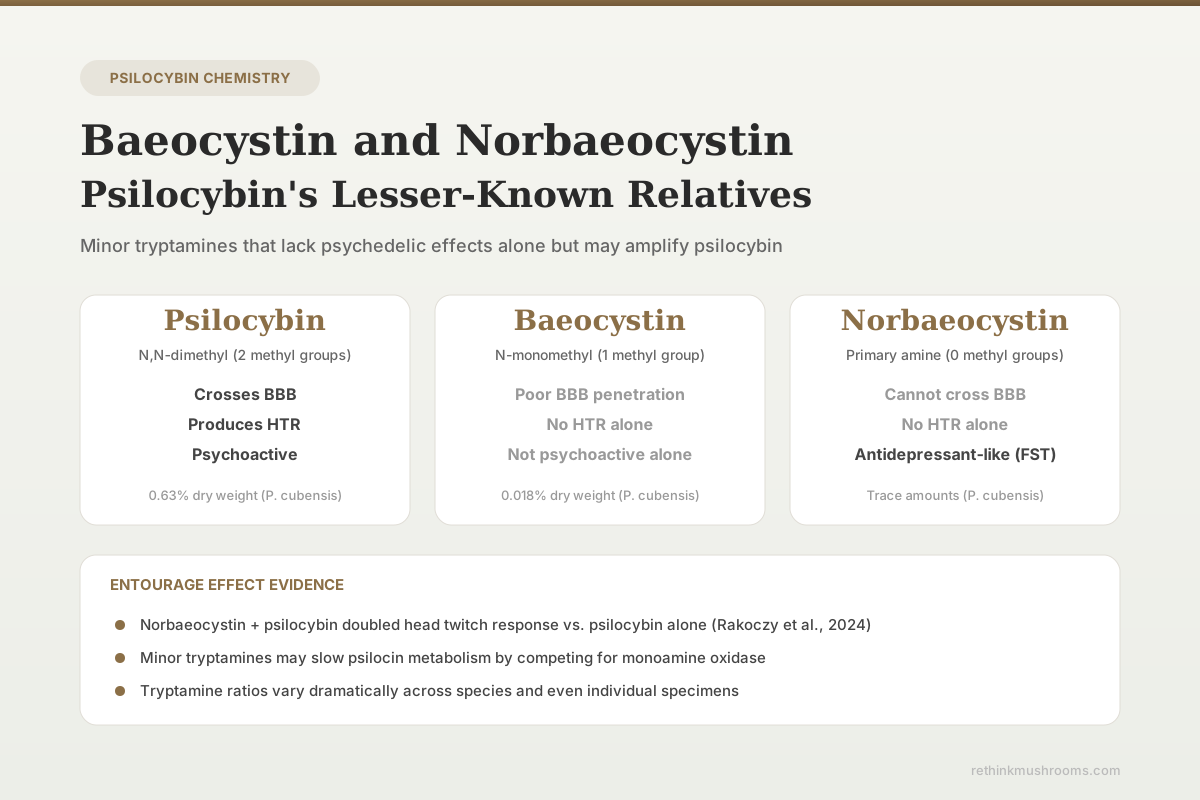
Every psilocybin mushroom contains more than psilocybin. Baeocystin (4-phosphoryloxy-N-methyltryptamine) and norbaeocystin (4-phosphoryloxytryptamine) are the two most commonly detected minor tryptamines, found alongside psilocybin and psilocin in nearly every Psilocybe species analyzed.[1] They differ from psilocybin by a single methyl group: psilocybin is dimethylated, baeocystin is monomethylated, and norbaeocystin has no methyl groups on the amine nitrogen. This simple structural difference has profound pharmacological consequences.
For decades, baeocystin was assumed to be psychoactive based on a single self-experiment by Jochen Gartz in the 1990s, who reported that 10 mg of baeocystin produced effects comparable to psilocybin. Modern pharmacological studies using controlled animal models and receptor binding assays have overturned that assumption. Baeocystin does not produce the head twitch response (the standard rodent marker for psychedelic activity) and appears unable to cross the blood-brain barrier efficiently.[2]
The question has shifted from "are these compounds psychoactive?" to "do they modulate psilocybin's effects when present together?" For how aeruginascin fits into this picture, see the dedicated article. For the broader question of whether minor tryptamines affect the psychedelic experience, see the experiential review.
Key Takeaways
- Baeocystin did not produce head twitch responses in mice (the standard psychedelic activity marker), despite its dephosphorylated metabolite norpsilocin being a potent 5-HT2A receptor agonist in vitro (Sherwood et al., 2020)
- Norbaeocystin showed no hallucinogenic activity independently but improved outcomes in the forced swim test (an antidepressant screening model), suggesting therapeutic potential without psychedelic effects (Rakoczy et al., 2024)
- When norbaeocystin was co-administered with psilocybin in rats, the head twitch response doubled compared to psilocybin alone, providing direct evidence for a pharmacological entourage effect (Rakoczy et al., 2024)
- All four minor tryptamines (baeocystin, norbaeocystin, aeruginascin, norpsilocin) shared nearly identical rates of dephosphorylation by alkaline phosphatase and metabolism by monoamine oxidase in vitro (Rakoczy et al., 2024)
- Baeocystin concentrations in wild Psilocybe cubensis averaged 0.018% dry weight compared to psilocybin's 0.63%, making it roughly 35 times less abundant in the most commonly cultivated species (Gotvaldova et al., 2022)
- Storage at room temperature degraded baeocystin and norbaeocystin faster than psilocybin in dried P. cubensis biomass, suggesting these compounds are less stable (Gotvaldova et al., 2021)
Chemical structure: one methyl group changes everything
Psilocybin, baeocystin, and norbaeocystin share an identical core: the 4-phosphoryloxytryptamine scaffold. They differ only in the number of methyl groups on the terminal nitrogen atom. Psilocybin has two methyl groups (dimethyl), baeocystin has one (monomethyl), and norbaeocystin has none (primary amine).[2]
All three are phosphorylated prodrugs. In the body, alkaline phosphatase removes the phosphate group, converting psilocybin to psilocin (4-hydroxy-DMT), baeocystin to norpsilocin (4-hydroxy-NMT), and norbaeocystin to 4-hydroxytryptamine. The dephosphorylated form is what actually interacts with serotonin receptors.[3]
The methylation state determines two critical pharmacological properties: receptor binding affinity at 5-HT2A (the primary psychedelic receptor) and the ability to cross the blood-brain barrier. Dimethylation (psilocin) provides both. The progressive loss of methyl groups reduces both properties, with norbaeocystin's primary amine being particularly poor at crossing biological membranes due to its polar, charged nature at physiological pH.
Do baeocystin or norbaeocystin produce psychedelic effects?
Sherwood et al. (2020) provided the first rigorous pharmacological evaluation of these compounds. They synthesized pure baeocystin, norbaeocystin, norpsilocin, and aeruginascin and tested them using the mouse head twitch response (HTR) assay, the standard behavioral proxy for 5-HT2A-mediated psychedelic activity in rodents.[2]
Baeocystin did not produce significant head twitch responses at any dose tested. This was surprising because norpsilocin (baeocystin's dephosphorylated metabolite) showed potent 5-HT2A agonist activity in receptor binding assays. The disconnect between in vitro receptor binding and in vivo behavioral effects points to a pharmacokinetic barrier: baeocystin is dephosphorylated to norpsilocin, but norpsilocin cannot efficiently reach the brain. The monomethylated amine likely does not cross the blood-brain barrier as readily as the dimethylated psilocin.[2]
Rakoczy et al. (2024) confirmed and extended these findings in a comprehensive pharmacological comparison. They tested baeocystin, norbaeocystin, and aeruginascin alongside psilocybin for: enzyme kinetics (dephosphorylation, monoamine oxidase metabolism), blood-brain barrier penetration, receptor binding profiles, and behavioral effects in rats.[3]
Only psilocybin induced significant head twitch responses when administered alone. Baeocystin, norbaeocystin, and aeruginascin did not. In vitro, all four compounds were dephosphorylated at nearly identical rates and metabolized by monoamine oxidase at similar rates. The difference is in blood-brain barrier penetration: the less methylated the compound, the less efficiently it enters the brain.[3]
The entourage effect: modulation without independent activity
The most provocative finding from Rakoczy et al. (2024) involved co-administration experiments. When norbaeocystin was given alongside psilocybin in rats, the head twitch response approximately doubled compared to psilocybin alone. This was not a simple additive effect (norbaeocystin alone produced zero head twitches), suggesting a genuine pharmacological interaction where norbaeocystin amplifies psilocybin's effects through an unknown mechanism.[3]
Several mechanistic hypotheses exist. Baeocystin and norbaeocystin may compete for monoamine oxidase (MAO), the enzyme that breaks down psilocin. By occupying MAO, these minor tryptamines could slow psilocin metabolism, effectively increasing psilocin concentration and duration in the brain. Alternatively, their dephosphorylated metabolites might act on peripheral serotonin receptors (outside the brain) in ways that influence the central nervous system response to psilocin.
Like psilocybin, norbaeocystin improved outcomes in the forced swim test (FST), a standard rodent screening model for antidepressant-like effects. This suggests norbaeocystin may share therapeutic potential with psilocybin through a mechanism that does not require psychedelic effects. If norbaeocystin can produce antidepressant-like effects without hallucinations, it could have therapeutic applications independent of its role in whole mushroom preparations.[3]
How much baeocystin and norbaeocystin is actually in mushrooms?
Gotvaldova et al. (2022) analyzed tryptamine alkaloid concentrations in an extensive collection of wild psychotropic mushrooms across multiple Psilocybe species and related genera. In Psilocybe cubensis (the most commonly cultivated species), baeocystin averaged approximately 0.018% dry weight compared to psilocybin's 0.63%. Norbaeocystin and aeruginascin were present at even lower concentrations.[1]
Concentration ratios varied dramatically across species and even between individual specimens of the same species. Some species (particularly in the Inocybe genus) contained relatively higher proportions of baeocystin and aeruginascin relative to psilocybin. Wild-grown mushrooms showed substantially more concentration variability than cultivated specimens, making standardized dosing based on total tryptamine content difficult.[1]
This variability has implications for both the entourage effect hypothesis and therapeutic standardization. If the ratio of minor tryptamines to psilocybin varies between mushroom batches, and if those minor tryptamines modulate the experience (as the Rakoczy data suggests), then whole mushroom preparations would produce inherently variable effects even at the same total psilocybin dose. This is one argument for using purified psilocybin in clinical settings, and one argument for studying whole mushroom extracts separately. For the question of whether albino mushroom strains differ in their tryptamine profiles, see the dedicated article.
Stability and degradation
Gotvaldova et al. (2021) studied the stability of psilocybin and its four analogs (psilocin, baeocystin, norbaeocystin, aeruginascin) in dried Psilocybe cubensis biomass under different storage conditions. Baeocystin and norbaeocystin degraded faster than psilocybin at room temperature, with psilocin being the least stable compound overall.[4]
The practical implication is that the minor tryptamine profile of a mushroom sample changes over time in storage. Fresh or recently dried mushrooms contain a different ratio of baeocystin-to-psilocybin than aged samples. If the entourage effect is real, storage conditions could alter the subjective experience of consuming mushrooms even at the same psilocybin content.
Structure-activity relationships: what the receptor data shows
Glatfelter et al. (2022) conducted a systematic structure-activity relationship (SAR) study for psilocybin, baeocystin, aeruginascin, and related analogues. They measured binding affinity and functional activity at a panel of serotonin receptors, providing the most detailed receptor pharmacology data for these compounds to date.[5]
The SAR data confirmed that the degree of N-methylation is the primary determinant of receptor potency and selectivity. Psilocin (dimethylated) has the highest 5-HT2A affinity. Norpsilocin (monomethylated) retains significant affinity but with altered selectivity across the receptor panel. 4-Hydroxytryptamine (unmethylated, from norbaeocystin) has broad but weak serotonin receptor affinity. These differences at the receptor level explain the behavioral differences observed in animal models and provide a structural rationale for why methylation status determines psychedelic potency.[5]
For the broader context of how 5-HT2A receptor density affects psilocybin response and the historical account of how psilocybin was first isolated, see the dedicated articles.
What this means for the full chemical profile question
The emerging picture is that baeocystin and norbaeocystin are not psychedelic on their own but may be pharmacologically relevant when present alongside psilocybin. The doubling of HTR with norbaeocystin co-administration is the strongest evidence for a mushroom entourage effect published to date, though it is a single study in rats. For a comprehensive look at all the compounds in psychedelic mushrooms and whether the entourage effect in magic mushrooms holds up to scrutiny, see the dedicated reviews.
Norbaeocystin's antidepressant-like effects in the FST, without accompanying psychedelic effects, open a separate line of inquiry. If non-hallucinogenic tryptamines can produce therapeutic effects, the minor alkaloids in psilocybin mushrooms may have clinical value beyond their potential to modulate the psilocybin experience.
The Bottom Line
Baeocystin and norbaeocystin are structurally related to psilocybin but lack independent psychedelic activity in animal models. Their dephosphorylated metabolites bind serotonin receptors but fail to cross the blood-brain barrier efficiently due to reduced N-methylation. Co-administration of norbaeocystin with psilocybin doubled head twitch responses in rats, providing the strongest evidence yet for a pharmacological entourage effect in mushrooms. Norbaeocystin also showed antidepressant-like effects without psychedelic activity, suggesting therapeutic potential independent of psilocybin.
Frequently Asked Questions
Sources & References
- 1RTHM-00762·Gotvaldová, Klára et al. (2022). “Extensive Collection of Psychotropic Mushrooms with Determination of Their Tryptamine Alkaloids..” International journal of molecular sciences.Study breakdown →PubMed →↩
- 2RTHM-00654·Sherwood, Alexander M et al. (2020). “Synthesis and Biological Evaluation of Tryptamines Found in Hallucinogenic Mushrooms: Norbaeocystin, Baeocystin, Norpsilocin, and Aeruginascin..” Journal of natural products.Study breakdown →PubMed →↩
- 3RTHM-00901·Rakoczy, Ryan J et al. (2024). “Pharmacological and behavioural effects of tryptamines present in psilocybin-containing mushrooms..” British journal of pharmacology.Study breakdown →PubMed →↩
- 4RTHM-00688·Gotvaldová, Klára et al. (2021). “Stability of psilocybin and its four analogs in the biomass of the psychotropic mushroom Psilocybe cubensis..” Drug testing and analysis.Study breakdown →PubMed →↩
- 5RTHM-00759·Glatfelter, Grant C et al. (2022). “Structure-Activity Relationships for Psilocybin, Baeocystin, Aeruginascin, and Related Analogues to Produce Pharmacological Effects in Mice..” ACS pharmacology & translational science.Study breakdown →PubMed →↩
- 6RTHM-00101·Jensen, Niels et al. (2006). “Aeruginascin, a trimethylammonium analogue of psilocybin from the hallucinogenic mushroom Inocybe aeruginascens..” Planta medica.Study breakdown →PubMed →↩