History of Psilocybin
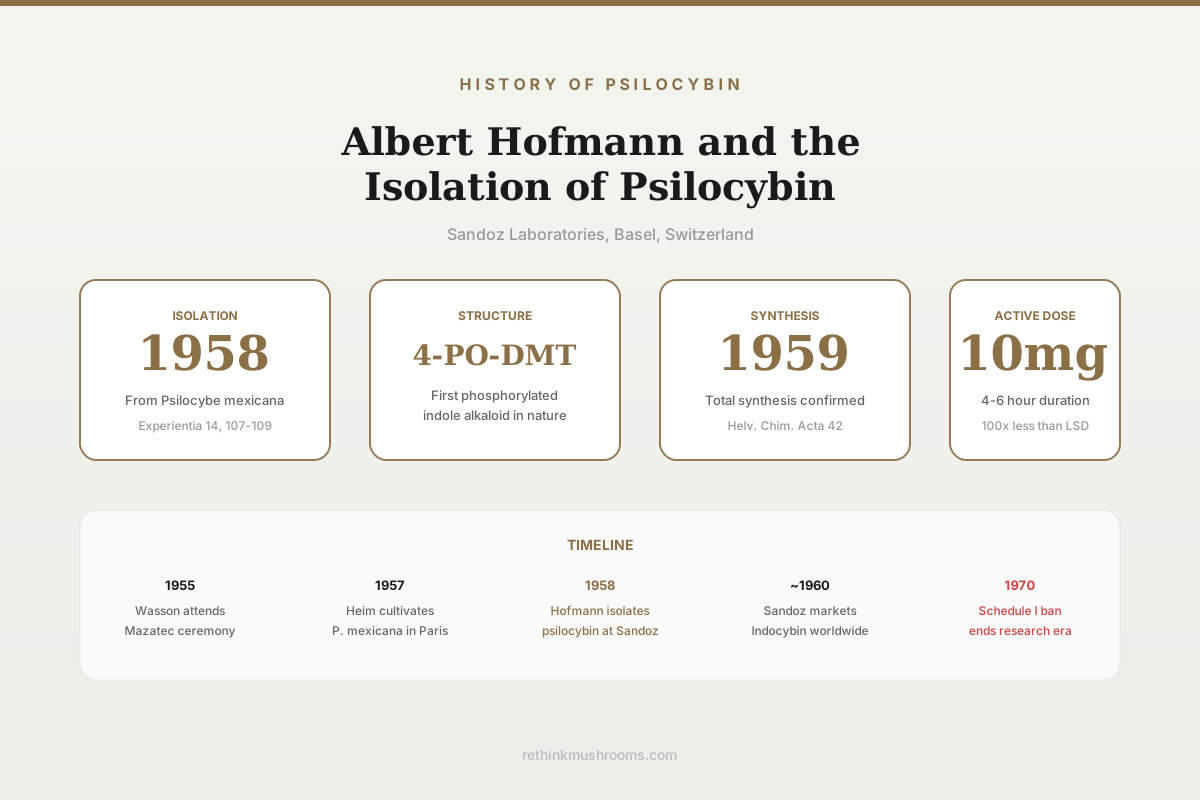
1958
Swiss chemist Albert Hofmann isolated psilocybin and psilocin from Psilocybe mexicana at Sandoz Laboratories in Basel, then synthesized both compounds and determined their chemical structures within the same year.
Hofmann et al., Experientia, 1958
4-PO-DMT
psilocybin: first known naturally phosphorylated indole
10 mg
average active dose in humans, 100x less potent than LSD
Indocybin
trade name Sandoz used to market pure psilocybin to researchers
Hofmann et al., Experientia, 1958
 View as image ↗
On a morning in 1957, Albert Hofmann ate 32 dried specimens of Psilocybe mexicana in his laboratory at Sandoz Pharmaceuticals in Basel, Switzerland. The dose corresponded to 2.4 g of dried mushroom, an amount selected to test whether samples cultivated in a Parisian greenhouse still contained active principles. Within 30 minutes, the world around him changed. "Everything assumed a Mexican character," he later wrote. Faces of the colleagues around him appeared as "colored Indian masks." He had confirmed, through his own nervous system, that the mushrooms were active. The next task was to isolate the molecule responsible.
That molecule, which Hofmann named psilocybin, turned out to be unlike anything previously known in natural product chemistry: the first naturally occurring phosphorylated indole alkaloid ever identified. Its isolation, structural determination, and synthesis, all accomplished within 1958, represent one of the fastest sequences from natural product discovery to total synthesis in the history of pharmacology. The story of how Hofmann came to possess those mushrooms begins with R. Gordon Wasson's Mazatec ceremony, and the broader arc from ancient use to modern clinical trials is covered in the full history of psilocybin.
Key Takeaways
- Hofmann isolated psilocybin (4-phosphoryloxy-N,N-dimethyltryptamine) and psilocin (4-hydroxy-N,N-dimethyltryptamine) from Psilocybe mexicana in 1958, publishing results in Experientia (Hofmann et al., Experientia, 1958)
- Psilocybin was the first naturally occurring phosphorylated indole alkaloid ever discovered, a structural novelty that surprised the chemistry community (Nichols, Journal of Antibiotics, 2020)
- The average active dose was determined at 10 mg, making psilocybin roughly 100 times less potent than LSD by weight, with effects lasting 4-6 hours compared to LSD's 8-12 hours (Geiger et al., ACS Chemical Neuroscience, 2018)
- Sandoz marketed pure synthetic psilocybin under the trade name Indocybin to clinicians and researchers worldwide through the early 1960s (Geiger et al., ACS Chemical Neuroscience, 2018)
- Dried Psilocybe mexicana mushrooms contained 0.2-0.4% psilocybin by weight, requiring Hofmann to process large quantities of cultivated material for initial isolation (Hofmann et al., Helvetica Chimica Acta, 1959)
- The chemical structure was confirmed by total synthesis in the same year as isolation, with the synthesis paper published in Helvetica Chimica Acta (Hofmann et al., 1959)
From Wasson's Mushrooms to Hofmann's Laboratory
The chain of events that placed psychoactive mushrooms in a Swiss chemistry lab began with R. Gordon Wasson, a Vice President at J.P. Morgan who had spent years investigating mushroom use in Indigenous Mesoamerican cultures. In June 1955, Wasson participated in a Mazatec velada (mushroom ceremony) led by the curandera Maria Sabina in Huautla de Jimenez, Mexico. He became the first outsider documented to have consumed sacred mushrooms in a traditional ritual context.[1]
Wasson brought mushroom specimens to Roger Heim, director of the Muséum national d'histoire naturelle in Paris, who identified and classified several species, including Psilocybe mexicana Heim. Heim succeeded in cultivating P. mexicana in his laboratory, producing enough material for chemical analysis. He sent samples to Sandoz Laboratories in Basel, where they landed on Albert Hofmann's desk. Hofmann, then head of Sandoz's natural products department, had already made the most consequential accidental discovery in psychopharmacology: the synthesis of LSD-25 in 1938 and his unintentional exposure to its effects in 1943.
The mushroom project was a natural fit. Sandoz was interested in identifying the active principles in ethnobotanical specimens for potential pharmaceutical development. Hofmann's experience with indole chemistry (LSD is an ergoline, structurally related to the tryptamine core of serotonin) gave him the technical background for the work.
The Isolation Process
Hofmann faced an immediate practical problem. Earlier attempts to isolate the active compound had failed, reportedly including efforts by other chemists who used chemical assays that missed the psychoactive principles. Hofmann took a different approach: he used himself and his colleagues as the assay system. At each step of the chromatographic fractionation, he tested fractions by oral ingestion.
"Since no chemical test was available for detecting the psychotropic constituents of these mushrooms, each fraction obtained from the chromatography had to be tested by oral self-experiment," Hofmann wrote in his autobiography "LSD: My Problem Child." The initial confirmation came when Hofmann consumed 2.4 g of dried P. mexicana and experienced vivid hallucinations lasting several hours.
Fact Check
Did Hofmann stumble onto psilocybin by accident?
The claim
“Hofmann discovered psilocybin's effects by accident, the same way he stumbled onto LSD.”
A conflation with his famous 1943 LSD self-exposure, which was genuinely accidental.
What research shows
MisleadingThe mushroom work was deliberate. Hofmann already knew the mushrooms were psychoactive from Wasson's and Heim's reports, and he intentionally used bioassay-guided self-experimentation because no chemical test could detect the active fractions.
The 1943 LSD exposure was accidental; the 1958 psilocybin isolation was a planned, systematic hunt for a known-active molecule.
Hofmann, LSD: My Problem Child; Nichols, Journal of Antibiotics, 2020
The dried mushrooms contained 0.2-0.4% psilocybin by weight, meaning Hofmann was working with trace quantities. He processed the cultivated material through a series of aqueous and organic solvent extractions, followed by chromatographic separation. The principal active compound crystallized as colorless needles. A second compound, present only in trace amounts, was also isolated.[4]
Hofmann named the major compound psilocybin and the minor one psilocin. The names derived from the genus Psilocybe, which itself comes from the Greek psilos (bare) and kybe (head), referring to the mushroom's bald cap.
Hofmann, Heim, Brack & Kobel (1958) · Experientia
- Population
- Cultivated Psilocybe mexicana; bioassay in Hofmann and Sandoz colleagues
- Intervention
- Bioassay-guided solvent extraction and chromatographic fractionation, with each fraction tested by oral self-experiment
- Comparator
- No chemical assay existed; the human nervous system was the detector
- Finding
- Two crystalline tryptamine alkaloids were isolated — psilocybin (the major, stable principle) and psilocin (a minor, trace compound) — establishing psilocybin as the psychotropic agent of the mushroom.
positive A discovery report, not a controlled trial: the significance is the isolation and identification itself, later confirmed by total synthesis.
Hofmann et al., Experientia, 1958 (14:107-109)
The Chemical Structure: An Unprecedented Molecule
The structural determination of psilocybin produced a genuine surprise. Elemental analysis showed that the molecule contained phosphorus, an element virtually unknown in alkaloid chemistry at that time. Hofmann determined the structure to be 4-phosphoryloxy-N,N-dimethyltryptamine (4-PO-DMT). It was a tryptamine (the same basic scaffold as serotonin and DMT) with two modifications: two methyl groups on the nitrogen (making it a dimethyltryptamine) and a phosphate ester group at the 4-position of the indole ring.[1]
Psilocin, the minor alkaloid, was identified as 4-hydroxy-N,N-dimethyltryptamine (4-HO-DMT), the dephosphorylated analog. Psilocybin is, in pharmacological terms, a prodrug: it is rapidly dephosphorylated by alkaline phosphatase in the body to yield psilocin, which is the actual compound that binds to 5-HT2A receptors and produces psychoactive effects.[2]
The phosphorylation was structurally unprecedented. No naturally occurring phosphorylated indole had been reported before. The phosphate group also explained a practical mystery: psilocybin was far more stable than psilocin. Psilocin oxidizes readily (turning blue, which accounts for the bluing reaction when psilocybin mushrooms are bruised), while psilocybin resists degradation. Nature had, in effect, added a protective group to stabilize the molecule.
The Synthesis
Hofmann and his team confirmed the structure by total synthesis, published in 1959 in Helvetica Chimica Acta. The synthesis proceeded from 4-hydroxyindole through a series of reactions: Vilsmeier formylation, reduction, reductive amination with dimethylamine, and finally phosphorylation with dibenzyl chlorophosphonate followed by hydrogenolytic deprotection.[2]
The synthetic product was identical to the natural isolate in all measured properties: melting point, optical rotation, crystalline form, and spectroscopic data. This confirmed the structural assignment unambiguously. The total synthesis also enabled production of larger quantities than natural extraction could provide, which was essential for pharmacological studies.
Hofmann and Franz Troxler subsequently synthesized a series of psilocybin analogs, systematically varying the nitrogen substituents (methyl, ethyl, propyl, isopropyl groups) and the phosphate position. These analogs helped define the structure-activity relationship (SAR) of the psilocybin scaffold, establishing which structural features were essential for psychoactivity and which could be modified.
Human Pharmacology: The First Dose-Response Data
The pharmacological characterization of psilocybin was conducted under conditions that would be impossible in modern institutional review frameworks. Hofmann, his laboratory assistant Hans Tscherter, and several Sandoz colleagues served as the experimental subjects. The protocol was straightforward: administer measured doses of synthetic psilocybin under controlled conditions, record onset time, duration, and subjective effects, and compare across doses and individuals.
Through these self-experiments, the basic human pharmacology was established:[3]
- Active dose: approximately 10 mg of psilocybin, making it roughly 100 times less potent than LSD by weight (where 0.1 mg constitutes a strong dose)
- Onset: 20-30 minutes after oral ingestion
- Duration: 4-6 hours, significantly shorter than LSD's 8-12 hours
- Subjective effects: visual hallucinations, altered perception of time and space, synesthesia, emotional intensification, and a dreamlike state described by Hofmann as "a world of Mexican motifs and colors"
Potency & Pharmacology
Psilocybin vs. LSD: The Two Molecules Hofmann Defined
Psilocybin
LSD
Active dose (by weight)
~10 mg
~0.1 mg (100x less needed)
Onset
20–30 min
30–60 min
Duration
4–6 hours
8–12 hours
Chemical class
Substituted tryptamine (serotonin-like)
Ergoline (lysergic acid derivative)
How it works
Prodrug → psilocin → 5-HT2A receptor
Direct 5-HT2A receptor agonist
Hofmann milestone
Isolated & synthesized 1958
Synthesized 1938; effects found 1943
Both are indole psychedelics acting at the 5-HT2A receptor, but they are not interchangeable. Hofmann judged psilocybin “the better drug” for its shorter, more manageable course — the same properties that make it the compound of choice in modern clinical trials.
Sources: Geiger et al. (2018), ACS Chemical Neuroscience; Hofmann self-experiment data as reported in LSD: My Problem Child. LSD pharmacokinetics: established literature.
Hofmann noted that the effects of psilocybin were qualitatively similar to LSD but differed in several respects: shorter duration, a more pronounced visual component, and what he perceived as a more "gentle" or "natural" character. He attributed this last quality to psilocybin's structural relationship to serotonin (both are substituted tryptamines, while LSD is an ergoline).
The consistency of the dose-response relationship confirmed that psilocybin was the principal psychoactive agent. Psilocin was active at similar doses but less stable, and its presence in mushrooms was too low to account for the full effect. Other tryptamine derivatives detected in trace amounts (baeocystin, norbaeocystin) were present at concentrations too low for significant pharmacological contribution at normal mushroom doses.
Hofmann also noted an important observation about set and setting, though he did not use that terminology. The character of the experience varied with the physical environment and the emotional state of the subject. In his own experiments, conducted in a familiar laboratory surrounded by trusted colleagues, the effects were predominantly pleasant. This observation anticipated by decades the formal research on how context modulates psychedelic experiences.
Indocybin: The Pharmaceutical Product
Sandoz recognized the research potential and marketed pure synthetic psilocybin under the trade name Indocybin. The product was supplied as tablets (typically 2 mg) to clinicians and researchers worldwide through the late 1950s and 1960s. This made standardized psilocybin research possible for the first time, as natural mushroom preparations varied unpredictably in potency.[3]
Indocybin was used in approximately 40,000 patients across more than 1,000 published papers during the initial research era (1958-1965), spanning applications in psychotherapy, alcoholism treatment, end-of-life anxiety, and basic neuroscience. The research suggested therapeutic potential, but study designs were often open-label and lacked modern controls.
Legal & Medical Status
LowThis is history and chemistry, not medical guidance
Concern
The 10 mg 'active dose' and Indocybin figures describe Hofmann's mid-century self-experiments and Sandoz's discontinued product — not a protocol anyone can follow today.
What the research says
Psilocybin is a Schedule I controlled substance in the United States and is restricted in most countries. It is legal only within authorized clinical trials or specific regulated programs.
Particularly relevant for: Anyone reading this as dosing information
What to do
Treat these numbers as historical record. Do not use them to guide personal use; any therapeutic use belongs in a supervised, legally authorized setting.
U.S. Controlled Substances Act (psilocybin scheduled 1970); article body
The arc from Sandoz's laboratory to the counterculture and eventual prohibition is covered in the article on Timothy Leary to Roland Griffiths. The placement of psilocybin on the U.S. Schedule I controlled substances list in 1970, and on equivalent schedules in most other countries, ended legal clinical research for decades. Sandoz withdrew Indocybin from the market. The modern psychedelic renaissance that began with Roland Griffiths' 2006 Johns Hopkins study represents a direct resumption of the research program that Hofmann's 1958 isolation made possible.
Hofmann's Legacy in Psilocybin Chemistry
Hofmann's 1958 work established the chemical foundation on which all modern psilocybin research rests. The molecular structure he determined remains the reference standard. The synthesis he developed, while refined by modern methods, follows the same fundamental logic. The dose-response parameters he established through self-experimentation match those documented in contemporary clinical trials using current Good Manufacturing Practice (cGMP) psilocybin.
David Nichols, one of the leading contemporary researchers on psychedelic pharmacology, placed Hofmann's achievement in context in a 2020 review: the isolation, structure determination, and synthesis of psilocybin happened with "remarkable speed" and represented a "tour de force" of mid-century natural products chemistry.[1] The fact that psilocybin contained a phosphate group was entirely unexpected and expanded the known chemical diversity of plant and fungal alkaloids.
Hofmann continued to work at Sandoz until his retirement in 1971. He remained intellectually active in psychedelic research and chemical ecology for the rest of his life, publishing and speaking on the subject until his death in 2008 at age 102. In a 1996 interview, he described psilocybin as "the better drug" compared to LSD, citing its shorter duration and more manageable effects. Modern clinical trial protocols at Johns Hopkins, Imperial College London, and other institutions have largely validated that assessment: psilocybin is the compound of choice for therapeutic research precisely because of the pharmacological properties Hofmann first documented in 1958.
The Bottom Line
Albert Hofmann isolated psilocybin and psilocin from Psilocybe mexicana at Sandoz Laboratories in 1958, determined their unprecedented phosphorylated indole structures, and completed total synthesis within the same year. The basic human pharmacology (10 mg active dose, 4-6 hour duration, 100x less potent than LSD) was established through self-experimentation. Sandoz marketed synthetic psilocybin as Indocybin for clinical research until scheduling ended the program in 1970. Hofmann's structural and pharmacological determinations remain the foundation of all contemporary psilocybin research.
Frequently Asked Questions
Sources & References
- 1RTHM-00646·Nichols, David E (2020). “Psilocybin: from ancient magic to modern medicine..” The Journal of antibiotics.Study breakdown →PubMed →↩
- 2RTHM-00439·Nichols, David E (2016). “Psychedelics..” Pharmacological reviews.Study breakdown →PubMed →↩
- 3RTHM-00509·Geiger, Haden A et al. (2018). “DARK Classics in Chemical Neuroscience: Psilocybin..” ACS chemical neuroscience.Study breakdown →PubMed →↩
- 4RTHM-02280·Hofmann, Albert et al. (1958). “The 1958 paper that first isolated psilocybin from Psilocybe mexicana.” Experientia.Study breakdown →PubMed →↩