Psilocybin Neuroscience
up to 72% 5-HT2A Occupancy
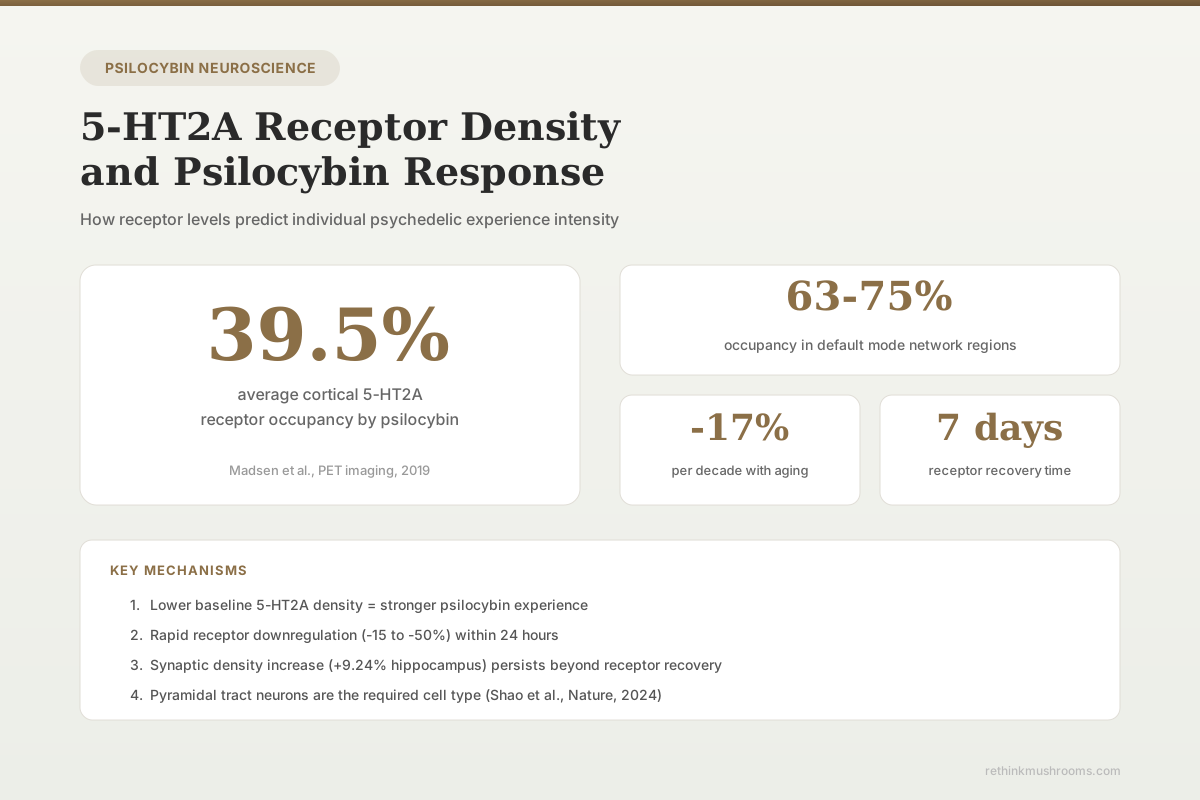
PET imaging of eight healthy volunteers given oral psilocybin (3–30 mg) showed dose-related cerebral 5-HT2A receptor occupancies up to 72%. Both plasma psilocin levels and 5-HT2A occupancy were closely associated with subjective psychedelic intensity.
Madsen et al., Neuropsychopharmacology, 2019
Dose-Related
occupancy and plasma psilocin tracked subjective intensity
Age Decline
5-HT2A density falls with age in PET studies
7-Day Recovery
receptor density normalizes within one week (pig brain)
Madsen et al., Neuropsychopharmacology, 2019
 View as image ↗
Psilocybin does not produce its effects directly. After oral ingestion, the liver converts psilocybin into psilocin, which crosses the blood-brain barrier and binds to serotonin 2A receptors (5-HT2A receptors) distributed across the cortex. The density of those receptors in a given person's brain, and the proportion of them that psilocin occupies, appears to determine the intensity, quality, and possibly the therapeutic outcome of the experience.
This is not speculation. It is the result of PET (positron emission tomography) imaging studies that have measured 5-HT2A receptor binding in living human brains before and after psilocybin administration. The data shows that people differ in how many 5-HT2A receptors they have, that these differences predict aspects of the psilocybin experience, and that a single dose temporarily reduces receptor density in specific brain regions. Understanding these mechanisms matters for anyone following the psilocybin therapy research. For a broader look at how 5-HT2A agonism creates the psychedelic experience, that process gets its own article. And the secondary receptor targets beyond 5-HT2A explain why the full picture is more complex than a single receptor.
Key Takeaways
- PET imaging in 8 healthy volunteers showed dose-related cerebral 5-HT2A receptor occupancy up to 72% after oral psilocybin (3–30 mg), with both plasma psilocin and occupancy tracking subjective psychedelic intensity (Madsen et al., Neuropsychopharmacology, 2019)
- Higher baseline neocortical 5-HT2A receptor binding was negatively associated with peak plateau duration and Mystical Experience Questionnaire total score in 16 volunteers given oral psilocybin (Stenbæk et al., Journal of Psychopharmacology, 2021)
- A single intravenous psilocybin dose in pigs decreased hippocampal/prefrontal 5-HT2A receptor signal by ~15–50% at day 1 while increasing the synaptic marker SV2A by 4.42% in hippocampus at day 1 (Raval et al., IJMS, 2021)
- PET imaging meta-analyses across healthy adults show 5-HT2A receptor density declines with age, with the largest loss before midlife — potentially altering psilocybin response in older adults
- Receptor signal returned to baseline by day 7 in the pig study, while SV2A remained elevated (+9.24% hippocampus, +6.10% prefrontal cortex) at day 7 (Raval et al., IJMS, 2021)
- In mouse medial frontal cortex, targeted 5-HT2A receptor knockout abolished psilocybin's structural plasticity and stress-related behavioral effects, and silencing pyramidal-tract neurons specifically eliminated the behavioral effect (Shao et al., Nature, 2025; bioRxiv preprint 2024)
What 5-HT2A Receptors Do
Serotonin 2A receptors sit on the surface of neurons, primarily on layer V pyramidal cells in the prefrontal cortex and other neocortical areas. These neurons are the main output cells of the cortex. They integrate information from multiple brain regions and send signals to subcortical structures.
When serotonin (5-HT) binds to a 5-HT2A receptor under normal conditions, it modulates excitability, sensory processing, and mood regulation. The receptor is one of 14 serotonin receptor subtypes, but it holds outsized importance in psychedelic pharmacology because it is the primary mediator of the psychedelic experience.
Carhart-Harris and colleagues demonstrated this in 2012 using fMRI to image the brains of 15 healthy volunteers who received intravenous psilocybin.[1] They found that psilocybin decreased neural activity in hub regions of the brain, particularly the medial prefrontal cortex and the posterior cingulate cortex, both key nodes of the default mode network (DMN). The DMN is active during self-referential thinking, mind-wandering, and maintaining a stable sense of self. Disrupting it correlates with the ego dissolution and altered perception that characterize the psychedelic state.
Measuring Receptor Occupancy in Living Brains
PET imaging allows researchers to see how many 5-HT2A receptors psilocin actually occupies during a session. The technique works by injecting a radioactive tracer that competes with psilocin for receptor binding. Fewer receptors available for the tracer means more are occupied by psilocin.
Madsen and colleagues published the first detailed measurement of cerebral 5-HT2A receptor occupancy by psilocybin in humans in 2019, in Neuropsychopharmacology.[2] Using [11C]Cimbi-36, a radioligand that binds selectively to 5-HT2A receptors, they imaged eight healthy volunteers at baseline and on the same day after a single oral dose of psilocybin in the 3–30 mg range.
The results: psilocybin produced dose-related cerebral 5-HT2A receptor occupancies up to 72%. Both plasma psilocin levels and 5-HT2A occupancy were closely associated with subjective psychedelic intensity, and occupancy versus plasma psilocin conformed to a single-site binding model. That last point matters mechanistically — it is the kind of binding curve expected if psilocin is doing its work primarily at one receptor site.
Individual and dose-related variation was substantial. The same 3–30 mg range produced widely different occupancies across people, which is part of why the same labeled dose of psilocybin can produce vastly different experiences in different individuals.
Baseline Receptor Density Predicts Experience Intensity
If two people take the same dose of psilocybin, the person with fewer 5-HT2A receptors in their neocortex tends to have a more intense experience. This counterintuitive finding comes from Stenbæk and colleagues, who published in the Journal of Psychopharmacology in 2021.[3]
They used PET imaging with [11C]Cimbi-36 to measure baseline 5-HT2A receptor binding in 16 healthy volunteers before a single psilocybin session at 0.2–0.3 mg/kg. Subjective drug intensity (SDI) was assessed every 20 minutes during the session and the Mystical Experience Questionnaire (MEQ) was completed at the end. Neocortex 5-HT2A receptor binding was statistically significantly negatively associated with peak plateau duration and with MEQ total score, and positively associated with time to return to normal waking consciousness — meaning lower baseline binding tracked with longer peak plateaus and higher mystical-experience scores at a fixed weight-based dose.
Why would fewer receptors produce stronger effects? One hypothesis: when receptor density is lower, psilocin achieves a higher proportion of total receptor occupancy at the same dose. If you have 100 receptors and psilocin binds 40, that is 40% occupancy. If you have 70 receptors and psilocin binds 40, that is 57% occupancy. Higher fractional occupancy may cross functional thresholds that produce more intense subjective effects.
This has practical implications. People with naturally lower 5-HT2A density, which includes older adults and potentially those with certain psychiatric conditions, may be more sensitive to psilocybin at standard doses.
The Age Factor
5-HT2A receptor density declines with age. PET imaging studies in healthy adults have consistently shown this pattern, with most of the loss occurring before midlife and a slower rate of decline thereafter.
Combined with the Stenbæk finding that lower baseline receptor density tracks with stronger psilocybin experiences, this age-related decline suggests that older adults may achieve a higher fractional 5-HT2A occupancy at the same labeled dose. No clinical trial has yet tested age-stratified psilocybin dosing against direct receptor-density measurements, but the pharmacological logic is straightforward: fewer baseline receptors plus a fixed dose of psilocin equals a higher proportion of receptors bound.
What Happens to Receptors After a Dose
Psilocybin does not just occupy 5-HT2A receptors temporarily. It triggers a cascade that changes receptor availability for days afterward.
Raval and colleagues published a landmark pig brain study in 2021 in the International Journal of Molecular Sciences.[4] One day after a single psilocybin injection, they found two simultaneous changes:
- 5-HT2A receptor density decreased by 15-50% in the hippocampus and prefrontal cortex
- Synaptic density increased by 4.4% in the hippocampus, measured by the vesicular marker SV2A
Seven days after the dose, the picture had shifted. 5-HT2A receptor density had returned to baseline. But synaptic density remained elevated: +9.24% in the hippocampus and +6.10% in the prefrontal cortex compared to pre-dose levels.
This temporal pattern matters. The receptors downregulate quickly (within one day) and recover quickly (within one week). The synaptic growth that psilocybin triggers outlasts the receptor changes. This may explain why the therapeutic effects of psilocybin, reported in depression trials lasting weeks to months, persist long after the drug has cleared the system and receptors have normalized.
Madsen and colleagues confirmed a related finding in humans in 2020.[5] In 10 healthy volunteers who received a single oral psilocybin dose and underwent PET imaging one week later, 5-HT2A receptor binding at one week was similar to baseline. However, participants showed statistically significant increases in trait mindfulness, and the magnitude of that mindfulness change correlated with the degree of neocortical 5-HT2A receptor change.
Pyramidal Cells Are the Key Target
A 2024 bioRxiv preprint by Shao and colleagues, peer-reviewed and published in Nature in 2025, pinpointed exactly which cells mediate psilocybin's lasting effects.[6] Using in vivo optical imaging, chemogenetic perturbation, and cell-type-specific electrophysiology in mouse medial frontal cortex, the authors examined the two main pyramidal cell types: subcortical-projecting pyramidal tract (PT) neurons and intratelencephalic (IT) neurons.
A single dose of psilocybin increased dendritic spine density in both PT and IT neurons. Behaviorally, however, silencing PT neurons eliminated psilocybin's ability to ameliorate stress-related phenotypes, while silencing IT neurons had no detectable effect. In PT neurons specifically, psilocybin boosted synaptic calcium transients and elevated firing rates acutely after administration. Targeted knockout of 5-HT2A receptors abolished psilocybin's effects on stress-related behavior and on structural plasticity. Together these results identify the PT pyramidal cell type and the 5-HT2A receptor in the medial frontal cortex as essential for psilocybin's long-term drug action.
This finding narrows the mechanism. Psilocybin's therapeutic potential appears to depend on 5-HT2A receptor activation specifically on cortical pyramidal output neurons, not on serotonin receptors broadly distributed across the brain. For more on the other serotonin receptors psilocybin activates and their role, that complexity is worth understanding separately.
From Receptor Occupancy to Therapeutic Response
Carhart-Harris and colleagues connected the neuroimaging data to clinical outcomes in 2017.[7] In 19 patients with treatment-resistant depression who received psilocybin therapy, they measured cerebral blood flow and resting-state functional connectivity using fMRI before and after treatment (quality pre/post fMRI was available for 16 of 19). All 19 showed decreased depressive symptoms at one week, and 47% met criteria for response at five weeks.
The brain imaging revealed two key changes: decreased cerebral blood flow in the temporal cortex (including the amygdala), and increased resting-state functional connectivity within the default mode network post-treatment. Decreased amygdala blood flow correlated with reduced depressive symptoms. Increased ventromedial-prefrontal-to-bilateral-inferior-lateral-parietal-cortex connectivity predicted treatment response at five weeks, as did decreased parahippocampal–prefrontal cortex connectivity. The authors framed this as a "reset" pattern that differs from the acute effects of psychedelics seen during dosing.
This links the receptor-level data (5-HT2A occupancy disrupting the DMN acutely) to the network-level data (post-treatment connectivity changes) to the clinical-level data (symptom improvement). The chain is: psilocin binds 5-HT2A receptors on cortical pyramidal cells, disrupts default mode network activity acutely, triggers receptor downregulation and synaptic growth, and produces lasting changes in brain connectivity patterns that correlate with symptom relief.
What This Means for Psilocybin Variability
The research collectively explains several observations from clinical psilocybin trials:
Why the same dose affects people differently: Baseline 5-HT2A receptor density varies between individuals. Lower density means higher fractional occupancy at the same dose, which on the Stenbæk data tracks with longer peak plateaus and stronger mystical-experience scores.
Why older adults may respond differently: PET data consistently show that 5-HT2A receptor density declines with age, most steeply before midlife. That shifts where on the dose-response curve a given milligram dose lands, even before considering hepatic conversion of psilocybin to psilocin.
Why effects last longer than the drug: In the Raval pig study, psilocybin triggered SV2A increases that persisted at day 7 (+9.24% in hippocampus, +6.10% in prefrontal cortex) after 5-HT2A receptor signal had returned to baseline. The structural change outlasts the pharmacological event.
Why repeated dosing may show diminishing returns: In the same pig study, 5-HT2A receptor signal fell sharply at day 1 (-15% to -50% across regions and radioligands) before normalizing by day 7. This is mechanistically consistent with the well-documented clinical tolerance effect, where a second psilocybin dose within a few days produces weaker subjective effects.
The 5-HT2A receptor is not the whole story. Psilocin also binds to 5-HT1A, 5-HT2C, and other receptor subtypes that modulate the overall experience. But 5-HT2A is the gateway: without it, the psychedelic effect does not occur, the structural plasticity does not happen, and the lasting behavioral changes are abolished. The full gateway mechanism from receptor binding to the psychedelic experience covers this pathway in depth.
The Bottom Line
PET imaging studies in humans have established that psilocybin produces dose-related cortical 5-HT2A receptor occupancy (up to 72% in the Madsen 2019 sample), and that lower baseline neocortical 5-HT2A binding tracks with longer peak plateaus and stronger mystical-experience scores at fixed weight-based doses. PET meta-analyses also show 5-HT2A density declines with age, with most loss occurring before midlife. In a pig brain study, a single intravenous psilocybin dose decreased 5-HT2A receptor signal by ~15–50% at day 1 followed by recovery to baseline by day 7, while the synaptic marker SV2A remained elevated through day 7. The 2025 Shao et al. Nature paper established that targeted 5-HT2A receptor knockout in mouse medial frontal cortex abolishes psilocybin's structural plasticity and stress-related behavioral effects, with pyramidal tract neurons specifically required for the behavioral effect.
Frequently Asked Questions
Sources & References
- 1RTHM-00245·Carhart-Harris, Robin L et al. (2012). “Neural correlates of the psychedelic state as determined by fMRI studies with psilocybin..” Proceedings of the National Academy of Sciences of the United States of America.Study breakdown →PubMed →↩
- 2RTHM-00578·Madsen, Martin K et al. (2019). “Psychedelic effects of psilocybin correlate with serotonin 2A receptor occupancy and plasma psilocin levels..” Neuropsychopharmacology : official publication of the American College of Neuropsychopharmacology.Study breakdown →PubMed →↩
- 3RTHM-00720·Stenbæk, Dea Siggaard et al. (2021). “Brain serotonin 2A receptor binding predicts subjective temporal and mystical effects of psilocybin in healthy humans..” Journal of psychopharmacology (Oxford.Study breakdown →PubMed →↩
- 4RTHM-00714·Raval, Nakul Ravi et al. (2021). “A Single Dose of Psilocybin Increases Synaptic Density and Decreases 5-HT2A Receptor Density in the Pig Brain..” International journal of molecular sciences.Study breakdown →PubMed →↩
- 5RTHM-00635·Madsen, Martin Korsbak et al. (2020). “A single psilocybin dose is associated with long-term increased mindfulness, preceded by a proportional change in neocortical 5-HT2A receptor binding..” European neuropsychopharmacology : the journal of the European College of Neuropsychopharmacology.Study breakdown →PubMed →↩
- 6RTHM-00906·Shao, Ling-Xiao et al. (2024). “Pyramidal cell types and 5-HT2A receptors are essential for psilocybin's lasting drug action..” bioRxiv : the preprint server for biology.Study breakdown →PubMed →↩
- 7RTHM-00463·Carhart-Harris, Robin L et al. (2017). “Psilocybin for treatment-resistant depression: fMRI-measured brain mechanisms..” Scientific reports.Study breakdown →PubMed →↩