Psilocybin & Neuroscience
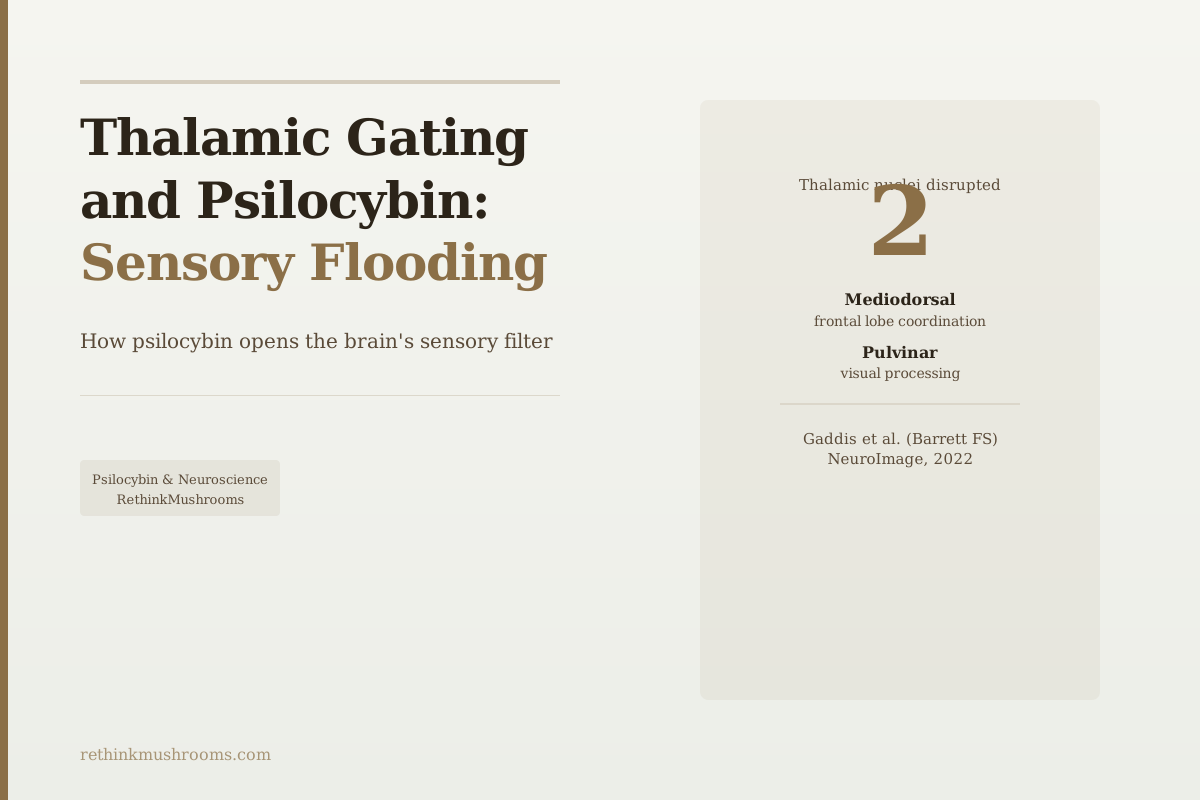
2 specific thalamic nuclei — mediodorsal and pulvinar — where psilocybin produces its focal disruption
Gaddis and colleagues at Johns Hopkins mapped psilocybin's thalamic effects with fMRI, finding spatially-specific alterations concentrated in the mediodorsal and pulvinar nuclei, with decreased connectivity to visual and default mode networks.
Gaddis et al. (Barrett FS), NeuroImage, 2022
CSTC model
psilocybin reduces striatal inhibition of the thalamus, opening the sensory gate (Doss et al., Brain, 2022)
Nature 2024
global brain desynchronization from psilocybin is consistent with thalamic gating failure (Siegel et al.)
Plasticity window
thalamic reorganization during sessions may create the therapeutic window for lasting change (Smausz 2022)
Gaddis et al. (Barrett FS), NeuroImage, 2022
 View as image ↗
A research team at Johns Hopkins put participants in an fMRI scanner and measured what psilocybin does to the thalamus — the brain's sensory relay and filter — with enough spatial resolution to see which specific parts of the structure were affected. The answer: psilocybin produced significant alterations concentrated in two nuclei, the mediodorsal thalamus and the pulvinar, primarily reducing their connectivity with visual and default mode networks. The changes correlated with the subjective effects participants reported.[1]
That finding, from Gaddis and colleagues (2022), is the clearest direct human evidence for how psilocybin disrupts thalamic gating and produces the characteristic sensory flooding of the psychedelic state. This article covers the mechanism: what the thalamus does as a sensory gatekeeper, why psilocybin specifically disrupts it, what the imaging evidence shows, and why this mechanism may be part of what makes psilocybin therapeutically useful beyond its well-known serotonin effects. The broader picture of psilocybin's non-serotonin mechanisms is covered in the psilocybin neuroscience overview.
Key Takeaways
- The thalamus acts as the brain's sensory gatekeeper: it filters incoming signals before they reach the cortex, preventing the cortex from being overwhelmed by unprocessed sensory information
- Psilocybin disrupts this gating via the CSTC loop — it reduces striatal inhibition of the thalamus, allowing more unfiltered sensory input to reach the cortex[2]
- Gaddis et al. (Johns Hopkins, NeuroImage, 2022) found spatially specific thalamic disruption concentrated in two nuclei: the mediodorsal thalamus (frontal lobe coordination) and the pulvinar (visual processing), with changes correlating with subjective psilocybin effects[1]
- The 2024 Nature study by Siegel et al. found global brain desynchronization from psilocybin that is mechanistically consistent with thalamic gating failure releasing coordinated cortical activity into a less-filtered state[3]
- The 5-HT2A serotonin receptor is expressed in thalamic neurons, giving psilocybin a direct pharmacological route into the thalamic system, not just an indirect one[4]
- Thalamic disruption may contribute to the therapeutic plasticity window — the reorganization of thalamocortical circuits during a session may be part of what makes psilocybin-assisted therapy more effective than therapy alone[5]
What Thalamic Gating Is and Why the Brain Needs a Filter
Thalamic gating is the process by which the thalamus controls how much sensory information reaches the cerebral cortex. The thalamus sits at the center of the brain and acts as a relay station: virtually all sensory information from the body and environment passes through it before reaching the cortex for conscious processing.
The gating function works like a volume control for sensory experience. Under normal conditions, the thalamus filters out the bulk of incoming signals, allowing only the most relevant information through at any given moment. Without this filtering, the cortex would be bombarded by undifferentiated sensory noise — every sound, every visual input, every internal body signal arriving simultaneously.
The specific mechanism: a brain structure called the striatum sends inhibitory (quieting) signals to the thalamus. This striatal inhibition keeps the thalamic gate partially closed, regulating how much signal gets through. The entire loop is called the CSTC pathway: cortico-striato-thalamo-cortical. The cortex influences the striatum, the striatum inhibits the thalamus, and the thalamus filters what returns to the cortex.
Two specific thalamic nuclei are central to this filtering function. The mediodorsal thalamus coordinates signals to and from the prefrontal cortex, the region responsible for higher-level cognition, attention control, and decision-making. The pulvinar coordinates visual processing and attention signals, integrating information across visual cortical areas. These are the two nuclei that the Johns Hopkins imaging study found most significantly affected by psilocybin.
The CSTC Circuit: How Psilocybin Opens the Gate
Doss and colleagues (2022) formalized the CSTC model as one of three circuit-level frameworks for understanding how psychedelics alter brain function.[2] The other two are the REBUS model (changes in how the brain weighs predictions against sensory input) and the CCC model (disruption of the cortico-claustro-cortical network). These models are not competing explanations; they describe different levels and aspects of the same broad brain-state change.
Within the CSTC model, psilocybin's effect on the thalamic gate works as follows. Psilocybin activates 5-HT2A serotonin receptors throughout the brain, including in the striatum and in cells that project to the striatum. Activation of these receptors reduces the striatum's inhibitory output to the thalamus. With less striatal inhibition, the thalamic gate opens wider: more sensory signals pass through to the cortex than would normally be filtered out.
The result is sensory flooding: the cortex begins processing inputs that are normally excluded. Unfiltered visual signals produce visual disturbances. Unfiltered signals from multiple sensory channels begin crossing into each other's processing areas. The boundaries that normally keep sensory systems separate become permeable.
This is not simply a matter of "more input equals more confusion." The specific pattern of what gets through depends on which thalamic nuclei are most affected. Psilocybin's preferential disruption of the mediodorsal thalamus — which coordinates prefrontal processing — directly interferes with the higher-level cognitive filtering that normally imposes meaning and context on sensory experience. And disruption of the pulvinar alters visual processing at the level of cross-area integration, not just raw visual signal intensity.
The 2022 Johns Hopkins fMRI Study: Direct Human Evidence
Gaddis and colleagues measured thalamic functional connectivity in human participants before and after a moderate dose of psilocybin, using high-resolution fMRI to map connectivity changes across different thalamic nuclei.[1]
The key finding: psilocybin's thalamic effects were not uniform. While the drug produced widespread modest increases in thalamocortical connectivity across many nuclei, it simultaneously produced concentrated decreases in the mediodorsal and pulvinar nuclei. These focal decreases — in the specific nuclei responsible for prefrontal coordination and visual integration — correlated with participants' subjective reports of the psychedelic experience.
This spatial specificity matters. Earlier theoretical work on thalamic gating and psychedelics predicted that disruption would concentrate in the nuclei most relevant to integrative processing and attentional control. The Gaddis 2022 data confirmed this prediction with direct human imaging. The disruption is not a blunt global effect; it targets the thalamic structures most responsible for the high-level filtering of experience.
The study also addressed an important question about the CSTC model's predictions: if psilocybin opens the thalamic gate, you would expect both increases and decreases in thalamocortical connectivity, not simply one or the other. Some sensory channels become noisier; others, previously dominant, become relatively quieter. The simultaneous widespread modest increases alongside the focal decreases in specific nuclei fit this prediction.
What the 2024 Nature Desynchronization Data Adds
The Gaddis 2022 study measured thalamic connectivity specifically. In 2024, Siegel and colleagues published a broader mapping of psilocybin's effects on global brain network organization, finding that psilocybin desynchronizes the human brain at a systems level: the normal temporal coordination between brain regions breaks down.[3]
The thalamic gating model predicts exactly this outcome. One of the thalamus's functions is to coordinate the timing of cortical activity: it helps different cortical regions stay synchronized by controlling when they receive their inputs. When the thalamic gate is disrupted, this coordination function is impaired. Cortical regions that normally fire in synchronized patterns lose their temporal coordination.
The Siegel 2024 finding of global desynchronization is therefore mechanistically coherent with the Gaddis 2022 finding of focal thalamic disruption. The two studies, using different measurement approaches, converge on the same underlying story: psilocybin disrupts the thalamus's role as a coordinator of cortical activity, and the result is the coordinated, synchronized brain activity pattern falling apart.
A landmark 2022 review in Nature Neuroscience by Kwan, Olson, Preller, and Roth synthesized this picture: psychedelics alter thalamocortical functional connectivity as part of a multi-system modification of brain function that includes receptor-level, cellular, circuit, and network effects simultaneously.[4] The thalamic mechanism does not replace the serotonin mechanism; it is downstream of it.
Why Thalamic Disruption May Be Part of What Makes Psilocybin Therapeutic
The CSTC model has primarily been used to explain the phenomenology of the psychedelic state: why users report sensory flooding, synaesthesia, and the dissolution of normal perceptual categories. But Smausz, Neill, and Gigg (2022) argued that the thalamic mechanism may be directly relevant to psilocybin's therapeutic effects, not just its perceptual ones.[5]
Their argument: in conditions like depression, PTSD, and addiction, the thalamocortical system becomes rigidly locked into patterns that reinforce the pathological state. The same default mode network overactivity that characterizes depression involves thalamocortical circuits that keep the brain running in a narrow, self-referential loop. Thalamic gating disruption by psilocybin may temporarily break this loop, creating a window in which the cortex is processing inputs more broadly and the fixed circuits can be reorganized.
The glutamate cascade that follows 5-HT2A activation also contributes to this picture: increased glutamate release in the frontal cortex, documented by Mason et al.'s 7T MRI study and reviewed by Szpregiel and colleagues (2024), amplifies the cortical response to the newly unfiltered thalamic inputs.[6] The thalamus opens the gate; glutamate ensures the cortex is responsive to what comes through.
Smausz and colleagues argued that in vivo electrophysiology (direct recording of neural firing patterns during the session, rather than blood-flow imaging measured after) is the next essential step in understanding exactly how thalamic reorganization creates the conditions for lasting therapeutic change. Most existing evidence comes from fMRI, which measures blood flow rather than neural firing directly. The electrophysiology data that would confirm the thalamic plasticity window hypothesis has not yet been published in humans.
What the Evidence Does and Doesn't Yet Show
The thalamic gating model for psilocybin is well-supported by a convergence of sources: theoretical framework (Doss 2022), direct human fMRI (Gaddis 2022), global brain imaging (Siegel 2024 Nature), and mechanistic synthesis (Kwan 2022 Nature Neuroscience). The core claim — that psilocybin disrupts thalamic filtering with focal effects in the mediodorsal and pulvinar nuclei — has direct human imaging confirmation.
What remains less established: the direct causal link between thalamic disruption and therapeutic outcomes. The studies above documented the thalamic effects; they did not design their measurements to test whether participants with greater thalamic disruption showed better antidepressant outcomes or addiction recovery. That correlation has not been tested directly.
Most of the mechanistic research on the CSTC model was developed with LSD, not psilocybin specifically. Gaddis 2022 is the most directly relevant psilocybin-thalamus imaging study, and its findings are consistent with the CSTC predictions, but replication with larger samples and different doses has not yet been published.
The thalamic picture is also only part of the larger story. The claustrum mechanism, the glutamate cascade, and the default mode network disruption all operate alongside the thalamic effects, not sequentially. For the claustrum's role in psilocybin's consciousness effects and how thalamic disruption connects to the relaxed predictive coding model, see REBUS: how psilocybin relaxes the brain's beliefs. The fMRI evidence that ties these circuit changes together is reviewed in functional connectivity changes under psilocybin: fMRI evidence.
The Bottom Line
Psilocybin disrupts thalamic gating via the CSTC circuit — reducing striatal inhibition to open the thalamus's sensory filter. Direct human fMRI evidence from Johns Hopkins found the disruption concentrated in two specific nuclei: the mediodorsal thalamus and the pulvinar, with changes correlating with subjective psychedelic effects. The 2024 Nature desynchronization data is mechanistically consistent with thalamic gating failure. The therapeutic relevance of this disruption is plausible and under investigation, but the direct link between thalamic changes and therapeutic outcomes has not been tested in clinical populations.
Frequently Asked Questions
Sources & References
- 1. Source details for this reference are not yet available.
- 2. Source details for this reference are not yet available.
- 3. Source details for this reference are not yet available.
- 4. Source details for this reference are not yet available.
- 5. Source details for this reference are not yet available.
- 6. Source details for this reference are not yet available.