Psilocybin & Neuroscience
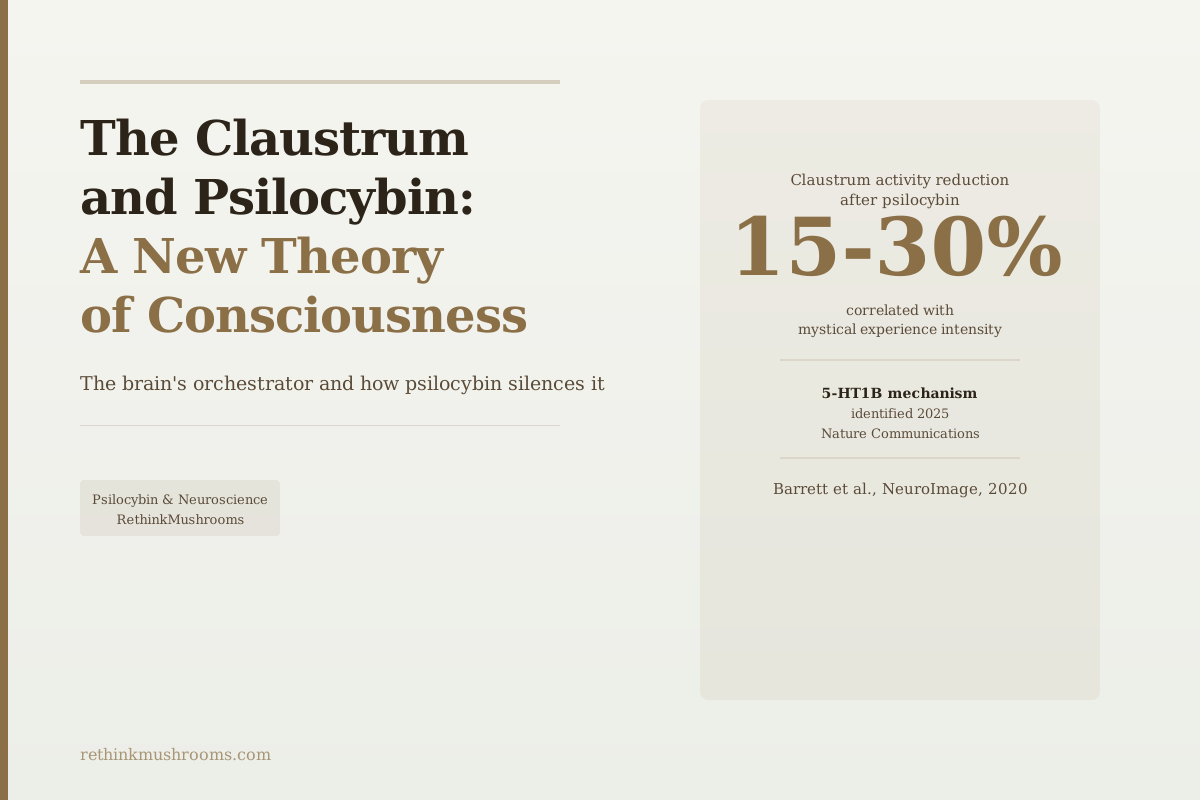
15-30% reduction in claustrum activity after psilocybin, correlating with mystical experience intensity
Barrett and colleagues found psilocybin significantly reduced activity in the right claustrum in 15 participants, with the degree of reduction predicting how intensely each person experienced the mystical dissolution of self.
Barrett et al., NeuroImage, 2020
5-HT1B + 5-HT2A
two serotonin receptor subtypes drive claustrum suppression by psilocybin (Madden et al., Nature Comms, 2025)
LTD to LTP
psychedelics reverse synaptic plasticity polarity in claustrum neurons, enabling lasting circuit changes (eNeuro, 2025)
All cortical areas
the claustrum connects to virtually every region of the cortex, giving it unusual influence over network states
Barrett et al., NeuroImage, 2020
 View as image ↗
In 2004, the year before his death, Francis Crick — co-discoverer of the structure of DNA — published a paper arguing that a thin strip of grey matter buried deep in the brain might be central to consciousness itself. The claustrum, Crick proposed, acts like the conductor of an orchestra: it coordinates the activity of disparate cortical regions and brings them into the unified experience of conscious awareness.
Crick never tested this hypothesis with psychedelics. But in 2020, Barrett and colleagues at Johns Hopkins gave psilocybin to 15 participants in an fMRI scanner and measured what happened to the claustrum. Activity in the right claustrum dropped 15 to 30 percent. The degree of that drop predicted how intensely each participant experienced the dissolution of ordinary consciousness — the mystical experience that psilocybin is known for.[1] It was the first direct human evidence connecting psilocybin, the claustrum, and the disruption of unified conscious experience.
This article covers the psilocybin claustrum consciousness theory from that first data point through the 2025 mechanistic breakthroughs — including a Nature Communications paper that identified the specific receptor pathway psilocybin uses to suppress claustrum signaling. For the broader context of psilocybin's non-serotonin mechanisms, start with the psilocybin neuroscience overview.
Key Takeaways
- The claustrum is a thin strip of grey matter with an unusual property: it connects bidirectionally to virtually every cortical region, making it a plausible coordinator of unified conscious experience
- Francis Crick proposed the claustrum as the seat of the neural binding that creates integrated consciousness; psilocybin research has become the primary empirical test of this theory
- Barrett et al. (NeuroImage, 2020) found psilocybin reduced right claustrum activity 15-30% in 15 participants, with the reduction correlating with mystical experience intensity[1]
- Madden et al. (Nature Communications, 2025) found that psilocybin and serotonin activate 5-HT1B receptors on anterior cingulate cortex inputs to suppress claustrum signaling, revealing the presynaptic receptor mechanism[4]
- Anderson et al. (eNeuro, 2025) found psychedelics reverse synaptic plasticity in claustrum neurons from long-term depression (weakening) to long-term potentiation (strengthening), providing the first evidence of lasting structural change in claustrum circuits after psychedelic exposure[5]
- Key caveat: the Madden 2025 and Anderson 2025 studies used animal models and DOI (a related 5-HT2A agonist psychedelic), not psilocybin specifically — extrapolation to psilocybin in humans is mechanistically motivated but not directly confirmed
The Claustrum: What It Is and Why Crick Thought It Mattered
The claustrum is a thin, irregularly shaped layer of grey matter that sits beneath the insula on both sides of the brain. It is small relative to most other brain structures, but its connectivity is exceptional: the claustrum sends and receives connections to and from virtually every region of the cerebral cortex. It reaches the prefrontal cortex, sensory areas, motor regions, the limbic system, and the default mode network. No other structure has quite this breadth of cortical connectivity.
Crick and Koch, writing in 2005, proposed that this connectivity gives the claustrum a unique functional role. Conscious experience, they argued, requires the brain to bind together information from many separate cortical areas into a single unified experience. You see a red apple and simultaneously perceive its color, its shape, its relation to your hand, and your expectation of its taste, all as one coherent object. No single cortical region does all of this; it requires integration across areas. The claustrum, with connections to all of them, was their candidate for the structure that coordinates this binding.
When psilocybin research revealed that this structure shows dramatic, consciousness-correlated activity changes during psychedelic experiences, the Crick-Koch hypothesis gained its first empirical support — from a drug that dissolves the ordinary binding of conscious experience rather than enhancing it.
The 2020 Barrett Study: Claustrum Deactivation and Mystical Experience
Barrett and colleagues at Johns Hopkins used fMRI to measure claustrum activity and connectivity in 15 healthy participants who received psilocybin in a controlled session.[1]
The results were specific and striking. Psilocybin reduced claustrum activity by 15 to 30 percent, with the strongest effects in the right claustrum. The claustrum's connectivity with the auditory network and the default mode network decreased. Its connectivity with the fronto-parietal task control network — the system responsible for goal-directed attention — increased. And critically: the degree of claustrum deactivation correlated with the intensity of the mystical experience participants reported.
That correlation is the mechanistically interesting finding. Mystical experience during psilocybin sessions is characterized by the dissolution of ordinary self-consciousness: the sense that the usual boundaries between self and world have become permeable or absent. If the claustrum is indeed the structure that coordinates unified conscious experience, its deactivation by psilocybin is precisely what you would predict would dissolve that unity.
The study had limitations worth noting clearly. Fifteen participants is a small sample. The claustrum is difficult to measure reliably with standard fMRI because of its small size and irregular shape. The correlation between deactivation and mystical experience is an association, not proof of causation. But as a first data point connecting Crick's hypothesis to a specific pharmacological intervention in humans, it established the claustrum as a legitimate target for psychedelic consciousness research.
The CCC Model: Formalizing the Claustrum's Role
Doss and colleagues (2022) formalized the cortico-claustro-cortical (CCC) model as one of three circuit frameworks for understanding how psychedelics alter brain function.[2]
In the CCC model, the claustrum acts as a coordinator of cortical network states: it receives signals from one cortical region and broadcasts coordinating signals to other regions, helping different cortical areas stay in sync with each other. Psilocybin, by activating 5-HT2A receptors in and around the claustrum, disrupts this coordination function. The result: cortical regions that normally operate in coordinated synchrony begin to desynchronize and, simultaneously, regions that do not normally communicate begin exchanging signals.
This is the network-level mechanism underlying both the dissolution of unified experience (as the normally coordinated "self" representation falls apart) and the generation of novel mental content (as newly connected cortical areas generate cross-sensory and cross-categorical associations that would not occur in normal coordinated network states).
The CCC model sits alongside the CSTC model (thalamic gating failure) and the REBUS model (relaxed predictive coding) as three circuit-level descriptions of the same underlying brain-state change. They describe different structures and mechanisms that are all active simultaneously during a psychedelic experience — not competing explanations.[6]
2025: Nature Communications Identifies the Specific Receptor Mechanism
By 2025, the 5-HT2A receptor had been the assumed primary driver of claustrum effects from psilocybin, based on the receptor's known expression in the claustrum and cortical areas that project to it. A 2024 study by Anderson and colleagues found that multiple 5-HT receptor subtypes beyond 5-HT2A regulate claustrum excitability, suggesting the mechanism was more complex than previously assumed.[3]
Then Madden and colleagues published in Nature Communications, and the specific presynaptic mechanism became clear. Psilocybin and serotonin activate 5-HT1B receptors on the inputs from the anterior cingulate cortex (ACC) to the claustrum, suppressing the cortical signal arriving at the claustrum from the ACC.[4] The claustrum neurons that project back to the parietal association cortex are the specific targets.
In plain terms: the anterior cingulate cortex is the brain's error-detection and self-monitoring hub. It normally sends a continuous stream of signals to the claustrum about ongoing behavior and internal states. Psilocybin activates 5-HT1B receptors that sit on the presynaptic terminals of those ACC-to-claustrum connections, quieting the signal before it arrives. The claustrum receives less of the ACC's self-monitoring input, and its ability to coordinate cortical activity based on that input is reduced.
This is a more specific mechanism than was previously understood. The Madden 2025 paper shows that the claustrum suppression from psilocybin is not simply a consequence of 5-HT2A receptor activation in the claustrum itself — it is a presynaptic reduction of cortical input arriving from the ACC, mediated by 5-HT1B. The claustrum is quieted, in part, because the signal it normally receives from the self-monitoring cortex is being suppressed at the point of delivery.
The Madden 2025 study used animal models, and the specific drug used was serotonin and psilocybin (not just a related psychedelic). This is stronger evidence for psilocybin's claustrum mechanism than the earlier animal studies, though human-specific confirmation of this presynaptic 5-HT1B pathway awaits further research.
The 2025 Mechanism
How Psilocybin Quiets the Claustrum — at the Input, Not the Core
The surprise of the Madden 2025 finding is where the effect happens. Psilocybin doesn’t just switch off the claustrum from inside; it activates 5-HT1B receptors that suppress the anterior cingulate cortex’s signal before it reaches the claustrum. Follow the signal down: input suppressed → coordination lost → conscious experience comes apart.
Psilocybin activates 5-HT1B receptors
The receptors sit on the presynaptic terminals of the anterior cingulate cortex (ACC) inputs to the claustrum — not on the claustrum body itself.
Madden 2025 [4]
ACC → claustrum signal is quieted before it arrives
The ACC is the brain’s self-monitoring and error-detection hub. Its continuous stream of signals to the claustrum is cut at the point of delivery, so the claustrum receives less self-monitoring input.
Madden 2025 [4]
The claustrum can no longer coordinate the cortex
With less input to work from, the claustrum’s job — keeping disparate cortical regions in sync — breaks down. Activity in the right claustrum falls 15–30%.
Barrett 2020 [1] · Doss 2022 CCC model [2]
Cortex desynchronizes; unified experience dissolves
Cortical regions that normally move together drift apart. The depth of claustrum deactivation tracks the intensity of the mystical, ego-dissolving experience.
Barrett 2020 [1] · Siegel 2024 [7]
The human anchor is Barrett 2020 (15 participants): psilocybin reduced right-claustrum activity and the reduction correlated with mystical-experience intensity. The presynaptic 5-HT1B step (Madden 2025) and the plasticity reversal (Anderson 2025) are preclinical — Madden used serotonin and psilocybin in animal models, Anderson used the related psychedelic DOI. This is a mechanism map, not a confirmed human pathway.
Mechanism synthesis; steps from refs [1][2][4][5][7] (see references)
The Claustrum Can Structurally Rewire Itself After a Psychedelic Session
Both the Barrett 2020 study and the Madden 2025 study measured functional changes: how claustrum activity and connectivity shift during or shortly after a psilocybin session. In 2025, Anderson and colleagues published a finding that extends the claustrum story into structural territory.
Using a related 5-HT2A agonist psychedelic (DOI) in animal models, they found that psychedelics reversed the polarity of long-term synaptic plasticity in claustrum neurons that project to the anterior cingulate cortex.[5] Under normal conditions, repeated stimulation of these synapses produces long-term depression (LTD): the connections weaken over time. After DOI exposure, the same stimulation pattern produced long-term potentiation (LTP): the connections strengthened instead.
This reversal of plasticity polarity is not a small effect. It means that psychedelic exposure changes the fundamental rules by which claustrum neurons learn: connections that would normally weaken now strengthen. This is the cellular-level mechanism for lasting change — the claustrum-to-ACC circuit is rewriting its own connectivity rules during the plasticity window opened by the psychedelic.
Combined with the Madden 2025 finding, the 2025 picture of the claustrum is: psilocybin suppresses incoming ACC signals (via 5-HT1B), reducing the claustrum's coordination of cortical activity. During and after this period of reduced coordination, the claustrum's synaptic connections to the ACC change their plasticity rules (via Anderson 2025), potentially encoding new patterns of cortical coordination when normal function resumes.
The DOI extrapolation caveat applies here too: DOI is a 5-HT2A agonist that produces psychedelic effects, but it is not psilocybin. The structural plasticity reversal seen with DOI is expected to occur with psilocybin based on the shared receptor mechanism, but this has not been directly confirmed in published psilocybin-specific experiments.
What's Established, What's Extrapolated, and What's Still Ahead
The claustrum-psilocybin connection has moved through three stages of evidence in five years.
What is established in humans: Barrett 2020 confirmed that psilocybin reduces claustrum activity and that the reduction correlates with mystical experience intensity in a 15-person sample. Siegel 2024 confirmed global brain desynchronization from psilocybin, consistent with the claustrum's coordination function being disrupted.[7]
What is established in preclinical models: Madden 2025 (Nature Communications) identified the 5-HT1B presynaptic mechanism for ACC-to-claustrum signal suppression, using psilocybin as one of the compounds tested. Anderson 2025 (eNeuro) documented LTD-to-LTP polarity reversal in claustrum circuits using DOI. Anderson 2024 (Progress in Neurobiology) documented multi-receptor subtype involvement in claustrum regulation.[3]
What remains to be established: larger human fMRI studies with sufficient sample size and resolution to confirm the Barrett 2020 findings. Direct measurement of the 5-HT1B mechanism in human claustrum with psilocybin. Evidence connecting claustrum structural changes to therapeutic outcomes in clinical populations.
The claustrum is the most compelling candidate yet for where psilocybin's consciousness-altering effects originate at the circuit level. The Crick-Koch hypothesis, proposed without reference to psychedelics, predicted exactly the kind of disruption that psilocybin produces. The 2025 data now shows which receptor does it and how the claustrum's own connectivity is rewritten in the process.
For the receptor mechanism in more detail, see beyond 5-HT2A: other serotonin receptors psilocybin activates, which covers the 5-HT1B pathway in the context of psilocybin's full receptor profile. The neuroplasticity reversal documented in the claustrum connects to the broader pattern of psilocybin-driven structural brain change covered in thalamic gating and psilocybin and psilocybin's glutamate mechanisms. For how similar structural plasticity changes appear in other contexts, see mushrooms and post-stroke neuroplasticity.
The Bottom Line
Psilocybin reduces claustrum activity 15-30% in humans, with the reduction correlating with mystical experience intensity — the first empirical test of Crick's claustrum-consciousness hypothesis. The 2025 Nature Communications paper identified the presynaptic 5-HT1B mechanism: psilocybin suppresses ACC-to-claustrum signaling at the input terminal, quieting the claustrum's coordination of cortical activity. A separate 2025 paper found psychedelics reverse synaptic plasticity polarity in claustrum circuits, providing the first evidence of structural rewriting. Most mechanistic data comes from animal models and DOI rather than psilocybin specifically; human-specific confirmation of the 2025 findings is the next step.
Frequently Asked Questions
Sources & References
- 1RTHM-00608·Barrett, Frederick S et al. (2020). “Psilocybin acutely alters the functional connectivity of the claustrum with brain networks that support perception, memory, and attention..” NeuroImage.Study breakdown →PubMed →↩
- 2RTHM-01508·Doss, Manoj K et al. (2022). “Models of psychedelic drug action: modulation of cortical-subcortical circuits..” Brain : a journal of neurology.Study breakdown →PubMed →↩
- 3RTHM-01848·Anderson, Tanner L et al. (2024). “Distinct 5-HT receptor subtypes regulate claustrum excitability by serotonin and the psychedelic, DOI..” Progress in neurobiology.Study breakdown →PubMed →↩
- 4RTHM-02137·Madden, Maxwell B et al. (2025). “Serotonin and psilocybin activate 5-HT1B receptors to suppress cortical signaling through the claustrum..” Nature communications.Study breakdown →PubMed →↩
- 5RTHM-02050·Anderson, Tanner L et al. (2025). “Psychedelics Reverse the Polarity of Long-Term Synaptic Plasticity in Cortical-Projecting Claustrum Neurons..” eNeuro.Study breakdown →PubMed →↩
- 6RTHM-01558·Kwan, Alex C et al. (2022). “The neural basis of psychedelic action..” Nature neuroscience.Study breakdown →PubMed →↩
- 7RTHM-00911·Siegel, Joshua S et al. (2024). “Psilocybin desynchronizes the human brain..” Nature.Study breakdown →PubMed →↩