Psilocybin & Neuroscience
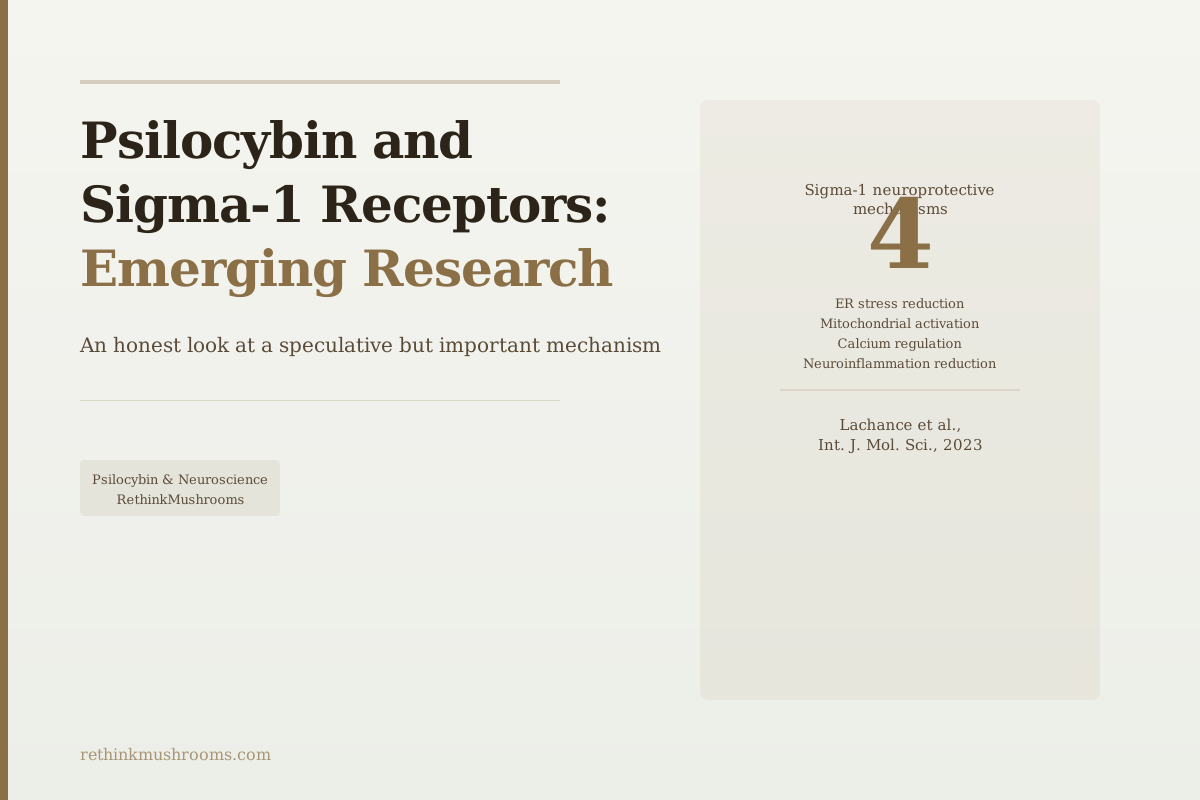
4 neuroprotective mechanisms of sigma-1 activation: ER stress, mitochondrial function, calcium regulation, neuroinflammation
Sigma-1 is an intracellular chaperone protein that reduces ER stress, activates mitochondrial function, and controls calcium homeostasis — mechanisms relevant to neuroplasticity whether activated directly or indirectly.
Lachance et al., International Journal of Molecular Sciences, 2023
Weak affinity
psilocybin binds sigma-1 directly with low affinity; DMT is the primary tryptamine S1R agonist
Not a surface receptor
sigma-1 is an intracellular ER chaperone — distinct from the serotonin and dopamine systems
Multi-target
psilocybin engages glutamate, dopamine, and sigma-1 systems alongside its primary serotonin mechanism
Lachance et al., International Journal of Molecular Sciences, 2023
 View as image ↗
When people search for psilocybin sigma-1 receptor emerging research, they are usually asking two questions at once: does psilocybin directly bind the sigma-1 receptor, and does sigma-1 signaling contribute to psilocybin's therapeutic effects? The answers are different. Psilocybin's direct binding affinity for the sigma-1 receptor is weak to negligible. The broader question of whether sigma-1 signaling plays a role in the therapeutic picture is more genuinely open.
This article addresses both questions clearly. What the sigma-1 receptor actually does, why DMT is the tryptamine most closely associated with S1R activity, what psilocybin's binding profile looks like in comparison, and why the neuroprotection pathway matters regardless of which tryptamine activates it. For the primary serotonin mechanism that forms the foundation for all of this, the psilocybin neuroscience overview is the starting point.
Key Takeaways
- Psilocybin's direct sigma-1 receptor (S1R) binding affinity is weak to negligible — this is not a confirmed primary mechanism
- Sigma-1 is an intracellular chaperone protein located at the endoplasmic reticulum, not a surface neurotransmitter receptor — it regulates ER stress, mitochondrial function, calcium homeostasis, and neuroinflammation[1]
- DMT (dimethyltryptamine), a structurally related tryptamine found endogenously in the body, has substantially stronger sigma-1 binding — making DMT, not psilocybin, the primary tryptamine for S1R research
- Psilocin (psilocybin's active metabolite) is structurally intermediate between psilocybin and DMT; researchers hypothesize some S1R activity, but this is not yet quantified in published studies
- Psilocybin engages multiple receptor systems beyond serotonin, including dopaminergic mesolimbic pathways[4], and a landmark Nature Neuroscience review framed psychedelics as multi-system brain modifiers rather than single-receptor drugs[2]
- The sigma-1 neuroprotection pathway is relevant to understanding why tryptamine compounds may have broad neuroprotective properties beyond their serotonergic effects
What the Sigma-1 Receptor Is and Why Neuroscientists Pay Attention
The sigma-1 receptor (S1R) is an unusual protein in the neuroscience literature because it does not behave like a typical receptor. Classical neurotransmitter receptors sit on cell surfaces, bind to neurotransmitters arriving from synapses, and trigger electrical or chemical cascades in the receiving cell. The sigma-1 receptor does not work this way.
S1R is located primarily at the endoplasmic reticulum (ER), the cellular compartment responsible for protein folding and calcium regulation. It functions as a chaperone protein: when the cell is under stress, S1R moves to mitochondria-associated membranes and the plasma membrane, where it stabilizes ion channels, reduces ER stress, and regulates calcium signaling between the ER and mitochondria. The downstream effects are neuroprotective: reduced inflammatory signaling, improved mitochondrial function and ATP production, stabilized calcium homeostasis, and protection against cell death under oxidative stress conditions.[1]
Neuroscientists have been interested in S1R for several reasons beyond its neuroprotective role. Many psychoactive compounds bind it, including cocaine, methamphetamine, and several antidepressants. This broad pharmacological relevance has made it a target for drug development in neurodegenerative diseases, depression, and addiction. When researchers found that endogenous tryptamines also show S1R affinity, the sigma-1 receptor became relevant to the psychedelic research field.
The key distinction to hold throughout this article: sigma-1 is not part of the serotonin system, the dopamine system, or the glutamate system. It is a separate regulatory protein with its own biology and its own activation requirements.
The Honest Answer: Psilocybin's Sigma-1 Binding Is Weak
In drug discovery research, binding affinity at a receptor is measured as a Ki value: the concentration of a drug needed to displace half of a known ligand from that receptor. Lower Ki values mean stronger binding. Drugs with Ki values in the nanomolar range are considered high-affinity binders; drugs with values in the micromolar range or higher have weak to negligible affinity.
Psilocybin's binding profile, established through standard receptor screening panels run by groups including the NIMH Psychoactive Drug Screening Program, shows high affinity for serotonin receptors (particularly 5-HT2A, 5-HT2B, and 5-HT2C) and low to negligible affinity for the sigma-1 receptor. Psilocybin does not appear to be a meaningful direct S1R agonist based on available binding data.
Psilocin, the active form produced when the body dephosphorylates psilocybin, is structurally different in ways that affect receptor binding. Psilocin lacks the phosphate group and has a hydroxyl group that gives it different pharmacokinetic and binding properties. Its sigma-1 binding profile has not been as thoroughly characterized, and some researchers have hypothesized minor S1R activity based on structural comparisons with DMT. This remains speculative rather than empirically confirmed.
The practical implication: if someone reads that psilocybin activates the sigma-1 receptor and infers this as a confirmed mechanism driving its therapeutic effects, that claim goes beyond what current evidence supports. The absence of strong direct S1R binding does not mean sigma-1 is irrelevant to the psilocybin story, but it does mean the mechanism, if present, is indirect rather than receptor-level pharmacology.
DMT and Sigma-1: The Tryptamine Family Connection
Dimethyltryptamine (DMT) is the endogenous tryptamine most strongly associated with sigma-1 activity. DMT is found in trace amounts throughout the human body and brain, and its sigma-1 binding affinity is substantially higher than psilocybin's. Research on DMT as an endogenous S1R ligand has generated significant interest in the hypothesis that sigma-1 receptors may be part of the body's natural stress-response and neuroprotection system.
The structural comparison is useful here. Both DMT and psilocin share the indole ring structure at the core of all tryptamine compounds. DMT has no substituents beyond the two methyl groups on the amine. Psilocin has a hydroxyl group at the 4-position of the indole ring. These structural differences affect how tightly each compound fits the sigma-1 receptor's binding pocket, and DMT's simpler structure appears to enable stronger S1R interaction.
Researchers studying DMT-S1R activity have proposed that this receptor interaction contributes to DMT's neuroprotective effects in model systems, including reducing cell death under hypoxic conditions. Whether similar effects occur with psilocin at the concentrations achieved during a psilocybin session has not been directly tested. The hypothesis is structurally motivated; the empirical verification is not yet done.
This matters for the psilocybin sigma-1 question because psilocybin research and DMT research are often conflated in popular accounts. DMT experiences have been associated with profound consciousness effects, and researchers have noted DMT's sigma-1 affinity as one potential mechanism. Psilocybin's lower structural similarity to DMT and its weaker S1R binding profile make direct extrapolation from DMT-S1R research to psilocybin-S1R research a significant inferential leap.
What Sigma-1 Activation Does to Neurons: The Neuroprotection Case
Setting aside the question of whether psilocybin directly activates S1R, the sigma-1 receptor's neuroprotective functions are worth understanding because they may be engaged by the broader tryptamine pathway, and because they represent a therapeutic mechanism relevant to several of the same conditions psilocybin is being studied for.
Lachance and colleagues (2023) conducted a comprehensive review of sigma-1 receptor biology across cellular compartments.[1] The four core neuroprotective mechanisms they documented:
First, ER stress reduction. Under stress conditions, misfolded proteins accumulate in the ER and trigger cell death pathways. S1R acts as a chaperone that helps proteins fold correctly, reducing ER stress and the inflammatory cascade it produces.
Second, mitochondrial function activation. S1R at the mitochondria-associated membrane facilitates calcium transfer between the ER and mitochondria, which is required for the cell's energy production (ATP). Neurons with better-functioning mitochondria have more energy to maintain their electrical activity and resist damage.
Third, calcium homeostasis regulation. Intracellular calcium signaling is involved in both healthy neurotransmission and in the toxic cascade that kills neurons under injury conditions. S1R moderates calcium release from the ER, providing a stabilizing effect on cellular calcium levels.
Fourth, anti-inflammatory effects. S1R activation suppresses inflammatory signaling pathways, including those involving microglial activation. Neuroinflammation is increasingly recognized as a driver of depression, addiction, and neurodegenerative disease. Compounds that reduce neuroinflammation through S1R may contribute to therapeutic effects through a pathway that is entirely separate from neurotransmitter systems.
These functions are relevant to psilocybin research not because psilocybin directly triggers them at the sigma-1 level, but because they describe what would be activated if any compound in the tryptamine family engaged S1R — and because the downstream cellular changes they produce (reduced inflammation, better mitochondrial function, more stable calcium) are consistent with some of what researchers observe following psilocybin administration.
The Multi-Target Hypothesis: Psychedelics as Compounds That Work in Many Places at Once
The framing of psilocybin as "a serotonin drug" has always been an oversimplification, and the research literature increasingly reflects this. A landmark 2022 review in Nature Neuroscience by Kwan, Olson, Preller, and Roth catalogued what psychedelics do beyond 5-HT2A receptor activation: they activate intracellular signaling cascades inside neurons (including G protein and calcium second-messenger pathways), modify how neurons fire across cortical and subcortical circuits, disrupt how the thalamus coordinates cortical activity, and produce lasting structural plasticity changes in dendritic architecture.[2]
Doss and colleagues (2022) formalized three circuit-level models for how psychedelics alter brain function: the CSTC model (thalamic gating failure leading to sensory flooding), the REBUS model (relaxed predictive coding in cortical hierarchies), and the CCC model (cortico-claustro-cortical network disruption).[3] All three models involve mechanisms beyond direct serotonin receptor activation.
Sakashita and colleagues (2015) demonstrated that psilocin (psilocybin's active form) significantly alters dopamine and serotonin levels simultaneously in two reward-related brain pathways: the mesoaccumbens pathway (connecting to the brain's reward center) and the mesocortical pathway (connecting to the prefrontal cortex).[4][4] The dopamine alteration in reward circuits has implications for addiction and motivation that are separate from serotonin signaling. This is the clearest available evidence that psilocin is not a serotonin-only compound in living brain tissue.
The sigma-1 receptor fits into this multi-target picture as a speculative third layer: if psilocin has any meaningful S1R activity (which has not been confirmed), the neuroprotective effects would add to the serotonergic and dopaminergic changes documented by Kwan 2022 and Sakashita 2015. The three-layer hypothesis would be: (1) 5-HT2A drives the primary consciousness and plasticity effects; (2) dopaminergic pathways shape the motivational and reward-relevant aspects; (3) sigma-1 may contribute neuroprotective effects that support the therapeutic window.
This is a mechanistic possibility supported by structural reasoning, not a confirmed pathway. The multi-target framing does not require sigma-1 to be a significant component — it simply creates the conceptual space for it to be one.
Where the Research Stands: Genuinely Emerging, Not Hype
The "emerging research" framing in the title of this article is accurate, not marketing language. Here is what the evidence actually supports at this point:
Confirmed: psilocybin is a potent 5-HT2A receptor agonist. This is the primary mechanism and is not in question. Psilocin also alters dopaminergic activity in mesolimbic and mesocortical pathways. The downstream effects of 5-HT2A activation include glutamate release, GABA interneuron changes, thalamocortical disruption, claustrum effects, and neuroplasticity via BDNF and dendritic spine growth.
Not yet confirmed: psilocybin's direct sigma-1 binding. This has not been demonstrated at pharmacologically relevant concentrations in published data.
Plausible but unverified: some sigma-1 contribution from psilocin, given its structural relationship to DMT. This requires empirical testing that has not been published.
Separately relevant: the sigma-1 neuroprotection pathway is real and biologically important. Whether psilocybin engages it or not, understanding S1R is useful for anyone studying tryptamine pharmacology and the neuroprotective effects of psychedelics at the cellular level.
The sigma-1 story is genuinely interesting. It should not be oversold as a confirmed psilocybin mechanism, but dismissing it entirely would also misrepresent a field in active development. The most accurate characterization is: weak direct evidence for psilocybin-S1R interaction, strong mechanistic rationale for why the pathway matters if it turns out to be engaged, and DMT-S1R research that may eventually shed light on whether similar effects occur with psilocin.
For the secondary receptor targets of psilocin where evidence is stronger, see beyond 5-HT2A: secondary receptor targets of psilocin. For the binding affinity comparison across receptors, see psilocybin receptor binding: why 5-HT2A selectivity matters. The cluster articles on psilocybin and glutamate, the claustrum, and thalamic gating cover the non-serotonin mechanisms with stronger evidentiary backing.
The Bottom Line
Psilocybin's direct sigma-1 receptor affinity is weak to negligible based on available binding data. DMT, a structurally related endogenous tryptamine, is the primary tryptamine for sigma-1 research. The sigma-1 receptor's neuroprotective functions — ER stress reduction, mitochondrial activation, calcium regulation, and anti-inflammation — are well characterized, but whether psilocybin engages them meaningfully remains unconfirmed. Psilocybin is a multi-target compound beyond its primary 5-HT2A mechanism, including dopaminergic pathway effects, but sigma-1 remains a speculative rather than confirmed contributor.
Frequently Asked Questions
Sources & References
- 1. Source details for this reference are not yet available.
- 2. Source details for this reference are not yet available.
- 3. Source details for this reference are not yet available.
- 4. Source details for this reference are not yet available.