Mushrooms and Stroke Recovery
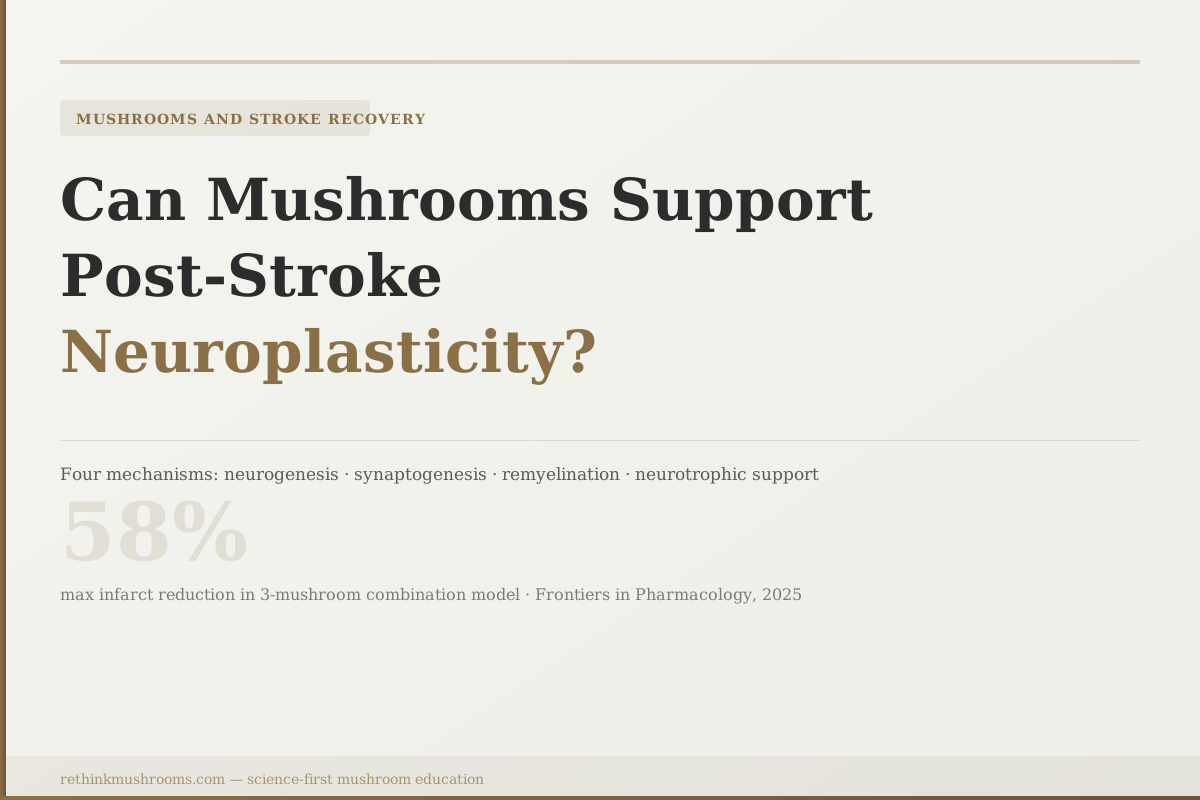
58% max infarct reduction
Three medicinal mushrooms combined in a December 2025 animal study reduced post-stroke brain damage by up to 58% and improved memory maze performance by up to 46%, the largest effect size reported for a mushroom combination in stroke models.
Frontiers in Pharmacology, December 2025 (DOI: 10.3389/fphar.2025.1698883)
4
post-stroke repair mechanisms mapped to mushroom compounds: neurogenesis, synaptogenesis, remyelination, neurotrophic support
BDNF
confirmed mechanism behind psilocybin-driven synaptogenesis in stroke model rats (Yu et al., BMC Neuroscience, 2024)
Erinacine S
protects oligodendrocytes (myelin-producing cells) from demyelination damage (Fu et al., Biomedicine & Pharmacotherapy, 2024)
Frontiers in Pharmacology, December 2025 (DOI: 10.3389/fphar.2025.1698883)
 View as image ↗
A December 2025 study published in Frontiers in Pharmacology combined three mushroom species in stroke-model animals and measured the results. The combination of Tiger Milk mushroom (Lignosus rhinocerotis), lion's mane (Hericium erinaceus), and reishi (Ganoderma lucidum) reduced brain infarct size by 32 to 58% and improved memory maze performance by 25 to 46% (DOI: 10.3389/fphar.2025.1698883). What made the result notable wasn't just the magnitude. It was the mechanism: this wasn't a single compound blocking a single death pathway. The three species together appeared to engage multiple arms of post-stroke neuroplasticity simultaneously.
This article maps what the research shows about mushrooms and post-stroke neuroplasticity, specifically the brain rewiring processes that determine whether functional recovery happens. The evidence is organized around four distinct mechanisms: neurogenesis, synaptogenesis, remyelination, and neurotrophic support. Each targets different cell types, unfolds on a different timescale, and has a different set of mushroom compounds in the evidence base. For the broader picture of how mushrooms affect brain health over time, see Mushrooms and Cognitive Aging: Can They Protect Your Brain?. For the overall stroke evidence by species, see Mushrooms and Stroke Recovery: Neuroprotective Research.
All evidence here is preclinical. No human neuroplasticity trial has been run for any of these compounds in the stroke context.
Key Takeaways
- A December 2025 three-mushroom combination study (Tiger Milk + lion's mane + reishi) reduced post-stroke infarct size by 32-58% and improved Morris maze memory performance by 25-46% in animal models (Frontiers in Pharmacology, 2025; DOI: 10.3389/fphar.2025.1698883)
- Erinacine A from lion's mane mycelium promotes post-stroke neurogenesis and reduces neural cell death via Nrf2-dependent antioxidant pathways, confirmed by a 2025 systematic review across preclinical models (Spangenberg et al., 2025)
- A sterol compound from Antrodia camphorata activated the Akt/GSK3/beta-catenin post-stroke neurogenesis pathway while simultaneously blocking NF-κB-driven inflammation in ischemic stroke animal models (Wang et al., Food & Function, 2019)
- Psilocybin (from psilocybin mushrooms, not traditional medicinal species) upregulated MAP2 and synaptophysin, both proteins that mark active synapse formation, and reduced microglial activation in stroke rats via BDNF signaling (Yu et al., BMC Neuroscience, 2024)
- Erinacine S from lion's mane mycelium protects oligodendrocytes, the cells that build and maintain myelin sheaths, from demyelination damage relevant to post-stroke white matter recovery (Fu et al., 2024)
- Every finding here is from animal or cell-culture studies; no human clinical trials have tested mushroom compounds for post-stroke neuroplasticity
What Post-Stroke Neuroplasticity Means for Brain Rewiring
After a stroke, some neurons die immediately from lack of oxygen. The region surrounding the dead tissue, called the penumbra, remains partially viable for days to weeks. Whether those cells survive, and whether the brain relearns functions lost to the damaged area, depends on four interconnected repair processes.
Neurogenesis is the creation of new neurons from stem cells, primarily in the hippocampus and in the subventricular zone lining the brain's fluid-filled chambers. It unfolds slowly, over weeks, but contributes to memory recovery and the gradual return of cognitive function.
Synaptogenesis is the formation of new connections between surviving neurons. When old pathways are severed by stroke damage, surviving neurons can sprout new branches and build new synaptic contacts with neighboring cells. This rewiring is the primary mechanism behind the functional gains seen in physical and cognitive rehabilitation.
Remyelination is the restoration of the myelin sheath, the insulating coating around nerve fibers that allows signals to travel at speed. Stroke frequently damages white matter, the brain tissue composed mainly of myelinated nerve fibers. When the cells that build myelin, called oligodendrocytes, are damaged or killed, signal transmission slows or stops across the affected circuits.
Neurotrophic signaling refers to the molecular signals that tell neurons and support cells to survive, grow, and form new connections. Brain-derived neurotrophic factor (BDNF) and nerve growth factor (NGF) are the most studied of these. Without adequate neurotrophic signaling, the other three processes stall at the starting gate.
The four processes are not sequential. They begin within hours of stroke onset and run in parallel. An intervention that activates only one of them will produce a narrower recovery benefit than one that engages several simultaneously.
No competitor resource maps mushroom compounds to all four of these mechanisms. Most consumer content covers lion's mane and NGF or BDNF, then stops. The preclinical literature goes considerably further.
Neurogenesis After Stroke: Two Compounds That Activate New-Neuron Growth
The most studied compound in mushroom-stroke research is erinacine A, a small molecule from lion's mane mycelium. A 2025 systematic review of preclinical studies confirmed that erinacine A dose-dependently enhances neurogenesis, reduces programmed cell death, and activates Nrf2, the master regulatory protein for cellular antioxidant defense.[1] These effects were replicated across animal models of stroke, Alzheimer's disease, and Parkinson's disease. Nrf2 activation is particularly relevant to post-stroke neurogenesis because oxidative stress is one of the primary forces killing both new neurons and the stem cells that produce them.
An earlier review (Li et al., 2018) catalogued the same erinacine effects and documented improvements in cognitive and behavioral outcomes specifically in ischemic stroke animal models.[2] The 2024 follow-up by Lee and colleagues tested novel structural variants of erinacine in a mild traumatic brain injury model and found that multiple variants reduced neuroinflammation in glial cells via the same Nrf2-dependent antioxidant pathways.[3]
Less known, but equally direct in its neurogenesis mechanism, is the evidence from Antrodia camphorata, a medicinal mushroom native to Taiwan. Wang and colleagues (2019) isolated a sterol compound from Antrodia called ergostatrien-7,9(11),22-trien-3β-ol and tested it in ischemic stroke rats. The compound did two things simultaneously. It blocked two proteins that drive inflammation and programmed cell death after stroke: NF-κB and caspase-3. And it activated the Akt/GSK3/beta-catenin pathway, the primary signaling chain driving post-stroke neurogenesis in the brain's stem cell zones.[4]
That dual action, shutting down the death signal while turning on the growth signal, is the mechanistic goal of stroke neuroprotection research. Most compounds studied for stroke accomplish one or the other. The Antrodia sterol appears to do both in the same experiment.
For the full preclinical evidence on cerebral ischemia across species, see Mushroom Compounds and Cerebral Ischemia: Preclinical Evidence.
Synaptogenesis: Psilocybin's Unexpected Role in Stroke Research
One of the most striking data points in the mushroom-stroke literature involves a compound that most people do not associate with stroke recovery.
Psilocybin, the active compound in psilocybin mushrooms (Psilocybe cubensis and related species), is not a traditional medicinal mushroom compound. It is a different category from lion's mane, reishi, or cordyceps, and it warrants clear labeling as such. But the mechanism it engages is directly relevant to post-stroke synaptogenesis, and the 2024 study is the only data point in the field on this specific neuroplasticity outcome.
Yu and colleagues (2024) gave stroke-model rats psilocybin both before and after inducing ischemic stroke. Pre-treatment reduced brain infarction volume and neurological deficits. Post-treatment psilocybin improved locomotor recovery and increased two proteins that mark active synapse formation: MAP2 and synaptophysin. When both increase together, new synaptic connections are being built in the affected tissue. The treatment also reduced IBA1, a protein that rises when the brain's immune cells (microglia) are overactivated and damaging surrounding tissue.[5]
The researchers then confirmed the mechanism by blocking the BDNF receptor with a drug called ANA12. Blocking BDNF abolished the recovery effects, establishing that BDNF upregulation was required for the observed synaptogenesis benefits.
This is a single animal study in a complex legal and regulatory environment. Psilocybin faces substantial barriers to human clinical trials for stroke indications. As a mechanistic demonstration, however, it provides the clearest evidence in the mushroom literature that a fungal compound can specifically upregulate synaptic density markers in stroke-model brains through a confirmed molecular mechanism. The microglial finding also connects directly to the broader anti-inflammatory stroke picture covered in Can Mushrooms Help After a Stroke? Anti-Inflammatory Brain Effects.
Remyelination: Why White Matter Recovery Is the Harder Problem
Stroke frequently damages white matter, and white matter repair depends on remyelination. The cells that build myelin sheaths, oligodendrocytes, are among the most vulnerable to ischemic injury. They die at the same rate as neurons when oxygen runs out. What distinguishes them from neurons is that they can sometimes be replaced by progenitor cells that mature into new oligodendrocytes, a process that mushroom compounds appear capable of supporting at two different stages.
Fu and colleagues (2024) tested erinacine S, a small structural variant of the erinacine compound family in lion's mane mycelium, in a model where oligodendrocytes are specifically destroyed. Erinacine S protected oligodendrocytes from demyelination damage and also reduced the mood abnormalities associated with the white matter loss that followed.[6] This is protection of existing myelin-producing cells, not replacement of dead ones.
The replacement angle was tested by Huang and colleagues (2021). Instead of asking whether mushroom compounds protect existing oligodendrocytes, they asked whether those compounds could accelerate the maturation of new ones from progenitor cells. Hericium erinaceus mycelium extract and several isolated small compounds from that extract increased myelin basic protein expression and promoted oligodendrocyte maturation in cell cultures. Myelin basic protein is the structural protein that forms the actual insulating wrap around nerve fibers.[7]
The broadest view comes from Yamashina and colleagues (2022), who tested multiple medicinal mushroom fruiting body extracts in the same demyelination model type. Multiple species suppressed demyelination and reduced the motor dysfunction associated with white matter loss, establishing that remyelination support is not unique to lion's mane or its erinacine compounds.[8]
The translational gap here is significant. The demyelination model used in these studies targets oligodendrocytes chemically, not through vascular occlusion. It does not replicate the inflammation cascade, oxidative burst, and energy failure of ischemic stroke. The evidence supports a plausible remyelination mechanism but does not demonstrate it operates under actual stroke conditions. For context on how mushrooms affect the blood-brain barrier and post-stroke brain structure more broadly, see Mushrooms and Blood-Brain Barrier Protection After Stroke.
Neurotrophic Support: The Chemical Signals That Coordinate Recovery
The fourth mechanism is the molecular signaling layer that regulates whether the other three processes happen at all. Neurotrophic factors, particularly BDNF and NGF, control whether neurons survive, whether they extend new connections, and whether stem cells differentiate into mature neurons or oligodendrocytes. Two mushroom compounds engage this layer through mechanisms that have not received much consumer coverage.
Lin and colleagues (2023) found that erinacine S from lion's mane mycelium promotes neuronal regeneration in cell cultures by inducing the accumulation of neurosteroids, which are compounds that neurons synthesize internally from cholesterol and use as local chemical signals for plasticity and recovery.[9] Neurosteroid signaling overlaps with NGF and BDNF signaling in several pathways that regulate synaptic plasticity and neuronal survival. The connection to the broader neurotrophic framework is mechanistically coherent, though the in vitro setting is a significant limitation.
The Tremella finding is older and harder to find in any consumer health resource. Park and colleagues (2007) tested Tremella fuciformis extract in a standard model for studying neuron growth and survival responses. The extract demonstrated both neuroprotective effects (cells surviving oxidative stress) and NGF-like neurotrophic activity that promotes neuronal differentiation and survival.[10]
Tremella is primarily known as a culinary mushroom used in soups and desserts, not a medicinal compound. It does not appear in most discussions of neurotrophic mushroom research. The NGF-like data is from a single cell-culture study and has not been followed up in stroke-specific models. But neurotrophic activity from a common dietary species is worth noting as a mechanistic datapoint that currently sits entirely outside consumer awareness.
A Three-Mushroom Combination Cuts Infarct Size by Up to 58%
The combination study published in Frontiers in Pharmacology in December 2025 (DOI: 10.3389/fphar.2025.1698883) tested what happens when the multi-mechanism approach is applied deliberately. The three species were not combined arbitrarily. Tiger Milk mushroom (Lignosus rhinocerotis), lion's mane (Hericium erinaceus), and reishi (Ganoderma lucidum) were selected because each engages different parts of the stroke-recovery cascade.
Tiger Milk is a Malaysian medicinal mushroom with traditional use in respiratory and neurological complaints. Its mechanisms in stroke had not been widely characterized before this study. Lion's mane brings the erinacine compounds targeting neurogenesis and remyelination. Reishi brings anti-inflammatory polysaccharides with documented effects on microglial activation in neuroinflammation models. Together, the three produced a 32 to 58% reduction in infarct size and a 25 to 46% improvement in Morris maze spatial memory performance across dose groups.
The size of the effect is large by preclinical standards. The range reflects variation across dose levels. No single-species extract in the prior stroke literature had produced effects of that magnitude consistently across both infarct and cognitive outcomes simultaneously.
This study has not yet been assigned a PubMed ID. It is not yet indexed in PubMed as of this writing. No consumer health site has covered it. The DOI (10.3389/fphar.2025.1698883) is the current identifying reference.
Where the Evidence Ends: Everything Here Is from Animals
Everything described above has one critical qualifier: it is from animal models and cell cultures. No human trial has tested any of these compounds specifically for post-stroke neuroplasticity outcomes in people.
This limitation is not a minor caveat. The gap between promising preclinical stroke data and human benefit is where most stroke drugs have failed over the past three decades. Compounds that block ischemic damage in animals frequently fail to replicate that protection in humans, often because the inflammation cascade in human stroke is more variable, the timing of intervention is harder to control, and the dose that works in a 300-gram rat does not scale simply to a 70-kilogram person.
The preclinical evidence reviewed here does support specific mechanisms. Neurogenesis pathways can be activated by erinacine A and Antrodia sterol compounds. Synaptogenesis markers can be upregulated by BDNF-activating compounds in stroke-model brains. Oligodendrocyte survival can be supported by erinacine S. Neurotrophic activity has been demonstrated for multiple species. Whether these mechanisms operate in human post-stroke recovery at achievable dietary or supplemental doses remains an open question that no current published research can answer.
The same mechanistic evidence base applies across acquired brain injuries more broadly. For overlapping research in traumatic brain injury, see Mushrooms for Traumatic Brain Injury: Neuroprotective Research and Lion's Mane After Concussion: Can It Help Recovery?. Stroke risk also increases substantially with age, and the neuroplasticity mechanisms reviewed here intersect with the general brain health research covered in Best Mushrooms for Brain Health in Older Adults.
The Bottom Line
Preclinical research maps four mechanisms through which mushroom compounds may support post-stroke brain rewiring: neurogenesis (erinacine A from lion's mane, ergostatrien from Antrodia), synaptogenesis (psilocybin via BDNF in stroke-model rats), remyelination (erinacine S protecting oligodendrocytes), and neurotrophic signaling (erinacine S neurosteroids, Tremella NGF-like activity). A December 2025 three-mushroom combination study produced 32 to 58% infarct reduction in animal models. No human neuroplasticity trials exist for any of these compounds.
Frequently Asked Questions
Sources & References
- 1. Source details for this reference are not yet available.
- 2. Source details for this reference are not yet available.
- 3. Source details for this reference are not yet available.
- 4. Source details for this reference are not yet available.
- 5. Source details for this reference are not yet available.
- 6. Source details for this reference are not yet available.
- 7. Source details for this reference are not yet available.
- 8. Source details for this reference are not yet available.
- 9. Source details for this reference are not yet available.
- 10. Source details for this reference are not yet available.