Mushrooms and Cognitive Aging
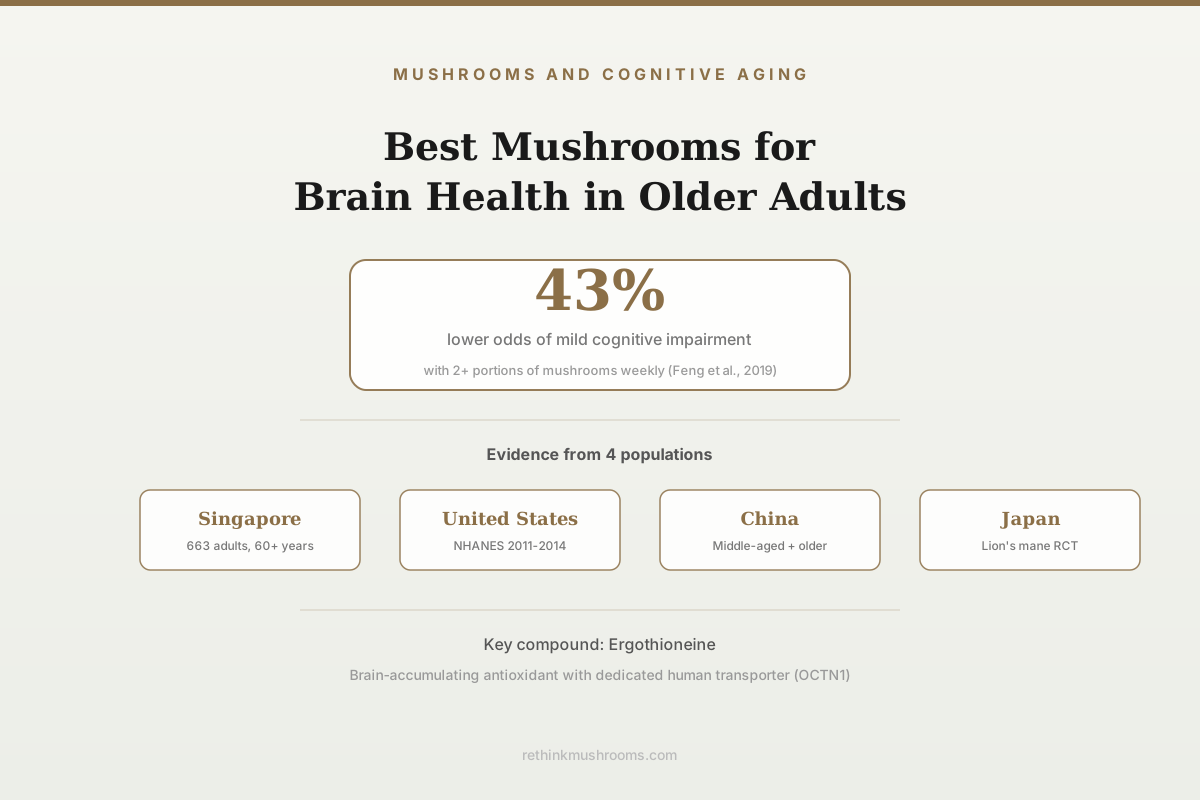
43% lower odds
Older adults in Singapore who ate more than two portions of mushrooms per week had 43% lower odds of mild cognitive impairment compared to those eating mushrooms less than once weekly.
Feng et al., J. Alzheimer's Dis., 2019
663
participants aged 60+ in the Singapore study
Ergothioneine
brain-accumulating antioxidant in all mushrooms
4 Studies
epidemiological studies linking mushrooms to cognition
Feng et al., J. Alzheimer's Dis., 2019
 View as image ↗
The evidence connecting mushroom consumption to brain health in older adults comes from two converging lines of research. Epidemiological studies across Singapore, the United States, the United Kingdom, and China consistently find that older adults who eat more mushrooms perform better on cognitive tests and have lower rates of cognitive impairment. Separately, clinical trials on specific mushroom species (particularly lion's mane) show measurable cognitive improvements in older adults with mild cognitive impairment. The proposed link between these findings is ergothioneine, a brain-accumulating antioxidant found in virtually all edible mushrooms, for which humans have a dedicated cellular transporter. For the broader question of whether mushrooms can protect against cognitive aging, see the companion overview.
Key Takeaways
- Singaporean adults aged 60+ who consumed more than two portions (300 g) of mushrooms weekly had 43% lower odds of mild cognitive impairment (OR = 0.43, 95% CI 0.23-0.78) independent of age, education, and chronic disease (Feng et al., 2019)
- In US NHANES data (2011-2014), higher mushroom intake was associated with better scores on the Digit Symbol Substitution Test (processing speed) and CERAD word learning test (memory) in adults aged 60+ (Ba et al., 2022)
- Lion's mane at 3,000 mg/day for 16 weeks improved cognitive function scores in 50-80 year old Japanese adults with mild cognitive impairment, with scores declining after supplementation stopped (Mori et al., 2009)
- A cross-sectional study of middle-aged and older Chinese adults found mushroom consumption positively associated with cognitive performance across multiple domains (Yan et al., 2023)
- Ergothioneine from dietary mushrooms is bioavailable in humans, with plasma levels increasing dose-dependently, and low plasma ergothioneine has been associated with cognitive decline risk (Weigand-Heller et al., 2012)
- A 2025 narrative review concluded that lion's mane shows promise as a future therapeutic treatment for prevention and delayed progression of Alzheimer's disease through NGF-stimulating hericenones and erinacines (Cornford et al., 2025)
The Singapore Study: Where the Evidence Started
Feng et al. (2019) conducted the landmark epidemiological study connecting mushroom intake to cognitive health in older adults. The Diet and Healthy Aging (DaHA) study enrolled 663 Singaporeans aged 60 and above and assessed both dietary mushroom consumption and cognitive function.[1]
Participants who consumed more than two portions of mushrooms per week (where one portion equals approximately 150 grams of cooked mushrooms, or three-quarters of a cup) had 43% lower odds of having mild cognitive impairment compared to those eating mushrooms less than once weekly (odds ratio = 0.43, 95% CI 0.23-0.78, p = 0.006). This association held after adjustment for age, gender, education, cigarette smoking, alcohol consumption, hypertension, diabetes, heart disease, stroke, physical activity, and social activity.
Six commonly consumed mushroom varieties were included: golden, oyster, shiitake, white button, dried, and canned mushrooms. The study did not isolate the effect of any single species, suggesting that the cognitive association relates to compounds shared across mushroom types rather than species-specific metabolites.[1]
The researchers proposed ergothioneine as the likely mediating compound. Ergothioneine is found in all six mushroom varieties studied, and humans possess a dedicated transporter (OCTN1/SLC22A4) that actively accumulates it in cells, particularly in the brain, liver, and kidneys. The existence of a dedicated transporter suggests evolutionary importance for this compound. For a deeper analysis of the Singapore mushroom study methodology and findings, see the dedicated article. For the full Singapore study implications, see the companion piece.
US NHANES Data: Replication Across Populations
Ba et al. (2022) tested the mushroom-cognition association in a different population using nationally representative US data from the National Health and Nutrition Examination Survey (NHANES), 2011-2014.[2]
In adults aged 60 and older, higher mushroom intake was associated with better scores on the Digit Symbol Substitution Test (DSST, measuring processing speed and executive function) and the Consortium to Establish a Registry for Alzheimer's Disease word learning test (CERAD-WL, measuring memory). Participants in the highest category of mushroom intake performed better across both cognitive domains compared to those in the lowest category.
The NHANES analysis adds population-level evidence because it uses a nationally representative sample with standardized dietary assessment and validated cognitive testing. The consistency between the Singapore finding (Asian population, specific mushroom varieties) and the US finding (diverse population, general mushroom consumption) strengthens the case that the association is not confounded by a single cultural dietary pattern.[2]
Chinese Cross-Sectional Data
Yan et al. (2023) extended the evidence to mainland Chinese middle-aged and older adults. In this cross-sectional study, mushroom consumption was positively associated with cognitive performance across multiple domains.[3]
The replication across three distinct populations (Singaporean, American, Chinese) with different dietary patterns, mushroom species consumed, preparation methods, and confounding structures substantially reduces the likelihood that the association is an artifact of any single population's characteristics.
However, all three studies share a fundamental limitation: they are cross-sectional or observational. They cannot establish that mushrooms cause better cognitive function. The association could be confounded by unmeasured factors: people who eat more mushrooms may have generally healthier diets, higher socioeconomic status, or other lifestyle factors that independently protect cognition. The dose-response pattern (more mushrooms associated with better cognition) makes confounding less likely but does not eliminate it. For a broader perspective on how much mushroom is needed to protect cognition, see the dietary evidence review.
Lion's Mane: The Interventional Evidence
While epidemiological studies show associations between general mushroom consumption and cognition, interventional trials testing specific mushroom species provide stronger evidence for causation.
Mori et al. (2009) conducted a double-blind, placebo-controlled trial in 30 Japanese men and women aged 50-80 diagnosed with mild cognitive impairment. Participants received 3,000 mg/day of lion's mane (Hericium erinaceus) powder or placebo for 16 weeks.[4]
The lion's mane group showed progressive improvement on the Revised Hasegawa Dementia Scale at weeks 8, 12, and 16. Scores increased with each assessment point, suggesting a cumulative benefit over the 16-week treatment period. The placebo group showed no improvement.
The washout data provides the strongest evidence for a real pharmacological effect. After participants stopped taking lion's mane, their improved cognitive scores declined back toward baseline over four weeks. This reversal pattern is inconsistent with a pure placebo effect (which would be expected to persist after stopping placebo) and consistent with a compound that must be present continuously to maintain its cognitive benefit.[4]
The mechanism involves hericenones (from fruiting body) and erinacines (from mycelium), both of which stimulate nerve growth factor (NGF) synthesis. NGF is critical for the survival and function of cholinergic neurons, the neuronal population most affected in Alzheimer's disease. Age-related decline in NGF signaling contributes to cholinergic neurodegeneration and cognitive decline.
Cornford et al. (2025) reviewed the accumulating evidence and concluded that lion's mane shows promise as a future therapeutic treatment for prevention and delayed progression of Alzheimer's disease, while noting that robust clinical trials with larger sample sizes remain needed.[5]
A systematic review by Cha et al. (2024) evaluated mushroom effects on mood and neurocognitive health across the lifespan and found that lion's mane had the most consistent evidence among all species, though overall study quality was low and sample sizes small.[6]
Ergothioneine: The Cross-Species Link
Ergothioneine provides a mechanistic bridge between the epidemiological data (general mushroom consumption protects cognition) and the interventional data (lion's mane specifically improves cognition). Every edible mushroom contains ergothioneine, but the concentrations vary.
Weigand-Heller et al. (2012) demonstrated that ergothioneine from common button mushrooms (Agaricus bisporus) is bioavailable in humans. After consuming a single serving, plasma ergothioneine levels increased dose-dependently. Markers of oxidative stress showed favorable trends, though the study was too small and short to demonstrate clinical endpoints.[7]
Ergothioneine crosses the blood-brain barrier via its dedicated OCTN1 transporter and accumulates in brain tissue. This active brain accumulation, combined with its potent antioxidant and anti-inflammatory properties, makes it a plausible mediator of the epidemiological mushroom-cognition association. Reduced plasma ergothioneine has been reported in patients with mild cognitive impairment and Alzheimer's disease in several observational studies, though whether low ergothioneine is a cause or consequence of neurodegeneration remains unresolved.
The mushroom species with the highest ergothioneine concentrations are king oyster (Pleurotus eryngii), oyster (Pleurotus ostreatus), shiitake (Lentinula edodes), and maitake (Grifola frondosa), with concentrations ranging from 0.4 to 2.0 mg per gram dry weight. Button mushrooms contain moderate levels. Lion's mane contains ergothioneine but also provides the additional NGF-stimulating compounds (hericenones, erinacines) that make it uniquely suited for cognitive applications.
Reishi: The Stress and Sleep Layer
Cognitive decline in older adults is accelerated by chronic stress, poor sleep, and inflammation, all of which reishi (Ganoderma lucidum) has evidence for modulating. Zhao et al. (2012) showed that reishi spore powder at 3,000 mg/day reduced fatigue and improved well-being in a clinical population.[8]
For older adults, reishi's role is protective rather than directly cognitive: by reducing stress-related cortisol exposure and improving sleep quality, it may slow the cognitive damage caused by chronic stress and sleep deprivation. This makes it a rational complement to lion's mane in an older adult's mushroom regimen, though the evidence for reishi's direct effect on cognitive scores in healthy older adults is absent. For more on adaptogenic mushrooms and stress management, see the dedicated article.
Practical Guidance for Older Adults
The evidence supports three approaches, from simplest to most targeted:
Dietary approach (easiest): Eat at least two portions (300 grams total) of mixed mushrooms per week. The Singapore study suggests this level of intake is associated with meaningfully lower odds of cognitive impairment. Any commonly available mushrooms (button, shiitake, oyster, king oyster, maitake) contribute ergothioneine and other bioactive compounds. Cooking is preferred over raw consumption, as heat breaks down chitin cell walls and releases beta-glucans and ergothioneine for better absorption.
Supplementation approach (targeted): Lion's mane at 1,800-3,000 mg/day of fruiting body powder or extract is the most evidence-based single-species supplement for cognitive protection in older adults. The Mori et al. (2009) trial used 3,000 mg/day and showed progressive improvement over 16 weeks.
Combined approach: Dietary mushrooms for broad ergothioneine and beta-glucan intake, plus targeted lion's mane supplementation for NGF-stimulating compounds. This combines the epidemiological evidence base (general mushroom consumption) with the interventional evidence base (lion's mane specifically). For specific mushroom nootropic stack recommendations, see the evidence-based guide.
All three approaches have the same limitation: no long-term randomized controlled trial has demonstrated that mushroom consumption or supplementation prevents dementia or Alzheimer's disease. The epidemiological associations and the short-term cognitive improvement data from lion's mane trials are consistent with a protective effect, but definitive proof requires large-scale, multi-year intervention studies that have not yet been conducted.
The Bottom Line
Four epidemiological studies across Singapore, the US, and China consistently show that older adults who eat more mushrooms perform better on cognitive tests and have lower rates of mild cognitive impairment. The Singapore study found 43% lower odds of MCI in adults eating 2+ portions weekly. Lion's mane is the only species with interventional trial evidence showing cognitive improvement in older adults with mild cognitive impairment at 3,000 mg/day. Ergothioneine, a brain-accumulating antioxidant present in all edible mushrooms, is the proposed link between general mushroom consumption and cognitive protection. No long-term trial has tested whether mushroom intake prevents dementia.
Frequently Asked Questions
Sources & References
- 1RTHM-00554·Feng, Lei et al. (2019). “The Association between Mushroom Consumption and Mild Cognitive Impairment: A Community-Based Cross-Sectional Study in Singapore..” Journal of Alzheimer's disease : JAD.Study breakdown →PubMed →↩
- 2RTHM-00741·Ba, Djibril M et al. (2022). “Mushroom intake and cognitive performance among US older adults: the National Health and Nutrition Examination Survey, 2011-2014..” The British journal of nutrition.Study breakdown →PubMed →↩
- 3RTHM-00858·Yan, Yaqiong et al. (2023). “The relationship between mushroom consumption and cognitive performance among middle-aged and older adults: a cross-sectional study..” Food & function.Study breakdown →PubMed →↩
- 4RTHM-00165·Mori, Koichiro et al. (2009). “Improving effects of the mushroom Yamabushitake (Hericium erinaceus) on mild cognitive impairment: a double-blind placebo-controlled clinical trial..” Phytotherapy research : PTR.Study breakdown →PubMed →↩
- 5RTHM-00922·Cornford, Nisha et al. (2025). “Hericium erinaceus: A possible future therapeutic treatment for the prevention and delayed progression of Alzheimer's disease? - A narrative review..” Nutrition research reviews.Study breakdown →PubMed →↩
- 6RTHM-00868·Cha, Sara et al. (2024). “A review of the effects of mushrooms on mood and neurocognitive health across the lifespan..” Neuroscience and biobehavioral reviews.Study breakdown →PubMed →↩
- 7RTHM-00270·Weigand-Heller, AuBrei J et al. (2012). “The bioavailability of ergothioneine from mushrooms (Agaricus bisporus) and the acute effects on antioxidant capacity and biomarkers of inflammation..” Preventive medicine.Study breakdown →PubMed →↩
- 8RTHM-00276·Zhao, Hong et al. (2012). “Spore Powder of Ganoderma lucidum Improves Cancer-Related Fatigue in Breast Cancer Patients Undergoing Endocrine Therapy: A Pilot Clinical Trial..” Evidence-based complementary and alternative medicine : eCAM.Study breakdown →PubMed →↩