Mushrooms for TBI, Concussion & CTE
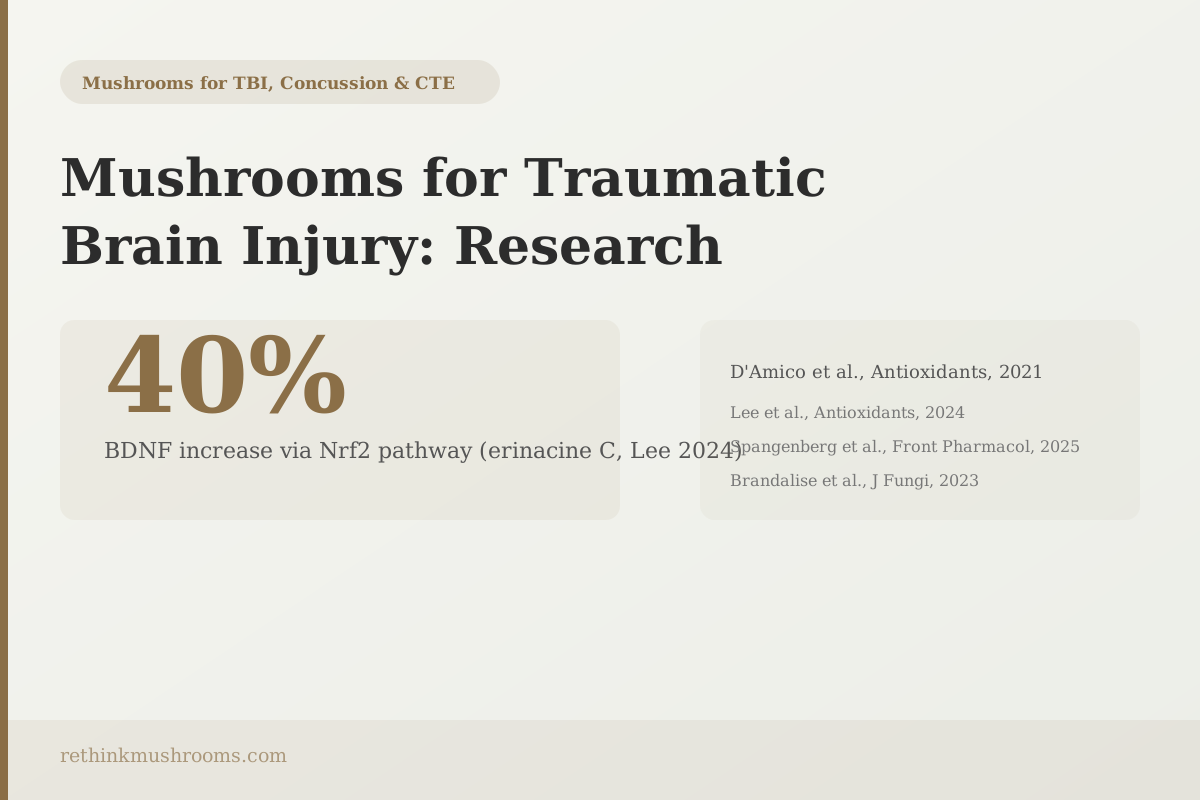
40% BDNF increase
Erinacine C from Lion's Mane mycelium increased BDNF, a protein that promotes neuron survival and recovery, by 40% and key antioxidant enzymes by 45 to 80% via the Nrf2 pathway in a mild traumatic brain injury animal model.
Lee et al., Antioxidants, 2024
CAT & TrxR +80%
two antioxidant enzymes activated by erinacine C via Nrf2 in mild TBI mice; SOD increased 45% (Lee 2024)
TH & DAT preserved
dopaminergic markers in the substantia nigra held in TBI mice treated with HE and turkey tail; untreated controls declined (D'Amico 2021)
2025 systematic review
Spangenberg et al. synthesized all preclinical erinacine neuroprotection evidence in Frontiers in Pharmacology
Lee et al., Antioxidants, 2024
 View as image ↗
In 2021, a research team applied controlled cortical impact, the standard laboratory device for delivering precise, reproducible traumatic brain injuries in animals, to mice. They then treated the animals orally with Lion's Mane (Hericium erinaceus) and turkey tail (Coriolus versicolor) mushroom extracts. Over the following days, the behavioral deficits that emerged after injury reversed. More specifically, dopaminergic neurons in the substantia nigra, a brainstem region responsible for dopamine production, were protected from TBI-triggered damage. In untreated TBI animals, tyrosine hydroxylase and dopamine transporter levels in that region declined. In the mushroom-treated animals, they held.[1]
That study, D'Amico et al. 2021, published in Antioxidants, is the most direct experimental evidence available for any medicinal mushroom mitigating the molecular and behavioral consequences of traumatic brain injury. Three years later, Lee et al. expanded the picture with a mild TBI model (the preclinical approximation of concussion) and a specific compound: erinacine C from Lion's Mane mycelium activated a cellular antioxidant switch called the Nrf2 pathway, increasing BDNF by 40% and three antioxidant enzymes by 45 to 80%.[2]
This research is not discussed anywhere in consumer TBI content. This article is the overview. For a brain health context for this cluster, this work connects to broader research on mushrooms and cognitive aging.
Key Takeaways
- D'Amico et al. (2021, Antioxidants) found that oral Lion's Mane plus turkey tail treatment after controlled cortical impact TBI in mice restored behavioral function and prevented TBI-triggered decreases in tyrosine hydroxylase and dopamine transporter, the key markers of dopaminergic neurons in the substantia nigra
- Lee et al. (2024, Antioxidants) showed erinacine C from Lion's Mane mycelium activated the Nrf2 antioxidant pathway in mild TBI animals, increasing BDNF by 40%, catalase (CAT) by 80%, thioredoxin reductase (TrxR) by 80%, and superoxide dismutase (SOD) by 45%
- Erinacines are found in Lion's Mane mycelium, not the fruiting body; they cross the blood-brain barrier, which is why mycelium-based products are the more mechanistically relevant form for TBI neuroprotection
- Spangenberg et al.'s 2025 systematic review in Frontiers in Pharmacology synthesized all available preclinical erinacine neuroprotection evidence, establishing it as the primary active compound class for brain protection in Lion's Mane
- Abitbol et al. (2022) positioned mushroom natural products in the neurodegenerative disease drug discovery pipeline, relevant because TBI is a major risk factor for Alzheimer's and Parkinson's
- Every study cited here is preclinical; no randomized human clinical trials have tested mushroom supplements for TBI or concussion recovery
The 2021 Study: Two Mushrooms Tested Directly After TBI
A controlled cortical impact device delivers a precision mechanical strike to the exposed cortex of an anesthetized animal, producing a reproducible, measurable brain injury. The model is the gold standard for TBI research because the injury parameters (depth, velocity, duration) can be controlled and replicated across laboratories. It is analogous to moderate-to-severe TBI in its pathological consequences: neuroinflammation, oxidative stress, neuronal death, and behavioral deficits.
D'Amico's team used this model and then administered oral extracts of Lion's Mane and turkey tail starting immediately after injury.[1] The outcomes they measured were specific. First, behavioral assessment: TBI mice typically show deficits in motor coordination, spatial memory, and anxiety-related behavior. The treated mice showed reversal of these behavioral alterations compared to untreated TBI animals. Second, molecular assessment: in the substantia nigra, the study measured tyrosine hydroxylase (TH) and dopamine transporter (DAT), two proteins that serve as markers for the health of dopamine-producing neurons. In untreated TBI mice, both TH and DAT declined. In the Lion's Mane and turkey tail-treated mice, they were preserved.
The significance of the dopaminergic finding extends beyond the immediate injury. TBI is a documented risk factor for Parkinson's disease, a condition caused by the gradual loss of dopaminergic neurons in the substantia nigra. When TBI triggers early dopaminergic damage, it may accelerate the timeline toward Parkinson's pathology. The D'Amico study shows that the mushroom combination prevented the specific type of dopaminergic neuron loss that TBI can trigger. The mushrooms and Parkinson's disease neuroprotective research article covers the dopaminergic protection mechanisms that are relevant across both conditions.
The study used a combination of two species: Lion's Mane (which has direct neurotrophic and neuroprotective properties) and turkey tail (Coriolus versicolor, which has anti-inflammatory and immunomodulatory properties). The combination makes the results harder to attribute to any single compound or mechanism. The researchers noted attenuation of both neuroinflammatory and oxidative processes in treated animals, suggesting both species contributed through complementary pathways. For the combination therapy research, the Lion's Mane and Cordyceps for TBI dual therapy article addresses the mechanistic case for combining complementary mushroom species after brain injury.
Erinacine C and the Nrf2 Pathway: Specific Numbers From a Mild TBI Study
Lee et al.'s 2024 study in Antioxidants tested specific erinacine compounds, not a whole mushroom extract, in a mild TBI model, which is the closest preclinical approximation to concussion in humans.[2]
Mild TBI produces a different pathological profile than severe TBI. Instead of direct tissue destruction, it triggers a cascade of secondary damage: acute oxidative stress from reactive oxygen species, neuroinflammation from activated microglia (the brain's immune cells), and disruption of axonal signal transmission. Recovery depends partly on how quickly the brain can mount an antioxidant and anti-inflammatory response.
The Nrf2 pathway is the cell's master antioxidant switch. Nrf2 is a protein that, when activated, moves into the cell nucleus and turns on a set of protective genes simultaneously. The proteins those genes produce include catalase (an enzyme that neutralizes hydrogen peroxide, a reactive oxygen molecule), thioredoxin reductase (an enzyme that keeps other antioxidant proteins functional), and superoxide dismutase (an enzyme that converts superoxide radicals into less harmful molecules). Activating Nrf2 does not target one specific toxin; it switches on a coordinated antioxidant defense program.
Erinacine C activated this pathway in mild TBI animals. Compared to LPS-treated controls (animals given lipopolysaccharide to induce neuroinflammation), the erinacine C group showed BDNF expression increased by 40%, catalase increased by 80%, thioredoxin reductase increased by 80%, and superoxide dismutase increased by 45%.[2] Nrf2 expression itself was significantly induced in both the cortex and the sub-cortex of mTBI animals. The cortex and sub-cortex are the regions most directly affected by mild TBI, and Nrf2 induction in those specific regions suggests the pathway was activated where it was most needed.
BDNF, brain-derived neurotrophic factor, deserves specific mention. It is a protein that promotes the growth, maintenance, and survival of neurons. After brain injury, BDNF levels often drop, contributing to the neurodegenerative cascade. A 40% increase in BDNF expression is not a trivial signal; it suggests erinacine C supports the brain's endogenous neuronal repair signaling.
For readers specifically interested in concussion recovery, the Lion's Mane after concussion article covers the mild TBI evidence in depth, including the timing and form questions that the Lee 2024 study raises.
Erinacines vs. Hericenones: Why the Form of Lion's Mane Matters for TBI
Most people who buy Lion's Mane supplements purchase fruiting body products. The neuroprotective evidence for TBI points to a different part of the mushroom: the mycelium.
The two primary bioactive compound classes in Lion's Mane come from different plant organs. Hericenones are found in the fruiting body and are well-studied for NGF (nerve growth factor) induction, the mechanism that promotes nerve connection growth. Erinacines are found in the mycelium and are the primary compounds responsible for the neuroprotective effects documented in the TBI models: Nrf2 activation, BDNF induction, and the anti-apoptotic (cell-death-preventing) and anti-inflammatory effects characterized in the broader erinacine literature.
Critically, erinacines cross the blood-brain barrier. Most polysaccharides, the large sugar-based molecules that make up much of the immune-activating compounds in medicinal mushrooms, do not efficiently cross this barrier. Erinacines are small diterpene compounds (a class of naturally occurring molecules with a specific molecular structure), and their small size allows them to pass through the barrier and act directly in the brain rather than peripherally.
Li et al.'s 2018 review in Behavioral Neurology established erinacine-enriched mycelium as the primary neuroprotective product form, documenting its anti-apoptotic, anti-inflammatory, and NGF-inducing activities.[3] Wong et al.'s 2012 review established peripheral nerve regeneration as the foundational model for understanding how Lion's Mane promotes neural healing across multiple injury contexts, from peripheral nerves to central nervous system pathologies.[5]
The 2025 systematic review by Spangenberg et al. in Frontiers in Pharmacology synthesized the full preclinical erinacine neuroprotection evidence across multiple disease models.[7] As the most current and comprehensive synthesis, it establishes that erinacines, not hericenones, are the primary neuroprotective compound class in Lion's Mane, which has direct implications for what kind of product a person interested in TBI neuroprotection should look for.
For a deeper explanation of what erinacines and hericenones are at the molecular level, the hericenones and erinacines article covers both compound classes and their mechanisms.
Why Mushrooms Are Being Studied for Neurodegenerative Disease, Not Just Injury Recovery
TBI is not just an acute injury. It is a documented risk factor for long-term neurodegenerative disease. Epidemiological data consistently shows elevated rates of Alzheimer's disease, Parkinson's disease, and CTE (chronic traumatic encephalopathy) in populations with histories of head injury. The biological mechanisms connect: TBI triggers neuroinflammation and oxidative stress; both of these processes, if chronic or sustained, drive neurodegenerative pathology over years and decades.
This is the reason Abitbol et al.'s 2022 review in Cells positioned mushroom natural products specifically within the neurodegenerative disease drug discovery pipeline.[4] The compounds being studied for TBI recovery (erinacines, polysaccharides, terpenoids) are also the compounds being studied for Alzheimer's, Parkinson's, and other neurodegenerative conditions. If a compound can reduce the acute neuroinflammatory and oxidative damage after TBI, it may also reduce the long-term risk of the neurodegenerative conditions that TBI predisposes.
Brandalise et al.'s 2023 review in the Journal of Fungi framed this honestly with the question in its title: "From Bench to Bedside and Beyond, How Far from the Shoreline?"[6] For TBI specifically, the distance is substantial. The neuroinflammation and long-term neurodegeneration angle connects to the cross-species mushroom research in Alzheimer's article, which covers how mushroom compounds operate across the spectrum of neurodegeneration.
Honest Limitations: Animal Studies, No Human Trials, and the Translation Gap
Every study cited in this article is preclinical. The D'Amico 2021 study uses a controlled cortical impact model in mice. The Lee 2024 study uses a mild TBI model in animals and glial cell cultures. The Li 2018 and Wong 2012 reviews synthesize animal and cell culture data. The Spangenberg 2025 systematic review synthesizes preclinical models. No randomized clinical trial has tested any mushroom supplement in humans with TBI or concussion and measured clinical recovery outcomes.
This is the central limitation, and it is not a small one. The path from "erinacine C activates Nrf2 in a TBI mouse model" to "Lion's Mane mycelium reduces concussion recovery time in humans" crosses multiple unknowns: human dosing, timing relative to injury, form of administration, which specific erinacine compounds are present in commercial products, and whether the specific concentrations tested in animal models are achievable in a human brain through oral supplementation. None of these questions have been answered in clinical trials.
Brandalise et al.'s honest framing is useful here: the preclinical evidence for erinacines in neurological protection is genuinely strong across multiple models, but the clinical translation remains uncharted.[6]
There is also the distinction between mild and severe TBI. The Lee 2024 study uses a mild TBI model, most relevant to concussion. The D'Amico 2021 study uses controlled cortical impact, which models moderate-to-severe TBI. These are different injuries with different pathology, different acute timelines, and potentially different windows for intervention. An approach that shows benefit in one model may not translate to the other. The sibling articles in this cluster address concussion, brain inflammation, and CTE separately because these are mechanistically distinct questions. For the neuroinflammatory cascade specifically, the mushroom compounds and brain inflammation after injury article covers the secondary damage mechanisms in depth.
The Bottom Line
The strongest preclinical TBI evidence for medicinal mushrooms comes from D'Amico et al. (2021), which found that oral Lion's Mane and turkey tail after controlled cortical impact restored behavioral function and prevented dopaminergic neuron loss in the substantia nigra of TBI mice. Lee et al. (2024) provides the mechanism: erinacine C from Lion's Mane mycelium activates the Nrf2 antioxidant pathway in mild TBI animals, increasing BDNF by 40% and key antioxidant enzymes by 45 to 80%. Erinacines, found in mycelium rather than fruiting body, cross the blood-brain barrier. No human clinical trials exist for mushrooms and TBI.
Frequently Asked Questions
Sources & References
- 1RTHM-01340·D'Amico, Ramona et al. (2021). “Hericium erinaceus and Coriolus versicolor Modulate Molecular and Biochemical Changes after Traumatic Brain Injury..” Antioxidants (Basel.Study breakdown →PubMed →↩
- 2RTHM-01924·Lee, Kam-Fai et al. (2024). “The Cerebral Protective Effect of Novel Erinacines from Hericium erinaceus Mycelium on In Vivo Mild Traumatic Brain Injury Animal Model and Primary Mixed Glial Cells via Nrf2-Dependent Pathways..” Antioxidants (Basel.Study breakdown →PubMed →↩
- 3RTHM-00973·Li, I-Chen et al. (2018). “Neurohealth Properties of Hericium erinaceus Mycelia Enriched with Erinacines..” Behavioural neurology.Study breakdown →PubMed →↩
- 4RTHM-00737·Abitbol, Arjuna et al. (2022). “Mushroom Natural Products in Neurodegenerative Disease Drug Discovery..” Cells.Study breakdown →PubMed →↩
- 5RTHM-00500·Wong, Kah-Hui et al. (2012). “Neuroregenerative potential of lion's mane mushroom, Hericium erinaceus (Bull.: Fr.) Pers. (higher Basidiomycetes), in the treatment of peripheral nerve injury (review)..” International journal of medicinal mushrooms.Study breakdown →PubMed →↩
- 6RTHM-01662·Brandalise, Federico et al. (2023). “Hericium erinaceus in Neurodegenerative Diseases: From Bench to Bedside and Beyond, How Far from the Shoreline?.” Journal of fungi (Basel.Study breakdown →PubMed →↩
- 7RTHM-02184·Spangenberg, E T et al. (2025). “Unveiling the role of erinacines in the neuroprotective effects of Hericium erinaceus: a systematic review in preclinical models..” Frontiers in pharmacology.Study breakdown →PubMed →↩