Mushrooms for TBI
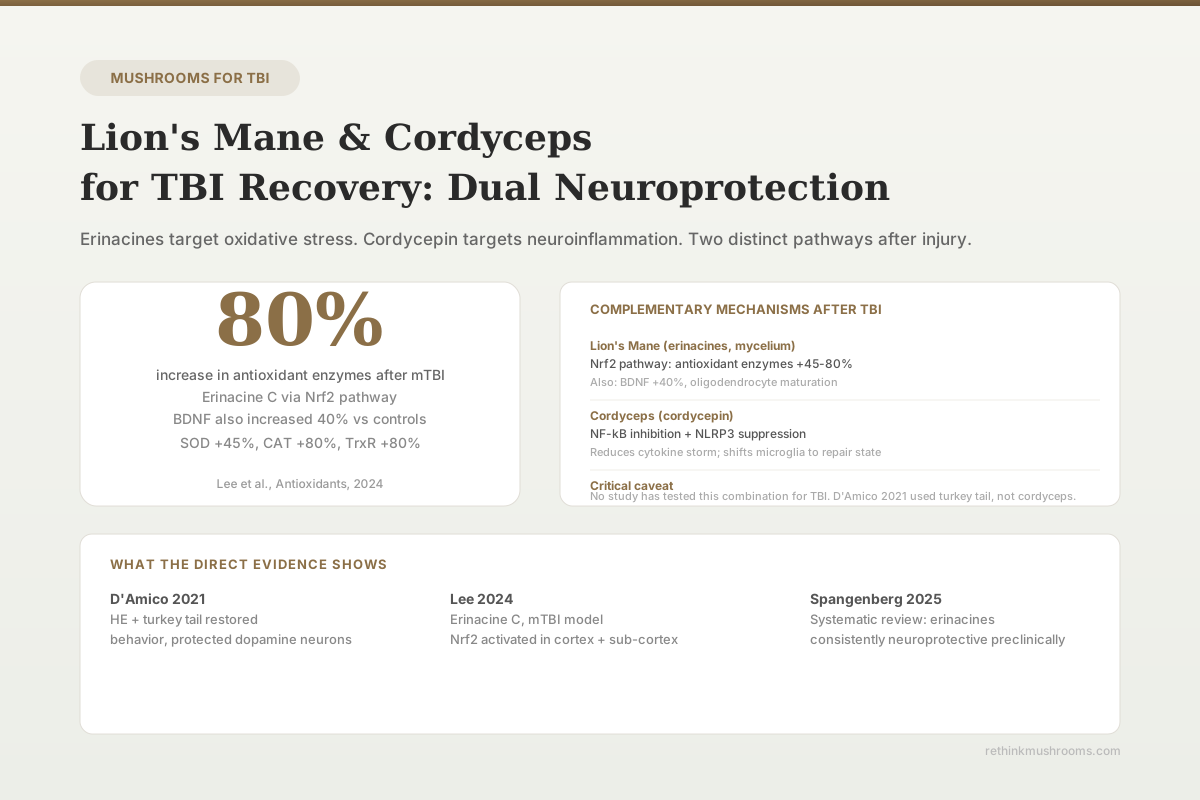
80% increase in antioxidant enzymes
Erinacine C from lion's mane mycelium activated the Nrf2 antioxidant pathway and increased key protective enzymes by 45-80% in animals after mild traumatic brain injury.
Lee et al., Antioxidants, 2024
BDNF +40%
after erinacine C in mTBI animals (Lee 2024)
TH and DAT preserved
dopaminergic neurons protected by HE + turkey tail (D'Amico 2021)
No human trials
all TBI neuroprotection data is preclinical
Lee et al., Antioxidants, 2024
 View as image ↗
When a brain injury happens, the first wave of damage is physical. Tissue tears, blood vessels rupture, cells die from direct mechanical force. But in the hours and days that follow, a second wave of damage unfolds that often exceeds the first: an inflammatory cascade that spreads beyond the initial injury site, a surge of harmful molecules that attack surviving neurons, and a partial breakdown of the protective barrier that keeps the immune system out of brain tissue.
This secondary injury cascade is where researchers think neuroprotective compounds might matter most. Two mushrooms, lion's mane and cordyceps, have published evidence for mechanisms that directly target this cascade. The case for using them together as a lion's mane and cordyceps TBI recovery combination is mechanistically coherent. It is also, as of 2025, completely untested as a combination.
This article covers what the research actually shows, where it is strong, and where the gaps are. For a broader overview of the cognitive protection evidence base, see Mushrooms and Cognitive Aging: Can They Protect Your Brain?.
Key Takeaways
- Erinacine C from lion's mane mycelium increased BDNF by 40% and key antioxidant enzymes by 45-80% in a mild TBI animal model via the Nrf2 pathway (Lee et al., 2024)
- Lion's mane combined with turkey tail (not cordyceps) restored behavioral function and prevented dopaminergic neuron loss after TBI in mice (D'Amico et al., 2021)
- Cordycepin from cordyceps blocks two key inflammatory drivers, NF-kB and the NLRP3 inflammasome, which fuel the secondary injury cascade after TBI (Chen et al., 2021)
- Cordyceps extract protected against cerebral ischemic brain injury in animals; ischemia shares the same core pathological features as TBI (Li et al., 2020)
- Lion's mane mycelium promoted oligodendrocyte maturation and increased myelin basic protein in cell culture, relevant to the myelin disruption that follows concussion (Huang et al., 2021)
- No human TBI trials exist for either mushroom, and no study has tested lion's mane and cordyceps together for brain injury recovery
Most Brain Damage After TBI Doesn't Happen at the Moment of Impact
The term traumatic brain injury suggests the damage is immediate and mechanical: force applied to skull, brain moves, tissue tears. That physical damage is real. But the research consistently shows that a large fraction of functional loss after TBI comes from what happens next.
Within minutes of the initial injury, cells that sense damage in the brain called microglia switch from a resting state into an activated inflammatory state. Once activated, they release signaling proteins called cytokines, particularly IL-1 beta and TNF-alpha, which trigger inflammation in surrounding tissue. This inflammatory signaling is useful in short bursts but harmful when it continues for days or weeks.
At the same time, the disruption to cellular energy systems causes an overproduction of molecules called reactive oxygen species. These are chemically aggressive molecules that damage cell membranes, proteins, and DNA in neurons that survived the initial impact. The blood-brain barrier, which normally keeps circulating immune cells out of brain tissue, partially breaks down. Peripheral immune cells infiltrate, amplifying the inflammatory response. This cascade can persist for weeks after the initial injury.
Two molecular switches drive most of this secondary damage. The first is NF-kB, a protein complex that acts as a master switch for inflammatory gene expression. Activate NF-kB and you get a sustained wave of cytokine production from microglia. The second is the Nrf2 pathway, a protective system that, when active, increases production of antioxidant enzymes that neutralize the reactive oxygen species driving oxidative damage. After TBI, Nrf2 activity often falls short of the oxidative burden.
These two pathways, NF-kB inflammatory signaling and Nrf2 antioxidant activation, are the molecular targets where lion's mane and cordyceps compounds appear to act.
The Strongest Evidence: What Direct TBI Studies Show About Lion's Mane
The most direct TBI evidence for lion's mane comes from two animal studies published in Antioxidants.
Lee and colleagues in 2024 tested novel erinacines extracted from lion's mane mycelium in animals after mild traumatic brain injury.[1] Erinacines are a class of compounds found specifically in lion's mane mycelium, not the fruiting body, and they are confirmed to cross the blood-brain barrier. Lee's group used the mild TBI model specifically, which is less severe than the controlled cortical impact model used for severe TBI research and more analogous to concussion.
The results were specific and quantified. In the cortex and sub-cortex of mTBI animals treated with erinacine C, Nrf2 expression was significantly induced. This Nrf2 activation drove measurable increases in three antioxidant enzymes: catalase increased by 80%, thioredoxin reductase increased by 80%, and superoxide dismutase increased by 45%, compared to untreated controls. BDNF, a protein that supports neuronal survival and repair, increased by 40%. The Nrf2 protective antioxidant response was being activated by erinacine C in the injured brain.
The second key TBI study came from D'Amico and colleagues in 2021.[2] D'Amico's team used a controlled cortical impact model, which produces a more severe and well-characterized brain injury. Animals received oral treatment with lion's mane combined with Coriolus versicolor, commonly known as turkey tail mushroom. This is a critical distinction: the mushroom combination tested by D'Amico was lion's mane and turkey tail, not lion's mane and cordyceps. The article title advertises both mushrooms, but the direct TBI evidence applies to a different combination.
The outcomes were significant. Treated animals showed restored behavioral function that untreated TBI animals had lost. TBI typically triggers a loss of tyrosine hydroxylase and dopamine transporter in the substantia nigra, markers of dopaminergic neurons. These are the same neurons that degenerate in Parkinson's disease, and TBI is a known risk factor for later Parkinsonism. In D'Amico's animals, treatment with lion's mane and turkey tail prevented this TBI-triggered loss of dopaminergic markers.
A 2025 systematic review by Spangenberg and colleagues synthesized the full body of preclinical erinacine neuroprotection research across multiple disease models.[3] The review concluded that erinacines from lion's mane mycelium consistently demonstrate neuroprotective effects in animal models, with Nrf2 activation and NGF and BDNF upregulation as primary mechanisms. This is the highest-quality current evidence synthesis for lion's mane neuroprotection.
Three Mechanisms That Make Lion's Mane Relevant to TBI Recovery
The direct TBI data points to three specific ways lion's mane could be relevant to brain injury recovery.
Nrf2 antioxidant activation. Erinacine C directly induced Nrf2 expression in the cortex and sub-cortex of mTBI animals, driving 45-80% increases in antioxidant enzymes.[1] Activating Nrf2 in the injured brain means producing more of the enzymes that neutralize the reactive oxygen species driving secondary damage. This is the most direct mechanism linking lion's mane mycelium to TBI pathology.
BDNF upregulation. The same Lee 2024 study found a 40% increase in BDNF in mTBI animals treated with erinacine C.[1] BDNF (brain-derived neurotrophic factor) is a protein that keeps neurons alive, supports their growth, and strengthens connections between them. After TBI, BDNF levels typically drop. A compound that increases BDNF in injured brain tissue addresses one of the fundamental molecular deficits of the injury state.
Oligodendrocyte maturation and myelin repair. Huang and colleagues in 2021 found that lion's mane mycelium and its small bioactive compounds promoted oligodendrocyte maturation and increased myelin basic protein in cell culture experiments.[4] Oligodendrocytes are the cells that produce myelin, the insulating coating around nerve fibers. TBI and concussion damage myelin, which slows and disrupts signal transmission between neurons. This cell culture finding suggests lion's mane could theoretically support myelin repair, adding a third mechanism distinct from the Nrf2 pathway.
For more on the specific compounds responsible for these effects and how mycelium and fruiting body differ, see Hericenones and Erinacines: Lion's Mane's Brain-Boosting Compounds.
Cordyceps and Brain Injury: A Case Built on Adjacent Evidence
The case for cordyceps in TBI recovery is not built from direct TBI studies. It is built from evidence in related conditions and from mechanistic research on cordycepin, the primary bioactive compound in cordyceps.
Li and colleagues in 2020 tested cordyceps sinensis extract in animals after cerebral ischemic injury, where blood flow to the brain is blocked by a clot rather than disrupted by physical trauma.[5] Ischemic brain injury and TBI share core pathological features: both trigger neuroinflammation, oxidative stress, excitotoxicity, and cell death cascades through similar molecular mechanisms. Cordyceps extract was protective in the ischemic model. The relevance to TBI is mechanistic reasoning, not a direct test.
The stronger mechanistic case comes from Chen and colleagues' 2021 review of cordycepin's anti-neuroinflammatory mechanisms.[6] Cordycepin acts on two molecular targets directly relevant to the post-TBI inflammatory cascade. First, it inhibits NF-kB, the master inflammatory switch that drives the sustained cytokine release from activated microglia. Second, it suppresses the NLRP3 inflammasome, a protein complex that when activated produces a large burst of pro-inflammatory cytokines including IL-1 beta. Both mechanisms target drivers of secondary TBI damage at the molecular level.
Additionally, cordycepin modulates microglial activation state. After TBI, microglia are driven toward a pro-inflammatory state that amplifies damage. Cordycepin appears to shift microglial activity toward a repair-promoting state instead.
A third line of evidence comes from Ashour and colleagues in 2021, who found that natural cordycepin showed anti-inflammatory and neuroprotective effects specifically for dopaminergic neurons in a Parkinson's disease mouse model.[7] This parallels the D'Amico 2021 finding that TBI damages the same dopaminergic system in the substantia nigra. If TBI triggers dopaminergic neuron loss through neuroinflammation, and cordycepin protects dopaminergic neurons from inflammation-driven degeneration, then cordycepin has a mechanistically plausible rationale for TBI-related dopaminergic protection.
The caveat throughout: this is mechanistic inference from adjacent evidence, not a tested cordyceps TBI hypothesis.
For more on how cordyceps interacts with neuroinflammation and dopaminergic systems, see Mushrooms and Parkinson's Disease: Neuroprotective Research.
Why the Combination Is Mechanistically Interesting (and Experimentally Untested)
The attraction of combining lion's mane and cordyceps for TBI recovery is that their active compounds target different pathological mechanisms, both of which drive secondary injury.
Erinacines from lion's mane mycelium primarily act through Nrf2, the antioxidant pathway. Cordycepin from cordyceps primarily acts through NF-kB and NLRP3, the inflammatory pathway. These are distinct molecular targets. Oxidative stress and neuroinflammation both contribute to secondary TBI damage but through partially independent mechanisms. A compound that targets oxidative stress does not automatically reduce inflammatory cytokines, and a compound that reduces NF-kB inflammatory signaling does not automatically increase antioxidant enzyme production.
The theoretical advantage of a combination approach is dual-pathway coverage: one compound reducing oxidative damage while the other reduces the inflammatory cascade. This is mechanistically coherent. It is not mechanistically proven because no study has tested this combination in any TBI model.
One important clarification is worth repeating: the only published study using a mushroom combination directly after TBI used lion's mane and turkey tail, not lion's mane and cordyceps.[2] Turkey tail's primary active compounds, polysaccharopeptides and polysaccharide-K, act mainly through immune modulation rather than direct NF-kB pathway inhibition. The D'Amico 2021 result is the best direct evidence available, but it does not tell us what a lion's mane and cordyceps combination would produce.
For a deeper look at the full secondary neuroinflammation picture and how multiple mushroom compounds address it, see Mushroom Compounds and Brain Inflammation After Injury.
What This Research Cannot Tell You About TBI Recovery
Several important questions remain unanswered by the current evidence.
Human trials do not exist. Every study discussed in this article used animals or cell cultures. No human clinical trial has tested either lion's mane or cordyceps for TBI recovery, concussion recovery, or any related brain injury endpoint. The Spangenberg 2025 systematic review found that while the preclinical evidence base for erinacine neuroprotection is consistent, the translation gap to human applications remains uncharacterized.[3]
Dose and timing are unknown. The Lee 2024 and D'Amico 2021 studies used specific doses administered under controlled conditions in animals. Whether a human supplement dose produces the same brain concentration of active compounds is unknown. Whether timing matters, such as whether compounds are most effective in the acute inflammatory phase or the later repair phase, has not been studied.
Animal models have real limits. The controlled cortical impact model and the mild TBI model reliably produce brain injury, but they do not replicate the full range of human TBI: different injury locations, different severities, different ages and preexisting conditions. Translation from any single animal model is inherently limited.
Product form matters significantly. The neuroprotective evidence for lion's mane focuses on erinacines, which are found in mycelium, not in the fruiting body. Most commercial lion's mane supplements use fruiting body extract, which contains hericenones rather than erinacines. For the Nrf2-activation mechanism described in Lee 2024 to be relevant, erinacine-rich mycelium extract is the applicable product form.
For a broader look at what lion's mane research shows for concussion specifically, see Lion's Mane After Concussion: Can It Help Recovery?.
The Bottom Line
Lion's mane and cordyceps have distinct, complementary neuroprotective mechanisms that are mechanistically relevant to the secondary injury cascade after traumatic brain injury. Erinacines from lion's mane mycelium activate the Nrf2 antioxidant pathway and increase BDNF in mild TBI animal models; cordycepin from cordyceps inhibits NF-kB and NLRP3 inflammatory signaling. The combination is theoretically attractive because these pathways are partially independent. In practice, no study has tested this combination for TBI, the only direct mushroom TBI combination study used lion's mane and turkey tail rather than cordyceps, and no human TBI trials exist for either mushroom individually. The preclinical evidence is consistent and mechanistically plausible, but the translation gap to human applications is uncharacterized.
Frequently Asked Questions
Sources & References
- 1RTHM-01924·Lee, Kam-Fai et al. (2024). “The Cerebral Protective Effect of Novel Erinacines from Hericium erinaceus Mycelium on In Vivo Mild Traumatic Brain Injury Animal Model and Primary Mixed Glial Cells via Nrf2-Dependent Pathways..” Antioxidants (Basel.Study breakdown →PubMed →↩
- 2RTHM-01340·D'Amico, Ramona et al. (2021). “Hericium erinaceus and Coriolus versicolor Modulate Molecular and Biochemical Changes after Traumatic Brain Injury..” Antioxidants (Basel.Study breakdown →PubMed →↩
- 3RTHM-02184·Spangenberg, E T et al. (2025). “Unveiling the role of erinacines in the neuroprotective effects of Hericium erinaceus: a systematic review in preclinical models..” Frontiers in pharmacology.Study breakdown →PubMed →↩
- 4RTHM-00692·Huang, Hui-Ting et al. (2021). “Hericium erinaceus mycelium and its small bioactive compounds promote oligodendrocyte maturation with an increase in myelin basic protein..” Scientific reports.Study breakdown →PubMed →↩
- 5. Source details for this reference are not yet available.
- 6. Source details for this reference are not yet available.
- 7. Source details for this reference are not yet available.