Mushrooms & Brain Health
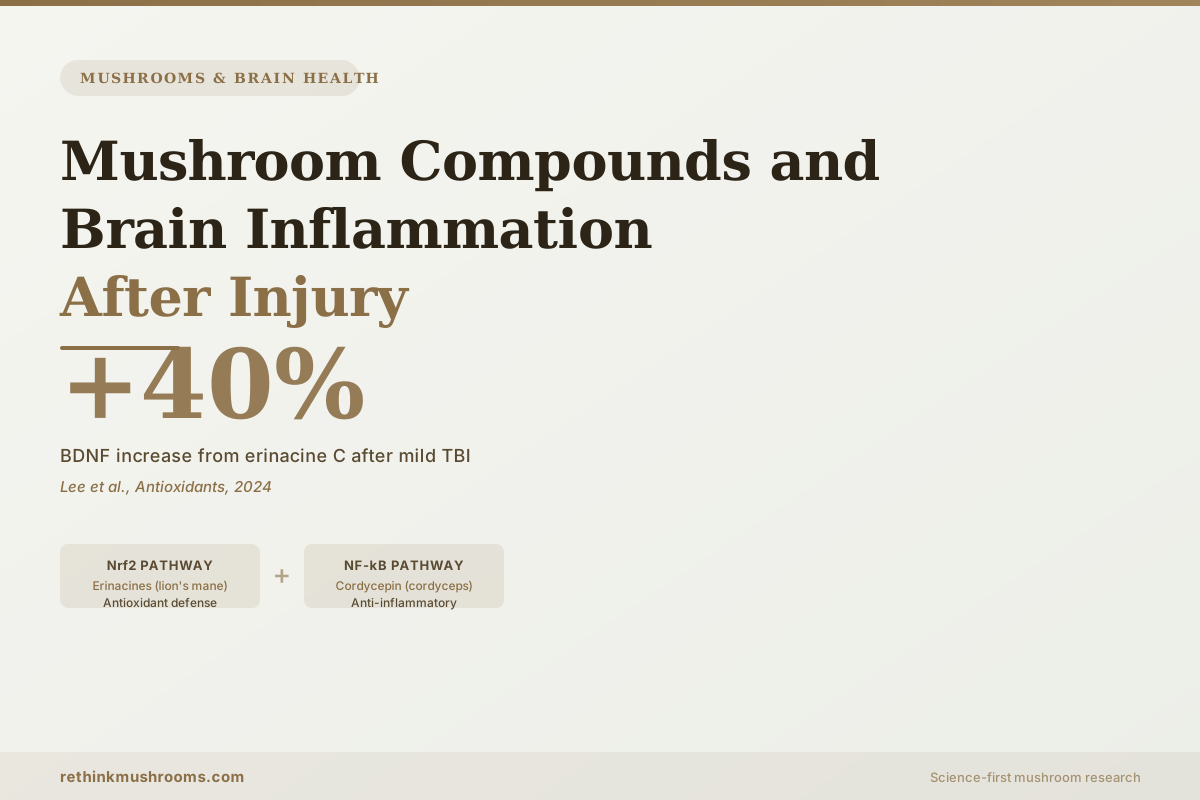
40% increase in BDNF from erinacine C after mild TBI
Erinacine C from lion's mane mycelium increased the neuron survival protein BDNF by 40% and key protective enzymes by 45-80% in a mild TBI animal model, via the Nrf2 antioxidant pathway.
Lee et al., Antioxidants, 2024
80%
increase in antioxidant enzymes CAT and TrxR after erinacine C treatment in mTBI animals (Lee et al., 2024)
2
molecular switches blocked by cordycepin (NF-κB and NLRP3), reducing the neuroinflammatory cytokine cascade (Chen et al., 2021)
Restored
behavioral function and dopaminergic neuron protection in TBI mice given lion's mane and turkey tail together (D'Amico et al., 2021)
Lee et al., Antioxidants, 2024
 View as image ↗
The physical impact in a brain injury is only the first phase of damage. In the hours and days that follow, a secondary inflammatory cascade unfolds inside brain tissue; the cascade acts like a chain reaction that often kills more neurons than the original trauma. Research on mushroom compounds shows that two specific molecules, erinacines from lion's mane mycelium and cordycepin from Cordyceps species, act on the molecular pathways that drive this cascade. Understanding how mushroom compounds target brain inflammation after injury requires understanding what that cascade actually is.
This article covers both: the biology of post-injury neuroinflammation and the specific evidence for how mushroom compounds interact with it. The evidence is entirely from animal models. No human brain injury trials using these compounds exist. The neuroprotective effects documented here fit within a broader area of mushroom and brain health research; our overview of mushrooms and cognitive aging surveys the wider evidence base.
Key Takeaways
- Erinacine C from lion's mane mycelium increased BDNF (a neuron survival protein) by 40%, and protective enzymes catalase and TrxR by 80% each, in a mild TBI animal model (Lee et al., Antioxidants, 2024)
- Cordycepin from Cordyceps species blocks two major molecular switches (NF-κB and the NLRP3 inflammasome) that trigger the neuroinflammatory cytokine cascade after brain injury (Chen et al., Phytomedicine, 2021)
- Lion's mane and turkey tail given together after controlled cortical impact TBI in mice restored behavioral alterations and prevented dopamine neuron loss in the brain region most vulnerable to Parkinson's disease (D'Amico et al., Antioxidants, 2021)
- Natural cordycepin independently showed anti-inflammatory and neuroprotective effects on dopamine-producing neurons, via mechanisms that parallel TBI-induced neurological damage (Ashour et al., J Neuroinflammation, 2021)
- Erinacines cross the blood-brain barrier; most mushroom polysaccharides do not, limiting their direct brain activity
- All brain injury evidence is preclinical animal data; human clinical trials with mushroom compounds for TBI or concussion do not exist
Why Brain Inflammation After Injury Keeps Growing Past the Initial Impact
When the brain sustains a physical injury, the damage begins before the bruising shows. The initial mechanical force tears axons, ruptures cell membranes, and disrupts the normal function of neural circuits. This is the primary injury, and it happens in an instant.
What happens next is the secondary injury, and it plays out over hours to days. The secondary phase is driven by the brain's own immune response; the response is trying to protect but often overshoots into territory that causes additional, preventable harm.
The key actors in secondary brain injury are the brain's resident immune cells, called microglia. Under normal conditions, microglia patrol brain tissue, clearing debris and protecting against infection. After injury, they activate rapidly. In their activated state, they release inflammatory messenger proteins called cytokines, including two of the most studied: a protein called interleukin-1 beta (IL-1β) and one called tumor necrosis factor alpha (TNF-α). These cytokines are meant to signal danger and recruit support. In the context of an already-injured brain, they also trigger further cell death.
Simultaneously, an oxidative stress response unfolds. The damaged tissue generates highly reactive oxygen molecules called free radicals. These molecules attack cell membranes, damage DNA inside neurons, and disrupt the energy metabolism that neurons depend on to survive. The antioxidant defenses that normally neutralize free radicals are overwhelmed by the post-injury surge.
A third process compounds both: the blood-brain barrier, a selective membrane that normally keeps most blood components out of brain tissue, breaks down after injury. As it does, peripheral immune cells and inflammatory proteins that are never supposed to enter the brain begin to infiltrate. The result is an inflammatory environment that persists long after the mechanical trauma itself has stopped.
This secondary cascade is, in many cases, more damaging to long-term outcomes than the primary impact. It is also potentially modifiable; identifying compounds that act on its key molecular actors is a legitimate research priority.
The Three-Stage Cascade and What Mushroom Compounds Do at Each Stage
After a traumatic brain injury, secondary neuroinflammation unfolds in a recognizable sequence:
-
Microglial activation: The brain's immune cells detect damage and activate, releasing inflammatory cytokines (IL-1β and TNF-α) and triggering nearby glial cells into inflammatory states. This initial alarm response is protective in principle but harmful when sustained.
-
Oxidative stress amplification: Reactive oxygen molecules (free radicals) flood the damaged tissue from multiple sources. These include mitochondria with disrupted function, activated immune cells, and the breakdown products of membrane lipids. The cell's antioxidant enzyme systems become insufficient; these include catalase (an enzyme that neutralizes the damaging molecule hydrogen peroxide), superoxide dismutase or SOD (which neutralizes a class of reactive oxygen molecules called superoxides), and thioredoxin reductase or TrxR (which recycles antioxidant molecules for reuse).
-
Blood-brain barrier breakdown and infiltration: The inflammatory environment weakens the normally tight junction between brain endothelial cells, allowing peripheral immune cells and inflammatory proteins to enter. This perpetuates the neuroinflammatory cycle and expands the zone of secondary damage.
Mushroom compounds target this cascade at two distinct points. Erinacines from lion's mane mycelium activate a molecular pathway called Nrf2, which is the master switch for the cell's antioxidant defense programs. Activating Nrf2 induces more production of the protective enzymes that the oxidative stress stage overwhelms. Cordycepin from Cordyceps species blocks two separate protein complexes: NF-κB (the switch that turns on inflammatory gene programs) and the NLRP3 inflammasome (an alarm complex that triggers cytokine release), targeting the inflammatory activation stage directly.
The two compounds address the two primary arms of secondary TBI damage using two mechanistically distinct pathways.
Erinacine C After Mild TBI: BDNF Up 40%, Protective Enzymes Up 45-80%
The most specific recent evidence for mushroom compounds and brain injury comes from a 2024 study by Lee and colleagues, published in Antioxidants, that used a mild traumatic brain injury model in rodents.[4]
The study tested novel erinacines from lion's mane mycelium, including a compound called erinacine C, on animals subjected to mild TBI. Mild TBI is the category that covers most concussions, a distinct and clinically important type of brain injury with different pathology from severe TBI. The researchers measured both molecular markers and behavioral outcomes.
The results were specific and quantifiable. Erinacine C increased the amount of a protein called BDNF, or brain-derived neurotrophic factor, a molecule that promotes neuron survival and helps maintain the growth of new neural connections, by 40% compared to controls exposed to an inflammatory stimulus. The two antioxidant enzymes involved in the oxidative stress stage of secondary injury, specifically catalase and TrxR, increased by 80% each. A third antioxidant enzyme, SOD, increased by 45%.
These changes occurred via the Nrf2 pathway. Nrf2 is a protein that sits dormant in cells until oxidative stress rises. When activated, it moves into the cell's nucleus and turns on a coordinated program of antioxidant gene expression, producing more of the protective enzymes that free radicals are overwhelming. The Lee study found significant Nrf2 induction in both the cortex and sub-cortex of mTBI animals treated with erinacine C.
A key practical implication: erinacines are found predominantly in lion's mane mycelium, not in the fruiting body. Hericenones, the more commonly discussed bioactive compounds in lion's mane, are fruiting body compounds with different mechanisms. The mechanistic data for mTBI and Nrf2 pathway activation runs through erinacines, which means mycelium-derived extract with documented erinacine content is the more relevant product form for this specific application. For more on the distinction between these two compound classes, see hericenones and erinacines: lion's mane's brain-boosting compounds. For a concussion-specific deep dive, see lion's mane after concussion: can it help recovery?
Cordycepin: Blocking Two Molecular Switches Behind the Neuroinflammatory Storm
Cordycepin is a naturally occurring compound found in Cordyceps species. Its structure resembles adenosine, a molecular building block that cells use for energy and signaling. This structural similarity allows cordycepin to interfere with multiple molecular pathways involved in inflammation.
A 2021 review by Chen and colleagues in Phytomedicine examined the molecular mechanisms by which cordycepin counters neuroinflammation.[2] The review identified two primary targets.
The first is NF-κB, a protein that acts as an on-switch for inflammatory gene programs. When NF-κB is activated, it travels into the cell nucleus and turns on genes that produce inflammatory cytokines including IL-1β and TNF-α. This is the signaling step that transforms microglial activation into a sustained inflammatory response. Cordycepin inhibits NF-κB activation, reducing the transcription of these inflammatory genes before they are produced.
The second target is the NLRP3 inflammasome. This is a protein complex inside immune cells that acts as an alarm trigger: when the NLRP3 inflammasome is assembled and activated, it causes the rapid release of a highly potent inflammatory cytokine called IL-1β in large quantities. The NLRP3 inflammasome is a key amplification step in the neuroinflammatory cascade; it converts microglial activation into a cytokine surge. Cordycepin suppresses NLRP3 inflammasome assembly, reducing this cytokine amplification step.
The Chen review also documented that cordycepin modulates microglial behavior directly, reducing their tendency to shift into the sustained inflammatory state that is associated with ongoing secondary damage after TBI.
In a separate 2021 animal study, Ashour and colleagues tested natural cordycepin in a Parkinson's disease mouse model, a context where the mechanism is directly relevant to brain injury.[3] The dopamine-producing neurons in the substantia nigra, a region deep in the brain whose loss defines Parkinson's disease, were protected from inflammation-driven degeneration. The protection came through anti-inflammatory and neuroprotective mechanisms: reduced inflammatory cytokine production and reduced oxidative damage to neurons. This data is relevant to TBI because D'Amico and colleagues found that TBI itself triggers the very same pattern of dopaminergic neuron loss in the substantia nigra that Ashour's cordycepin counteracted.
For more on how mushroom compounds interact with dopaminergic neuroprotection, see mushrooms and Parkinson's disease: neuroprotective research.
The TBI Mouse Study That Used Two Mushrooms Together
The most direct experimental evidence for mushroom compounds in the context of traumatic brain injury comes from a 2021 study by D'Amico and colleagues, published in Antioxidants.[1]
The study used an animal model of brain injury called controlled cortical impact, which models moderate-to-severe TBI at a severity level beyond most concussions. After the injury was induced, the researchers gave oral treatment with a combination of two mushroom preparations: lion's mane (Hericium erinaceus) and turkey tail (Coriolus versicolor). This is an important distinction: the combination that was tested was lion's mane and turkey tail, not lion's mane and cordyceps.
The results covered both behavioral and molecular outcomes. Animals that received the mushroom combination showed restored behavioral alterations; the impaired movement and coordination that followed TBI improved compared to injured animals that received no treatment. At the molecular level, the combination prevented TBI-triggered decreases in two proteins: tyrosine hydroxylase, a protein that marks and enables the function of dopamine-producing neurons, and the dopamine transporter, a protein that clears dopamine from the spaces between neurons and is a marker of healthy dopaminergic function. Both of these proteins decreased in the substantia nigra of untreated TBI animals. In animals that received the mushroom combination, this decrease was attenuated.
The significance of the substantia nigra finding goes beyond TBI recovery. Traumatic brain injury is an established risk factor for developing Parkinson's disease years or decades after the initial injury; the mechanism is exactly this: TBI triggers the progressive loss of dopaminergic neurons in the substantia nigra that characterizes Parkinson's disease. The D'Amico study provides direct experimental evidence that mushrooms can interfere with this specific post-TBI dopaminergic damage pathway.
The study does not establish dose, timing, or human relevance. It establishes a proof of concept in a controlled animal model that the mushroom combination modulates the molecular and biochemical changes that follow TBI. For the full overview of TBI-related mushroom research, see mushrooms for traumatic brain injury: neuroprotective research.
The Blood-Brain Barrier: Which Mushroom Compounds Actually Get Into the Brain?
One of the most relevant questions for this entire research area is whether the active compounds being discussed can actually reach the brain. The blood-brain barrier is a selective filter that most molecules in the bloodstream cannot cross.
Erinacines are small lipophilic molecules, meaning they have a fat-soluble character that allows them to cross cell membranes. They are confirmed to cross the blood-brain barrier. This is a central reason why erinacines are the focus of the most mechanistically specific TBI research: they reach the target organ.
Cordycepin is structurally similar to adenosine, a molecule that does cross the blood-brain barrier through specific transporters. The neurological effects observed in cordycepin research, including the direct microglial modulation and the central nervous system-specific outcomes in the Ashour 2021 Parkinson's model, provide indirect evidence that cordycepin or its metabolites reach the brain in functionally meaningful concentrations, though direct blood-brain barrier permeability data for cordycepin specifically is limited in the published literature.
Beta-glucans, the polysaccharides that represent the major active compound class in most mushroom products, present a different picture. These are large, water-soluble molecules. Large polysaccharides do not efficiently cross the blood-brain barrier under normal conditions. Their biological activity, including the immunomodulatory effects well-documented in peripheral immune research, is likely mediated through systemic anti-inflammatory mechanisms rather than direct brain entry. This limits the relevance of beta-glucan content for the TBI and neuroinflammation applications described here, compared to their significance for peripheral immune modulation.
The practical implication: the brain injury research runs through erinacines and cordycepin, not through beta-glucan content. Standard beta-glucan percentage, which is the quality marker most relevant to general immune supplement applications, may not be the primary variable for neuroprotective purposes.
The Translation Gap: Animal Models, Not Human Trials
The preclinical evidence for mushroom compounds and brain injury is mechanistically coherent: the pathways are identified, the molecular targets are real, and the animal model outcomes are consistent with the proposed mechanisms. The question of whether this translates to humans remains open.
A 2022 review by Abitbol and colleagues in the journal Cells examined mushroom natural products as candidates in neurodegenerative disease drug discovery.[5] The review positioned mushroom compounds as legitimate candidates for further development, covering multiple species and mechanisms. The framing is drug discovery, not clinical prescription; the research community is at the stage of characterizing mechanism and confirming activity in model systems, not deploying these compounds in clinical practice.
What the evidence supports: erinacines activate Nrf2 and increase protective enzyme production in mTBI animal models. Cordycepin blocks NF-κB and NLRP3 in cell and animal systems. A lion's mane and turkey tail combination attenuated TBI-induced behavioral and molecular changes in mice.
What the evidence cannot yet tell us: effective dose in humans, optimal timing relative to injury, whether the animal model results will reproduce in human trials, the duration of treatment needed, and whether the compounds interact with existing TBI treatment protocols.
There are no human clinical trials of mushroom compounds for TBI, concussion, or CTE. Consumer claims that specific products heal or cure brain injuries are not supported by any clinical evidence. The preclinical data is genuinely interesting and mechanistically credible. It is also incomplete; the gap between an animal model effect and a human clinical benefit is not bridged by mechanism alone.
For a CTE-specific discussion of what the evidence does and does not support, see mushrooms for CTE: preclinical evidence and speculation. The rationale for combining lion's mane and cordyceps specifically is explored in lion's mane and cordyceps for TBI recovery: neuroprotective dual therapy research.
The Bottom Line
The secondary neuroinflammatory cascade that follows traumatic brain injury, driven by microglial activation, oxidative stress, and blood-brain barrier breakdown, is a legitimate pharmacological target. Erinacines from lion's mane mycelium act on the Nrf2 antioxidant pathway, increasing neuron-protective enzyme production in mild TBI models. Cordycepin from Cordyceps blocks the NF-κB and NLRP3 molecular switches that amplify neuroinflammation. A direct TBI animal study using lion's mane and turkey tail together showed restored behavior and prevented dopaminergic neuron loss. No human brain injury trials exist for any mushroom compound.
Frequently Asked Questions
Sources & References
- 1RTHM-01340·D'Amico, Ramona et al. (2021). “Hericium erinaceus and Coriolus versicolor Modulate Molecular and Biochemical Changes after Traumatic Brain Injury..” Antioxidants (Basel.Study breakdown →PubMed →↩
- 2. Source details for this reference are not yet available.
- 3. Source details for this reference are not yet available.
- 4RTHM-01924·Lee, Kam-Fai et al. (2024). “The Cerebral Protective Effect of Novel Erinacines from Hericium erinaceus Mycelium on In Vivo Mild Traumatic Brain Injury Animal Model and Primary Mixed Glial Cells via Nrf2-Dependent Pathways..” Antioxidants (Basel.Study breakdown →PubMed →↩
- 5RTHM-00737·Abitbol, Arjuna et al. (2022). “Mushroom Natural Products in Neurodegenerative Disease Drug Discovery..” Cells.Study breakdown →PubMed →↩