Stroke Recovery
Reduced infarct volume
Oral administration of Antrodia camphorata extract 2 hours after induced ischemic stroke in mice reduced brain infarction volume and increased tracking distance, acting through NF-kB suppression and Akt-mediated neurogenesis.
Wang et al., Food & Function, 2019
3 species
studied in stroke models: Antrodia camphorata, Ganoderma lucidum, Hericium erinaceus
NF-kB
pathway suppression is the most replicated anti-inflammatory mechanism across species
0 RCTs
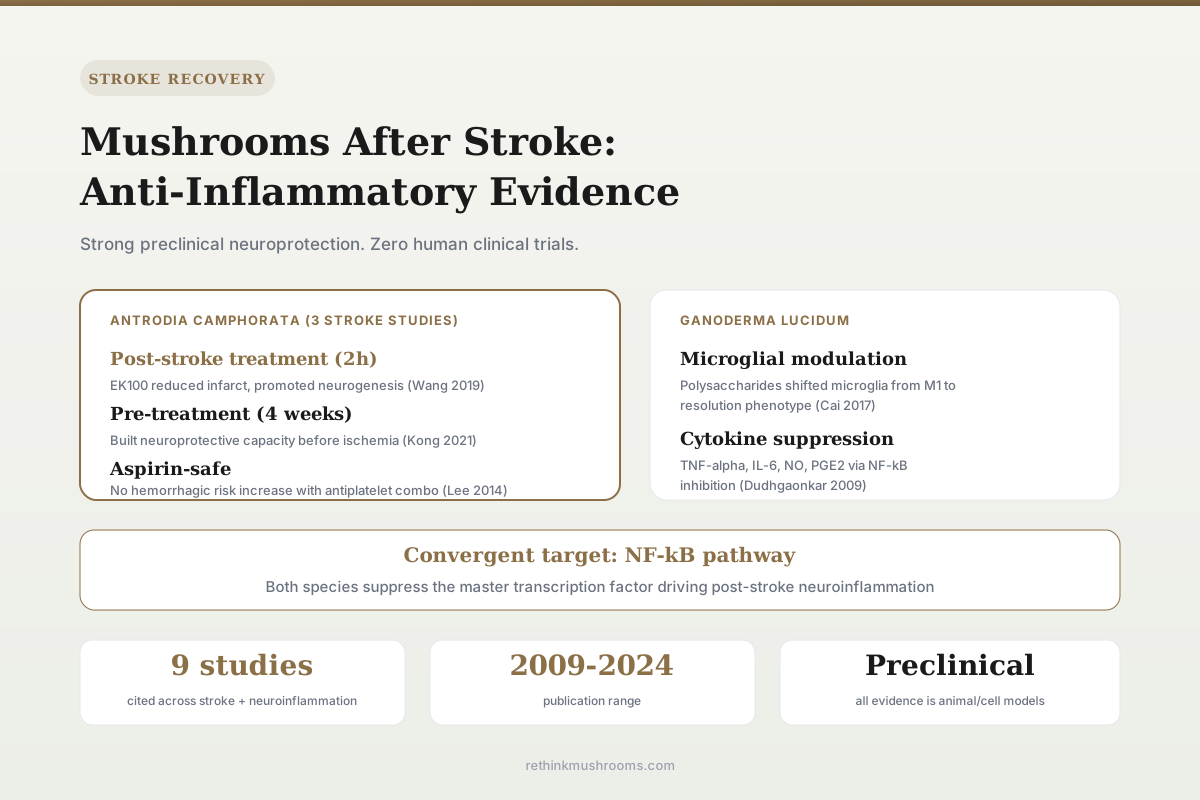
no human clinical trials have tested mushroom compounds for stroke recovery
Wang et al., Food & Function, 2019
 View as image ↗
Ischemic stroke triggers a cascade of neuroinflammation that extends brain damage well beyond the initial oxygen-deprived core. In the hours and days following arterial occlusion, microglia activate, pro-inflammatory cytokines surge, the blood-brain barrier breaks down, and oxidative stress compounds the injury. This secondary inflammatory damage is a therapeutic target: if the post-stroke inflammatory cascade can be attenuated, the extent of permanent brain injury might be reduced. Several mushroom species produce compounds that suppress exactly these pathways in preclinical models. Antrodia camphorata triterpenoids reduce brain infarct volume in rat and mouse stroke models. Ganoderma lucidum polysaccharides attenuate microglia-mediated neuroinflammation. A 2024 review identified Antrodia camphorata as "one of the most promising candidates" for neurological disorders, including stroke. But this evidence is entirely preclinical. No human clinical trial has tested any mushroom compound for stroke recovery. The distance between a reduced infarct in a rat and a improved outcome in a stroke patient is vast, and it has not been crossed. For the full neuroprotective research landscape, see mushrooms and stroke recovery: neuroprotective research.
Key Takeaways
- Oral Antrodia camphorata extract (0.25-0.75 g/kg/day for 60 days) reduced brain infarct volume after embolic stroke in rats without increasing hemorrhagic risk, even when combined with aspirin (Lee et al., 2014)[1]
- Ergostatrien-7,9(11),22-trien-3beta-ol (EK100), an active triterpenoid from A. camphorata, given orally 2 hours after ischemic stroke induction in mice reduced brain infarction, suppressed NF-kB and caspase 3, and activated Akt/GSK3/catenin-associated neurogenesis (Wang et al., 2019)[2]
- A. camphorata alcohol extracts pre-treated for 4 weeks protected against ischemia/reperfusion-induced brain damage in rats, reducing oxidative stress and neuronal apoptosis (Kong et al., 2021)[3]
- Ganoderma lucidum polysaccharides attenuated microglia-mediated neuroinflammation and modulated microglial phagocytosis in a dose-dependent manner (Cai et al., 2017)[4]
- Triterpene extract from G. lucidum suppressed TNF-alpha, IL-6, nitric oxide, and PGE2 in LPS-stimulated macrophages by inhibiting NF-kB transcriptional activity (Dudhgaonkar et al., 2009)[5]
- A 2024 review concluded that A. camphorata crude extracts and active metabolites have "various pharmacological activities" against neurological disorders including stroke, Alzheimer's, and Parkinson's disease, but noted the absence of human clinical evidence (Li et al., 2024)[6]
Antrodia camphorata: The Most Stroke-Specific Evidence
Three separate preclinical studies have tested Antrodia camphorata compounds in ischemic stroke models, making this Taiwanese medicinal mushroom the most studied single species for stroke-related brain injury.
Lee et al. (2014) used a rat embolic stroke model in which middle cerebral artery occlusion was induced with whole blood clots. Rats were then treated orally with A. camphorata extract at 0.25 and 0.75 g/kg/day, alone or combined with aspirin (5 mg/kg/day), for 60 days. Brain sections stained with triphenyltetrazolium chloride showed that the extract reduced infarct volume. A particularly relevant finding: unlike some anti-inflammatory compounds that increase hemorrhagic risk when combined with antiplatelet agents, the A. camphorata extract did not increase hemorrhagic incidence when co-administered with aspirin. This is relevant to stroke care because most ischemic stroke patients receive antiplatelet therapy, and any adjunctive neuroprotective treatment must not compromise hemostasis.[1]
Wang et al. (2019) took the investigation further by identifying the specific active compound responsible for much of the neuroprotective effect. Ergostatrien-7,9(11),22-trien-3beta-ol (EK100), a triterpenoid isolated from A. camphorata, was administered orally to mice 2 hours after acute ischemic stroke induction. The timing is clinically meaningful: treatment began after the injury, not before. EK100 at 60 and 120 mg/kg reduced brain infarction volume, increased locomotor tracking distance (indicating functional recovery), and acted through two distinct pathways. First, it suppressed NF-kB (the master transcription factor for inflammatory gene expression) and caspase 3 (the executioner caspase in apoptotic cell death). Second, it activated Akt/GSK3/beta-catenin signaling in the peri-infarct region, promoting neurogenesis.[2]
This dual mechanism is notable. Most anti-inflammatory interventions only reduce secondary damage. EK100 appears to both reduce inflammation and actively promote neural regeneration in the tissue surrounding the infarct. The Akt/GSK3/beta-catenin pathway is a known regulator of neural stem cell proliferation and differentiation, and its activation in the peri-infarct zone suggests that EK100 may support endogenous repair processes.
Kong et al. (2021) tested a preventive paradigm. Rats were pre-treated with A. camphorata alcohol extracts (AC-AE) for 4 weeks before ischemia/reperfusion injury was induced. The pre-treatment reduced cell damage, decreased reactive oxygen species production, and protected against hypoxic cell injury both in vitro and in vivo. While a pre-treatment model is less directly applicable to clinical stroke (where treatment begins after onset), it demonstrates that chronic oral exposure to A. camphorata compounds builds neuroprotective capacity that is available when ischemic injury occurs.[3]
EK100 also showed efficacy in ischemia/reperfusion injury in the liver. Chao et al. (2021) demonstrated that EK100 attenuated oxidative stress, inflammation, and hepatic ischemia/reperfusion injury in rats, supporting the compound's broad anti-inflammatory profile across ischemic injury models in multiple organ systems.[7]
Li et al. (2024) published a comprehensive review of Antrodia camphorata for neurological disorders in Frontiers in Pharmacology. The review covered stroke alongside Alzheimer's and Parkinson's disease, concluding that crude extracts and active metabolites demonstrate pharmacological activities relevant to neurodegeneration and acute brain injury. The review identified anti-oxidative, anti-inflammatory, and anti-apoptotic mechanisms as the convergent pathways. For the broader Antrodia neuroinflammation data, see antrodia and neuroinflammation: brain protection research.[6]
Ganoderma lucidum: Suppressing the Neuroinflammatory Cascade
While Antrodia camphorata has been tested in direct stroke models, Ganoderma lucidum (reishi) has been studied more broadly for the neuroinflammatory pathways that drive post-stroke secondary damage.
Cai et al. (2017) showed that Ganoderma lucidum polysaccharides (GLP) attenuated microglia-mediated neuroinflammation. Microglia are the brain's resident immune cells, and their activation after stroke is a primary driver of secondary inflammatory damage. GLP modulated microglial phagocytosis and behavioral response in a dose-dependent manner. The study used quantitative analysis to demonstrate that GLP shifted microglia from a pro-inflammatory (M1) state toward a resolution-promoting phenotype, reducing the production of inflammatory mediators that extend tissue damage beyond the ischemic core.[4]
Dudhgaonkar et al. (2009) tested the anti-inflammatory effects of the triterpene extract from G. lucidum (GLT) in LPS-stimulated macrophages. GLT suppressed TNF-alpha, IL-6, nitric oxide, and prostaglandin E2 production. The mechanism involved direct inhibition of NF-kB transcriptional activity, the same pathway that EK100 from Antrodia suppresses in stroke models. GLT also down-regulated inducible nitric oxide synthase (iNOS) and cyclooxygenase-2 (COX-2) expression, both key enzymes in the inflammatory cascade.[5]
The convergence is clear: both Antrodia camphorata triterpenoids and Ganoderma lucidum triterpenes target the NF-kB pathway, the central regulatory node of inflammatory gene expression. In post-stroke neuroinflammation, NF-kB activation in microglia and infiltrating macrophages drives the production of the cytokines, chemokines, and reactive oxygen species that extend brain damage into the ischemic penumbra. Compounds that suppress this activation have a logical therapeutic basis.
The anti-inflammatory mechanism of A. camphorata extends to ischemic tissue injury beyond the brain. Tsai et al. (2015) demonstrated anti-inflammatory effects in a mouse skin ischemia model induced by surgical skin flap. Both solid-state-cultured and wood-cultured A. camphorata, as well as the isolated compound ST1 (ergostatrien-3beta-ol, closely related to EK100), reduced inflammatory markers in ischemic tissue.[8]
The Broader Mushroom Neuroprotection Landscape
Phan et al. (2015) reviewed over 20 culinary-medicinal mushroom species with brain-related pharmacological activity, including Hericium erinaceus, Ganoderma lucidum, Antrodia camphorata, Pleurotus giganteus, Lignosus rhinocerotis, and Grifola frondosa. The review identified common mechanisms: stimulation of nerve growth factor synthesis, anti-neuroinflammation, antioxidant protection, and modulation of neurotransmitter systems. For stroke specifically, the anti-inflammatory and anti-apoptotic properties are most directly relevant, as the post-stroke brain requires protection from inflammatory secondary damage and support for endogenous neural repair.[9]
A 2025 review published in Frontiers in Pharmacology examined a combination mushroom formulation (NevG, containing Lignosus rhinocerotis, Hericium erinaceus, and Ganoderma lucidum) specifically in middle cerebral artery occlusion (MCAO) rats, reporting reduced tissue damage, preserved neuronal structure, lower inflammatory responses, and improvements in both cognitive and motor outcomes. This multi-species approach is consistent with the idea that combining complementary anti-inflammatory and neurotrophic mushroom compounds may produce additive neuroprotection in stroke models. For how these mechanisms relate to post-stroke neural rewiring, see mushrooms and post-stroke neuroplasticity: can fungi accelerate brain rewiring?.
Why No Human Evidence Exists
The gap between preclinical stroke neuroprotection and human stroke treatment is not unique to mushrooms. The history of stroke neuroprotection research is littered with compounds that showed robust efficacy in rodent models and failed in human trials. The reasons are well-documented: rodent stroke models use young, healthy animals with predictable, clean arterial occlusion and reperfusion, while human strokes occur in elderly patients with comorbidities, variable locations, and heterogeneous timing. Treatment that begins 2 hours post-stroke in a controlled mouse model faces a fundamentally different clinical reality than treatment initiated 4-24 hours post-stroke in a hospital.
The specific challenges for mushroom compounds include: oral bioavailability (large polysaccharides and triterpenoids may not cross the blood-brain barrier in sufficient concentrations after oral administration), dose translation (the mg/kg doses used in rodents may not scale linearly to human doses), standardization (different A. camphorata preparations contain different concentrations of EK100 and other active compounds), and safety in the acute post-stroke setting (where anticoagulation, blood pressure management, and thrombolysis create complex pharmacological interactions).
The most translatable finding may be the Kong 2021 pre-treatment model: chronic oral consumption of mushroom compounds building neuroprotective capacity before a stroke occurs. This aligns with the broader concept of dietary neuroprotection, where long-term consumption of anti-inflammatory and antioxidant-rich foods reduces the severity of eventual neurovascular events. Whether mushroom consumption specifically reduces stroke severity or improves recovery has not been epidemiologically studied. For the blood-brain barrier evidence specifically, see mushrooms and blood-brain barrier protection after stroke. For the preclinical cerebral ischemia data, see mushroom compounds and cerebral ischemia: preclinical evidence. For how neuroinflammation relates to other brain conditions, see ALS and neuroinflammation: can mushrooms help?.
The Bottom Line
Multiple preclinical studies demonstrate that mushroom compounds, particularly triterpenoids from Antrodia camphorata and polysaccharides/triterpenes from Ganoderma lucidum, reduce brain inflammation and infarct volume in ischemic stroke models. The most striking result: EK100 from A. camphorata administered orally 2 hours post-stroke reduced brain infarction through dual anti-inflammatory (NF-kB suppression) and pro-regenerative (Akt/neurogenesis) mechanisms. However, this entire evidence base is preclinical. No human clinical trial has tested any mushroom compound for stroke recovery, and the history of stroke neuroprotection drug development suggests that the path from rodent model to clinical efficacy is long and uncertain.
Frequently Asked Questions
Sources & References
- 1RTHM-00335·Lee, Ye-Ming et al. (2014). “Extract of Antrodia camphorata exerts neuroprotection against embolic stroke in rats without causing the risk of hemorrhagic incidence..” TheScientificWorldJournal.Study breakdown →PubMed →↩
- 2RTHM-00595·Wang, Yea-Hwey et al. (2019). “Ergostatrien-7,9(11),22-trien-3β-ol from Antrodia camphorata ameliorates ischemic stroke brain injury via downregulation of p65NF-κ-B and caspase 3, and activation of Akt/GSK3/catenin-associated neurogenesis..” Food & function.Study breakdown →PubMed →↩
- 3RTHM-00693·Kong, Zwe-Ling et al. (2021). “Protective effects of Antrodia camphorata extract against hypoxic cell injury and ischemic stroke brain damage..” Phytotherapy research : PTR.Study breakdown →PubMed →↩
- 4RTHM-00462·Cai, Qing et al. (2017). “Polysaccharides from Ganoderma lucidum attenuate microglia-mediated neuroinflammation and modulate microglial phagocytosis and behavioural response..” Journal of neuroinflammation.Study breakdown →PubMed →↩
- 5RTHM-00152·Dudhgaonkar, Shailesh et al. (2009). “Suppression of the inflammatory response by triterpenes isolated from the mushroom Ganoderma lucidum..” International immunopharmacology.Study breakdown →PubMed →↩
- 6RTHM-00890·Li, Weiling et al. (2024). “Current and further outlook on the protective potential of Antrodia camphorata against neurological disorders..” Frontiers in pharmacology.Study breakdown →PubMed →↩
- 7RTHM-00677·Chao, Ting-Yu et al. (2021). “Ergostatrien-3β-ol (EK100) from Antrodia camphorata Attenuates Oxidative Stress, Inflammation, and Liver Injury In Vitro and In Vivo..” Preventive nutrition and food science.Study breakdown →PubMed →↩
- 8RTHM-00406·Tsai, Tung-Chou et al. (2015). “Anti-inflammatory effects of Antrodia camphorata, a herbal medicine, in a mouse skin ischemia model..” Journal of ethnopharmacology.Study breakdown →PubMed →↩
- 9RTHM-00397·Phan, Chia-Wei et al. (2015). “Therapeutic potential of culinary-medicinal mushrooms for the management of neurodegenerative diseases: diversity, metabolite, and mechanism..” Critical reviews in biotechnology.Study breakdown →PubMed →↩