Antrodia and Inflammation
NLRP3 inflammasome suppressed
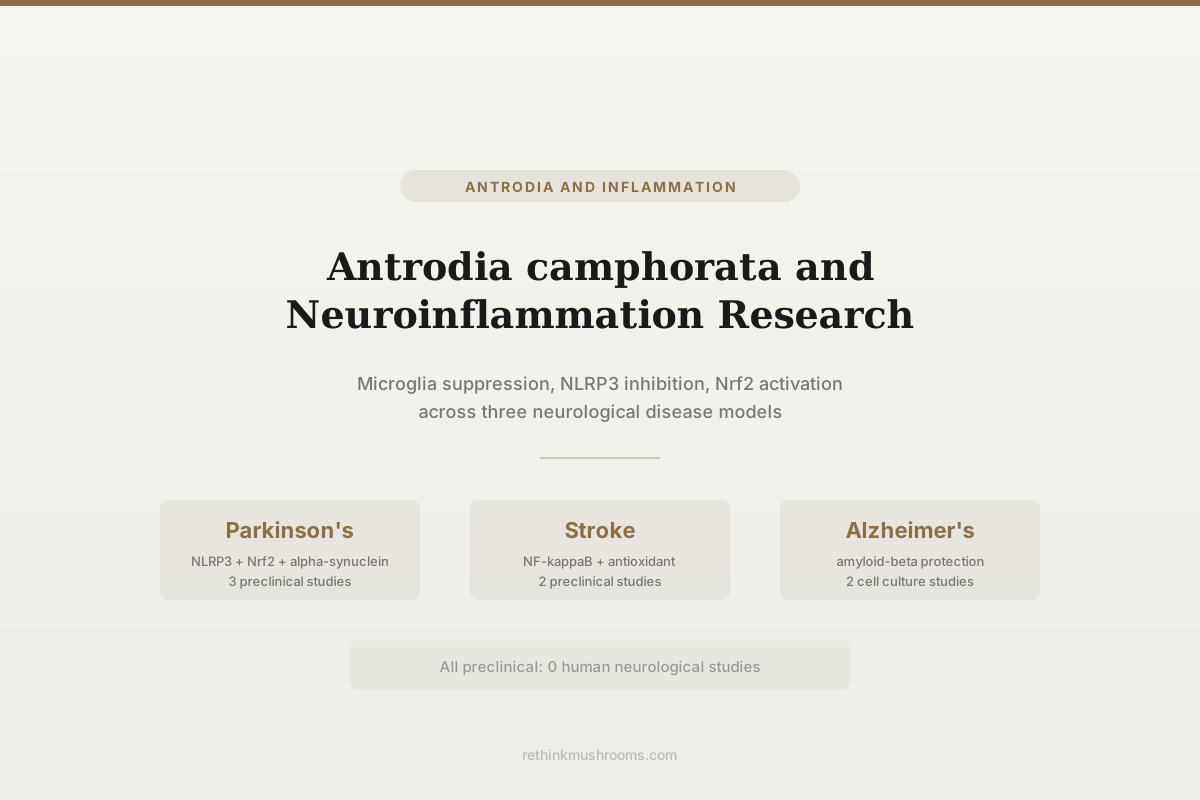
Antrodia camphorata polysaccharide decreased NLRP3 inflammasome expression and improved motor behavior in a Parkinson's disease mouse model induced by 6-hydroxydopamine.
Han et al., Phytotherapy Research, 2019
3 disease models
Parkinson's, stroke, Alzheimer's
Microglia targeted
ergosterol suppresses LPS neuroinflammation
0 human trials
all preclinical as of 2026
Han et al., Phytotherapy Research, 2019
 View as image ↗
Antrodia camphorata targets neuroinflammation through at least three distinct mechanisms in preclinical models: suppressing microglial activation, inhibiting the NLRP3 inflammasome, and activating the Nrf2 antioxidant defense pathway. These mechanisms have been tested across Parkinson's disease, ischemic stroke, and amyloid-beta neurotoxicity models. Ergosterol from Antrodia camphorata suppressed LPS-induced neuroinflammation in both microglia cell cultures and ICR mice.[1] Antrodia polysaccharide improved motor behavior in a Parkinson's disease mouse model by decreasing NLRP3 inflammasome expression.[2]
A 2024 review in Frontiers in Pharmacology characterized Antrodia camphorata as one of the most promising candidates for neurological disorder research, with bioactive metabolites showing antioxidant, anti-inflammatory, anti-apoptotic, NGF-stimulating, and amyloid-beta inhibiting activities.[3] All evidence is preclinical. No human studies have tested Antrodia for any neurological condition. For Antrodia's broader anti-inflammatory triterpenoid research, see the companion article.
Key Takeaways
- Ergosterol from Antrodia camphorata suppressed LPS-induced neuroinflammation in BV2 microglia cells and reduced neuroinflammatory markers in ICR mice brains (Sun et al., 2023)
- Antrodia camphorata polysaccharide alleviated Parkinson's disease motor symptoms in 6-OHDA mice by decreasing NLRP3 inflammasome expression and reducing reactive oxygen species (Han et al., 2019)
- Antrodia camphorata extract activated the Nrf2 transcription factor pathway and reduced alpha-synuclein aggregation in a rotenone-induced Parkinson's disease mouse model (Lanza et al., 2023)
- Ergostatrien-7,9(11),22-trien-3beta-ol from Antrodia camphorata reduced ischemic stroke brain injury by downregulating inflammatory NF-kappaB signaling (Wang et al., 2019)
- Deep ocean water supplementation enhanced Antrodia camphorata's ability to protect neuronal cells against amyloid-beta-induced toxicity (Shi et al., 2016)
- A 2024 comprehensive review identified six neuroprotective mechanism categories for Antrodia camphorata across cellular and animal models (Li et al., 2024)
Neuroinflammation: how the brain's immune system goes wrong
Neuroinflammation differs from peripheral inflammation in critical ways. The brain's resident immune cells are microglia, which make up 5 to 12 percent of total brain cells. In their resting (ramified) state, microglia survey the brain environment and clear debris. When activated by injury, infection, or protein aggregates (like amyloid-beta or alpha-synuclein), microglia shift to an activated (amoeboid) state and release pro-inflammatory cytokines (TNF-alpha, IL-1beta, IL-6), reactive oxygen species, and nitric oxide.
In neurodegenerative diseases, this activation becomes chronic and self-reinforcing. Activated microglia damage neurons through sustained inflammatory mediator release. Damaged neurons release danger signals that activate more microglia. The cycle drives progressive neuronal loss in Alzheimer's disease, Parkinson's disease, ALS, and other neurodegenerative conditions.
The NLRP3 inflammasome is a key amplifier of this cycle. NLRP3 is a multi-protein complex that, when activated, cleaves pro-IL-1beta and pro-IL-18 into their active forms and triggers pyroptosis (inflammatory cell death). NLRP3 activation has been documented in Alzheimer's, Parkinson's, and multiple sclerosis brain tissue. Inhibiting NLRP3 is an active pharmaceutical target.
The Nrf2 (nuclear factor erythroid 2-related factor 2) pathway provides the counterbalance. Nrf2 activates antioxidant response element (ARE) genes that produce protective enzymes (HO-1, NQO1, SOD). In neurodegenerative diseases, Nrf2 activity declines, leaving neurons vulnerable to oxidative damage. Compounds that activate Nrf2 while suppressing NLRP3 address both the offensive (inflammation) and defensive (antioxidant) arms of neuroprotection.
Three Mechanisms, Three Disease Models
Broad Across Diseases, But Every Row Is Preclinical
Antrodia camphorata reaches neuroprotection through three molecular levers — suppress the NLRP3 inflammasome, block NF-κB, activate the Nrf2 antioxidant pathway — tested across Parkinson’s, stroke, and amyloid-β models. Reading down the strength column shows the real shape of the evidence: wide, but animal- and cell-only. There are zero human trials for any neurological condition.
Parkinson's disease
Strongest evidence · 3 studies
- Compounds
- Polysaccharide · whole extract · mycelium
- Targets
- NLRP3 ↓, ROS ↓ [2] · Nrf2 ↑, α-synuclein ↓, TH ↑ [4]
- Models
- 6-OHDA mice [2] · rotenone mice [4] · PC12 cells [5]
- Refs
- [2] [4] [5]
Ischemic stroke
Moderate evidence · 2 studies
- Compounds
- Ergostatrien-7,9(11),22-trien-3β-ol · extract
- Targets
- NF-κB p65 ↓ [6] · antioxidant + anti-inflammatory [7]
- Models
- Ischemic stroke model [6] · hypoxia + in-vivo [7]
- Refs
- [6] [7]
Alzheimer's / amyloid-β
Weakest evidence · 2 studies
- Compounds
- Fruiting body vs mycelium · fermented product
- Targets
- Anti-amyloid-β neurotoxicity [8] · enhanced by minerals [9]
- Models
- Cell culture only — no in-vivo AD model
- Refs
- [8] [9]
A direct microglial anti-inflammatory effect underlies all three rows: ergosterol from Antrodia suppressed NF-κB and lowered GFAP/IBA-1 activation markers in BV2 microglia and LPS-challenged ICR mice (Sun 2023 [1]). Every result shown is animal or cell culture. Whether Antrodia compounds cross the blood-brain barrier at effective doses after oral intake in humans has not been measured, and the amyloid-β row has no in-vivo Alzheimer’s model behind it.
Evidence synthesis; cells from refs [1][2][4][5][6][7][8][9] (see references)
Ergosterol: direct microglial anti-inflammatory activity
Sun et al. (2023) isolated ergosterol from Antrodia camphorata and tested it against LPS-induced neuroinflammation in BV2 microglia cells and in ICR mice. In cell culture, ergosterol suppressed the production of nitric oxide, TNF-alpha, IL-1beta, and IL-6 in activated microglia. It inhibited NF-kappaB nuclear translocation, the central transcription factor driving inflammatory gene expression in activated microglia.[1]
In vivo, ergosterol reduced neuroinflammatory markers in the brains of LPS-challenged ICR mice. GFAP (a marker of reactive astrocytes) and IBA-1 (a marker of activated microglia) levels decreased, indicating reduced glial activation in treated animals. The dual cell culture and animal validation strengthens the finding.[1]
Ergosterol is not unique to Antrodia. It is the primary sterol in fungal cell membranes across all mushroom species. What distinguishes Antrodia is the concentration of ergosterol and its derivatives in the fruiting body and mycelium. Whether Antrodia-derived ergosterol has different bioactivity than ergosterol from other mushroom sources has not been directly compared. The anti-neuroinflammatory effect likely applies to ergosterol regardless of source. For antcin K's NF-kappaB inhibition specifically, see the dedicated compound article.
Parkinson's disease: NLRP3 inflammasome suppression
Two studies have tested Antrodia camphorata in Parkinson's disease (PD) models, targeting different aspects of PD pathology.
Han et al. (2019) tested Antrodia camphorata polysaccharide (ACP) in 6-OHDA-induced PD mice. 6-OHDA is a neurotoxin that selectively destroys dopaminergic neurons, the cells lost in Parkinson's disease. ACP treatment improved motor behavior on standard PD behavioral tests. The mechanism involved decreased NLRP3 inflammasome expression and reduced reactive oxygen species (ROS) in brain tissue. By suppressing the ROS-NLRP3 axis, ACP interrupted the inflammatory amplification loop that drives progressive dopaminergic neuron loss.[2]
Lanza et al. (2023) used a different PD model: rotenone-induced parkinsonism in mice. Rotenone is a mitochondrial complex I inhibitor that produces a more gradual, widespread neurodegeneration than 6-OHDA, arguably closer to human PD progression. Antrodia camphorata extract activated the Nrf2 transcription factor, upregulating antioxidant defense genes. The extract increased tyrosine hydroxylase (TH) expression, the rate-limiting enzyme for dopamine synthesis and a marker of surviving dopaminergic neurons. It also reduced alpha-synuclein aggregation, the pathological protein accumulation that defines PD at the molecular level.[4]
The complementary findings from two different PD models with two different Antrodia preparations (polysaccharide vs. whole extract) strengthen the case. ACP targets the NLRP3 inflammatory arm. The whole extract activates the Nrf2 protective arm. Together, they suggest that Antrodia may address PD pathology from both directions.
Zou et al. (2022) added in vitro support, showing that solid-state-cultured Antrodia camphorata mycelium protected PC12 cells (a neuronal cell model) against 6-OHDA-induced toxicity. The mycelium preparation reduced oxidative stress markers and improved cell viability in a dose-dependent manner.[5]
All three studies are preclinical. The 6-OHDA and rotenone models are standard in PD research but they are acute toxicity models that do not fully recapitulate the decades-long progressive neurodegeneration of human Parkinson's disease. Whether Antrodia compounds reach the brain in sufficient concentrations after oral administration to humans is unknown. The blood-brain barrier restricts passage of many large molecules, and polysaccharides typically have low brain penetrance.
Ischemic stroke: neuroprotection through anti-inflammatory pathways
Wang et al. (2019) tested ergostatrien-7,9(11),22-trien-3beta-ol, a triterpenoid compound from Antrodia camphorata, in an ischemic stroke model. The compound reduced brain injury scores by downregulating NF-kappaB inflammatory signaling in the ischemic brain tissue. Inflammatory cytokine levels decreased in the penumbra (the tissue surrounding the infarct core that is at risk of dying but potentially salvageable).[6]
Kong et al. (2021) extended the stroke research, demonstrating that Antrodia camphorata extract protected against hypoxic cell injury and ischemic stroke brain injury in complementary in vitro and in vivo models. The protection involved antioxidant and anti-inflammatory mechanisms.[7]
Ischemic stroke involves a different pathological process than neurodegeneration. The initial injury is oxygen deprivation (ischemia), but secondary injury is driven by neuroinflammation: reperfusion triggers massive microglial activation, cytokine release, and oxidative stress that extends damage beyond the original infarct. Anti-inflammatory and antioxidant agents given during this secondary phase could theoretically limit final stroke damage. The therapeutic window for such agents in human stroke is narrow (hours), making clinical translation challenging. For Antrodia's chronic inflammatory condition applications, see the companion article.
Alzheimer's disease: amyloid-beta protection
Wang et al. (2012) compared the neuroprotective effects of Antrodia camphorata fruiting body and mycelium preparations against amyloid-beta peptide toxicity. Amyloid-beta is the protein that aggregates into plaques in Alzheimer's disease brains and is directly neurotoxic. Both fruiting body and mycelium preparations showed protective activity, but with different potencies and likely through different active compounds given the different chemical compositions of the two growth forms.[8]
Shi et al. (2016) found that supplementing Antrodia camphorata fermented product with deep ocean water (mineral-rich water from below the ocean thermocline) enhanced its anti-amyloid-beta neurotoxicity activity. The mineral supplementation improved the protective effect in neuronal cell cultures. Whether the enhancement comes from mineral-triterpenoid interactions, improved bioavailability, or independent mineral effects was not fully characterized.[9]
The amyloid-beta data is the thinnest of the three disease areas. Two studies using cell culture models of amyloid toxicity, without in vivo Alzheimer's disease model validation. Given the failure rate of anti-amyloid strategies in Alzheimer's clinical trials (where amyloid clearance has not consistently translated to cognitive benefit), the relevance of in vitro amyloid protection to human Alzheimer's disease is uncertain. For related research on antroquinonol's NF-kappaB suppression, see the dedicated article.
The gut-brain axis: an emerging connection
The 2024 review by Li et al. noted that Antrodia camphorata and its metabolites showed prebiotic effects on the gut microbiome that may affect brain and nervous system function through the gut-brain axis.[3] This aligns with growing evidence that gut microbiota composition influences neuroinflammation, blood-brain barrier integrity, and neurodegenerative disease progression.
Antrodia polysaccharides modify gut microbiota composition (as documented in the metabolic syndrome research reviewed in Antrodia and AMPK-mediated fat oxidation). Specific gut bacteria produce short-chain fatty acids (butyrate, propionate) that cross the blood-brain barrier and reduce microglial activation. The gut-brain axis connection for Antrodia is mechanistically plausible but the direct link between Antrodia-induced microbiome changes and brain inflammation outcomes has not been tested in a single study.
What the preclinical evidence means and what it does not
The neuroprotective profile of Antrodia camphorata is preclinically broad: three neurodegenerative disease models (PD, stroke, AD), multiple active compounds (ergosterol, polysaccharides, triterpenoids, whole extract), and several validated molecular targets (NLRP3, NF-kappaB, Nrf2, alpha-synuclein). This breadth suggests genuine biological activity rather than isolated artifacts.
What the data does not establish: blood-brain barrier penetration of Antrodia compounds after oral dosing in humans, effective doses for neuroprotection in human physiology, safety during acute neurological events (stroke), or efficacy for slowing progression of chronic neurodegenerative diseases over years. The gap between "protects neurons in a dish" and "slows Parkinson's disease progression in a patient" is historically where most neuroprotective candidates fail.
The geographic concentration of research in Taiwan, shared with all Antrodia research, limits independent validation. The diversity of Antrodia preparations used (fruiting body, mycelium, polysaccharide fractions, isolated compounds) makes it difficult to know which product formulation would be most relevant for a human neuroprotection trial.
The Bottom Line
Antrodia camphorata demonstrates neuroprotective activity across Parkinson's disease, ischemic stroke, and Alzheimer's disease preclinical models through NLRP3 inflammasome suppression, Nrf2 antioxidant pathway activation, and direct microglial anti-inflammatory effects. Ergosterol, polysaccharides, and triterpenoids each contribute through different mechanisms. No human neurological studies exist. The preclinical breadth is substantial; clinical translation has not been attempted.
Frequently Asked Questions
Sources & References
- 1RTHM-00853·Sun, Ping et al. (2023). “Ergosterol Isolated from Antrodia camphorata Suppresses LPS-Induced Neuroinflammatory Responses in Microglia Cells and ICR Mice..” Molecules (Basel.Study breakdown →PubMed →↩
- 2RTHM-00558·Han, Chenyang et al. (2019). “Study on antrodia camphorata polysaccharide in alleviating the neuroethology of PD mice by decreasing the expression of NLRP3 inflammasome..” Phytotherapy research : PTR.Study breakdown →PubMed →↩
- 3RTHM-00890·Li, Weiling et al. (2024). “Current and further outlook on the protective potential of Antrodia camphorata against neurological disorders..” Frontiers in pharmacology.Study breakdown →PubMed →↩
- 4RTHM-00836·Lanza, Marika et al. (2023). “The Transcription Factor Nrf2 Mediates the Effects of Antrodia camphorata Extract on Neuropathological Changes in a Mouse Model of Parkinson's Disease..” International journal of molecular sciences.Study breakdown →PubMed →↩
- 5RTHM-00810·Zou, Xian-Guo et al. (2022). “Solid-state-cultured mycelium of Antrodia camphorata exerts potential neuroprotective activities against 6-hydroxydopamine-induced toxicity in PC12 cells..” Journal of food biochemistry.Study breakdown →PubMed →↩
- 6RTHM-00595·Wang, Yea-Hwey et al. (2019). “Ergostatrien-7,9(11),22-trien-3β-ol from Antrodia camphorata ameliorates ischemic stroke brain injury via downregulation of p65NF-κ-B and caspase 3, and activation of Akt/GSK3/catenin-associated neurogenesis..” Food & function.Study breakdown →PubMed →↩
- 7RTHM-00693·Kong, Zwe-Ling et al. (2021). “Protective effects of Antrodia camphorata extract against hypoxic cell injury and ischemic stroke brain damage..” Phytotherapy research : PTR.Study breakdown →PubMed →↩
- 8RTHM-00269·Wang, Li-Chun et al. (2012). “In vitro and in vivo comparisons of the effects of the fruiting body and mycelium of Antrodia camphorata against amyloid β-protein-induced neurotoxicity and memory impairment..” Applied microbiology and biotechnology.Study breakdown →PubMed →↩
- 9RTHM-00446·Shi, Yeuching et al. (2016). “Increasing anti-Aβ-induced neurotoxicity ability of Antrodia camphorata-fermented product with deep ocean water supplementary..” Journal of the science of food and agriculture.Study breakdown →PubMed →↩