Antrodia Anti-Inflammatory Research
NF-kB inhibited
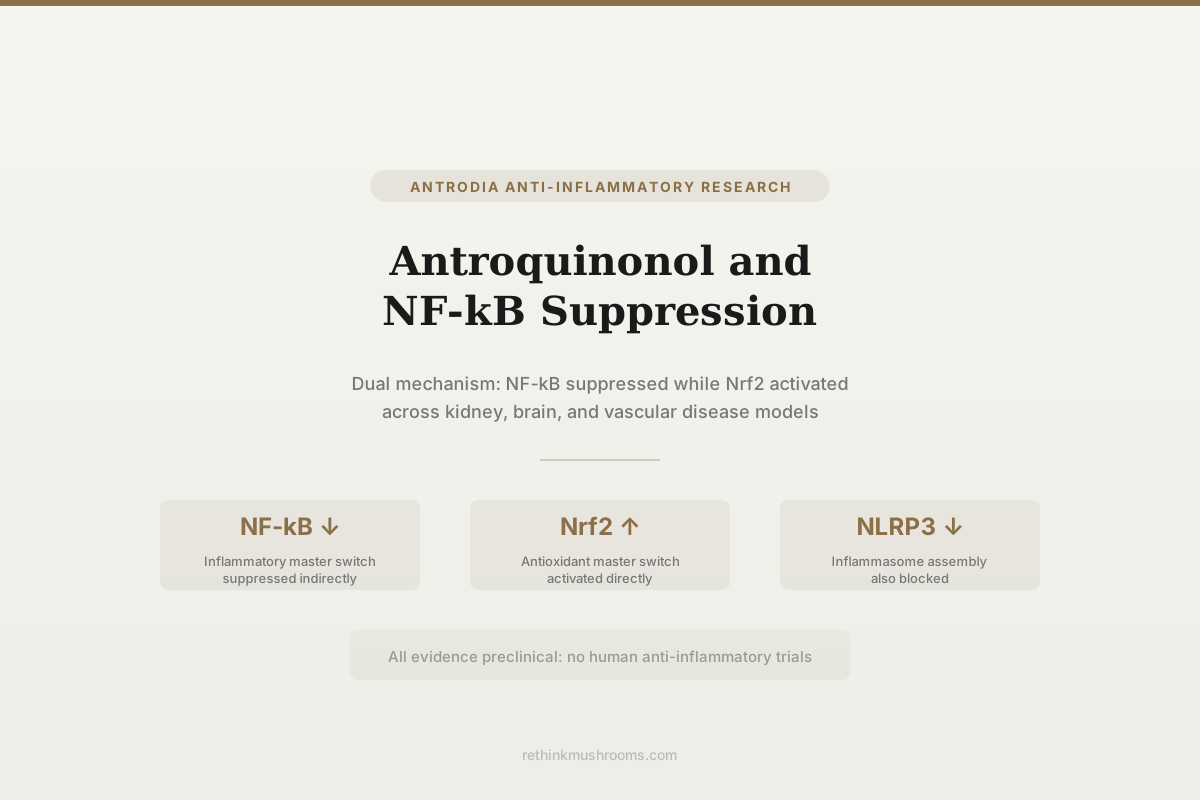
Antroquinonol simultaneously suppresses NF-kB inflammatory signaling while activating Nrf2 antioxidant defenses, a dual mechanism demonstrated across kidney, brain, and vascular disease models.
Tsai et al., Free Radical Biology & Medicine, 2011
Dual Action
NF-kB down + Nrf2 up simultaneously
NLRP3
inflammasome also suppressed
7 Studies
on Antrodia NF-kB pathway effects
Tsai et al., Free Radical Biology & Medicine, 2011
 View as image ↗
NF-kB (nuclear factor kappa-light-chain-enhancer of activated B cells) is the master transcription factor for inflammation. When activated, it drives the expression of pro-inflammatory cytokines (TNF-alpha, IL-1beta, IL-6), inflammatory enzymes (iNOS, COX-2), and cell adhesion molecules that recruit immune cells to sites of tissue damage. Chronic NF-kB activation underlies autoimmune disease, atherosclerosis, neurodegeneration, and cancer. Antroquinonol, a ubiquinone derivative unique to Antrodia camphorata, suppresses NF-kB signaling while simultaneously activating the Nrf2 antioxidant pathway, a dual mechanism that addresses both the inflammatory and oxidative arms of chronic disease. For the broader landscape of how Antrodia triterpenoids combat inflammation, see Antrodia and inflammation research.
Seven studies spanning kidney disease, neurodegeneration, vascular inflammation, liver injury, and macrophage biology demonstrate antroquinonol's NF-kB suppression through multiple converging mechanisms. The compound does not simply block NF-kB directly. It reduces the upstream oxidative stress signals that trigger NF-kB activation, inhibits the degradation of IkBalpha (the protein that holds NF-kB inactive in the cytoplasm), and activates Nrf2, which produces antioxidant enzymes that eliminate the reactive oxygen species driving NF-kB signaling.
Key Takeaways
- Antroquinonol inhibited NF-kB activation while enhancing Nrf2 and glutathione peroxidase activity in focal segmental glomerulosclerosis mice, reducing both inflammation and fibrosis (Tsai et al., 2011)
- In IgA nephropathy mice, antroquinonol activated Nrf2, inhibited T cell activation and NLRP3 inflammasome, and reduced macrophage infiltration in kidneys (Yang et al., 2013)
- Antroquinonol crossed the blood-brain barrier and reduced neuroinflammation in Alzheimer's transgenic mice via Nrf2 activation, lowering astrogliosis and brain amyloid-beta (Chang et al., 2015)
- Antrodia fermented broth suppressed NF-kB by preventing IkBalpha degradation in vascular smooth muscle cells exposed to cigarette smoke, reducing VEGF, PDGF, and EGR-1 overexpression (Yang et al., 2017)
- Eburicoic acid and dehydroeburicoic acid inhibited NF-kB activation and suppressed iNOS and COX-2 expression in carrageenan-induced inflammation (Deng et al., 2013)
- Antcin K and antcin B suppressed NF-kB-driven TNF-alpha, IL-1beta, iNOS, and COX-2 in CCl4-damaged liver tissue at potency matching silymarin (Li et al., 2017)
How NF-kB Drives Chronic Inflammation
Understanding why NF-kB suppression matters requires knowing its role in the inflammatory cascade. In resting cells, NF-kB dimers (typically p65/p50) are held in the cytoplasm by inhibitor proteins called IkBs. When the cell detects danger signals (pathogen molecules, oxidative stress, pro-inflammatory cytokines), IkB kinase (IKK) phosphorylates IkBalpha, marking it for proteasomal degradation. Free NF-kB translocates to the nucleus and activates hundreds of target genes.
The activated genes include TNF-alpha and IL-1beta (which further activate NF-kB in neighboring cells, creating positive feedback), iNOS (which produces nitric oxide), COX-2 (which produces prostaglandins), and cell adhesion molecules (which recruit immune cells). In acute infection, this cascade is protective. In chronic disease, sustained NF-kB activation causes progressive tissue damage.
Compounds that interrupt this cascade at different points can reduce chronic inflammation. Antroquinonol appears to act at multiple levels: reducing the upstream ROS that activate IKK, preventing IkBalpha degradation, and activating the parallel Nrf2 pathway that opposes NF-kB signaling.
Kidney Disease: The First Evidence of Dual Pathway Action
Tsai et al. (2011) provided the first detailed evidence of antroquinonol's simultaneous NF-kB suppression and Nrf2 activation in a model of focal segmental glomerulosclerosis (FSGS), a form of kidney disease that responds poorly to steroids.[1]
In FSGS mice, antroquinonol increased renal Nrf2 expression and glutathione peroxidase activity (antioxidant defense) while simultaneously inhibiting renal NF-kB activation (inflammatory signaling). The treatment decreased serum and kidney TGF-beta1 levels (a fibrosis driver) and reduced both inflammation and sclerosis (scarring) in kidney tissue.[1]
This dual-pathway mechanism is pharmacologically unusual. Most anti-inflammatory compounds target NF-kB directly (like aspirin or dexamethasone). Antroquinonol instead boosts the cell's endogenous antioxidant system through Nrf2, which indirectly suppresses NF-kB by eliminating the oxidative stress signals that maintain its activation. The result is reduced inflammation without the immunosuppressive side effects of direct NF-kB inhibitors.
Yang et al. (2013) confirmed and extended this mechanism in a more aggressive kidney disease model: accelerated IgA nephropathy.[2] Antroquinonol activated the Nrf2 pathway, inhibited T cell activation, suppressed NLRP3 inflammasome assembly, and reduced macrophage infiltration in kidney tissue. The NLRP3 inhibition adds a third anti-inflammatory mechanism beyond NF-kB suppression and Nrf2 activation: blocking the inflammasome complex that produces mature IL-1beta, a key driver of renal inflammation.
The kidney studies are particularly relevant because chronic kidney disease affects over 800 million people globally, and inflammation drives disease progression in most forms. A compound that simultaneously reduces inflammation (NF-kB/NLRP3), oxidative stress (Nrf2), and fibrosis (TGF-beta) in kidney tissue addresses multiple pathogenic mechanisms. For how antcin K inhibits NF-kB through a related but structurally distinct mechanism, the sibling article covers that triterpenoid specifically.
Neuroinflammation: NF-kB Suppression in the Brain
Chang et al. (2015) demonstrated antroquinonol's anti-inflammatory effects in the central nervous system using APP transgenic Alzheimer's mice.[3] After confirming that antroquinonol crosses the blood-brain barrier, the study showed that two months of oral consumption reduced hippocampal amyloid-beta levels and decreased astrogliosis (reactive astrocyte proliferation driven by neuroinflammation).
The mechanism again centered on Nrf2 activation. In Alzheimer's disease, Nrf2 signaling is downregulated, creating an environment of sustained oxidative stress and NF-kB-driven neuroinflammation. By restoring Nrf2 function, antroquinonol re-established the antioxidant defense that normally keeps NF-kB in check. The consequence was reduced neuroinflammation and improved spatial learning and memory in the Morris water maze.
This brain evidence connects directly to the broader Antrodia neuroprotection research and demonstrates that the NF-kB/Nrf2 dual mechanism operates across organ systems, not just in the kidneys where it was first characterized.
Vascular Inflammation and Atherosclerosis
Yang et al. (2017) tested Antrodia fermented culture broth in a vascular inflammation model using cigarette smoke extract-treated vascular smooth muscle cells and ApoE-deficient mice.[4]
In cell culture, Antrodia suppressed NF-kB activation through a specific mechanism: it prevented the degradation of IkBalpha, the inhibitor protein that holds NF-kB in the cytoplasm. With IkBalpha intact, NF-kB remained trapped in the cytoplasm and could not enter the nucleus to activate inflammatory genes. The extract also inhibited AP-1 transcription factor activity (another pro-inflammatory pathway) by reducing c-Fos and c-Jun expression. Downstream, VEGF, PDGF, and EGR-1 overexpression were all suppressed, reducing the vascular remodeling signals that drive atherosclerotic plaque growth.[4]
In ApoE-deficient mice, 8 weeks of oral Antrodia prevented cigarette smoke-accelerated atherosclerosis. Serum total antioxidant status increased while total cholesterol and triacylglycerol decreased, indicating systemic anti-inflammatory and metabolic benefits beyond the local vascular effects.
Other Antrodia Compounds That Target NF-kB
Antroquinonol is not the only Antrodia compound that suppresses NF-kB. Several triterpenoids converge on this same pathway through related mechanisms.
Deng et al. (2013) showed that eburicoic acid and dehydroeburicoic acid from Antrodia solid-state culture inhibited NF-kB activation in carrageenan-induced paw inflammation.[5] Both compounds suppressed iNOS and COX-2 protein expression (NF-kB target genes) and reduced TNF-alpha and IL-1beta levels. They simultaneously increased SOD, catalase, and GPx activity, mirroring the Nrf2-mediated antioxidant enhancement seen with antroquinonol.
Li et al. (2017) demonstrated that antcin K and antcin B, the major hepatoprotective triterpenoids from Antrodia fruiting body, suppressed NF-kB (p65/p-p65) in CCl4-damaged liver tissue.[6] Both compounds downregulated TNF-alpha, IL-1beta, iNOS, and COX-2 at both mRNA and protein levels. At 50 mg/kg, their hepatoprotective potency matched 100 mg/kg silymarin, a pharmaceutical-grade liver protectant.
Wu et al. (2007) found that specific polysaccharide fractions also modulate NF-kB-related signaling in macrophages, though through an anti-inflammatory rather than pro-inflammatory direction.[7] The alkaline extraction fraction inhibited LPS-induced nitric oxide, iNOS, IL-6, and IL-10 in mouse macrophages. This demonstrates that different Antrodia compound classes can modulate NF-kB-driven inflammation in context-dependent ways.
The convergence of multiple structurally distinct Antrodia compounds (antroquinonol, eburicoic acid, dehydroeburicoic acid, antcin K, antcin B, and specific polysaccharide fractions) on the NF-kB pathway suggests that NF-kB suppression is a fundamental property of Antrodia's pharmacology rather than a feature of any single compound. For a broader view of how chronic inflammation responds to Antrodia compounds, see Antrodia for chronic inflammatory conditions.
Why the NF-kB/Nrf2 Seesaw Matters
NF-kB and Nrf2 have a reciprocal relationship in cells. When NF-kB is highly active, Nrf2 is often suppressed, and vice versa. This "seesaw" means that compounds activating Nrf2 tend to suppress NF-kB indirectly, and compounds suppressing NF-kB tend to relieve the suppression of Nrf2.
Antroquinonol appears to push this seesaw toward the Nrf2 (antioxidant/anti-inflammatory) side across multiple organ systems. The consistency of this effect in kidneys (FSGS, IgA nephropathy), brain (Alzheimer's), and vasculature (atherosclerosis) suggests a fundamental cellular mechanism rather than tissue-specific activity.
This dual mechanism is therapeutically attractive because it addresses both the cause (oxidative stress via Nrf2) and the consequence (inflammatory gene expression via NF-kB) of chronic inflammatory disease. Pharmaceutical NF-kB inhibitors (like bortezomib) are effective but carry immunosuppressive risks because they block all NF-kB-dependent immune function, including the acute inflammatory responses needed for pathogen defense. Antroquinonol's Nrf2-first approach may provide anti-inflammatory benefits with a different safety profile, though this comparison remains theoretical until human trials are conducted.
The cross-organ consistency of this mechanism (kidneys, brain, vasculature, liver, peripheral inflammation) suggests that antroquinonol acts on a fundamental cellular process rather than a tissue-specific target. The NF-kB/Nrf2 seesaw operates in virtually every nucleated cell type, which explains why a compound that shifts this balance would show effects across diverse disease models. This universality is both a strength (broad potential applicability) and a limitation (lack of specificity may limit potency in any single condition compared to disease-specific therapeutics).
Limitations
All evidence is preclinical. No human trials have tested antroquinonol for anti-inflammatory endpoints. The NF-kB/Nrf2 mechanism has been demonstrated only in mouse models and cell cultures.
Dose-response data is limited. Most studies tested 1-3 doses of antroquinonol without establishing full dose-response curves or therapeutic windows. The minimum effective dose for NF-kB suppression in each organ system remains undefined.
Antroquinonol content varies between products. As a specific compound isolated from Antrodia, antroquinonol concentration depends on cultivation method and extraction. Commercial Antrodia products rarely standardize for antroquinonol content.
The kidney studies use different disease models. FSGS and IgA nephropathy have different pathogenic mechanisms. While antroquinonol showed benefit in both, the mechanism may not extend to all forms of kidney inflammation.
Long-term safety of sustained Nrf2 activation is untested. While Nrf2 activation is generally considered beneficial, chronic Nrf2 hyperactivation has been associated with drug resistance in cancer cells. Whether long-term antroquinonol use could promote this effect is unknown.
The distinction between prevention and treatment is unclear. The kidney and brain studies administered antroquinonol during disease development, not after established pathology in most cases. Whether antroquinonol can reverse existing NF-kB-driven inflammation or only prevent its escalation has not been systematically tested across disease models.
Comparison with established NF-kB inhibitors is absent. No study has compared antroquinonol head-to-head with pharmaceutical NF-kB inhibitors (dexamethasone, bortezomib, celecoxib) to quantify its relative potency. The Li et al. (2017) comparison with silymarin provides one benchmark (50 mg/kg antcin K matching 100 mg/kg silymarin), but silymarin is not primarily an NF-kB inhibitor. Without direct comparisons, claims about antroquinonol's anti-inflammatory potency relative to available drugs remain unsubstantiated.
The Bottom Line
Antroquinonol from Antrodia camphorata suppresses NF-kB inflammatory signaling through an indirect mechanism: it activates the Nrf2 antioxidant pathway, which reduces the oxidative stress that drives NF-kB activation. This dual NF-kB/Nrf2 mechanism has been demonstrated in kidney disease (FSGS, IgA nephropathy), Alzheimer's neuroinflammation, and vascular inflammation models. Multiple other Antrodia compounds (eburicoic acid, antcin K, antcin B) also converge on NF-kB suppression, suggesting this is a fundamental property of Antrodia pharmacology. All evidence is preclinical.
Frequently Asked Questions
Sources & References
- 1RTHM-00236·Tsai, Pei-Yi et al. (2011). “Antroquinonol reduces oxidative stress by enhancing the Nrf2 signaling pathway and inhibits inflammation and sclerosis in focal segmental glomerulosclerosis mice..” Free radical biology & medicine.Study breakdown →PubMed →↩
- 2RTHM-00311·Yang, Shun-Min et al. (2013). “Antroquinonol mitigates an accelerated and progressive IgA nephropathy model in mice by activating the Nrf2 pathway and inhibiting T cells and NLRP3 inflammasome..” Free radical biology & medicine.Study breakdown →PubMed →↩
- 3RTHM-00366·Chang, Wen-Han et al. (2015). “Antroquinonol Lowers Brain Amyloid-β Levels and Improves Spatial Learning and Memory in a Transgenic Mouse Model of Alzheimer's Disease..” Scientific reports.Study breakdown →PubMed →↩
- 4RTHM-00500·Yang, Hsin-Ling et al. (2017). “Antrodia camphorata attenuates cigarette smoke-induced ROS production, DNA damage, apoptosis, and inflammation in vascular smooth muscle cells, and atherosclerosis in ApoE-deficient mice..” Environmental toxicology.Study breakdown →PubMed →↩
- 5RTHM-00284·Deng, Jeng-Shyan et al. (2013). “Analgesic and anti-inflammatory bioactivities of eburicoic acid and dehydroeburicoic acid isolated from Antrodia camphorata on the inflammatory mediator expression in mice..” Journal of agricultural and food chemistry.Study breakdown →PubMed →↩
- 6RTHM-00479·Li, Zi-Wei et al. (2017). “Hepatoprotective activities of Antrodia camphorata and its triterpenoid compounds against CCl4-induced liver injury in mice..” Journal of ethnopharmacology.Study breakdown →PubMed →↩
- 7RTHM-00124·Wu, Yen-ying et al. (2007). “Modulation of inflammation-related genes of polysaccharides fractionated from mycelia of medicinal basidiomycete Antrodia camphorata..” Acta pharmacologica Sinica.Study breakdown →PubMed →↩