Antrodia and Inflammation
NF-kB blocked
Antrodia camphorata fermented broth inhibits LPS-induced NF-kB activation by blocking IkB-alpha degradation, suppressing iNOS, COX-2, TNF-alpha, and IL-1beta in RAW 264.7 macrophages.
Hseu et al., International Immunopharmacology, 2005
5 Triterpenoids
with confirmed anti-inflammatory activity
3 Pathways
NF-kB, AP-1, glucocorticoid receptor
IC50 5-20 uM
zhankuic acids in neutrophil ROS
Hseu et al., International Immunopharmacology, 2005
 View as image ↗
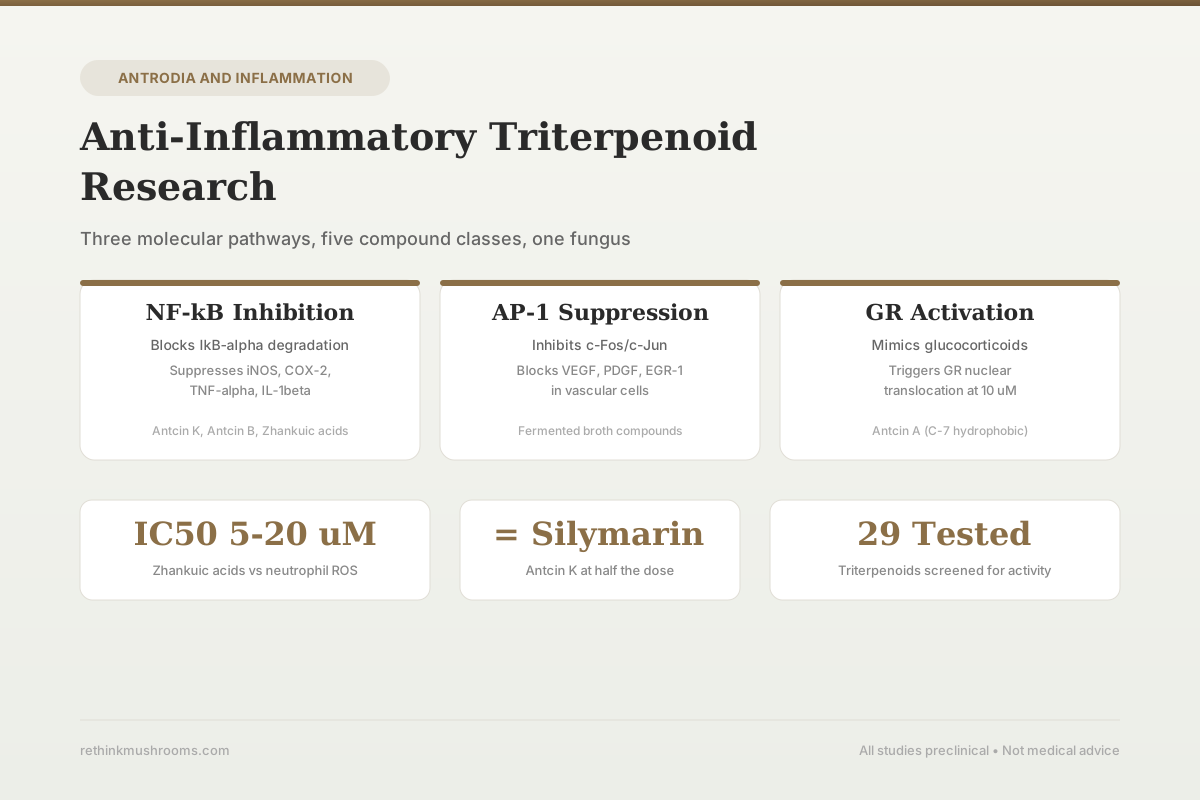
Chronic inflammation drives liver fibrosis, atherosclerosis, neurodegeneration, and metabolic disease. Antrodia camphorata, a medicinal fungus endemic to Taiwan, produces a family of triterpenoid compounds that suppress inflammatory signaling through at least three distinct molecular pathways: NF-kB inhibition, AP-1 suppression, and glucocorticoid receptor activation. Since 2004, Taiwanese and international research groups have characterized these mechanisms across macrophages, neutrophils, hepatocytes, vascular smooth muscle cells, and brain tissue.[1] For specific data on how antcin K blocks NF-kB signaling, the mechanism has been mapped at the protein level.
Key Takeaways
- Antrodia camphorata fermented broth (25 to 100 micrograms/mL) concentration-dependently inhibited LPS-induced NO and PGE2 production, iNOS and COX-2 expression, and TNF-alpha and IL-1beta secretion by blocking NF-kB activation in macrophages (Hseu et al., 2005)
- Zhankuic acids A, B, C, and antcin K from Antrodia fruiting bodies inhibited fMLP- and PMA-induced ROS production in human neutrophils with IC50 values of 5 to 20 micromolar (Shen et al., 2004)
- Antcin A mimics glucocorticoids by triggering glucocorticoid receptor translocation to the nucleus at 10 micromolar, providing anti-inflammatory activity through a steroid-receptor pathway distinct from NF-kB (Chen et al., 2011)
- Antcin K and antcin B at 50 mg/kg downregulated IL-1beta, TNF-alpha, iNOS, COX-2, and NF-kB in mouse liver tissue at both mRNA and protein levels, matching the efficacy of 100 mg/kg silymarin (Li et al., 2017)
- Antrodia fermented broth suppressed AP-1 activity by inhibiting c-Fos/c-Jun expression and NF-kB through IkB-alpha degradation inhibition in cigarette smoke-exposed vascular smooth muscle cells (Yang et al., 2017)
- Dietary Antrodia powder simultaneously upregulated the Nrf2 antioxidant pathway and downregulated NF-kB inflammatory signaling in liver tissue (Lee et al., 2018)
The NF-kB Pathway: Where Antrodia Hits Inflammation Hardest
NF-kB (nuclear factor kappa-light-chain-enhancer of activated B cells) is the master transcription factor for inflammatory gene expression. When inflammatory signals like bacterial lipopolysaccharide (LPS) arrive, the inhibitor protein IkB-alpha is degraded, releasing NF-kB to enter the nucleus and activate genes for iNOS (inducible nitric oxide synthase), COX-2 (cyclooxygenase-2), TNF-alpha, IL-1beta, and other inflammatory mediators.
Hseu et al. (2005) provided the first systematic evidence that Antrodia camphorata blocks this pathway. Using RAW 264.7 macrophages stimulated with LPS, they showed that fermented Antrodia culture broth at 25 to 100 micrograms/mL concentration-dependently inhibited NO production (the product of iNOS), PGE2 production (the product of COX-2), and the protein expression of both iNOS and COX-2 without cytotoxicity.[1]
The molecular mechanism was specific: Antrodia blocked IkB-alpha degradation, preventing NF-kB from entering the nucleus. This single upstream block suppressed the entire downstream inflammatory cascade, including TNF-alpha and IL-1beta secretion. The dose-dependent relationship and absence of cytotoxicity ruled out a non-specific toxic effect on the macrophages.[1]
Zhankuic Acids: Triterpenoids That Calm Neutrophils
Before the NF-kB mechanism was fully mapped, Shen et al. (2004) had already demonstrated anti-inflammatory activity for specific Antrodia triterpenoids. They isolated zhankuic acids A, B, and C alongside antcin K from Antrodia camphorata fruiting bodies and tested them in human peripheral blood neutrophils, a cell type that drives acute inflammation through ROS production and tissue adhesion.[2]
All four compounds concentration-dependently (1 to 25 micromolar) diminished ROS production triggered by both fMLP and PMA, with IC50 values ranging from 5 to 20 micromolar. They also inhibited neutrophil firm adhesion, a critical step in the inflammatory cascade where neutrophils attach to blood vessel walls and infiltrate tissue. The adhesion inhibition occurred without interfering with Mac-1 (CD11b/CD18) surface expression, indicating a mechanism downstream of integrin upregulation.[2]
The practical IC50 range of 5 to 20 micromolar for these triterpenoids is relevant because it falls within achievable tissue concentrations for orally administered compounds, though bioavailability data for zhankuic acids specifically remains limited. These compounds represent a structural class distinct from antcins, expanding the diversity of Antrodia's anti-inflammatory toolkit.
Antcin A: A Natural Glucocorticoid Mimic
Chen et al. (2011) discovered an entirely different anti-inflammatory mechanism for one specific Antrodia triterpenoid. Antcin A, but not antcins B, C, H, or K, triggers translocation of the cytosolic glucocorticoid receptor (GR) into the nucleus. This is the same mechanism by which pharmaceutical glucocorticoids like dexamethasone and cortisone suppress inflammation.[3]
The minimum effective concentrations for inducing GR nuclear migration were 10 micromolar for antcin A, 1 micromolar for cortisone, and 0.1 micromolar for dexamethasone. These relative potencies aligned with molecular docking simulations of each compound's binding affinity to the GR ligand-binding domain.[3]
The structural basis for antcin A's selectivity was elegant: molecular modeling showed that C-7 of antcin A (and of glucocorticoids) is exposed to a hydrophobic region in the GR binding cavity. The other four antcins have hydrophilic groups attached to C-7, which creates a steric and polarity mismatch that prevents binding. This finding established that antcin A operates through a fundamentally different pathway than the NF-kB inhibition demonstrated by zhankuic acids and the crude extract.[3]
The distinction has practical implications: glucocorticoid-pathway anti-inflammatory agents affect different gene sets than NF-kB inhibitors, suggesting that Antrodia extracts containing multiple triterpenoids could provide broader anti-inflammatory coverage than any single compound. For more on how the individual antcin compounds differ in structure and activity, the C-7 substitution pattern is a key determinant.
Antcin K and Antcin B: Liver Anti-Inflammatory Champions
Li et al. (2017) screened 29 Antrodia triterpenoids for hepatoprotective activity and identified antcin K and antcin B as the most potent anti-inflammatory compounds against CCl4-induced liver injury in mice. At 50 mg/kg orally for 7 days, both compounds dose-dependently decreased serum ALT and AST (liver damage markers) and reduced the incidence of liver necrosis. The effects of 50 mg/kg antcin K or antcin B were almost identical to those of 100 mg/kg silymarin, a pharmaceutical standard for liver protection.[4]
The anti-inflammatory mechanism was confirmed at both transcriptional and translational levels: qRT-PCR and Western blotting revealed that antcin K and antcin B downregulated IL-1beta, TNF-alpha, iNOS, COX-2, and NF-kB (p65/p-p65) in liver tissue. This dual-level confirmation (mRNA and protein) strengthens the evidence that these compounds genuinely suppress inflammatory signaling rather than simply preventing tissue damage through antioxidant effects.[4]
The study also compared different cultivation methods: wild-growing fruiting bodies, cutting wood culture fruiting bodies, and dish cultures all showed stronger anti-inflammatory hepatoprotection than mycelium preparations, consistent with the higher triterpenoid content found in fruiting body forms. Given antcin K's high natural abundance and demonstrated oral absorption, the authors identified it as a promising drug candidate for liver inflammatory conditions.[4] This hepatoprotective role connects directly to Antrodia's documented activity against alcohol-related liver damage.
AP-1 Suppression: A Third Anti-Inflammatory Pathway
Yang et al. (2017) identified a third molecular target for Antrodia's anti-inflammatory activity: the AP-1 (activator protein 1) transcription factor complex. In vascular smooth muscle cells exposed to cigarette smoke extract, Antrodia fermented broth suppressed AP-1 activity by inhibiting c-Fos and c-Jun expression, the two protein subunits that form the AP-1 heterodimer.[5]
This AP-1 suppression occurred alongside NF-kB inhibition (through IkB-alpha degradation block), meaning Antrodia simultaneously suppresses two major inflammatory transcription factor systems in the same cells. The downstream consequences included suppression of vascular endothelial growth factor (VEGF), platelet-derived growth factor (PDGF), and early growth response-1 (EGR-1), all of which promote vascular inflammation and atherosclerotic plaque development.[5]
In vivo, oral Antrodia administration for 8 weeks prevented cigarette smoke-accelerated atherosclerosis in ApoE-deficient mice. The anti-atherosclerotic effect correlated with increased serum total antioxidant status and decreased cholesterol and triacylglycerol levels, linking the anti-inflammatory mechanism to the cellular antioxidant mechanisms that Antrodia activates through Nrf2.[5]
The Nrf2-NF-kB Seesaw: Shifting Cells from Damage to Repair
Lee et al. (2018) revealed that Antrodia's anti-inflammatory and antioxidant effects are mechanistically linked through reciprocal regulation of Nrf2 and NF-kB. In broiler chickens supplemented with Antrodia cinnamomea powder at 0.1 to 0.4% of diet for 35 days, liver protein analysis showed that all supplemented groups had significantly higher Nrf2 expression while NF-kB expression was inhibited.[6]
The Nrf2 upregulation induced antioxidant genes HO-1 and GCLC, while the NF-kB downregulation reduced inflammatory genes IL-1beta and IL-6 at both 21 and 35 days. This bidirectional shift suggests that Antrodia does not simply block inflammation; it actively redirects cellular signaling from a damage/inflammation program toward a protection/repair program.[6]
The functional test confirmed this: peripheral blood mononuclear cells from supplemented birds showed higher survival when challenged with LPS or the peroxyl radical generator AAPH, indicating that the combined anti-inflammatory and antioxidant shift translated to genuine cellular resilience. While this study used an avian model, the Nrf2 and NF-kB signaling cascades are highly conserved across vertebrates. For specifics on how antroquinonol suppresses NF-kB, the ubiquinone derivative adds yet another compound class to Antrodia's anti-inflammatory repertoire.
Why Multiple Pathways Matter
The convergence of NF-kB inhibition (by crude extract, antcin K, antcin B), AP-1 suppression (by fermented broth), and glucocorticoid receptor activation (by antcin A) in a single fungus is unusual among medicinal mushrooms. Most natural anti-inflammatory agents work through a single mechanism, typically NF-kB. Antrodia's multi-pathway approach may explain why crude extracts often show stronger anti-inflammatory effects than individual purified compounds: the extract delivers simultaneous suppression through complementary pathways.
This also has implications for resistance. Pharmaceutical anti-inflammatory drugs targeting a single pathway (like COX-2 inhibitors) can lose efficacy as cells upregulate compensatory pathways. Antrodia's multi-target approach, hitting NF-kB, AP-1, and the glucocorticoid system simultaneously, may provide more durable suppression of inflammatory signaling, though this hypothesis has not been tested in chronic models.
Limitations of the Current Evidence
All studies cited are preclinical. No human clinical trial has measured Antrodia's effects on inflammatory markers like CRP, IL-6, or TNF-alpha. The Hseu et al. (2005) and Shen et al. (2004) studies used cell culture models that lack the pharmacokinetic complexity of whole-organism dosing. The Li et al. (2017) and Yang et al. (2017) studies used acute injury models (CCl4, cigarette smoke) that differ from the chronic low-grade inflammation that drives most human inflammatory disease.
Dose translation remains uncertain. The 50 mg/kg antcin K dose effective in mice (Li et al., 2017) would translate to approximately 4 mg/kg in humans using allometric scaling, but oral bioavailability of specific Antrodia triterpenoids in humans has not been measured. The Lee et al. (2018) broiler chicken model, while useful for mechanistic insights, introduces species-specific metabolic differences.
The comparison to silymarin (Li et al., 2017) provides a useful benchmark, but silymarin itself has limited clinical evidence for liver inflammation despite decades of use. The glucocorticoid receptor activation by antcin A (Chen et al., 2011) raises questions about whether long-term exposure could produce glucocorticoid-like side effects, which have not been investigated. Research on Antrodia's effects in chronic inflammatory conditions and neuroinflammation is ongoing but remains at the preclinical stage.
The Bottom Line
Antrodia camphorata triterpenoids suppress inflammation through at least three distinct molecular pathways: NF-kB inhibition (zhankuic acids, antcin K, antcin B, crude extract), AP-1 suppression (fermented broth), and glucocorticoid receptor activation (antcin A). These mechanisms have been demonstrated in macrophages, neutrophils, hepatocytes, and vascular smooth muscle cells, with in vivo confirmation in mouse liver injury, atherosclerosis, and poultry models. All evidence is preclinical with no human trials measuring anti-inflammatory endpoints.
Frequently Asked Questions
Sources & References
- 1RTHM-00079·Hseu, You-Cheng et al. (2005). “Anti-inflammatory potential of Antrodia Camphorata through inhibition of iNOS, COX-2 and cytokines via the NF-kappaB pathway..” International immunopharmacology.Study breakdown →PubMed →↩
- 2RTHM-00077·Shen, Yuh-Chiang et al. (2004). “Evaluation of the anti-inflammatory activity of zhankuic acids isolated from the fruiting bodies of Antrodia camphorata..” Planta medica.Study breakdown →PubMed →↩
- 3RTHM-00210·Chen, Yi-ching et al. (2011). “Antcin A, a steroid-like compound from Antrodia camphorata, exerts anti-inflammatory effect via mimicking glucocorticoids..” Acta pharmacologica Sinica.Study breakdown →PubMed →↩
- 4RTHM-00479·Li, Zi-Wei et al. (2017). “Hepatoprotective activities of Antrodia camphorata and its triterpenoid compounds against CCl4-induced liver injury in mice..” Journal of ethnopharmacology.Study breakdown →PubMed →↩
- 5RTHM-00500·Yang, Hsin-Ling et al. (2017). “Antrodia camphorata attenuates cigarette smoke-induced ROS production, DNA damage, apoptosis, and inflammation in vascular smooth muscle cells, and atherosclerosis in ApoE-deficient mice..” Environmental toxicology.Study breakdown →PubMed →↩
- 6RTHM-00515·Lee, M T et al. (2018). “Evaluation of potential antioxidant and anti-inflammatory effects of Antrodia cinnamomea powder and the underlying molecular mechanisms via Nrf2- and NF-κB-dominated pathways in broiler chickens..” Poultry science.Study breakdown →PubMed →↩