Antrodia and Metabolic Health
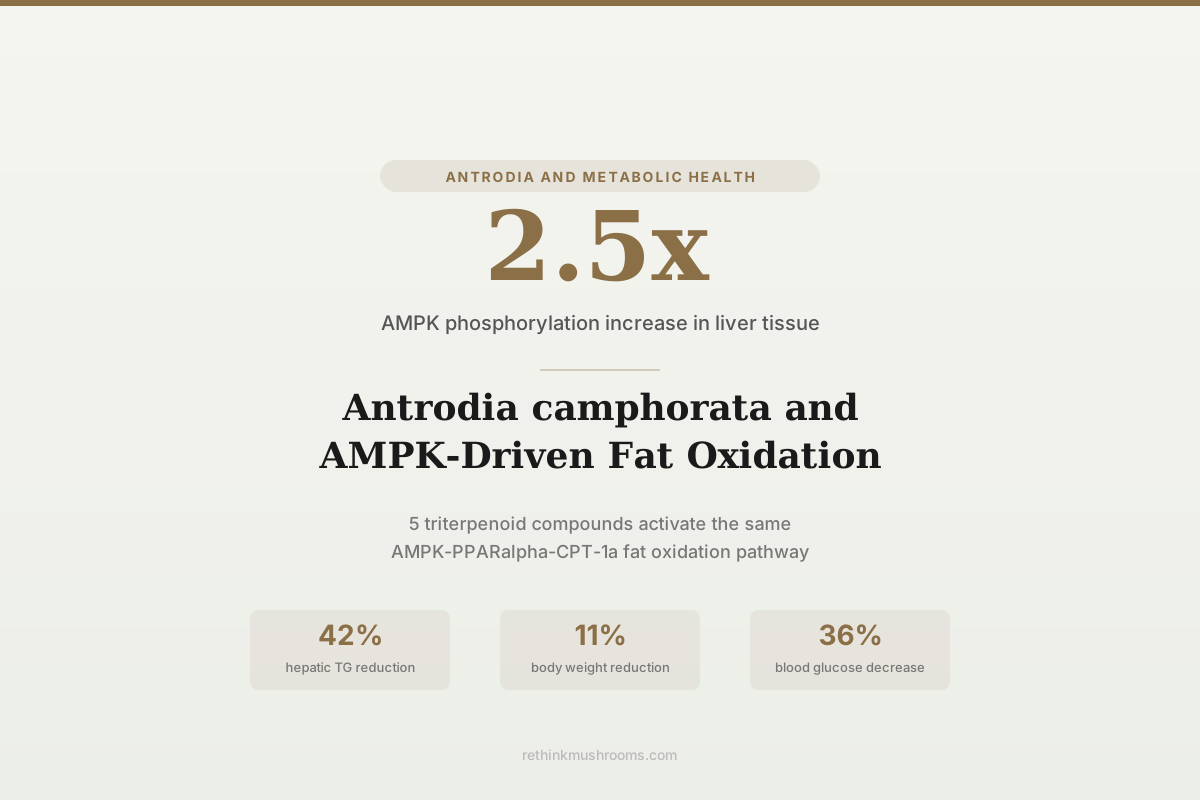
2.5x AMPK phosphorylation
Dehydroeburicoic acid from Antrodia camphorata increased hepatic AMPK phosphorylation approximately 2.5-fold in high-fat-diet-fed mice compared to untreated controls.
Kuo et al., Int J Mol Sci, 2016
5+ compounds
Antrodia triterpenoids activating AMPK
All preclinical
mouse and cell studies only
PPARalpha + CPT-1a
downstream fat oxidation genes upregulated
Kuo et al., Int J Mol Sci, 2016
 View as image ↗
Antrodia camphorata produces at least five distinct triterpenoid compounds that activate AMP-activated protein kinase (AMPK) in preclinical studies, each through slightly different molecular mechanisms. AMPK is the cell's master energy sensor. When activated, it shifts metabolism from fat storage toward fat burning by increasing fatty acid oxidation and suppressing lipogenesis. In high-fat-diet-fed mice, dehydroeburicoic acid from Antrodia camphorata increased hepatic AMPK phosphorylation approximately 2.5-fold and upregulated the fat oxidation enzyme CPT-1a.[1] For context on the broader Antrodia compound landscape, see Antrodia and metabolic syndrome: multi-target effects.
Every study reviewed here used animal models or cell cultures. No human clinical trials have tested isolated Antrodia triterpenoids for AMPK activation or fat oxidation. The preclinical evidence is consistent across multiple research groups and compounds, but the gap between mouse liver and human physiology remains wide.
Key Takeaways
- Dehydroeburicoic acid increased hepatic AMPK phosphorylation approximately 2.5-fold and upregulated fatty acid oxidation genes PPARalpha and CPT-1a in high-fat-diet mice (Kuo et al., 2016)
- Antcin K enhanced phospho-AMPK expression in both muscle and liver tissue while simultaneously increasing GLUT4 membrane translocation for improved glucose uptake (Kuo et al., 2016)
- Eburicoic acid activated AMPK in palmitate-treated C2C12 myotubes and reduced body weight by 11 percent in high-fat-diet mice over 12 weeks (Lin et al., 2017)
- Antrodia cinnamomea extract increased pAMPK and decreased SREBP-1 in liver tissue, reducing hepatic triglycerides by 42 percent in high-fat-diet mice (Peng et al., 2017)
- Ergostatrien-3beta-ol from Antrodia camphorata lowered blood glucose by 36 percent and total cholesterol by 19 percent in high-fat-diet mice through AMPK-mediated pathways (Kuo et al., 2015)
- All five triterpenoid compounds converge on the same AMPK-PPARalpha-CPT-1a signaling axis despite different chemical structures
What AMPK does and why fat oxidation researchers study it
AMPK (AMP-activated protein kinase) is a heterotrimeric enzyme complex found in virtually every mammalian cell. It monitors the ratio of AMP to ATP. When energy expenditure rises and ATP drops, AMPK activates. Once phosphorylated, AMPK triggers a cascade of downstream effects: it phosphorylates acetyl-CoA carboxylase (ACC), reducing malonyl-CoA levels, which lifts the brake on carnitine palmitoyltransferase 1a (CPT-1a). CPT-1a then shuttles fatty acids into mitochondria for beta-oxidation.
AMPK also suppresses lipogenic transcription factors. Sterol regulatory element-binding protein 1 (SREBP-1) and fatty acid synthase (FAS) both decrease when AMPK is active. The net effect is a metabolic shift: less fat synthesis, more fat burning. This dual action is why AMPK activators are studied for metabolic syndrome, obesity, type 2 diabetes, and non-alcoholic fatty liver disease.
Pharmaceutical AMPK activators like metformin and AICAR are well-established. The question for Antrodia research is whether its triterpenoid compounds activate AMPK at pharmacologically meaningful levels. The preclinical data from at least five separate compounds suggests they do, though at doses achievable in rodents, not yet validated in humans. For related research on Antrodia and blood glucose, see Antrodia and blood sugar: antidiabetic research.
Dehydroeburicoic acid: the most studied Antrodia AMPK activator
Dehydroeburicoic acid (DEA) has the deepest evidence base among Antrodia triterpenoids for AMPK-mediated fat oxidation. Kuo et al. (2016) tested DEA in C57BL/6J mice fed a high-fat diet for 12 weeks. DEA treatment at doses of 10 and 20 mg/kg body weight enhanced hepatic and skeletal muscle AMPK phosphorylation.[1]
The downstream effects were specific and measurable. DEA increased hepatic expression of PPARalpha, the nuclear receptor that drives fatty acid oxidation gene transcription. It increased mRNA levels of CPT-1a, the rate-limiting enzyme for mitochondrial fatty acid import. It decreased expression of FAS, the enzyme responsible for de novo lipogenesis. Blood glucose levels fell. Total cholesterol dropped. Triglycerides decreased. The mice gained less weight than high-fat-diet controls.[1]
In a separate study using streptozotocin-induced diabetic mice (a type 1 diabetes model rather than diet-induced metabolic syndrome), Kuo et al. (2015) confirmed that DEA also reduced blood glucose and improved lipid profiles through similar AMPK-related mechanisms.[2] The fact that DEA shows activity in both diet-induced and chemically induced models suggests its AMPK activation is not model-dependent, though neither model fully recapitulates human metabolic disease.
The limitation is dose translation. A 20 mg/kg dose in a mouse does not convert directly to a human dose. Allometric scaling suggests a human equivalent dose of roughly 1.6 mg/kg, but this assumes similar oral bioavailability, which has not been measured for DEA in humans. The compound's bioavailability, half-life, and tissue distribution in human physiology are unknown.
Antcin K: AMPK activation plus GLUT4 membrane translocation
Antcin K is one of the signature triterpenoid compounds unique to Antrodia camphorata. Kuo et al. (2016) demonstrated that antcin K activates AMPK in both muscle and liver while simultaneously increasing glucose transporter 4 (GLUT4) translocation to the cell membrane.[3] For deeper coverage of antcins as a compound class, see the dedicated overview.
In high-fat-diet-fed mice, antcin K treatment increased phospho-AMPK/total-AMPK ratios in skeletal muscle. GLUT4, the insulin-responsive glucose transporter, showed increased membrane expression, meaning more glucose was being pulled from blood into muscle cells. Hepatic FAS expression decreased while PPARalpha expression increased, the same pattern seen with DEA.[3]
The combined AMPK activation and GLUT4 translocation is pharmacologically relevant because it addresses two arms of metabolic syndrome simultaneously: impaired fat oxidation and impaired glucose disposal. Most metabolic drugs target one or the other. In preclinical models, antcin K appears to do both. Whether this translates to clinically meaningful dual activity in humans has not been tested.
Antcin K is structurally distinct from eburicoic acid derivatives. It belongs to the ergostane-type triterpenoids unique to Antrodia camphorata, while eburicoic acid and dehydroeburicoic acid are lanostane-type compounds. Despite different structures, they converge on AMPK. This convergence suggests that the AMPK activation may be related to general triterpenoid properties rather than a single pharmacophore.
Ergostatrien-3beta-ol: hepatic gene regulation through AMPK
Kuo et al. (2015) isolated ergostatrien-3beta-ol from Antrodia camphorata and tested it in high-fat-diet-fed ICR mice. The compound lowered blood glucose by 36 percent and total cholesterol by 19 percent compared to high-fat-diet controls.[4]
The molecular mechanism involved AMPK phosphorylation in both liver and skeletal muscle. Downstream, ergostatrien-3beta-ol increased hepatic GLUT4 expression and modulated hepatic gene expression related to glucose and lipid metabolism. Like the other Antrodia triterpenoids, it increased PPARalpha while decreasing lipogenic enzymes.[4]
The 36 percent blood glucose reduction and 19 percent cholesterol reduction are large effect sizes for a single compound in a diet-induced model. These numbers come from a single study with one dose level (at 10 and 20 mg/kg), without dose-response characterization across a wider range. The robustness of these effect sizes across different mouse strains, dietary compositions, and treatment durations is not established.
Ergostatrien-3beta-ol shares the ergostane skeleton with antcin K but has a simpler substitution pattern. It may represent a core pharmacophore that contributes to AMPK activation, with the more complex antcins providing additional biological activities through their additional functional groups. This is a hypothesis, not a demonstrated relationship.
Eburicoic acid: from myotubes to whole-body fat reduction
Eburicoic acid occupies a unique position in Antrodia AMPK research because it has been tested in both isolated muscle cells and whole animals within the same study. Lin et al. (2017) treated palmitate-loaded C2C12 myotubes (a cell model for fat-overloaded muscle) with eburicoic acid, then ran a parallel experiment in high-fat-diet mice.[5]
In cell culture, eburicoic acid activated AMPK and increased fatty acid oxidation gene expression. In mice fed a high-fat diet for 12 weeks, eburicoic acid at 10 mg/kg reduced body weight by approximately 11 percent compared to untreated high-fat-diet controls. Hepatic lipid accumulation decreased. Blood triglycerides and total cholesterol dropped. FAS expression declined while PPARalpha increased.[5]
A separate study by Lin et al. (2018) confirmed eburicoic acid's metabolic effects in streptozotocin-induced diabetic mice, showing regulation of Akt phosphorylation, gluconeogenesis, and PPARalpha.[6] For research on Antrodia's effects on cholesterol specifically, see Antrodia and lipid metabolism: cholesterol research.
The 11 percent body weight reduction is meaningful in mouse metabolic research. For comparison, metformin typically produces 5 to 10 percent weight reduction in similar mouse models. However, mouse body weight changes are influenced by food intake, activity levels, and thermoregulation in ways that do not scale linearly to humans. The study did not report whether eburicoic acid altered food intake, making it impossible to determine whether the weight loss came from increased energy expenditure, decreased caloric intake, or both.
Sulphurenic acid: extending the AMPK pattern
Sulphurenic acid is a lanostane-type triterpenoid from Antrodia camphorata that Lin et al. (2019) tested in streptozotocin-induced diabetic mice. Treatment reduced blood glucose, improved insulin sensitivity, and lowered blood lipids.[7]
The metabolic improvements followed the now-familiar Antrodia pattern: decreased FAS expression, increased PPARalpha, improved glucose transporter activity. While this study did not measure AMPK phosphorylation directly, the downstream gene expression profile mirrors what other Antrodia triterpenoids produce through confirmed AMPK activation. Sulphurenic acid likely activates the same pathway, though this inference awaits direct confirmation.[7]
The STZ model is a chemically induced diabetes model where pancreatic beta cells are destroyed, creating insulin deficiency. It is less relevant to metabolic syndrome (which involves insulin resistance, not deficiency) than the high-fat-diet model. The fact that sulphurenic acid shows activity in this context suggests broad metabolic effects, but the model mismatch means these results should be interpreted cautiously for metabolic syndrome applications.
Whole Antrodia extracts versus isolated compounds
Most studies reviewed above tested purified triterpenoid compounds. Two studies examined whole Antrodia extracts, which contain mixtures of these compounds plus polysaccharides, sterols, and other bioactives.
Peng et al. (2017) tested Antrodia cinnamomea ethanol extract in high-fat-diet mice. The extract increased pAMPK in liver tissue, decreased SREBP-1 (a master lipogenic transcription factor), and reduced hepatic triglycerides by 42 percent. Body weight decreased. Hepatic steatosis (fatty liver) improved visually on histological examination.[8]
Chang et al. (2018) published in the International Journal of Obesity, showing that Antrodia cinnamomea water extract reduced body weight by approximately 10 percent in high-fat-diet mice over 8 weeks, reduced fat accumulation, lowered serum triglycerides, and modulated the gut microbiota composition. The extract shifted the Firmicutes-to-Bacteroidetes ratio toward levels associated with lean phenotypes and increased Akkermansia abundance, a genus linked to improved metabolic health in both mouse and human studies.[9] For a broader perspective on Antrodia's anti-obesity research, see Antrodia for obesity: anti-adipogenic research.
Tsai et al. (2020) extended the obesity research to leptin-deficient ob/ob mice, a genetic obesity model. Antrodia cinnamomea reduced body weight and epididymal white adipose tissue mass without affecting food intake. In this model, the AMPK and SREBP signaling pathways were not significantly altered, suggesting Antrodia may act through different mechanisms in genetic versus diet-induced obesity.[10]
The 42 percent hepatic triglyceride reduction from Peng et al. and the gut microbiota modulation from Chang et al. are the most translatable findings, because whole extracts are what consumers and supplement manufacturers actually use. Isolated triterpenoids are research tools. Whole extracts are products. The extract studies suggest that the sum of Antrodia's compounds may produce metabolic benefits through multiple parallel mechanisms, including AMPK activation, SREBP suppression, and gut microbiome modulation.
What the preclinical data does and does not prove
The convergence of evidence is striking. Five structurally distinct triterpenoids from Antrodia camphorata, plus whole extracts, all activate the same core metabolic pathway (AMPK to PPARalpha to CPT-1a) and produce similar downstream effects (increased fat oxidation, decreased lipogenesis, lower blood glucose and lipids). This consistency across compounds and research groups reduces the likelihood that any single result is an artifact.
What the data does not establish: effective doses in humans, oral bioavailability of these triterpenoids in human gut physiology, long-term safety at therapeutic doses, interaction with common metabolic drugs (metformin, statins, GLP-1 agonists), or whether Antrodia extract standardization can deliver consistent AMPK activation batch to batch.
The gap between five positive mouse studies and a validated human metabolic therapy is where most natural product candidates fail. Bioavailability is the usual bottleneck: triterpenoids are large, lipophilic molecules with limited water solubility, and many are extensively metabolized by first-pass hepatic enzymes before reaching systemic circulation. Without pharmacokinetic data in humans, the impressive mouse results remain preclinical observations, not clinical evidence.
All current Antrodia AMPK research comes from Taiwanese research groups studying a fungus endemic to Taiwan. This geographic concentration is expected given the fungus's restricted natural habitat, but independent replication by non-affiliated labs would strengthen confidence in the results.
The Bottom Line
Antrodia camphorata produces multiple triterpenoid compounds that activate AMPK and increase fat oxidation in preclinical models. Dehydroeburicoic acid, antcin K, ergostatrien-3beta-ol, eburicoic acid, and sulphurenic acid all converge on the AMPK-PPARalpha-CPT-1a signaling axis, producing reduced lipogenesis, increased fatty acid oxidation, and improved metabolic markers in high-fat-diet and diabetic mouse models. Whole Antrodia extracts show similar effects plus gut microbiome modulation. No human clinical trials have tested these compounds for AMPK activation or metabolic syndrome treatment.
Frequently Asked Questions
Sources & References
- 1RTHM-00431·Kuo, Yueh-Hsiung et al. (2016). “Dehydroeburicoic Acid from Antrodia camphorata Prevents the Diabetic and Dyslipidemic State via Modulation of Glucose Transporter 4, Peroxisome Proliferator-Activated Receptor α Expression and AMP-Activated Protein Kinase Phosphorylation in High-Fat-Fed Mice..” International journal of molecular sciences.Study breakdown →PubMed →↩
- 2RTHM-00383·Kuo, Yueh-Hsiung et al. (2015). “Antidiabetic and Antihyperlipidemic Properties of a Triterpenoid Compound, Dehydroeburicoic Acid, from Antrodia camphorata in Vitro and in Streptozotocin-Induced Mice..” Journal of agricultural and food chemistry.Study breakdown →PubMed →↩
- 3RTHM-00430·Kuo, Yueh-Hsiung et al. (2016). “Antcin K, a Triterpenoid Compound from Antrodia camphorata, Displays Antidiabetic and Antihyperlipidemic Effects via Glucose Transporter 4 and AMP-Activated Protein Kinase Phosphorylation in Muscles..” Evidence-based complementary and alternative medicine : eCAM.Study breakdown →PubMed →↩
- 4RTHM-00382·Kuo, Yueh-Hsiung et al. (2015). “Ergostatrien-3β-ol from Antrodia camphorata inhibits diabetes and hyperlipidemia in high-fat-diet treated mice via regulation of hepatic related genes, glucose transporter 4, and AMP-activated protein kinase phosphorylation..” Journal of agricultural and food chemistry.Study breakdown →PubMed →↩
- 5RTHM-00480·Lin, Cheng-Hsiu et al. (2017). “Eburicoic Acid, a Triterpenoid Compound from Antrodia camphorata, Displays Antidiabetic and Antihyperlipidemic Effects in Palmitate-Treated C2C12 Myotubes and in High-Fat Diet-Fed Mice..” International journal of molecular sciences.Study breakdown →PubMed →↩
- 6RTHM-00518·Lin, Cheng-Hsiu et al. (2018). “Antidiabetic and hypolipidemic activities of eburicoic acid, a triterpenoid compound from Antrodia camphorata, by regulation of Akt phosphorylation, gluconeogenesis, and PPARα in streptozotocin-induced diabetic mice..” RSC advances.Study breakdown →PubMed →↩
- 7RTHM-00571·Lin, Cheng-Hsiu et al. (2019). “Antidiabetic and Antihyperlipidemic Effects of Sulphurenic Acid, a Triterpenoid Compound from Antrodia camphorata, in Streptozotocin-Induced Diabetic Mice..” International journal of molecular sciences.Study breakdown →PubMed →↩
- 8RTHM-00487·Peng, Chiung-Huei et al. (2017). “Antrodia cinnamomea Prevents Obesity, Dyslipidemia, and the Derived Fatty Liver via Regulating AMPK and SREBP Signaling..” The American journal of Chinese medicine.Study breakdown →PubMed →↩
- 9RTHM-00502·Chang, C-J et al. (2018). “Antrodia cinnamomea reduces obesity and modulates the gut microbiota in high-fat diet-fed mice..” International journal of obesity (2005).Study breakdown →PubMed →↩
- 10RTHM-00659·Tsai, Yi-Ting et al. (2020). “Antrodia cinnamomea Confers Obesity Resistance and Restores Intestinal Barrier Integrity in Leptin-deficient Obese Mice..” Nutrients.Study breakdown →PubMed →↩