Antrodia and Metabolic Health
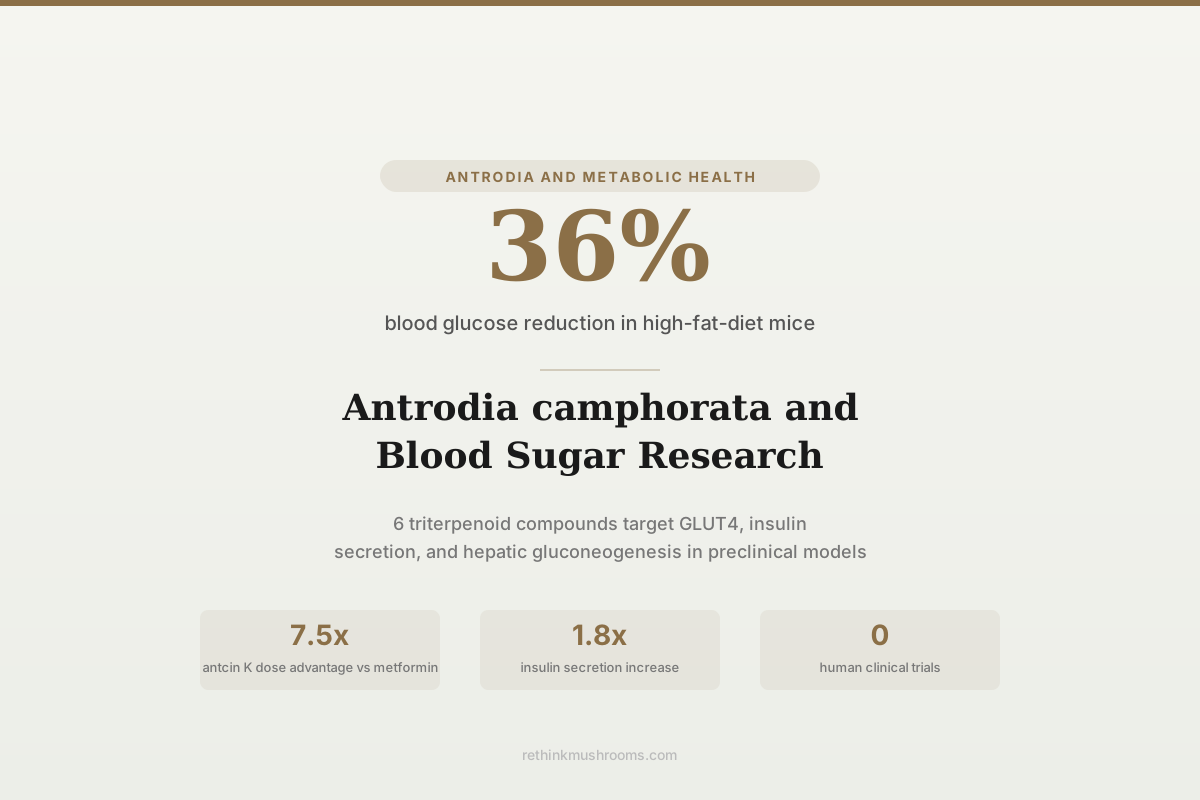
36% glucose reduction
Ergostatrien-3beta-ol from Antrodia camphorata lowered blood glucose by 36 percent in high-fat-diet mice, with effects comparable to the reference drug metformin in the same study.
Kuo et al., J Agric Food Chem, 2015
6 compounds
Antrodia triterpenoids with antidiabetic data
GLUT4 + insulin
dual mechanism: uptake and secretion
0 human trials
all preclinical as of 2026
Kuo et al., J Agric Food Chem, 2015
 View as image ↗
Six triterpenoid compounds isolated from Antrodia camphorata lower blood glucose in animal models through at least three distinct mechanisms: increasing glucose transporter 4 (GLUT4) membrane expression for faster glucose uptake into muscle, stimulating pancreatic insulin secretion, and suppressing hepatic gluconeogenesis. Ergostatrien-3beta-ol reduced blood glucose by 36 percent in high-fat-diet mice, with antcin K producing antihyperglycemic effects comparable to metformin at a fraction of the dose.[1][2] For how these same compounds drive fat oxidation through AMPK, see the companion article on Antrodia and AMPK-mediated fat oxidation.
All data comes from mouse models and cell cultures. No human clinical trials have tested Antrodia triterpenoids for blood glucose control. The consistency across compounds and research groups is notable, but the translation gap from rodent to human metabolism remains the central unanswered question.
Key Takeaways
- Ergostatrien-3beta-ol lowered blood glucose by 36 percent and total cholesterol by 19 percent in high-fat-diet ICR mice through GLUT4 upregulation and AMPK phosphorylation (Kuo et al., 2015)
- Antcin K at 40 mg/kg produced antihyperglycemic effects comparable to metformin at 300 mg/kg in high-fat-diet C57BL/6J mice, a 7.5-fold dose advantage (Kuo et al., 2016)
- Antrodia camphorata ethanol extract increased glucose-stimulated insulin secretion 1.8-fold in MIN6 beta cells through PPAR-gamma activation (Vong et al., 2016)
- Eburicoic acid suppressed hepatic gluconeogenesis by downregulating glucose-6-phosphatase and PEPCK gene expression in streptozotocin-induced diabetic mice (Lin et al., 2018)
- Dehydroeburicoic acid increased membrane GLUT4 levels in both skeletal muscle and liver tissue while reducing fasting blood glucose in two separate mouse models (Kuo et al., 2015, 2016)
- Network pharmacology analysis identified TNF, AKT1, and IL-6 as the three most connected targets through which antcin K may exert antidiabetic effects (Kuang et al., 2022)
Three mechanisms: how Antrodia compounds lower blood glucose
Blood glucose regulation involves three processes that Antrodia triterpenoids appear to affect simultaneously. First, glucose must enter cells from the bloodstream. Skeletal muscle handles roughly 80 percent of insulin-stimulated glucose disposal, primarily through GLUT4 transporters that move from internal vesicles to the cell membrane in response to insulin signaling. Second, the pancreas must produce and secrete adequate insulin to signal those transporters. Third, the liver must appropriately suppress glucose production (gluconeogenesis) when blood glucose is already elevated.
In type 2 diabetes and metabolic syndrome, all three processes fail. Muscle becomes insulin resistant, reducing GLUT4 translocation. Pancreatic beta cells become stressed and produce less insulin. The liver continues producing glucose even when blood levels are high. Conventional antidiabetic drugs typically target one of these mechanisms: metformin suppresses hepatic gluconeogenesis, sulfonylureas stimulate insulin secretion, thiazolidinediones improve insulin sensitivity.
Antrodia triterpenoids show activity across all three targets in preclinical studies. Whether this multi-target action represents a therapeutic advantage or simply reflects non-specific biological effects at high doses is a question the current data cannot answer. For Antrodia's effects on the broader metabolic syndrome picture, including lipids and inflammation, see the dedicated overview.
GLUT4 translocation: pulling glucose out of blood faster
The most consistently documented antidiabetic mechanism across Antrodia compounds is increased GLUT4 membrane expression. GLUT4 is the insulin-regulated glucose transporter in skeletal muscle and adipose tissue. When insulin binds its receptor, a signaling cascade through PI3K and Akt leads to GLUT4 vesicle fusion with the cell membrane, allowing glucose influx.
Kuo et al. (2016) showed that antcin K treatment increased phospho-AMPK and GLUT4 membrane expression in skeletal muscle of high-fat-diet-fed C57BL/6J mice.[2] At 40 mg/kg per day, antcin K lowered blood glucose to levels statistically comparable to metformin at 300 mg/kg per day. On a per-milligram basis, antcin K was approximately 7.5 times more potent, though the pharmacokinetic comparison is crude because the two compounds have different absorption, distribution, and metabolism profiles.
Dehydroeburicoic acid (DEA) produced similar GLUT4 effects. In high-fat-diet mice, DEA at 10 and 20 mg/kg increased membrane GLUT4 levels in both liver and skeletal muscle.[3] In a separate streptozotocin (STZ) model, Kuo et al. (2015) confirmed DEA's glucose-lowering effects, with treated mice showing improved glucose tolerance and increased phospho-Akt, the kinase directly upstream of GLUT4 translocation.[4]
Ergostatrien-3beta-ol rounded out the GLUT4 findings. Kuo et al. (2015) demonstrated that this compound lowered blood glucose by 36 percent and increased hepatic GLUT4 expression in high-fat-diet ICR mice.[1] The 36 percent reduction is a large effect size, but it came from a single study with one mouse strain and one dietary composition. Replication across strains and independent laboratories would strengthen confidence.
The GLUT4 data is mechanistically coherent. Multiple Antrodia triterpenoids increase AMPK and/or Akt phosphorylation, both of which converge on GLUT4 translocation through established signaling pathways. The compounds are not creating a novel mechanism; they are plugging into existing glucose disposal machinery. For deeper context on antcin compounds, see the dedicated Antrodia triterpenoid overview.
Insulin secretion: direct effects on pancreatic beta cells
Most Antrodia antidiabetic studies focus on insulin sensitivity (peripheral glucose uptake), but one study examined insulin secretion directly. Vong et al. (2016) tested Antrodia camphorata ethanol extract on MIN6 cells, a mouse pancreatic beta cell line widely used in diabetes research.[5]
The extract increased glucose-stimulated insulin secretion (GSIS) in a dose-dependent manner, approximately 1.8-fold at the highest tested concentration. The mechanism involved PPAR-gamma activation. PPAR-gamma is a nuclear receptor typically associated with adipocyte differentiation, but it also plays a role in beta cell function and survival. The extract also upregulated GLUT-2 and glucokinase (GLK) gene expression, two proteins essential for beta cell glucose sensing.[5]
Beyond secretion, the extract protected MIN6 cells from palmitate-induced apoptosis. Palmitate is a saturated fatty acid that accumulates in beta cells during metabolic syndrome, causing lipotoxic cell death. By preserving beta cell viability under lipotoxic stress, Antrodia extract could theoretically slow the progressive beta cell loss that characterizes type 2 diabetes progression.[5]
This is a single study using whole extract, not a purified compound. Which component of the extract drives insulin secretion is unknown. The MIN6 cell line, while useful, does not fully replicate primary human beta cell physiology. The 1.8-fold GSIS increase is moderate but potentially meaningful, as impaired GSIS is the defining functional defect in type 2 diabetes.
Gluconeogenesis suppression: stopping the liver from overproducing glucose
In insulin-resistant states, the liver continues producing glucose through gluconeogenesis even when blood glucose is already elevated. Two enzymes control the rate of hepatic glucose output: glucose-6-phosphatase (G6Pase), which catalyzes the final step of glucose release, and phosphoenolpyruvate carboxykinase (PEPCK), which controls the rate-limiting step of gluconeogenesis.
Lin et al. (2018) showed that eburicoic acid decreased mRNA levels of both G6Pase and PEPCK in STZ-induced diabetic mice. The mechanism involved increased Akt phosphorylation and phospho-FoxO1 expression.[6] When Akt phosphorylates FoxO1, FoxO1 exits the nucleus and can no longer drive transcription of gluconeogenic genes. This is the same pathway through which insulin suppresses hepatic glucose production, suggesting that eburicoic acid mimics or enhances insulin's hepatic signaling.
Eburicoic acid also increased blood insulin levels in STZ mice, which is unexpected because STZ destroys pancreatic beta cells. The insulin increase may indicate beta cell protection, incomplete STZ destruction, or residual beta cell stimulation. The study did not perform histological examination of pancreatic islets to distinguish between these possibilities.[6]
Lin et al. (2017) confirmed eburicoic acid's antidiabetic effects in the high-fat-diet model, showing reduced blood glucose and improved glucose tolerance alongside the AMPK-mediated fat oxidation effects covered in the AMPK fat oxidation article.[7]
Sulphurenic acid: islet cell restoration in diabetic mice
Sulphurenic acid is a lanostane-type triterpenoid that Lin et al. (2019) tested in STZ-induced diabetic mice. Beyond lowering blood glucose and improving lipid profiles, the study reported restoration of islet of Langerhans cell size in treated mice.[8]
STZ damages pancreatic islets, shrinking them and reducing insulin-producing capacity. Sulphurenic acid-treated mice showed larger islet areas compared to untreated diabetic controls, suggesting either protection of existing beta cells from further damage or stimulation of beta cell regeneration. The study did not perform immunostaining to distinguish between beta cell preservation and proliferation.[8]
If the islet restoration reflects genuine beta cell protection, this would be a significant finding. Beta cell loss is irreversible in advanced type 2 diabetes, and no current therapy restores beta cell mass once it is lost. However, the STZ model induces acute toxicity rather than the gradual metabolic stress that causes beta cell failure in human type 2 diabetes, so the protective effect may not translate to the human disease context. For Antrodia's effects on lipid metabolism and cholesterol specifically, see the dedicated review.
Network pharmacology: mapping antcin K's antidiabetic targets
Kuang et al. (2022) took a computational approach, using network pharmacology to predict how Antrodia camphorata and antcin K might exert antidiabetic effects. The analysis identified 73 potential targets shared between antcin K and type 2 diabetes, with TNF (tumor necrosis factor), AKT1, and IL-6 emerging as the three most highly connected nodes.[9]
Pathway enrichment analysis pointed to the AGE-RAGE signaling pathway, the TNF signaling pathway, and the insulin resistance pathway as the most significantly enriched. This suggests that antcin K's antidiabetic potential may partly work through anti-inflammatory mechanisms, reducing the TNF-alpha and IL-6-driven insulin resistance that characterizes metabolic syndrome.[9]
Network pharmacology is a prediction tool, not experimental validation. The identified targets are computationally inferred from structural similarity to known ligands and protein-protein interaction databases. The value of this study is in generating testable hypotheses, not confirming mechanisms. It does align with the experimental observation that Antrodia compounds reduce inflammatory markers in metabolic models, supporting the idea that anti-inflammatory activity contributes to glucose regulation alongside the direct GLUT4 and gluconeogenesis effects.
Gut microbiome connections to glucose regulation
Chang et al. (2018) demonstrated that whole Antrodia cinnamomea water extract modulated gut microbiota composition in high-fat-diet mice, increasing Akkermansia and shifting the Firmicutes-to-Bacteroidetes ratio toward lean-associated profiles.[10]
This is relevant to blood sugar because gut microbiota composition directly influences glucose metabolism. Akkermansia muciniphila improves gut barrier integrity and reduces metabolic endotoxemia, the chronic low-level exposure to bacterial lipopolysaccharide that drives insulin resistance. The microbiome shifts observed by Chang et al. could contribute to improved glucose homeostasis independently of the direct GLUT4 and gluconeogenesis effects documented for isolated triterpenoids. For Antrodia's anti-adipogenic and anti-obesity effects tied to these microbiome changes, see the dedicated article.
Whether Antrodia's gut microbiome effects contribute meaningfully to its antidiabetic properties, or whether they are a parallel finding, cannot be determined from the current data. The study used whole extract, not isolated compounds, so the active component driving microbiome changes is unknown.
What separates Antrodia antidiabetic data from clinical evidence
The preclinical antidiabetic profile of Antrodia camphorata is strong on internal consistency. Multiple triterpenoids lower blood glucose through mechanistically plausible pathways (GLUT4, gluconeogenesis, insulin secretion). Effect sizes are large (36 percent glucose reduction, metformin-comparable potency). The pharmacological targets are validated drug targets in human diabetes.
What is missing: human pharmacokinetic data (absorption, bioavailability, half-life), dose-response relationships in human subjects, interaction profiles with metformin, sulfonylureas, SGLT2 inhibitors, or GLP-1 agonists, and long-term safety data at any dose. The STZ model used in several studies is a type 1 diabetes model (beta cell destruction), not a metabolic syndrome model, which limits its relevance to the most common form of diabetes.
All published research comes from Taiwanese groups, reflecting Antrodia camphorata's endemic origin. Independent replication from other research centers would increase confidence. The network pharmacology study (Kuang et al., 2022) adds computational support but not experimental validation.
The triterpenoid bioavailability question is fundamental. These are large, lipophilic molecules. Without human pharmacokinetic studies, it is unknown whether oral Antrodia supplements deliver antcin K, dehydroeburicoic acid, or eburicoic acid to target tissues at concentrations sufficient to activate GLUT4 translocation or suppress gluconeogenesis in human liver and muscle cells.
The Bottom Line
Antrodia camphorata produces six triterpenoid compounds with preclinical antidiabetic activity spanning three glucose-lowering mechanisms: GLUT4-mediated glucose uptake in muscle, direct insulin secretion from beta cells, and hepatic gluconeogenesis suppression. Antcin K matched metformin's glucose-lowering effect at 7.5-fold lower doses in mice. Ergostatrien-3beta-ol reduced blood glucose by 36 percent. No human trials exist. The transition from consistent animal data to validated clinical evidence has not occurred.
Frequently Asked Questions
Sources & References
- 1RTHM-00382·Kuo, Yueh-Hsiung et al. (2015). “Ergostatrien-3β-ol from Antrodia camphorata inhibits diabetes and hyperlipidemia in high-fat-diet treated mice via regulation of hepatic related genes, glucose transporter 4, and AMP-activated protein kinase phosphorylation..” Journal of agricultural and food chemistry.Study breakdown →PubMed →↩
- 2RTHM-00430·Kuo, Yueh-Hsiung et al. (2016). “Antcin K, a Triterpenoid Compound from Antrodia camphorata, Displays Antidiabetic and Antihyperlipidemic Effects via Glucose Transporter 4 and AMP-Activated Protein Kinase Phosphorylation in Muscles..” Evidence-based complementary and alternative medicine : eCAM.Study breakdown →PubMed →↩
- 3RTHM-00431·Kuo, Yueh-Hsiung et al. (2016). “Dehydroeburicoic Acid from Antrodia camphorata Prevents the Diabetic and Dyslipidemic State via Modulation of Glucose Transporter 4, Peroxisome Proliferator-Activated Receptor α Expression and AMP-Activated Protein Kinase Phosphorylation in High-Fat-Fed Mice..” International journal of molecular sciences.Study breakdown →PubMed →↩
- 4RTHM-00383·Kuo, Yueh-Hsiung et al. (2015). “Antidiabetic and Antihyperlipidemic Properties of a Triterpenoid Compound, Dehydroeburicoic Acid, from Antrodia camphorata in Vitro and in Streptozotocin-Induced Mice..” Journal of agricultural and food chemistry.Study breakdown →PubMed →↩
- 5RTHM-00454·Vong, Chi Teng et al. (2016). “Antrodia camphorata Increases Insulin Secretion and Protects from Apoptosis in MIN6 Cells..” Frontiers in pharmacology.Study breakdown →PubMed →↩
- 6RTHM-00518·Lin, Cheng-Hsiu et al. (2018). “Antidiabetic and hypolipidemic activities of eburicoic acid, a triterpenoid compound from Antrodia camphorata, by regulation of Akt phosphorylation, gluconeogenesis, and PPARα in streptozotocin-induced diabetic mice..” RSC advances.Study breakdown →PubMed →↩
- 7RTHM-00480·Lin, Cheng-Hsiu et al. (2017). “Eburicoic Acid, a Triterpenoid Compound from Antrodia camphorata, Displays Antidiabetic and Antihyperlipidemic Effects in Palmitate-Treated C2C12 Myotubes and in High-Fat Diet-Fed Mice..” International journal of molecular sciences.Study breakdown →PubMed →↩
- 8RTHM-00571·Lin, Cheng-Hsiu et al. (2019). “Antidiabetic and Antihyperlipidemic Effects of Sulphurenic Acid, a Triterpenoid Compound from Antrodia camphorata, in Streptozotocin-Induced Diabetic Mice..” International journal of molecular sciences.Study breakdown →PubMed →↩
- 9RTHM-00774·Kuang, Yi et al. (2022). “A network pharmacology-based strategy to explore the pharmacological mechanisms of Antrodia camphorata and antcin K for treating type II diabetes mellitus..” Phytomedicine : international journal of phytotherapy and phytopharmacology.Study breakdown →PubMed →↩
- 10RTHM-00502·Chang, C-J et al. (2018). “Antrodia cinnamomea reduces obesity and modulates the gut microbiota in high-fat diet-fed mice..” International journal of obesity (2005).Study breakdown →PubMed →↩