Antrodia and Metabolic Health
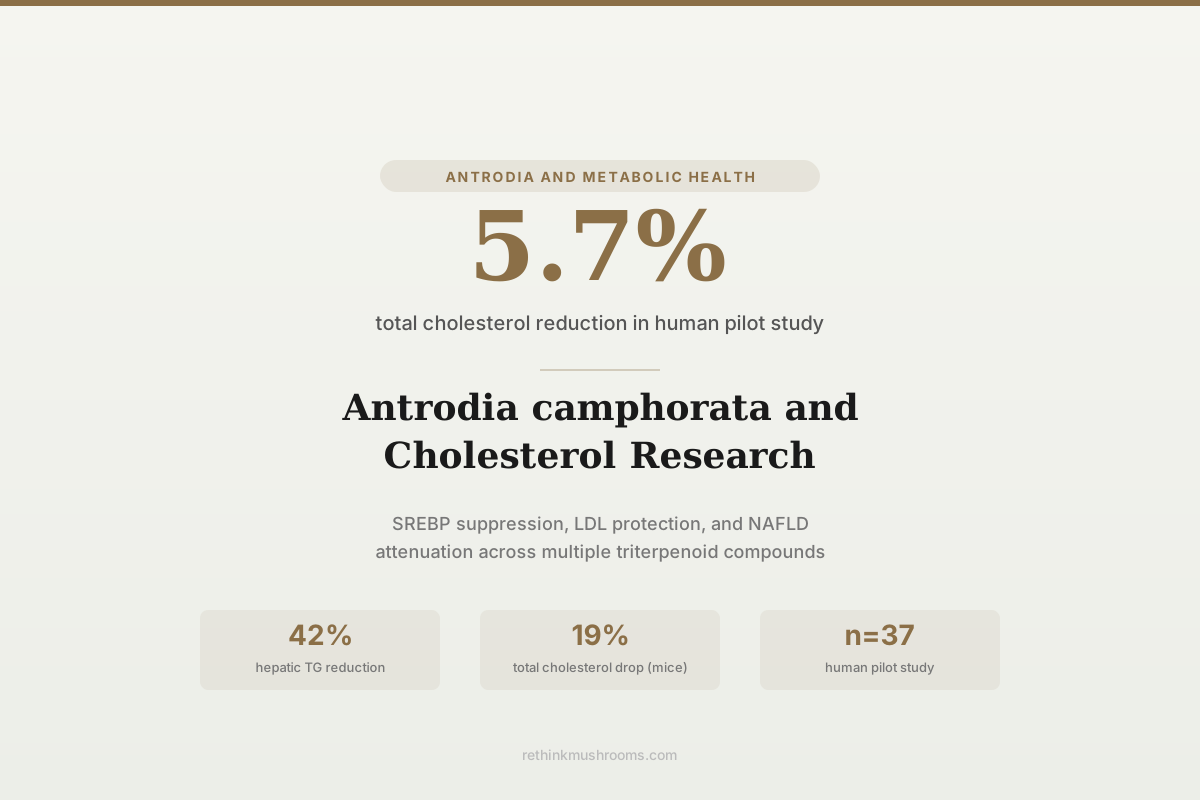
5.7% cholesterol drop
Men consuming Antrodia cinnamomea mycelium for three months showed a 5.7 percent decrease in total cholesterol. The trial that produced that number had no control group.
Chen and Chang, Evid Based Complement Alternat Med, 2020
3 human trials
two randomized, one uncontrolled
SREBP2
cholesterol-synthesis branch suppressed in mice
LDL unreported
no PubMed-indexed trial has separated LDL from HDL
Chen and Chang, Evid Based Complement Alternat Med, 2020
 View as image ↗
Antrodia camphorata is one of the few medicinal mushrooms with human cholesterol data. An open-label pilot study in 32 healthy adults found that consuming Antrodia cinnamomea solid-state cultivated mycelium for three months reduced total cholesterol by 5.7 percent in men and 5.3 percent in women.[1] That pilot is the number everyone quotes, and it is also the weakest of the three human trials that have reported lipid-related outcomes. Beneath them sits a larger preclinical base in which multiple Antrodia triterpenoids lower cholesterol and triglycerides in mice through AMPK activation, SREBP suppression, and reduced HMG-CoA reductase expression, the same enzyme statin drugs inhibit directly.
This article reviews Antrodia's lipid-lowering research from LDL oxidation protection through fatty liver disease, with one eye on where the human data stands and the other on where it falls short. For how these lipid effects integrate with Antrodia's blood sugar effects and AMPK-mediated fat oxidation, see the companion articles.
Key Takeaways
- An open-label, single-arm pilot study in 32 healthy adults found total cholesterol decreased 5.7 percent in men and 5.3 percent in women over three months, with no placebo group and no LDL or HDL measurement (Chen and Chang, 2020)
- A 6-month randomized, double-blind, placebo-controlled trial in 28 patients with nonalcoholic steatohepatitis found Antrodia cinnamomea mycelium improved hepatic steatosis and lowered TNF-alpha (Chiou et al., 2021)
- A randomized placebo-controlled trial in 80 adults with elevated GGT found an antroquinonol-containing Antrodia extract significantly lowered serum triglycerides and liver enzymes over 12 weeks (Yen et al., 2022)
- Antrodia cinnamomea ethanol extract increased pAMPK while decreasing SREBP, fatty acid synthase, and HMG-CoA reductase in high-fat-diet mice (Peng et al., 2017)
- The compound published as ergostatrien-3-beta-ol and the compound published as antrosterol are the same molecule, EK100, tested in two different mouse models (Kuo et al., 2015; Chang et al., 2017)
- Antrodia camphorata fermented broth and mycelial extract both protected human LDL against copper- and AAPH-induced oxidation in vitro, and protected endothelial cells from oxidized LDL (Yang et al., 2006)
- Dehydroeburicoic acid attenuated nonalcoholic fatty liver disease in mice by upregulating ALDH2; the effect disappeared in ALDH2 knockout mice and returned when ALDH2 was restored (Cao et al., 2022)
The human evidence: three trials, not one
Coverage of Antrodia and cholesterol almost always cites a single uncontrolled pilot study and stops there. Three PubMed-indexed human trials have reported lipid or liver-fat endpoints. The two with randomization and placebo control are usually omitted from cholesterol discussions because their headline outcomes were liver markers rather than cholesterol, which is a reason to read them carefully rather than a reason to skip them.
Human Evidence · Three Indexed Trials
The Human Lipid Data Is Not One Pilot Study
Antrodia cholesterol coverage almost always cites a single uncontrolled pilot. Three PubMed-indexed human trials have actually reported lipid or liver-fat endpoints, and the two with randomization and placebo control are the ones usually left out — because their headline endpoints were liver markers, not cholesterol. Sorted by design strength, strongest first.
| Trial | Design | n | Population & regimen | Lipid-relevant result |
|---|---|---|---|---|
| Chiou 2021[ref 2] | Strongest designRandomized, double-blind, placebo-controlled | 28 | Patients with nonalcoholic steatohepatitis (NASH)3 x 420 mg/day mycelium vs. starch placebo · 6 months | Hepatic steatosis improved — SteatoTest fell from 0.66 to 0.49; TNF-alpha decreased at 3 and 6 months |
| Yen 2022[ref 3] | RandomizedRandomized, placebo-controlled | 80 | Adults with elevated GGT (60-180 U/L) after alcohol consumption300 mg/day antroquinonol-containing extract vs. placebo · 12 weeks | Serum triglycerides declined vs. placebo (p = 0.0158); AST and ALT also declined |
| Chen 2020[ref 1] | No control armOpen-label, single-arm (no control group) | 32 | Healthy adults aged 20-60 (18 men, 14 women)Solid-state cultivated mycelium capsules · 3 months | Total cholesterol fell 5.7% in men and 5.3% in women (p < 0.01); triglycerides unchanged |
The inversion worth noticing: the only trial that measured cholesterol directly is the only one without a control group. The two trials with randomization and placebo measured triglycerides and liver fat instead. No single study has yet combined a strong design with a full lipid panel.
The hole all three share: not one of them reported LDL and HDL cholesterol separately. Chen 2020 states plainly that it “only analyzes total cholesterol and does not do more blood lipid profiling.” A total cholesterol drop is uninterpretable until you know which fraction moved.
Sources: Chiou et al. (2021), J Am Coll Nutr 40(4) [ref 2]; Yen et al. (2022), Front Pharmacol 13 [ref 3]; Chen & Chang (2020), Evid Based Complement Alternat Med [ref 1]. Populations differ substantially — NASH patients, adults with elevated GGT, and healthy adults — so these trials are complementary rather than replications of one another. None was powered as a dyslipidemia efficacy trial.
The cholesterol pilot
Chen and Chang (2020) ran the only human study that measured cholesterol as a stated outcome. Thirty-six healthy adults were recruited; four were excluded at screening, leaving 32 who completed the trial (18 men, 14 women), aged 20 to 60 and screened as healthy rather than dyslipidemic. Participants took Antrodia cinnamomea solid-state cultivated mycelium capsules daily for three months at a hospital in Taipei, Taiwan.[1]
Men showed a 5.7 percent decrease in total cholesterol and women a 5.3 percent decrease, both statistically significant. Fasting blood glucose, blood pressure, triglycerides, and liver and renal function indices did not change significantly, and no adverse events occurred during the trial.[1]
Chen and Chang (2020) · Evid Based Complement Alternat Med
- Population
- 32 healthy adults aged 20 to 60 (18 men, 14 women), screened as healthy rather than dyslipidemic
- Intervention
- Antrodia cinnamomea solid-state cultivated mycelium capsules, daily for three months
- Comparator
- None — open-label, single-arm design
- Finding
- Total cholesterol fell 5.7 percent in men and 5.3 percent in women. Triglycerides, glucose, blood pressure, and liver and kidney indices were unchanged. No adverse events occurred.
preliminary No control group, no LDL or HDL measurement, and a healthy population with limited room to improve. The authors positioned it as a food-safety and feasibility study.
Chen and Chang (2020), Evid Based Complement Alternat Med 2020:5865764 [ref 1]
Two limitations deserve more weight than they usually get. The first is design: with no placebo arm, the observed reduction could reflect regression to the mean, seasonal variation, or lifestyle change during the study. The second is scope. The paper states directly that it "only analyzes total cholesterol and does not do more blood lipid profiling." A total cholesterol reduction driven by LDL would be clinically meaningful; the same reduction driven by falling HDL would be counterproductive. Nothing in the trial distinguishes the two.
Two further details are worth carrying forward. At a follow-up visit one month after the trial ended, total cholesterol had rebounded only 2.3 to 2.6 percent and was not significantly different from the end-point value; the authors read this as the reduction being largely retained after participants stopped taking the capsules.[1] In an uncontrolled study, that reading is plausible but not secure, since a small sample failing to show a significant difference is weak evidence that nothing changed.
The second detail concerns LDL. In discussing its own missing lipid panel, the paper points to a separate randomized double-blind study reporting that an antroquinonol-containing Antrodia cinnamomea mycelium extract significantly lowered LDL cholesterol in people with marginal to mildly elevated LDL.[1] That trial was published in a journal not indexed in PubMed, so it could not be independently verified for this article and is not counted among the three trials above. It is worth knowing that it exists: statements that no one has ever measured LDL after Antrodia supplementation are too strong. What is accurate is that no PubMed-indexed trial has reported LDL and HDL separately.
The two randomized trials
Chiou et al. (2021) conducted a 6-month randomized, double-blind, placebo-controlled trial in 28 patients with nonalcoholic steatohepatitis, the inflammatory form of fatty liver disease. Participants took three capsules daily containing either 420 mg of Antrodia cinnamomea mycelium or 420 mg of starch. The treated group showed significant improvement in hepatic steatosis, with the SteatoTest mean value falling from 0.66 at baseline to 0.49 at six months, alongside reduced TNF-alpha at both three and six months. No participant experienced an adverse event.[2]
Yen et al. (2022) randomized 80 adults with elevated gamma-glutamyl transferase (60 to 180 U/L) following alcohol consumption to either 300 mg per day of an antroquinonol-containing Antrodia camphorata preparation or placebo for 12 weeks. Serum triglycerides declined significantly relative to placebo, as did AST and ALT. Safety parameters showed no clinically significant differences between groups.[3]
Neither trial was designed as a cholesterol study, and neither enrolled a dyslipidemic population. But together they establish something the pilot alone cannot: that randomized, placebo-controlled Antrodia trials with lipid-adjacent endpoints exist, that they have been positive on triglycerides and liver fat, and that the supplement has been tolerated in patient populations, not just healthy volunteers.
- Cell & Lab Studiescompleted
Human LDL protected against copper- and AAPH-induced oxidation by both fermented broth and mycelial extract; endothelial cells protected from oxidized LDL (Yang 2006). Hepatocyte and HepG2 work establishing ALDH2 dependence (Cao 2022)
- Animal Studiescompleted
Three distinct triterpenoids plus whole extracts lower triglycerides in high-fat-diet, streptozotocin-diabetic and alcohol-fed mice via AMPK, SREBP-1c and PPAR-α; total cholesterol reductions via SREBP2 are reported for two of the three compounds
- Case Reports & Early Seriescompleted
First-in-human Phase I dose escalation in 18 healthy volunteers established a maximum tolerated dose of 2988 mg/day (Liao 2023)
- Small Human Trialscurrent
One uncontrolled pilot measuring total cholesterol only (n=32); one randomized double-blind NASH trial measuring liver fat (n=28); one randomized placebo-controlled trial measuring triglycerides and liver enzymes (n=80)
- Large Randomized Trialsmissing
No adequately powered trial in a dyslipidemic population, and no PubMed-indexed trial of any size reporting LDL and HDL separately
- Meta-Analyses & Systematic Reviewsmissing
Too few comparable human lipid trials to pool — the three that exist used different populations, preparations, and endpoints
The ladder is climbed further than the 'one pilot study' framing suggests, but it stalls at exactly the rung that matters for a cholesterol claim. Small human trials exist and two are randomized. What is absent is any PubMed-indexed human trial, at any size, that reports LDL cholesterol.
Chen and Chang 2020 [ref 1]; Chiou 2021 [ref 2]; Yen 2022 [ref 3]; Liao 2023 [ref 13]; Yang 2006 [ref 9]; Cao 2022 [ref 10]
SREBP suppression: turning off the cholesterol production machinery
Sterol regulatory element-binding proteins are transcription factors controlling the genes that build fats and cholesterol. When they are active, they drive production of HMG-CoA reductase (the rate-limiting enzyme for cholesterol synthesis and the target of statin drugs), fatty acid synthase, and other lipogenic enzymes.
Peng et al. (2017) fed C57BL/6 mice a high-fat diet with 0.5, 1, or 2 percent Antrodia cinnamomea extract for 10 weeks. The extract significantly restored high-fat-diet elevations in body weight gain, body fat, free fatty acids, triglycerides, total cholesterol, and the LDL-to-HDL cholesterol ratio. Mechanistically it increased pAMPK while decreasing SREBP, fatty acid synthase, and HMG-CoA reductase, and it reduced AST, ALT, and hepatic lipid deposits.[4] That LDL-to-HDL ratio result is notable: it is the closest any Antrodia study comes to showing the cholesterol reduction lands on the right fraction, and it is in mice.
The SREBP story is more specific than "SREBP goes down," and the specificity changes how much of the cholesterol claim is actually supported.
Mechanism · Two SREBP Isoforms
“SREBP Suppression” Is Two Different Findings
SREBP is usually described as one master switch for fat and cholesterol alike. The Antrodia papers separate it into two isoforms with two different outputs, and they do not have equal evidence behind them. The triglyceride branch is the well-replicated one; the cholesterol branch — the one that matters for the statin comparison — rests on fewer studies.
SREBP-1c
Broadly replicatedDrives: Fatty acid (lipogenic) synthesis
Downstream enzyme: Fatty acid synthase (FAS)
Blood marker moved: Triglycerides
Suppression reported by: EK100 [ref 5] · eburicoic acid [ref 8] · dehydroeburicoic acid via FAS [ref 7]
Suppression reported across all three distinct triterpenoids, consistently paired with PPAR-α induction
SREBP2
Narrower baseDrives: Cholesterol synthesis
Downstream enzyme: HMG-CoA reductase — the statin target
Blood marker moved: Total cholesterol
Suppression reported by: EK100 [ref 5] · dehydroeburicoic acid [ref 7]
Measured for two compounds only; the eburicoic acid paper reports SREBP-1c but not SREBP2
The HDL question this answers: a fall in total cholesterol is only good news if it is not HDL falling. In the one Antrodia study that measured it, EK100 increased HDL-C by raising hepatic apolipoprotein A-I — the opposite of the counterproductive scenario. That result is from mice, and no human trial has yet reported HDL at all.
Where the imprecision creeps in: the Peng 2017 whole-extract study reports “SREBP” without specifying the isoform, alongside reduced FAS and reduced HMG-CoA reductase. That paper is often cited as the cholesterol mechanism, but on its own it cannot distinguish which branch was engaged.
Sources: Kuo, Lin & Shih (2015), J Agric Food Chem [ref 5]; Kuo et al. (2015), STZ model [ref 7]; Lin, Kuo & Shih (2017), Int J Mol Sci [ref 8]; Peng et al. (2017), Am J Chin Med [ref 4]. All isoform-level data are from mouse liver tissue. No human study has measured SREBP-1c or SREBP2 expression after Antrodia supplementation.
This mechanism is pharmacologically interesting because it reaches the statin target from a different direction. Statins inhibit HMG-CoA reductase enzyme activity directly. Antrodia compounds appear to reduce HMG-CoA reductase gene expression through AMPK-mediated SREBP suppression. Whether those routes are additive, synergistic, or redundant in combination has not been tested. For the broader picture of Antrodia's multi-target metabolic effects, see the comprehensive overview.
Triterpenoid compounds and cholesterol reduction in animal models
Several Antrodia triterpenoids reduce cholesterol and triglycerides in mice, each through mechanisms converging on the same lipid pathways. Counting them correctly requires resolving one naming problem first.
Compound Identity · EK100
Two Compound Names, One Molecule
Summaries of Antrodia’s lipid research often list ergostatrien-3β-ol and antrosterol as two separate cholesterol-lowering triterpenoids. Both papers explicitly name the compound EK100 and both isolate it from the same submerged whole broth. It is one molecule tested in two different disease models — which is still useful, but it is replication across models, not breadth across compounds.
Published as "ergostatrien-3β-ol"
Kuo et al. 2015 [ref 5]
Model: C57BL/6J mice on a high-fat diet, 12 weeks
Dosing: Three dose levels, oral gavage
Lipid finding: Lowered triglycerides via SREBP-1c suppression and PPAR-α induction; lowered total cholesterol via SREBP2 suppression; raised HDL-C via apolipoprotein A-I
Published as "antrosterol"
Chang et al. 2017 [ref 11]
Model: Mice on a Lieber-DeCarli 5% ethanol liquid diet
Dosing: 1, 5 and 10 mg/kg body weight
Lipid finding: Reduced serum and liver lipids via upregulated fatty-acid β-oxidation and downregulated lipogenesis; increased fecal lipid and bile-acid output
What the two papers share
- Both papers designate the compound EK100
- Both isolate it from Antrodia camphorata submerged whole broth
- Both share author Yueh-Hsiung Kuo
- Both report lipid lowering through reduced lipogenesis
Why the distinction matters: a compound that works in two unrelated liver-stress models (high-fat diet and chronic alcohol) is genuinely more interesting than one tested twice the same way. But counting EK100 twice makes the Antrodia triterpenoid literature look broader than it is. Once merged, the distinct compounds with lipid data reduce to three: EK100, dehydroeburicoic acid, and eburicoic acid.
Sources: Kuo, Lin & Shih (2015), J Agric Food Chem 63(9) [ref 5]; Chang et al. (2017), J Ethnopharmacol 202 [ref 11]. The 2017 paper states the identity directly: “the hepatoprotection of antrosterol (named as EK100).” Neither paper reports a human dose, and both used oral administration in mice.
With EK100 counted once, three distinct compounds have lipid data.
EK100 (ergostatrien-3-beta-ol / antrosterol). In C57BL/6J mice on a high-fat diet for 12 weeks, EK100 at three dose levels significantly lowered blood glucose, HbA1c, total cholesterol, triglycerides, insulin, and leptin, and reduced hepatic ballooning degeneration. It lowered triglycerides by dampening SREBP-1c and raising PPAR-alpha, lowered total cholesterol by decreasing hepatic SREBP2, and increased HDL cholesterol by raising apolipoprotein A-I expression in liver tissue.[5] In a separate model, the same compound reduced serum and liver lipids in chronic alcohol-fed mice while increasing fecal lipid and bile-acid output.[11]
Dehydroeburicoic acid. Kuo et al. (2016) showed it reduced high-fat-diet-induced hyperglycemia, hypertriglyceridemia, hyperinsulinemia, and hypercholesterolemia in mice, increasing hepatic and skeletal muscle AMPK phosphorylation and PPAR-alpha while decreasing fatty acid synthase in liver and adipose tissue.[6] In streptozotocin-induced diabetic mice, the same compound reversed the triglyceride and cholesterol elevations caused by diabetes, with decreased SREBP2 mRNA accompanying the cholesterol reduction.[7]
Eburicoic acid. In a 14-week study, mice were fed a high-fat diet for 10 weeks and then given eburicoic acid at three dose levels for 4 weeks. It decreased glucose, triglycerides, free fatty acids, insulin, and leptin, increased hepatic PPAR-alpha, and decreased fatty acid synthase and SREBP-1c.[8] Its reported blood-lipid effect is on triglycerides; the paper does not report a total cholesterol reduction or SREBP2 change for this compound.
The pattern is consistent on triglycerides: AMPK activation, SREBP-1c suppression, and PPAR-alpha induction appear across all three compounds. The cholesterol arm of the pattern is narrower, resting on the two compounds where SREBP2 was measured. For related research on antcin compounds specifically, see the compound overview.
LDL oxidation: protecting cholesterol particles from damage
Cholesterol levels alone do not fully explain cardiovascular risk. Oxidized LDL is more atherogenic than native LDL: oxidized particles are taken up by macrophages in arterial walls, forming the foam cells that initiate atherosclerotic plaques. Preventing LDL oxidation addresses that process independently of LDL concentration.
Yang et al. (2006) tested two preparations, a fermented culture broth and an aqueous extract of mycelia, against human LDL oxidized by either copper sulfate or AAPH. Both preparations inhibited oxidation in a time- and concentration-dependent manner, measured by thiobarbituric acid-reactive substances, conjugated diene production, and cholesterol degradation. Both also rescued the relative electrophoretic mobility and the fragmentation of the apolipoprotein B moiety, and both protected endothelial cells from damage by copper-oxidized LDL.[9]
The active antioxidant constituents were not identified, which means no product can be standardized for this specific effect. Still, the finding is mechanistically useful: it suggests Antrodia could touch cardiovascular risk through two independent routes, lowering cholesterol concentration through SREBP2 and reducing the atherogenicity of the particles that remain.
Fatty liver disease: where lipid metabolism meets liver health
Nonalcoholic fatty liver disease is the hepatic manifestation of metabolic syndrome, and it is the endpoint where Antrodia's human and preclinical evidence overlap most directly.
Cao et al. (2022) produced the most rigorous mechanistic work in this literature. Antrodia cinnamomea and its compound dehydroeburicoic acid reduced hepatic lipid accumulation in mice fed either a methionine-choline deficient or high-fat diet, upregulating ALDH2 activity, decreasing 4-hydroxynonenal, inhibiting lipogenesis, and promoting fatty acid beta-oxidation. The decisive detail is what happened when ALDH2 was removed: in ALDH2 knockout mice the effects were abolished, and re-expressing ALDH2 by lentivirus restored them. Knockdown and overexpression in HepG2 cells moved the effect in the corresponding directions.[10]
Cao et al. (2022) · Journal of Ethnopharmacology
- Population
- Wild-type mice, ALDH2 knockout mice, ALDH2-restored mice, primary hepatocytes, and HepG2 cells
- Intervention
- Antrodia cinnamomea extract (200 and 500 mg/kg/day) and its compound dehydroeburicoic acid
- Comparator
- ALDH2 knockout animals and ALDH2 knockdown cells as mechanistic controls
- Finding
- Antrodia reduced hepatic lipid accumulation, raised ALDH2 activity, and cleared the lipid peroxidation product 4-HNE. Every effect vanished in ALDH2 knockout mice and returned when ALDH2 was re-expressed.
positive The knockout-and-rescue design does what correlational mechanism studies cannot: it shows ALDH2 is required, not merely associated. This remains an animal and cell study.
Cao et al. (2022), J Ethnopharmacol, PMID 35304272 [ref 10]
The ALDH2 route is distinct from the AMPK/SREBP pathway. It addresses the damage caused by lipid peroxidation rather than the synthesis of lipid itself, which means Antrodia compounds may reduce hepatic lipid accumulation and simultaneously blunt the oxidative consequences of whatever accumulation remains.
This is also the one place where the human evidence catches up with the mechanism. Chiou et al. (2021) found improved steatosis and reduced TNF-alpha in NASH patients over six months in a double-blind placebo-controlled design, and Yen et al. (2022) found reduced liver enzymes and triglycerides in adults with elevated GGT.[2][3] For Antrodia's anti-obesity and adipogenesis research, see the dedicated review.
Gut microbiome contributions to lipid metabolism
Chang et al. (2018) added a microbiome dimension. Antrodia cinnamomea water extract reduced body weight by roughly 10 percent and significantly reduced fat accumulation and serum triglycerides in high-fat-diet mice. It also reversed high-fat-diet effects on interleukin-1-beta, interleukin-6, and TNF-alpha, increased intestinal tight junction proteins and antimicrobial proteins, and reduced blood endotoxemia. Alongside those changes it reduced the Firmicutes-to-Bacteroidetes ratio and increased Akkermansia muciniphila.[12]
Gut bacteria influence lipid metabolism through bile acid handling, short-chain fatty acid production, and intestinal cholesterol absorption, and Akkermansia muciniphila is consistently associated with better metabolic parameters. Whether the microbiome shift caused the lipid improvement or followed it cannot be determined here. High-fat diets alter microbiome composition on their own, and improving metabolic status by any route would shift it back. The temporal relationship was not characterized.
Dose, safety, and the statin question
Human dosing evidence is thinner than the mechanistic literature. The trials used markedly different preparations and amounts: 300 mg per day of an antroquinonol-containing extract in Yen 2022, three 420 mg mycelium capsules daily in Chiou 2021, and mycelium capsules in Chen 2020. A first-in-human Phase I dose-escalation study in 18 healthy volunteers took a standardized Antrodia cinnamomea botanical drug up to 2988 mg per day for one month, establishing that as the maximum tolerated dose after a single participant developed urticaria; all clinical biochemistry stayed within normal range and no serious adverse effects occurred.[13]
Because preparations differ so much in triterpenoid content, extract type, and cultivation method, a dose from one trial does not transfer to a different product. Across the trials that reported safety outcomes, Antrodia was well tolerated, with no adverse events in Chen 2020 or Chiou 2021 and no clinically significant safety differences in Yen 2022.
Theoretical interaction
ModerateCombining Antrodia with statin therapy has never been studied
Concern
Antrodia compounds reduce HMG-CoA reductase gene expression through AMPK-mediated SREBP suppression, while statins inhibit the HMG-CoA reductase enzyme directly. Both converge on the same cholesterol synthesis step, and no published study has examined the combination for cholesterol outcomes or interaction safety in people or animals.
What the research says
The interaction is plausible on mechanism alone, not demonstrated. It could be additive, redundant, or clinically irrelevant. What is not known is whether combined suppression raises the risk of statin-associated effects such as myopathy or elevated liver enzymes.
Particularly relevant for: Anyone taking a statin, or being monitored for dyslipidemia, who is considering an Antrodia supplement
What to do
Discuss it with the prescribing clinician before combining. This article is research education, not medical advice, and nothing here should be used to start, stop, or change a prescribed lipid-lowering medication.
Mechanistic basis: Peng et al. (2017) [ref 4]; Kuo et al. (2015) [ref 5]. No interaction study exists.
Where Antrodia cholesterol research stands
The evidence landscape has an unusual shape. Three human trials have reported lipid or liver-fat outcomes, and the strongest designs measured the endpoints furthest from cholesterol. The one trial that measured cholesterol had no control group, ran in healthy adults with little room to improve, and reported only a total cholesterol figure. Its one-month follow-up suggested the reduction largely persisted after participants stopped, which is encouraging but hard to interpret without a comparison group. Beneath that sits a genuinely substantial preclinical base: three distinct triterpenoids and several whole extracts lowering lipids through AMPK activation, SREBP-1c and SREBP2 suppression, HMG-CoA reductase downregulation, PPAR-alpha induction, LDL oxidation protection, ALDH2-dependent NAFLD attenuation, and microbiome modulation.
A 5 to 6 percent total cholesterol reduction, if it survives a controlled trial, would be modest next to statin therapy but comparable to plant sterols or soluble fiber. That "if" is carrying the weight of the entire claim.
What would settle it
What would move Antrodia from plausible to established?
What would it take to know whether Antrodia actually lowers clinically meaningful cholesterol?
A full lipid panel with LDL and HDL reported separately
Every PubMed-indexed human trial has skipped this, and it is the single largest gap. The mouse data hint the direction is favorable — Peng 2017 improved the LDL-to-HDL ratio and EK100 raised HDL via apolipoprotein A-I — but no PubMed-indexed human study has reported both fractions
A dyslipidemic study population
Participants with elevated baseline cholesterol rather than healthy volunteers, who have limited room to improve
Randomization and placebo control for a cholesterol endpoint
Chiou 2021 and Yen 2022 show randomized placebo-controlled Antrodia trials are feasible; neither used cholesterol as an endpoint
Adequate power and duration
Existing trials enrolled 28, 32 and 80 participants over 12 weeks to 6 months. A properly powered dyslipidemia trial would need more of both
A standardized, characterized preparation
Trials used solid-state mycelium, an antroquinonol-rich extract, and a standardized botanical drug. Triterpenoid content differs, so results cannot be pooled across products
Dose-response characterization in humans
Phase I established a maximum tolerated dose of 2988 mg/day, but no study has tested whether higher doses produce greater lipid reduction
Chen and Chang 2020 [ref 1]; Chiou 2021 [ref 2]; Yen 2022 [ref 3]; Peng 2017 [ref 4]; Kuo 2015 [ref 5]; Liao 2023 [ref 13]
The Bottom Line
Antrodia camphorata compounds lower cholesterol and triglycerides in preclinical models through AMPK activation, SREBP-1c and SREBP2 suppression, LDL oxidation protection, and ALDH2-dependent regulation of hepatic lipid handling. In humans, an uncontrolled pilot found total cholesterol fell 5.7 percent in men over three months, an effect that faded a month after stopping, and two randomized placebo-controlled trials found reduced triglycerides, liver enzymes, and hepatic steatosis. No PubMed-indexed human trial has yet reported LDL and HDL separately, which leaves the central cholesterol claim mechanistically plausible and clinically unresolved.
Frequently Asked Questions
Sources & References
- 1RTHM-00612·Chen, Wan-Jing et al. (2020). “A Pilot Study to Assess Food Safety and Potential Cholesterol-Lowering Efficacy of Antrodia cinnamomea Solid-State Cultivated Mycelium in Healthy Adults..” Evidence-based complementary and alternative medicine : eCAM.Study breakdown →PubMed →↩
- 2RTHM-00681·Chiou, Ya-Ling et al. (2021). “Hepatoprotective Effect of Antrodia cinnamomea Mycelium in Patients with Nonalcoholic Steatohepatitis: A Randomized, Double-Blind, Placebo-Controlled Trial..” Journal of the American College of Nutrition.Study breakdown →PubMed →↩
- 3RTHM-00805·Yen, Yu-Ting et al. (2022). “Clinical Benefits of Golden-Antrodia Camphorata Containing Antroquinonol in Liver Protection and Liver Fat Reduction After Alcoholic Hepatitis..” Frontiers in pharmacology.Study breakdown →PubMed →↩
- 4RTHM-00487·Peng, Chiung-Huei et al. (2017). “Antrodia cinnamomea Prevents Obesity, Dyslipidemia, and the Derived Fatty Liver via Regulating AMPK and SREBP Signaling..” The American journal of Chinese medicine.Study breakdown →PubMed →↩
- 5RTHM-00382·Kuo, Yueh-Hsiung et al. (2015). “Ergostatrien-3β-ol from Antrodia camphorata inhibits diabetes and hyperlipidemia in high-fat-diet treated mice via regulation of hepatic related genes, glucose transporter 4, and AMP-activated protein kinase phosphorylation..” Journal of agricultural and food chemistry.Study breakdown →PubMed →↩
- 6RTHM-00431·Kuo, Yueh-Hsiung et al. (2016). “Dehydroeburicoic Acid from Antrodia camphorata Prevents the Diabetic and Dyslipidemic State via Modulation of Glucose Transporter 4, Peroxisome Proliferator-Activated Receptor α Expression and AMP-Activated Protein Kinase Phosphorylation in High-Fat-Fed Mice..” International journal of molecular sciences.Study breakdown →PubMed →↩
- 7RTHM-00383·Kuo, Yueh-Hsiung et al. (2015). “Antidiabetic and Antihyperlipidemic Properties of a Triterpenoid Compound, Dehydroeburicoic Acid, from Antrodia camphorata in Vitro and in Streptozotocin-Induced Mice..” Journal of agricultural and food chemistry.Study breakdown →PubMed →↩
- 8RTHM-00480·Lin, Cheng-Hsiu et al. (2017). “Eburicoic Acid, a Triterpenoid Compound from Antrodia camphorata, Displays Antidiabetic and Antihyperlipidemic Effects in Palmitate-Treated C2C12 Myotubes and in High-Fat Diet-Fed Mice..” International journal of molecular sciences.Study breakdown →PubMed →↩
- 9RTHM-00109·Yang, Hsin-Ling et al. (2006). “Antrodia camphorata in submerged culture protects low density lipoproteins against oxidative modification..” The American journal of Chinese medicine.Study breakdown →PubMed →↩
- 10RTHM-00747·Cao, Yi-Ni et al. (2022). “Antrodia cinnamomea and its compound dehydroeburicoic acid attenuate nonalcoholic fatty liver disease by upregulating ALDH2 activity..” Journal of ethnopharmacology.Study breakdown →PubMed →↩
- 11RTHM-00464·Chang, Yuan-Yen et al. (2017). “Effects of antrosterol from Antrodia camphorata submerged whole broth on lipid homeostasis, antioxidation, alcohol clearance, and anti-inflammation in livers of chronic-alcohol fed mice..” Journal of ethnopharmacology.Study breakdown →PubMed →↩
- 12RTHM-00502·Chang, C-J et al. (2018). “Antrodia cinnamomea reduces obesity and modulates the gut microbiota in high-fat diet-fed mice..” International journal of obesity (2005).Study breakdown →PubMed →↩
- 13RTHM-00839·Liao, Yu-Tso et al. (2023). “A Botanical Drug Extracted From Antrodia cinnamomea: A First-in-human Phase I Study in Healthy Volunteers..” Journal of the American Nutrition Association.Study breakdown →PubMed →↩