Antrodia and Metabolic Health
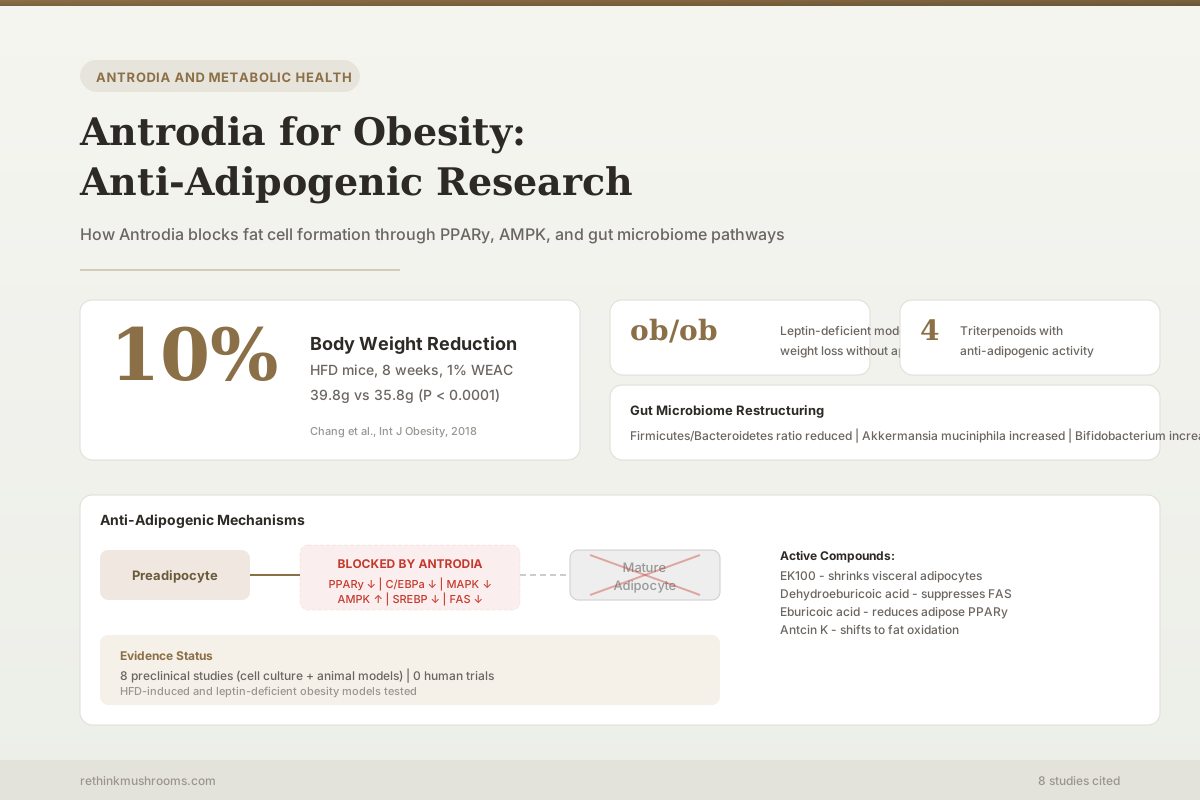
10% weight reduction
A 1% water extract of Antrodia cinnamomea reduced body weight by 10% in high-fat-diet mice over 8 weeks while restructuring gut microbiota.
Chang et al., International Journal of Obesity, 2018
PPARγ ↓
master adipogenic regulator suppressed
Akkermansia ↑
beneficial gut bacteria increased
2 Models
HFD-induced and leptin-deficient obesity
Chang et al., International Journal of Obesity, 2018
 View as image ↗
Obesity research on Antrodia camphorata has moved beyond simple weight measurements. The recent studies do not just show that Antrodia-treated animals weigh less; they trace the molecular mechanisms through which specific compounds block fat cell formation, shrink existing fat deposits, and alter the gut microbiome in ways that favor leanness. The convergence of these findings across eight studies points to a consistent anti-adipogenic profile, with PPARγ downregulation and AMPK activation as the central mechanisms. That convergence needs one immediate qualification, developed later in this article: the eight papers come from five research groups, not eight, and a single laboratory produced every one of the isolated-compound results. For a broader overview of how these obesity effects fit into Antrodia's full metabolic profile, see Antrodia and Metabolic Syndrome: Multi-Target Effects.
Key Takeaways
- Water extract of Antrodia cinnamomea reduced body weight by 10% (39.8 g vs. 35.8 g, P < 0.0001) in HFD mice over 8 weeks (Chang et al., 2018)
- Antrodia alcohol extract inhibited 3T3-L1 adipocyte differentiation by downregulating PPARγ and C/EBPα while activating AMPK and suppressing MAPK signaling (Lin et al., 2025)
- In leptin-deficient ob/ob mice, Antrodia reduced body weight and epididymal white adipose tissue without reducing food intake (Tsai et al., 2020)
- Ergostatrien-3β-ol (EK100) reduced hepatic ballooning degeneration and visceral adipocyte size in HFD mice (Kuo et al., 2015)
- Antrodia extract at 0.5-2% of diet reduced body weight gain, body fat deposition, serum FFA, and triglycerides over 10 weeks (Peng et al., 2017)
- Eburicoic acid reduced adipose expression of lipogenic FAS and PPARγ, decreasing lipid accumulation in adipose tissue (Lin et al., 2017)
- The eight papers come from five research groups, and all four isolated-compound studies share one laboratory and one protocol — no compound result has been independently replicated
- No human trial has measured weight or body composition with Antrodia, so no human dose or effect size exists
How Fat Cells Form: The Adipogenesis Pathway
Understanding Antrodia's anti-obesity mechanisms requires a brief look at how fat cells develop. Adipogenesis is the process by which precursor cells (preadipocytes) differentiate into mature fat-storing adipocytes. Two master transcription factors drive this process: PPARγ (peroxisome proliferator-activated receptor gamma) and C/EBPα (CCAAT/enhancer-binding protein alpha). When both are active, preadipocytes accumulate lipid droplets and become functional fat cells.
Blocking either PPARγ or C/EBPα prevents preadipocyte differentiation. This is the mechanism targeted by several Antrodia compounds, and it operates upstream of fat storage itself. Rather than merely burning stored fat, these compounds reduce the body's capacity to create new fat cells.
Antrodia cinnamomea · anti-adipogenic mechanism
Four Sequential Steps to a Fat Cell — and Where Antrodia Interrupts Each One
Body fat grows two ways: more fat cells, and bigger fat cells. Making a new one runs through four steps in order. Different Antrodia preparations and isolated compounds have been tested against each step, which is why the extract lowers fat mass rather than simply burning stored fat. The colour of each card marks how strong that specific evidence is — purple is cell culture only, green is a live animal.
Stage assignments from refs [1]–[8]; see Sources & References
Blocking Fat Cell Formation In Vitro
The most mechanistically detailed evidence comes from 3T3-L1 preadipocyte cell studies. Lin et al. (2025) demonstrated that an Antrodia cinnamomea alcohol extract inhibited adipocyte differentiation and lipid accumulation in 3T3-L1 cells through three parallel pathways: downregulation of PPARγ and C/EBPα (the master adipogenic switches), activation of AMPK (the cellular energy sensor that opposes lipogenesis), and suppression of MAPK signaling (which promotes preadipocyte proliferation).[1]
The same study did not stop at cell culture. The authors gave the extract to high-fat-diet mice and found reduced body weight, reduced adipose tissue mass, and reduced liver lipid accumulation, then ran transcriptomic analysis on the adipose tissue itself. That analysis showed the extract suppressing gene expression for lipid synthesis while enhancing β-oxidation, the pathway that breaks fatty acids down.[1] The transcriptomic layer matters because it tests the mechanism in the tissue that actually stores fat, rather than inferring it from a cell line.
The triple-pathway blockade (PPARγ/C/EBPα suppression + AMPK activation + MAPK inhibition) is notable because it targets adipogenesis at multiple control points simultaneously. A compound that only blocked PPARγ might be compensated by alternative adipogenic pathways. The breadth of Antrodia's molecular targets reduces the likelihood of compensatory adaptation, at least in this cell model.
These cell culture findings provide mechanism but not clinical relevance. 3T3-L1 cells are a murine preadipocyte line, and the concentrations of extract used in cell culture do not translate directly to achievable tissue concentrations after oral consumption. Cell culture also cannot capture the complex interplay between adipose tissue, liver, muscle, and gut that determines whole-body adiposity.
Whole-Body Weight and Fat Reduction
High-Fat-Diet Models
Chang et al. (2018) published the Antrodia obesity study that appeared in the highest-profile venue in this literature, International Journal of Obesity. C57BL/6J mice fed a high-fat diet supplemented with 1% water extract of Antrodia cinnamomea (WEAC) for 8 weeks showed a mean body weight of 35.8 ± 1.3 g compared to 39.8 ± 1.2 g in HFD controls, a difference of 4 g or 10% of body weight (P < 0.0001). WEAC supplementation reduced fat accumulation and serum triglycerides while reversing HFD-induced changes in inflammatory markers: interleukin-1β, interleukin-6, and TNF-α all decreased. Leptin dropped while adiponectin rose, a shift characteristic of improved insulin sensitivity.[2]
Chang et al. (2018) · International Journal of Obesity
- Population
- Male C57BL/6J mice fed a high-fat diet for 8 weeks to induce obesity and chronic inflammation
- Intervention
- Water extract of Antrodia cinnamomea (WEAC) at 1% of diet, given alongside the high-fat diet
- Comparator
- High-fat-diet-fed controls without extract
- Finding
- Mean body weight 35.8 ± 1.3 g with 1% WEAC versus 39.8 ± 1.2 g in HFD controls — a 4 g or 10% reduction (P < 0.0001). Fat accumulation and serum triglycerides fell significantly. IL-1β, IL-6 and TNF-α were reversed toward control levels, leptin fell and adiponectin rose, intestinal tight junction proteins (ZO-1, occludin) and antimicrobial proteins (Reg3g, lysozyme C) increased, blood endotoxemia fell, the Firmicutes/Bacteroidetes ratio dropped and Akkermansia muciniphila increased.
positive Unusually complete for this field: weight, adiposity, inflammation, insulin sensitivity, gut barrier and microbiome were all measured in one experiment, which is why the causal chain here is easier to follow than in the compound studies. It remains a mouse study with no human counterpart.
Chang et al., International Journal of Obesity, 2018 (ref 2)
Peng et al. (2017) corroborated these findings using Antrodia cinnamomea extract (ACE) at three doses (0.5%, 1%, and 2% of diet) over 10 weeks. Body weight gain and body fat deposition were significantly reduced at all three doses; the published abstract reports significance across the dose range but does not establish a formal dose-response relationship, so the three doses are best read as three confirmations rather than as a gradient. Serum free fatty acids, triglycerides, total cholesterol, and the LDL/HDL ratio were all reduced. At the molecular level, ACE increased phosphorylated AMPK while decreasing SREBP (which drives lipogenesis), fatty acid synthase (FAS), 1-acylglycerol-3-phosphate acyltransferase (AGPAT), and HMG-CoA reductase.[3]
For the details of how AMPK-mediated fat oxidation drives these metabolic shifts, see the dedicated AMPK review.
Leptin-Deficient Obesity Model
Tsai et al. (2020) used a different and arguably more challenging model: leptin-deficient (ob/ob) mice, which overeat spontaneously and develop severe obesity without any dietary manipulation. After four weeks of Antrodia cinnamomea supplementation, ob/ob mice showed reduced body weight and epididymal white adipose tissue mass with no compromise on food intake. The extract promoted lipid metabolism and inhibited lipogenesis-associated genes and proteins in the liver and adipose tissue.[4]
The food intake finding is important to interpret correctly. If Antrodia reduced weight only by suppressing appetite, the mechanism would be different. The fact that ob/ob mice continued eating normally while losing weight and adipose tissue suggests the extract affects fat metabolism directly, independent of caloric intake. This is consistent with the AMPK activation and lipogenesis inhibition documented at the molecular level.
The ob/ob model also represents a more severe metabolic challenge than HFD-induced obesity. Leptin-deficient mice have profound dysregulation of energy homeostasis, not just caloric excess. That Antrodia produced measurable effects in this model suggests the anti-adipogenic mechanisms operate even under conditions of extreme metabolic dysfunction.
Tsai et al. (2020) · Nutrients
- Population
- Leptin-deficient (ob/ob) mice, which overeat spontaneously and develop severe obesity without dietary manipulation, alongside wild-type controls
- Intervention
- Antrodia cinnamomea for four weeks
- Comparator
- Untreated ob/ob mice and wild-type mice
- Finding
- Body weight and epididymal white adipose tissue mass both fell with no reduction in food intake. Liver and adipose lipid deposits decreased through promotion of lipid metabolism and inhibition of lipogenesis-associated genes and proteins. Antrodia also repaired the intestinal-barrier injury caused by leptin deficiency and improved barrier integrity in Caco-2 human intestinal epithelial cells.
positive The unchanged food intake is the informative detail: it separates a metabolic effect from simple appetite suppression. The model itself is the limitation — complete leptin deficiency is vanishingly rare in humans, who typically have leptin resistance instead.
Tsai et al., Nutrients, 2020 (ref 4)
Tsai et al. also found that Antrodia repaired intestinal-barrier injury caused by leptin deficiency and enhanced intestinal barrier integrity in Caco-2 human intestinal epithelial cells.[4] A compromised intestinal barrier ("leaky gut") allows endotoxin translocation into the bloodstream, driving systemic inflammation that worsens insulin resistance and promotes further fat storage. This is not left as speculation in the Antrodia literature: Chang et al. measured the chain directly, reporting increased expression of the tight-junction proteins zonula occludens-1 and occludin and of the antimicrobial proteins Reg3g and lysozyme C in the small intestine, and reduced blood endotoxemia as a result.[2] Two groups, two obesity models, and the same barrier finding is one of the more reproducible observations in this body of work.
Individual Compounds and Adipose Tissue
While whole-extract studies demonstrate the net anti-obesity effect, isolated compound studies reveal which specific molecules are responsible and through which pathways they act. This distinction matters for understanding whether the whole extract's effects are driven by one dominant compound or by the additive contributions of multiple molecules. The evidence points to the latter: at least four distinct triterpenoids show independent anti-adipogenic activity through partially overlapping but non-identical mechanisms.
Ergostatrien-3β-ol (EK100) reduced hepatic ballooning degeneration and the size of visceral adipocytes in HFD mice. Beyond shrinking fat cells, EK100 lowered blood glucose, HbA1c, total cholesterol, triglycerides, insulin, and leptin while ameliorating insulin resistance through regulation of GLUT4, PEPCK, G6Pase, SREBP1c, SREBP2, and AMPK phosphorylation.[5]
Dehydroeburicoic acid decreased expression of fatty acid synthase (FAS) in both liver and adipose tissue and reduced hepatic adipocyte fatty acid binding protein 2 (aP2). It raised membrane GLUT4 in skeletal muscle specifically, and enhanced AMPK phosphorylation in both liver and skeletal muscle.[6]
Eburicoic acid reduced adipose expression of lipogenic FAS and PPARγ, leading to decreased adipose lipid accumulation. In insulin-resistant C2C12 myotubes, it restored membrane GLUT4 and the phosphorylation of AMPK and Akt that palmitate exposure had suppressed — the machinery muscle uses to take up glucose — connecting the anti-adipogenic effects to the broader metabolic improvements seen in the whole-extract studies.[7]
Antcin K, identified by chemical analysis as the most abundant triterpene in Antrodia extract and described elsewhere as the main constituent of the fruiting body,[3] inhibited hepatic fatty acid synthase while enhancing fatty acid oxidation through PPARα. This shifted the metabolic balance from fat storage toward fat burning, contributing to reduced hepatic steatosis and lower circulating triglycerides and cholesterol. At 40 mg/kg/day, antcin K's effects on triglycerides matched fenofibrate at 250 mg/kg/day, providing one of the few direct drug comparisons in this research field.[8]
The pattern across all four compounds is convergence on AMPK activation and lipogenesis suppression, with each compound having additional unique targets. This multi-compound, multi-target profile is characteristic of Antrodia's pharmacology and may explain why whole extracts sometimes produce stronger effects than would be predicted from any single compound alone. For more on the antcin compound family, see Antcins in Antrodia: Taiwan's Most Valuable Bioactive Compound Class.
Who Ran These Studies
There is a caveat to that convergence that only becomes visible when the author lists are read rather than the abstracts. All four isolated-compound papers above come from the same Taiwanese laboratory: Kuo Yueh-Hsiung, Lin Cheng-Hsiu, and Shih Chun-Ching appear as the core author trio on every one of them.[5][6][7][8] They also share a protocol: high-fat-diet mice, 8 to 10 weeks of induction followed by 4 weeks of treatment, fenofibrate and metformin as reference drugs, and C2C12 muscle cells for the in vitro component.
Four compounds tested by one group under one protocol is not the same evidentiary situation as four compounds tested by four groups. A shared protocol means shared assumptions, shared assays, and shared potential for systematic error, and it means the "convergence" partly reflects methodological similarity rather than independent confirmation. The whole-extract weight-loss finding is in a different position: it has been reproduced by four separate groups using water extract, alcohol extract, and dietary supplementation across two obesity models.
Independence check · who actually ran these studies
Eight Papers, Five Groups — and One Lab Wrote Every Compound Study
“Eight studies agree” is only meaningful if eight separate teams looked. Sorting the reference list by author reveals that half the papers come from a single Taiwanese group, and that group produced all four of the isolated-triterpenoid results using one shared protocol. The whole-extract findings are genuinely multi-group; the compound-level findings are not.
Author lists as indexed for refs [1]–[8]
The Gut Microbiome Connection
Chang et al. (2018) found that WEAC restructured the gut microbiome in ways associated with leanness. The Firmicutes-to-Bacteroidetes ratio, typically elevated in obese individuals and animal models, was reduced. Akkermansia muciniphila, a bacterium linked to improved metabolic health, anti-inflammatory properties, and intestinal barrier integrity, increased.[2]
Lin et al. (2025) confirmed the microbiome connection in a more recent study: Antrodia alcohol extract increased beneficial Akkermansia and Bifidobacterium populations while reducing pro-inflammatory Escherichia-Shigella species in HFD-fed mice.[1]
Whether Antrodia acts as a prebiotic (feeding beneficial bacteria), directly suppresses pathogenic species through antimicrobial compounds, or alters the gut environment indirectly through metabolic changes in the host remains unknown. The polysaccharide fraction of Antrodia could serve as a fermentation substrate for beneficial bacteria, while the triterpenoid fraction might exert direct antimicrobial effects against inflammatory species. The microbiome data is descriptive: it tells us what changed, not why, and the causal relationship between microbiome shifts and weight loss has not been established in these studies.
The consistency of the Akkermansia finding across two independent studies (Chang et al., 2018 and Lin et al., 2025) using different extraction methods (water vs. alcohol) strengthens the observation but does not resolve the causation question. Outside the mushroom literature, there is reason to think the bacterium is more than a marker: Everard and colleagues gave Akkermansia muciniphila directly to high-fat-diet mice and reversed fat-mass gain, metabolic endotoxemia, adipose tissue inflammation, and insulin resistance, with heat-killed bacteria producing none of those effects.[9] That establishes the bacterium can be a mediator in principle. It does not establish that the Akkermansia increase is what drives the weight change in the Antrodia experiments, because neither Antrodia study manipulated the bacterium independently of the extract. For a broader look at how Antrodia's anti-inflammatory triterpenoids may interact with gut inflammation in obesity, see that dedicated review.
What the Evidence Does Not Show
No human obesity data. Every study reviewed here uses rodent models or cell lines. No published trial has tested Antrodia for weight management in humans. The 10% weight reduction in mice does not predict a 10% reduction in humans.
Dosing uncertainty. Animal studies express dose as a percentage of diet for whole extracts (0.5-2%) or as mg/kg body weight for isolated compounds (antcin K was tested at 40 mg/kg/day). Neither has an established human equivalent. Retail Antrodia products are also a different material from the research preparations: they are commonly sold as mycelium powder, whereas most of the studies above used characterised fruiting-body or submerged-culture extracts, so a label dose cannot be mapped onto a study dose at all.
Short duration. The longest continuous supplementation period in this set was 10 weeks (Peng et al., 2017). The isolated-compound experiments ran 12 to 14 weeks in total, but that figure includes 8 to 10 weeks of high-fat-diet induction before treatment began, leaving only 4 weeks of actual compound exposure. Obesity is a chronic condition managed over years. Whether Antrodia's anti-adipogenic effects persist, diminish, or compound over longer time frames is untested.
Extract variability. Different studies use water extracts, alcohol extracts, and isolated compounds. Each produces different compound profiles and potentially different effects. Comparing results across studies requires accounting for the extraction method, which is not always fully reported.
No comparison to anti-obesity drugs. Unlike the blood sugar studies where antcin K was compared head-to-head with metformin, and the lipid metabolism studies where it was compared to fenofibrate, none of the obesity studies included an anti-obesity drug comparator such as orlistat, liraglutide, or semaglutide. Without such comparisons, the clinical relevance of the observed weight and fat reductions cannot be gauged.
Genetic model limitations. The ob/ob model (Tsai et al., 2020) produces obesity through complete leptin deficiency, which is extremely rare in humans. Most human obesity involves leptin resistance, not absence. Effects in ob/ob mice may not predict effects in the more common form of obesity.
Concentrated authorship. The eight papers come from five research groups, and one group produced all four isolated-compound studies under a shared protocol. No isolated Antrodia triterpenoid has had its anti-adipogenic effect confirmed by an independent laboratory. The whole-extract finding is better supported on this axis, having been reproduced across four separate groups.
Unmeasured causal links. Two of the mechanisms described above are associations rather than demonstrated causes. The microbiome shift is measured alongside weight loss but was never manipulated independently, so it cannot be shown to drive the weight loss. The same applies to the intestinal barrier improvements.
- Cell studiescompleted
3T3-L1 preadipocytes for adipogenesis (Lin K-T 2025), C2C12 myotubes for glucose handling (Kuo 2016; Lin C-H 2017), and Caco-2 cells for barrier integrity (Tsai 2020).
- Animal studiescurrent
Eight papers across two models — high-fat-diet mice and leptin-deficient ob/ob mice. Consistent direction of effect on body weight, fat mass, and lipogenic gene expression.
- Human case reportsmissing
None reporting a weight or adiposity outcome with Antrodia.
- Small human trialsmissing
None. No human trial has used weight or fat mass as an endpoint for Antrodia.
- Large randomised trialsmissing
None.
- Meta-analysismissing
None. There is no human dataset to pool.
This literature is unusually deep at the preclinical level and completely empty above it. Mechanism is characterised down to individual transcription factors, and the highest rung ever reached with a body-weight endpoint is a mouse. The gap between rung two and rung three is the whole story.
Lin K-T et al., 2025 [ref 1]; Chang et al., 2018 [ref 2]; Peng et al., 2017 [ref 3]; Tsai et al., 2020 [ref 4]; Kuo et al., 2015 [ref 5]; Kuo et al., 2016 [refs 6, 8]; Lin C-H et al., 2017 [ref 7]
Fact Check
The 10% number
The claim
“Antrodia produces 10% weight loss, which would make it competitive with prescription weight-loss medication.”
The headline figure from Chang et al. (2018) travels well because it is a clean, quotable percentage from a respected journal, and it is routinely repeated without its species or its design.
What research shows
Context DependentThe 10% figure is a difference between two groups of mice — 35.8 g versus 39.8 g — in animals given the extract at 1% of their diet at the same time as the high-fat diet that was making them obese. It is a prevention result in rodents, not a treatment result in people who are already overweight.
The finding itself is solid and statistically strong (P < 0.0001). What does not survive is the transfer: no human has been weighed in an Antrodia trial, the extract was dosed as a fraction of total food intake in a way that has no human equivalent, and preventing weight gain in a mouse on a controlled diet is a fundamentally easier problem than reversing established obesity in a person.
Chang et al., International Journal of Obesity, 2018 [ref 2]
Research Gap
What would settle the question
What would it take to know whether Antrodia helps human weight management?
A single human trial with a body-composition endpoint
Not one exists. Every result in this article is a mouse or a cell line.
A defined, characterised human dose
Animal doses are expressed as a percentage of diet or per kg of body weight, neither of which converts cleanly to a capsule.
Independent replication of the compound findings
All four isolated-triterpenoid results come from one laboratory using one protocol.
A treatment design rather than a prevention design
The mouse studies mostly co-administer extract with the obesogenic diet. Human weight management means reversing obesity that already exists.
An anti-obesity drug comparator
Fenofibrate and metformin appear as comparators for lipids and glucose, but no study has benchmarked against orlistat, liraglutide, or semaglutide on weight.
Causal testing of the microbiome mechanism
Akkermansia causality is established in a non-Antrodia mouse study (Everard 2013), but never tested within an Antrodia experiment.
Chang et al., 2018 [ref 2]; Kuo et al., 2015–2016 [refs 5, 6, 8]; Lin C-H et al., 2017 [ref 7]; Everard et al., 2013 [ref 9]
Before You Read Further
ModerateThis is preclinical research, not a weight-loss protocol
Concern
Nothing in this literature establishes a safe or effective human dose of Antrodia for weight management, because no human weight trial has been run. Antrodia preparations act on lipid metabolism, glucose handling, and inflammatory signalling — the same systems targeted by diabetes, lipid-lowering, and anti-obesity medications — which is precisely why unsupervised combination is a live concern rather than a theoretical one. Obesity is also frequently managed alongside prescription drugs whose dosing depends on stable metabolic parameters.
What the research says
Read this article as a description of what has been measured in mice, not as a basis for taking anything. The mechanisms are interesting and the preclinical consistency is real; neither substitutes for a human trial.
Particularly relevant for: Anyone taking antidiabetic, lipid-lowering, or anti-obesity medication, anyone with liver disease, and anyone who is pregnant or breastfeeding
What to do
Talk to a qualified healthcare provider before using any Antrodia product, particularly alongside prescription medication for blood sugar, cholesterol, or weight.
No human obesity trial exists for Antrodia; drug-comparator context from Kuo et al., 2016 [refs 6, 8]
The Bottom Line
Antrodia camphorata extracts and isolated triterpenoids block fat cell formation through PPARγ and C/EBPα downregulation, reduce body weight and adipose mass through AMPK activation and SREBP suppression, and restructure the gut microbiome toward lean-associated bacterial profiles. These effects are consistent across eight preclinical papers using two different obesity models (high-fat diet and leptin-deficient mice), though those papers come from five research groups rather than eight, and every isolated-compound result traces to a single laboratory. No human data exists. The anti-adipogenic mechanisms are well-characterized at the molecular level, but translation to human weight management remains entirely hypothetical.
Frequently Asked Questions
Sources & References
- 1RTHM-00937·Lin, Kuen-Tze et al. (2025). “Antrodia cinnamomea Extract Attenuates Obesity by Targeting Adipogenic Pathways and Gut Dysbiosis in High-Fat Diet-Fed Mice..” International journal of molecular sciences.Study breakdown →PubMed →↩
- 2RTHM-00502·Chang, C-J et al. (2018). “Antrodia cinnamomea reduces obesity and modulates the gut microbiota in high-fat diet-fed mice..” International journal of obesity (2005).Study breakdown →PubMed →↩
- 3RTHM-00487·Peng, Chiung-Huei et al. (2017). “Antrodia cinnamomea Prevents Obesity, Dyslipidemia, and the Derived Fatty Liver via Regulating AMPK and SREBP Signaling..” The American journal of Chinese medicine.Study breakdown →PubMed →↩
- 4RTHM-00659·Tsai, Yi-Ting et al. (2020). “Antrodia cinnamomea Confers Obesity Resistance and Restores Intestinal Barrier Integrity in Leptin-deficient Obese Mice..” Nutrients.Study breakdown →PubMed →↩
- 5RTHM-00382·Kuo, Yueh-Hsiung et al. (2015). “Ergostatrien-3β-ol from Antrodia camphorata inhibits diabetes and hyperlipidemia in high-fat-diet treated mice via regulation of hepatic related genes, glucose transporter 4, and AMP-activated protein kinase phosphorylation..” Journal of agricultural and food chemistry.Study breakdown →PubMed →↩
- 6RTHM-00431·Kuo, Yueh-Hsiung et al. (2016). “Dehydroeburicoic Acid from Antrodia camphorata Prevents the Diabetic and Dyslipidemic State via Modulation of Glucose Transporter 4, Peroxisome Proliferator-Activated Receptor α Expression and AMP-Activated Protein Kinase Phosphorylation in High-Fat-Fed Mice..” International journal of molecular sciences.Study breakdown →PubMed →↩
- 7RTHM-00480·Lin, Cheng-Hsiu et al. (2017). “Eburicoic Acid, a Triterpenoid Compound from Antrodia camphorata, Displays Antidiabetic and Antihyperlipidemic Effects in Palmitate-Treated C2C12 Myotubes and in High-Fat Diet-Fed Mice..” International journal of molecular sciences.Study breakdown →PubMed →↩
- 8RTHM-00430·Kuo, Yueh-Hsiung et al. (2016). “Antcin K, a Triterpenoid Compound from Antrodia camphorata, Displays Antidiabetic and Antihyperlipidemic Effects via Glucose Transporter 4 and AMP-Activated Protein Kinase Phosphorylation in Muscles..” Evidence-based complementary and alternative medicine : eCAM.Study breakdown →PubMed →↩
- 9RTHM-02381·Everard, Amandine et al. (2013). “Giving obese mice a specific gut bacterium reversed diet-induced fat gain.” Proceedings of the National Academy of Sciences of the United States of America.Study breakdown →PubMed →↩