Psilocybin, 5-HT2A Receptors & the Psychedelic Experience
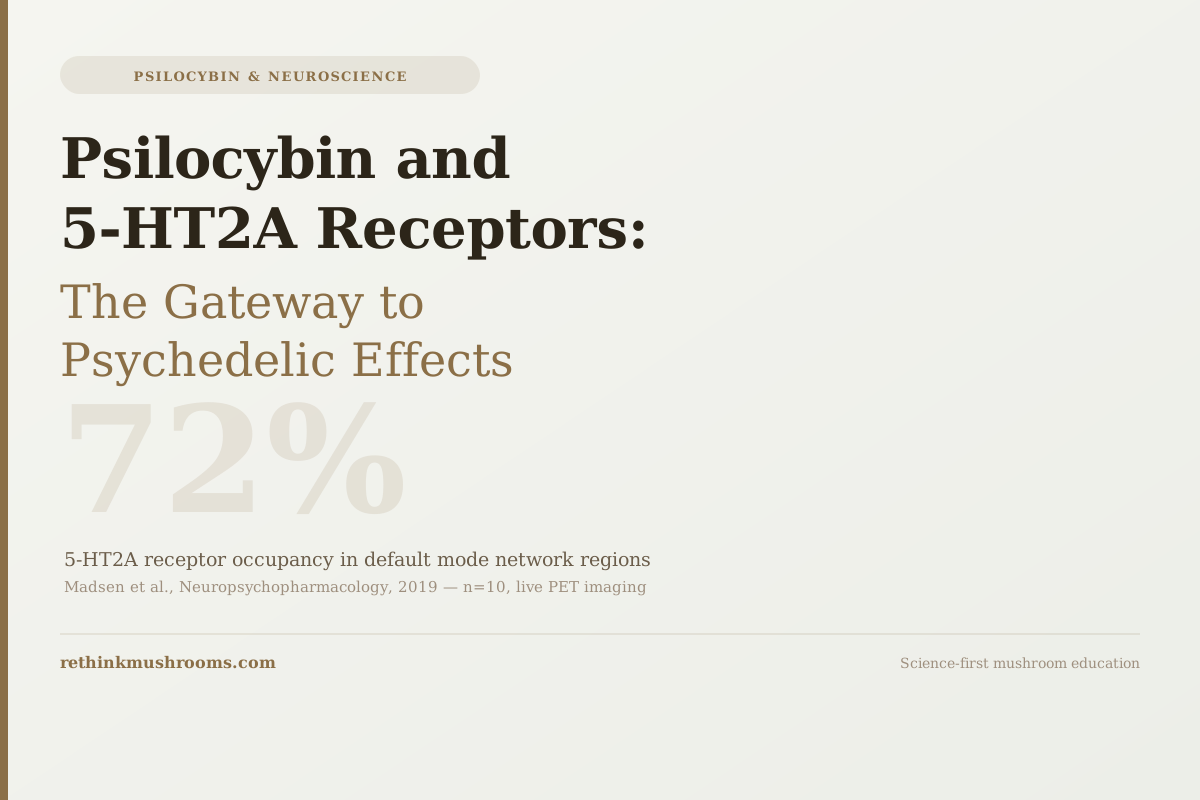
72% receptor occupancy
In eight volunteers undergoing live PET scanning, psilocybin occupied up to 72% of its primary target receptor in the human brain, and the percentage occupied tracked directly with how intense the experience felt.
Madsen et al., Neuropsychopharmacology, 2019
8 volunteers, 3–30 mg
the PET occupancy study behind the 72% figure
Gq, not β-arrestin
the internal signal that determines psychedelic potential
Contested
whether 5-HT2A is required for the antidepressant effect
Madsen et al., Neuropsychopharmacology, 2019
 View as image ↗
In 2019, researchers put eight volunteers inside PET scanners, dosed them with psilocybin, and watched in real time as the serotonin receptors in their brains filled up.[1] At the highest doses tested, up to 72% of the brain's 5-HT2A receptors were occupied. And the more receptors that filled, the more intense the experience became. That correlation was not incidental. It is the most direct human evidence yet that the relationship between psilocybin and 5-HT2A receptors is not a side effect of the drug's action. It is the primary mechanism of the psychedelic state.
But that sentence needs a boundary drawn around it. The evidence that 5-HT2A drives the experience is strong, human, and replicated. The evidence that 5-HT2A is required for psilocybin's therapeutic effects is neither settled nor unanimous — and the studies that test it directly currently disagree with each other. This article follows the mechanistic story from the moment psilocin (psilocybin's active form) contacts the receptor through the downstream signals that reshape the brain weeks later, and it marks the places where the field is still arguing rather than smoothing them over.
For the broader context of what this receptor activation does to the brain's self-referential network, see the complete overview of psilocybin and the default mode network.
Key Takeaways
- In live PET brain imaging of eight people given 3–30 mg of psilocybin orally, occupancy of brain 5-HT2A receptors reached up to 72%, and both occupancy and plasma psilocin levels tracked how intense the experience felt (Madsen 2019)
- The field's consensus position is that psychedelics act as agonists or partial agonists at 5-HT2A, with particular importance at receptors on the apical dendrites of layer V cortical pyramidal cells — not as uniformly "full" agonists (Nichols 2016)
- The specific internal protein a 5-HT2A drug recruits is what makes it psychedelic: Gq recruitment efficacy predicts psychedelic potential in mice, β-arrestin2 recruitment does not, and a threshold level of Gq activation must be crossed (Wallach 2023)
- No published structure shows psilocin inside the 5-HT2A receptor. The 2020 cryo-EM structure that is routinely cited for this used 25-CN-NBOH, a different chemical class; psilocin's pose is inferred from that template, not observed (Kim 2020)
- A pool of 5-HT2A receptors located inside neurons rather than at the cell surface mediates the plasticity-promoting effects of psychedelics, which helps explain why the brain's own serotonin — which cannot cross the membrane — does not produce them (Vargas 2023)
- Whether 5-HT2A activation is required for the antidepressant effect is genuinely disputed: blocking the receptor with ketanserin abolishes the perceptual effects in humans, yet failed to block psilocybin's antidepressant-like and synaptic effects in mice (Kometer 2013; Hesselgrave 2021; Drewko 2025)
The 72% Number: How PET Scans Confirmed the Receptor-Experience Link
The most concrete piece of evidence for psilocybin's mechanism came from a 2019 neuroimaging study by Madsen and colleagues.[1] They recruited eight healthy volunteers and used positron emission tomography — a scanning method that tracks where specific molecules bind in the living brain — to measure psilocybin's effect on 5-HT2A receptors in real time.
PET imaging works by introducing a radioactively labeled probe molecule that competes with psilocin for the same receptor site. In this study the probe was [11C]Cimbi-36, itself a 5-HT2A agonist radioligand. When psilocybin is present, psilocin displaces the probe. The less probe signal detected, the more receptors psilocin has occupied. This is called receptor occupancy measurement, and it gives a direct read on how much of the receptor pool a drug has actually engaged: not a model, not an estimate, but a live measurement.
Each volunteer had a baseline scan and one or two further scans on the same day after a single oral dose of psilocybin, ranging across participants from 3 mg to 30 mg. Occupancy was dose-related and reached up to 72% at the top of that range. Plasma psilocin levels and receptor occupancy fitted a single-site binding model — the pharmacological signature of one drug engaging one target, rather than a tangle of competing effects.
The number that mattered most was not the peak figure but the correlation: subjective intensity tracked both 5-HT2A occupancy and plasma psilocin levels. The authors concluded that this "strongly supports that stimulation of 5-HT2AR is a key determinant for the psychedelic experience."
That correlation is the strongest human evidence that 5-HT2A receptor engagement drives the psychedelic state rather than merely accompanying it. Psilocybin does many things: it activates multiple receptor types, alters cerebral blood flow, and changes activity across large brain networks. But the receptor-experience relationship in the Madsen data points at 5-HT2A as the primary lever.
Two caveats belong with the 72% figure. It comes from eight people, which is a small sample even by neuroimaging standards. And it is a whole-brain occupancy measure — it is often repeated as though the 72% applied specifically to the default mode network, which is not what the study reported. The connection between psychedelics and the default mode network is real, but it comes from a different kind of measurement: psilocybin and LSD produce decreases in oscillatory power in default mode network regions.[2]
The Binding Site: What the 2020 Structures Actually Showed
Understanding that psilocin binds 5-HT2A is one thing. Knowing exactly how it binds, at atomic resolution, is another — and here the popular account and the published record have come apart.
The paper almost always cited is Kim and colleagues, published in Cell in 2020.[4] It is genuinely a landmark. The team determined the active-state structure of the 5-HT2A receptor in complex with an engineered Gαq heterotrimer by cryo-electron microscopy, a technique that flash-freezes proteins mid-activity and uses electron beams to build a three-dimensional map accurate to the level of individual atoms. They also obtained X-ray crystal structures of the receptor bound to LSD, an arrestin-biased ligand, and to methiothepin, an inverse agonist.
What the cryo-EM structure did not contain is psilocin. The hallucinogen bound in that active-state structure was 25-CN-NBOH — a substituted N-benzyl phenylalkylamine, a structurally distinct chemical class from the tryptamine psilocin.
Provenance Audit · The 2020 5-HT2A Structures
What Was Actually Inside the Receptor in Kim et al. 2020
It is widely written that psilocin has been imaged at atomic resolution inside the 5-HT2A receptor. The landmark structural paper cited for that claim solved three structures — and psilocin is in none of them.
| Ligand in the structure | Chemical class | Method | Receptor state captured |
|---|---|---|---|
| 25-CN-NBOH | Substituted N-benzyl phenylalkylamine | Cryo-EM, with engineered Gαq heterotrimer | Active state, Gq-coupled |
| LSD | Ergoline | X-ray crystallography | Arrestin-biased ligand |
| Methiothepin | Tricyclic | X-ray crystallography | Inverse agonist |
| Psilocin | Tryptamine | — not solved in this paper — | Absent from all three structures |
How to read it: the Gq-coupled active-state structure is real, and it is genuinely informative about how a hallucinogen locks 5-HT2A into its signalling conformation. But it was solved with 25-CN-NBOH, a phenylalkylamine — a different chemical class from the tryptamine psilocin. Psilocin’s own pose in that pocket is inferred by homology, not observed. Any article that tells you psilocin has been photographed inside the receptor is describing a picture that has not been taken.
Source: ligands, methods and receptor states exactly as reported in Kim et al. 2020, Cell 182(6):1574-1588.e19 [4]. Agonist/partial-agonist consensus per Nichols 2016, Pharmacological Reviews [2].
This is not a pedantic distinction. The Kim structures tell us, at atomic resolution, what the receptor looks like when a hallucinogen has locked it into the Gq-coupling conformation, and they reveal the determinants of the receptor's interaction with Gαq and the rearrangements involved in the active-state transition. That is a powerful template, and psilocin almost certainly engages the same orthosteric pocket — the site where serotonin normally docks. But psilocin's specific contacts within that pocket are inferred from the template by homology, not observed. Descriptions of exactly how psilocin's dimethylamine tail seats itself in the receptor are extrapolation presented as photograph.
The same care applies to how psilocin's efficacy is described. It is common to read that psilocin is a "full agonist" at 5-HT2A. Nichols's 2016 review in Pharmacological Reviews, the standard reference for the pharmacology of this drug class, states the consensus differently: psychedelics are "agonists or partial agonists at brain serotonin 5-HT2A receptors," with particular importance attaching to the receptors expressed on the apical dendrites of layer V neocortical pyramidal cells.[2] Reported binding affinities for psilocin at 5-HT2A sit in the high-nanomolar range, but the specific value varies substantially with the assay and radioligand used, which is why it is better treated as a range than as a fixed constant.
Gq vs. β-Arrestin: The Molecular Switch That Separates Psychedelic from Non-Psychedelic
The 5-HT2A receptor does not do one thing when activated. Like most receptors that sit in the cell membrane and respond to external signals, it can trigger distinct internal pathways depending on which proteins it recruits after binding.
The first pathway runs through a protein called Gq. Gq activation sets off a cascade inside the cell: it activates an enzyme called phospholipase C, which breaks apart a membrane lipid and generates two messenger molecules. One of those messengers, IP3, unlocks calcium stored inside the cell. The other, DAG, activates protein kinase C, which changes which genes the neuron expresses and how strong its synaptic connections become. The calcium release and the kinase activation together alter how neurons fire and how they wire together over time.
The second pathway runs through a protein called β-arrestin2. β-arrestin2 tends to dampen signaling and pull the receptor off the cell surface, internalizing it — a braking mechanism, the cell's way of reducing its own sensitivity when a receptor has been heavily activated.
For decades, the 5-HT2A receptor was known to engage both. Which one produces psychedelic effects was addressed directly by Wallach and colleagues in 2023.[5]
Rather than knocking out a pathway, their approach was to build a set of tools. They developed a series of 5-HT2A-selective ligands spanning a range of Gq efficacies, including deliberately β-arrestin-biased compounds, and measured psychedelic-like effect in male mice using head-twitch response magnitude — the standard rodent proxy for psychedelic activity. The result was clean: Gq recruitment efficacy predicted psychedelic potential; β-arrestin2 recruitment efficacy did not. Separately disrupting Gq-PLC signaling attenuated the head-twitch response.
Two further findings sharpen the picture. First, there is a threshold — a certain level of Gq activation has to be reached to produce psychedelic-like effects at all. This is why some 5-HT2A partial agonists are non-psychedelic despite genuinely activating the receptor; the authors give lisuride as the example. A drug can occupy the receptor and turn it on without turning it on hard enough.
Second, and counterintuitively, β-arrestin-biased 5-HT2A agonists did not simply fail to produce psychedelic effects — they actively blocked them, and induced receptor downregulation and tachyphylaxis (a rapid falling-off of response on repeated dosing). Biasing the receptor toward β-arrestin is not a neutral alternative route; it is a brake on the psychedelic pathway.
The broader framework for thinking about 5-HT2A signaling — its structure, its neuroanatomical distribution, and its function, along with the recognition that hallucinogens also bind other G protein-coupled receptors — was set out in López-Giménez and González-Maeso's 2018 review.[3]
For a step-by-step account of the downstream cascade that 5-HT2A activation sets in motion, from Gq firing to pyramidal neuron excitation to thalamocortical disruption, see the companion article on how 5-HT2A agonism creates the psychedelic experience.
The Receptor Inside the Cell: Psilocybin's Most Surprising 2023 Discovery
For most of receptor pharmacology's history, receptor action was understood to happen at the cell surface. The receptor sits in the membrane, the drug arrives from outside, and the signal flows inward. That picture turned out to be incomplete for 5-HT2A.
Vargas and colleagues, publishing in Science in 2023, used molecular and genetic tools to demonstrate that intracellular 5-HT2A receptors — receptors located inside the neuron rather than on its surface — mediate the plasticity-promoting properties of psychedelics.[6] Decreased dendritic spine density in the cortex is a hallmark of several neuropsychiatric diseases, and the ability of psychedelics to promote cortical neuron growth has been proposed as the basis of their rapid and sustained therapeutic effects. Activation of 5-HT2A is essential for that plasticity — but until this work it was unclear why some 5-HT2A agonists promote neuroplasticity and others do not.
Location was the answer. To reach an intracellular receptor, a drug has to be lipophilic enough to cross the cell membrane on its own. Psilocin is; serotonin is not. That single physicochemical difference explains something that had been puzzling for years: why the brain's own serotonin, which binds the same receptor at the same site, does not produce the structural plasticity that psychedelics do. The authors framed this as location bias in 5-HT2A signaling, identified the intracellular receptor pool as a therapeutic target in its own right, and raised the possibility that serotonin may not even be the endogenous ligand for these intracellular receptors in the cortex.
The appeal of this finding is that it offers a mechanism by which the acute experience and the lasting structural change might be at least partly separable — surface receptors mediating one, intracellular receptors the other. That is a genuinely promising model. It is worth being clear, though, that "partly separable in principle" is not the same as "demonstrated to be separable in people," and the next section is where that gap becomes visible.
Why Some People's Experiences Are More Profound Than Others — and Why the Obvious Answer Is Wrong
The PET occupancy data established that more receptor engagement during the session produces a more intense experience. A natural extension is to assume that people who start with more receptors will have bigger experiences. A 2021 study by Stenbæk and colleagues tested that directly, and found the opposite.[7]
Sixteen participants completed a pre-drug [11C]Cimbi-36 PET scan to measure baseline neocortical 5-HT2A binding. On a separate day they received a single oral dose of psilocybin at 0.2–0.3 mg/kg, with subjective drug intensity rated every 20 minutes across the session and the Mystical Experience Questionnaire completed at the end. The intensity time-course was modelled in three phases — onset, peak plateau, and return to normal consciousness — using segmented linear regression.
Higher baseline neocortical 5-HT2A binding was significantly negatively associated with mystical experience scores. It was also negatively associated with peak plateau duration, and positively associated with the time taken to return to normal waking consciousness.
Direction of Effect · Stenbæk 2021
More Receptors Did Not Mean a More Profound Experience
Sixteen healthy volunteers had their baseline neocortical 5-HT2A binding measured by PET before a single psilocybin session. The obvious prediction — more receptors, bigger experience — failed. Two of the three significant associations run the other way.
Mystical Experience Questionnaire, completed at end of session
Higher baseline binding → LOWER mystical scores
Opposite of the intuitive expectation
Length of the peak phase of subjective drug intensity
Higher baseline binding → SHORTER peak plateau
Opposite of the intuitive expectation
Time taken to come back to ordinary waking state
Higher baseline binding → LONGER return
Consistent with a longer overall drug effect
How to read it: baseline receptor density does appear to shape the psychedelic experience — but not as a simple volume dial. In this sample, people with more neocortical 5-HT2A binding available before dosing reported less mystical experience and a shorter peak, while taking longer to return to baseline. Why the relationship inverts is unresolved; receptor density is only one input into a response shaped by dose, set, setting and pharmacokinetics.
Source: directions of association exactly as reported in Stenbæk et al. 2021, J Psychopharmacol 35(4):459-468 [7]. n = 16 healthy volunteers, single session, oral psilocybin 0.2-0.3 mg/kg, pre-drug [11C]Cimbi-36 PET. Associations only — no causal inference, and results in this size of sample await replication.
In other words: people with more 5-HT2A receptors available before dosing reported less mystical experience and a shorter peak, while taking longer to come down. The intuitive model — more receptors, more profound trip — is not what the data show.
Why the relationship runs this way is unresolved. Receptor density may influence the kinetics of the response as much as its magnitude, and baseline binding is only one of many inputs into an experience also shaped by dose, individual pharmacokinetics, expectation, and setting. What the study does establish is that individual variation in psilocybin response has a measurable biological correlate — just not the one most people would guess. This is a single study in sixteen healthy volunteers, reporting associations rather than causes, and it awaits replication.
For a detailed examination of what determines baseline receptor density, how it changes over time, and what a single dose does to that density, see the companion article on 5-HT2A receptor density and psilocybin response.
The Reset Effect: One Dose Builds Synapses and Temporarily Shrinks Receptor Density
A single dose of psilocybin does not leave the receptor system where it found it. A 2021 pig brain study by Raval and colleagues tracked what happened to both synaptic density and 5-HT2A receptor density after a single psilocybin exposure.[8]
Twenty-four awake pigs received either 0.08 mg/kg psilocybin or saline intravenously. Half were euthanized one day post-injection and half seven days post-injection, six per intervention at each timepoint. The researchers performed autoradiography on hippocampus and prefrontal cortex sections using three radioligands: [3H]UCB-J for synaptic vesicle protein 2A (SV2A, a proxy for the total number of functional synapses), plus [3H]MDL100907 and [3H]Cimbi-36 for 5-HT2A receptor density.
One day after dosing, the two measures moved in opposite directions. Hippocampal SV2A density was 4.42% higher, while 5-HT2A receptor density in the hippocampus and prefrontal cortex was lower by between 15.21% and 50.19% depending on region and radioligand. The differences were statistically significant in the hippocampus for all three radioligands, and in the prefrontal cortex for [3H]Cimbi-36 only.
The seven-day timepoint is where the story gets more interesting, and it is the part most often left out. At one week, synaptic density was still elevated — 9.24% higher in the hippocampus and 6.10% higher in the prefrontal cortex — while the 5-HT2A receptor differences had disappeared entirely.
That dissociation is the finding. The synaptic growth persists and even increases; the receptor downregulation is transient. This reframes what is meant by the "reset" effect: not a restoration to a previous state, but a reorganization in which the durable change is structural rather than receptor-level.
It also means a common inference should be handled carefully. Receptor downregulation is frequently invoked to explain why psilocybin sessions taken close together produce weaker experiences. Acute downregulation is real and was measured here — but in pigs it had resolved by day seven, so it cannot by itself account for tolerance persisting beyond that window. Wallach's finding that β-arrestin-biased agonism drives downregulation and tachyphylaxis suggests the receptor-regulation story is more complicated than a simple depletion-and-refill model.[5]
On the clinical side, Daws and colleagues assessed the subacute impact of psilocybin on brain function across two depression trials, reported in Nature Medicine in 2022: an open-label trial in treatment-resistant depression (10 mg then 25 mg, seven days apart) and a double-blind phase II randomized trial comparing psilocybin therapy against escitalopram in major depressive disorder.[9] In both, the antidepressant response was rapid and sustained, and it correlated with decreases in fMRI brain network modularity — meaning the brain's functional modules became less segregated and more globally integrated. Network analyses indicated that 5-HT2A-receptor-rich higher-order networks became more interconnected and more flexible after treatment. The escitalopram response was milder and produced no comparable change in network organization.
The Frontier: Is 5-HT2A Activation Actually Required for the Therapeutic Effect?
Everything above builds toward an obvious question, and the honest answer is that the field does not yet agree.
The cleanest way to test necessity is blockade: give a 5-HT2A antagonist first, then give psilocybin, and see what survives. Ketanserin is the antagonist of choice, and the experiment has been run on both sides of the question with opposite results.
In humans, Kometer and colleagues gave healthy volunteers psilocybin at 215 µg/kg against placebo, with and without 50 mg of ketanserin as pretreatment.[12] Psilocybin sharply reduced prestimulus parieto-occipital alpha power and reduced N170 visual-evoked potentials, changes that accompanied visual perceptual alterations including hallucinations. Ketanserin blocked all of it. For the acute perceptual effects, 5-HT2A is not merely involved — it is required.
In mice, Hesselgrave and colleagues asked whether the same held for the antidepressant effect, and reported in PNAS in 2021 that it did not.[13] In chronically stressed male mice, a single psilocybin injection reversed anhedonia on both the sucrose preference and female urine preference tests, accompanied by a strengthening of excitatory synapses in the hippocampus. Pretreatment with ketanserin — with confirmed evidence that the ketanserin was pharmacologically effective — prevented neither the behavioural nor the electrophysiological response. The authors concluded that altered perception may not be required for psilocybin's antidepressant effects.
Contested Case · Is 5-HT2A Activation Required?
The Same Blocker, Two Different Answers
Block the 5-HT2A receptor with ketanserin and the psychedelic experience goes away. Block it and the antidepressant-like effect, at least in mice, does not. That split is the single most important unresolved question in psilocybin pharmacology.
Supports necessity
5-HT2A is doing the work
Kometer 2013 [12]
Healthy humans, psilocybin 215 µg/kg, ketanserin 50 mg pretreatment
Ketanserin blocked all of it — the alpha-power drop, the N170 reduction, and the visual perceptual alterations.
Madsen 2019 [1]
Healthy humans, PET occupancy, psilocybin 3–30 mg oral
Subjective intensity tracked 5-HT2A occupancy, "strongly supporting" the receptor as a key determinant of the experience.
Vargas 2023 [6]
Molecular and genetic tools, cortical neurons
Plasticity requires 5-HT2A — but specifically the intracellular pool, which serotonin itself cannot reach.
Challenges necessity
Something else may carry the benefit
Hesselgrave 2021 [13]
Chronically stressed male mice, ketanserin pretreatment
Ketanserin did NOT prevent psilocybin’s antianhedonic behaviour or its strengthening of hippocampal synapses — despite confirmed ketanserin efficacy.
Drewko 2025 [10]
Narrative review of the necessity literature
"Many studies remain in conflict on whether action at the receptor is also required for neuroplastic effects." Presents a model rather than a resolution.
How to read it: the two sides are not measuring the same thing, and that is the point. The human evidence that 5-HT2A drives the experience is strong and direct. The evidence that it is required for the therapeutic effect rests largely on rodent work that currently points both ways. Treat “psilocybin works through 5-HT2A” as established for the trip and provisional for the cure.
Sources: findings as reported in Madsen 2019 [1], Vargas 2023 [6], Drewko 2025 [10], Kometer 2013 [12] and Hesselgrave 2021 [13]. Hesselgrave and Drewko concern rodent and review evidence respectively; no human trial has yet tested whether blocking 5-HT2A preserves psilocybin’s antidepressant effect.
A 2025 narrative review by Drewko and colleagues in Molecular Psychiatry surveyed exactly this literature and did not declare a winner.[10] The review notes that while it is broadly agreed psychedelics produce their antidepressant effects by inducing rapid and sustained neuroplasticity, the molecular mechanisms are widely debated and the role of 5-HT2A specifically is "under scrutiny," with many studies "in conflict on whether action at the receptor is also required for neuroplastic effects." The authors critically assess the necessity studies and propose a model — a contribution to an open argument, not its resolution.
Part of what keeps the question open is that 5-HT2A is not psilocin's only target. Cameron and colleagues, in a 2023 mini-review in the Journal of Neuroscience, mapped the wider landscape: alongside 5-HT2A, serotonergic psychedelics interact with other serotonin receptor subtypes including 5-HT1A and 5-HT2C, and with neurotrophin receptors such as tropomyosin receptor kinase B (TrkB), the receptor that normally responds to BDNF.[11] They also raise the possibility that psychedelics act as substrates for post-translational modification of proteins. Any of these could contribute to therapeutic effects along routes that a 5-HT2A blocker would leave untouched — which would be one way to reconcile the ketanserin results.
The term "psychoplastogen" has emerged to describe compounds that produce neuroplasticity without the full psychedelic state, and interest in non-hallucinogenic derivatives is now a major thread in the field. Whether such drugs retain psilocybin's therapeutic benefits remains an open question. What the receptor pharmacology makes clear is that the 5-HT2A system is complex enough — surface versus intracellular pools, Gq versus β-arrestin bias, 5-HT2A versus TrkB versus secondary serotonin subtypes — that different interventions within the same system can produce substantially different outcomes.
For a complete picture of the other serotonin receptor subtypes psilocin engages beyond 5-HT2A, see beyond 5-HT2A: other serotonin receptors psilocybin activates and the complementary deep-dive on psilocin's full receptor binding profile.
For a look at how 5-HT2A activation feeds into the REBUS model of how psilocybin destabilizes the brain's top-down predictive filters, see the article on how psilocybin relaxes the brain's beliefs. For the structural brain changes that follow, see psilocybin and dendritic spine growth.
What This Means in Practice
This is receptor pharmacology, not a treatment guide, but a few practical implications follow from it.
The strength of the human evidence is concentrated in one place: 5-HT2A activation produces the psychedelic experience. Occupancy tracks intensity, and blocking the receptor abolishes the perceptual effects. That much you can rely on.
The therapeutic story is one step less settled than most coverage suggests. The clinical antidepressant results are real and are accompanied by measurable, lasting changes in brain network organization. But the mechanistic claim that those benefits flow through 5-HT2A activation rests substantially on animal work that currently points in two directions, and no human trial has yet tested whether blocking 5-HT2A preserves psilocybin's antidepressant effect.
Individual variation is biologically real but does not run in the direction people expect. If you have read that having more 5-HT2A receptors predicts a more profound experience, the one study to test it found the reverse for mystical-experience scores.
This article is for education, not medical advice. Psilocybin is a controlled substance in most jurisdictions, and the clinical results described here come from trials conducted with screening, preparation, professional supervision, and integration support — conditions that do not transfer to unsupervised use. Psilocybin carries real risks, including for people with a personal or family history of psychosis and for those taking serotonergic medications. Nothing here is a recommendation to use it. If you are considering psilocybin in any context, including a clinical trial, discuss it with a qualified physician who knows your history.
The Bottom Line
The 5-HT2A serotonin receptor is the primary molecular target of psilocybin. PET imaging in eight volunteers found up to 72% occupancy of brain 5-HT2A receptors, with occupancy and plasma psilocin levels both tracking experience intensity, and blocking the receptor with ketanserin abolishes psilocybin's perceptual effects in humans. Mechanistically, Gq recruitment rather than β-arrestin2 recruitment predicts whether a 5-HT2A drug is psychedelic, and a threshold of Gq activation must be crossed. Two common overstatements are worth correcting: no published structure shows psilocin inside the receptor — the 2020 cryo-EM structure used a different hallucinogen entirely — and higher baseline receptor density predicts lower, not higher, mystical-experience scores. The most consequential open question is whether 5-HT2A activation is actually required for the antidepressant effect: the discovery that intracellular 5-HT2A receptors mediate plasticity suggests the trip and the therapeutic change are partly separable, but ketanserin failed to block psilocybin's antidepressant-like effects in mice, and a 2025 review found the necessity literature still in conflict.
Frequently Asked Questions
Sources & References
- 1RTHM-00578·Madsen, Martin K et al. (2019). “Psychedelic effects of psilocybin correlate with serotonin 2A receptor occupancy and plasma psilocin levels..” Neuropsychopharmacology : official publication of the American College of Neuropsychopharmacology.Study breakdown →PubMed →↩
- 2RTHM-00439·Nichols, David E (2016). “Psychedelics..” Pharmacological reviews.Study breakdown →PubMed →↩
- 3RTHM-00980·López-Giménez, Juan F et al. (2018). “Hallucinogens and Serotonin 5-HT2A Receptor-Mediated Signaling Pathways..” Current topics in behavioral neurosciences.Study breakdown →PubMed →↩
- 4RTHM-01219·Kim, Kuglae et al. (2020). “Structure of a Hallucinogen-Activated Gq-Coupled 5-HT2A Serotonin Receptor..” Cell.Study breakdown →PubMed →↩
- 5RTHM-01814·Wallach, Jason et al. (2023). “Identification of 5-HT2A receptor signaling pathways associated with psychedelic potential..” Nature communications.Study breakdown →PubMed →↩
- 6RTHM-01813·Vargas, Maxemiliano V et al. (2023). “Psychedelics promote neuroplasticity through the activation of intracellular 5-HT2A receptors..” Science (New York.Study breakdown →PubMed →↩
- 7RTHM-00720·Stenbæk, Dea Siggaard et al. (2021). “Brain serotonin 2A receptor binding predicts subjective temporal and mystical effects of psilocybin in healthy humans..” Journal of psychopharmacology (Oxford.Study breakdown →PubMed →↩
- 8RTHM-00714·Raval, Nakul Ravi et al. (2021). “A Single Dose of Psilocybin Increases Synaptic Density and Decreases 5-HT2A Receptor Density in the Pig Brain..” International journal of molecular sciences.Study breakdown →PubMed →↩
- 9RTHM-00752·Daws, Richard E et al. (2022). “Increased global integration in the brain after psilocybin therapy for depression..” Nature medicine.Study breakdown →PubMed →↩
- 10RTHM-02078·Drewko, Adam J et al. (2025). “Above the threshold, beyond the trip: the role of the 5-HT2A receptor in psychedelic-induced neuroplasticity and antidepressant effects..” Molecular psychiatry.Study breakdown →PubMed →↩
- 11RTHM-01665·Cameron, Lindsay P et al. (2023). “Beyond the 5-HT2A Receptor: Classic and Nonclassic Targets in Psychedelic Drug Action..” The Journal of neuroscience : the official journal of the Society for Neuroscience.Study breakdown →PubMed →↩
- 12RTHM-02446·Kometer, Michael et al. (2013). “Activation of serotonin 2A receptors underlies the psilocybin-induced effects on α oscillations, N170 visual-evoked potentials, and visual hallucinations..” The Journal of neuroscience.Study breakdown →PubMed →↩
- 13RTHM-02447·Hesselgrave, Natalie et al. (2021). “Harnessing psilocybin: antidepressant-like behavioral and synaptic actions of psilocybin are independent of 5-HT2R activation in mice..” Proceedings of the National Academy of Sciences.Study breakdown →PubMed →↩