Mushroom Tryptamine Alkaloids
6 tryptamines identified
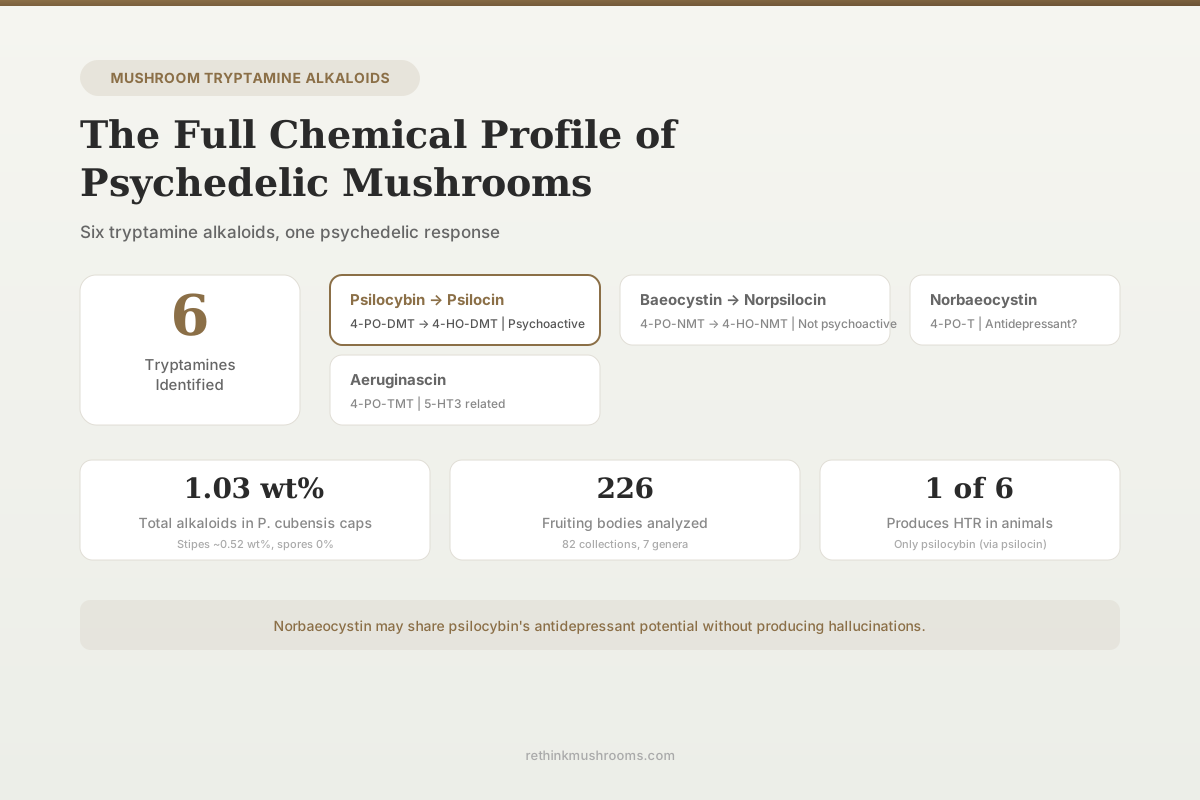
Psilocybe mushrooms contain at least six structurally related tryptamine alkaloids. Only psilocybin (via psilocin) produces the classic psychedelic head-twitch response in animal models.
Glatfelter et al., ACS Pharmacol Transl Sci, 2022
1.03 wt%
total alkaloids in P. cubensis caps
226
fruiting bodies analyzed across 7 genera
Extreme
variability between individual mushrooms
Glatfelter et al., ACS Pharmacol Transl Sci, 2022
 View as image ↗
Psilocybin gets all the attention, but it is one member of a family of at least six tryptamine alkaloids found in Psilocybe and related genera. The others, baeocystin, norbaeocystin, aeruginascin, norpsilocin, and psilocin itself, are present in varying concentrations across species and even between individual fruiting bodies of the same species.[1] Whether these minor tryptamines contribute to the psychedelic experience or to therapeutic effects is a question that has moved from speculation to direct pharmacological testing in the past five years.
The answer so far: most of them do not produce psychedelic-like effects on their own, but at least one, norbaeocystin, may share therapeutic potential with psilocybin through non-hallucinogenic mechanisms.[2] For detailed profiles of specific minor alkaloids, see baeocystin and norbaeocystin: psilocybin's lesser-known relatives.
Key Takeaways
- Six tryptamine alkaloids have been identified in Psilocybe mushrooms: psilocybin, psilocin, baeocystin, norbaeocystin, aeruginascin, and norpsilocin (Gotvaldova et al., 2022)
- P. cubensis caps contain approximately 1.03 wt% total tryptamines; stipes contain approximately 0.52 wt%, roughly half the cap concentration (Gotvaldova et al., 2021)
- Only psilocybin induced the head-twitch response in rats; baeocystin, norbaeocystin, and aeruginascin did not, despite sharing metabolic pathways (Rakoczy et al., 2024)
- Norbaeocystin improved forced swim test outcomes similarly to psilocybin, suggesting antidepressant potential without hallucinogenic effects (Rakoczy et al., 2024)
- Tryptamine concentrations vary extremely between individual mushroom fruiting bodies, posing dosing challenges for whole-mushroom preparations (Gotvaldova et al., 2022)
- Aeruginascin is structurally related to the 5-HT3 agonist bufotenidine and has been found in Inocybe aeruginascens and multiple Psilocybe species (Jensen et al., 2006)
The Six Tryptamines
All six compounds share the same 4-substituted indole core, differing only in their N-alkyl substitution pattern and phosphorylation state. Understanding the relationships between them requires tracking two chemical transformations: dephosphorylation (removing the phosphate group, which happens enzymatically in the body) and demethylation (removing N-methyl groups).
Psilocybin (4-PO-DMT): The most abundant alkaloid. A prodrug that is dephosphorylated to psilocin.
Psilocin (4-HO-DMT): The active metabolite with two N-methyl groups. Binds serotonin receptors directly.
Baeocystin (4-PO-NMT): One N-methyl group instead of two. Dephosphorylated to norpsilocin. Also called norpsilocybin.
Norbaeocystin (4-PO-T): No N-methyl groups. The fully demethylated analogue of psilocybin.
Aeruginascin (4-PO-TMT): Three N-methyl groups (quaternary ammonium). Structurally related to bufotenidine, a 5-HT3 agonist.[3]
Norpsilocin (4-HO-NMT): The dephosphorylated form of baeocystin. One N-methyl group. Binds 5-HT2A but does not cross the blood-brain barrier efficiently in its native form.[4]
Concentration Variability Across Species
Gotvaldova et al. (2022) conducted the largest published survey of tryptamine alkaloid concentrations in psychedelic mushrooms: 226 fruiting bodies from 82 individual collections across seven genera. Concentrations were determined using ultra-high performance liquid chromatography coupled with tandem mass spectrometry (UHPLC-MS/MS).[1]
The highest psilocybin/psilocin concentrations were found in Psilocybe species, but the study reported two Psilocybe species (P. fuscofulva and P. fimetaria) with no detectable tryptamines. For many species, concentrations of baeocystin, norbaeocystin, and aeruginascin were reported for the first time. The critical finding: tryptamine concentrations are "extremely variable," even within the same species. This variability represents a concrete problem for anyone using whole mushroom preparations, whether for therapeutic or research purposes, because the dose of each compound is unpredictable.
Gotvaldova et al. (2021) examined the distribution of tryptamines within P. cubensis fruiting bodies. Caps contained approximately 1.03 wt% total tryptamine alkaloids. Stipes contained approximately 0.52 wt%, roughly half the cap concentration, though this difference was not statistically significant due to high variability between individual mushrooms. No tryptamines were detected in basidiospores. Only psilocin was found in mycelium at 0.47 wt%.[5]
The storage stability data from the same study is practically relevant: the highest degradation of tryptamines occurred in fresh mushrooms stored at -80 degrees C, while the lowest decay was observed in dried biomass stored in the dark at room temperature. Freeze-thaw cycles appear more destructive than simple desiccation, likely because ice crystal formation ruptures cell walls and releases enzymes (including phosphatases) that degrade psilocybin to psilocin, which then oxidizes to inactive blue-colored products.
This has implications for research as well as practical use. Studies analyzing mushroom tryptamine content need to standardize their sample preparation methods, since the extraction and storage protocol itself can alter the measured alkaloid ratios. A sample prepared one way might show high psilocybin and low psilocin, while the same mushroom prepared differently might show the reverse. For an analysis of whether these varying ratios actually affect the subjective experience, see do minor tryptamines affect the experience?.
Which Minor Tryptamines Are Psychoactive?
Glatfelter et al. (2022) tested the structure-activity relationships of psilocybin, baeocystin, aeruginascin, and related analogues in mice. All psilocybin analogues showed low-to-mid nanomolar affinities for 5-HT1A, 5-HT2A, 5-HT2B, and 5-HT2C subtypes in vitro. But in vivo, the behavioral effects diverged substantially.[6] Norbaeocystin, aeruginascin, 4-hydroxytryptamine (4-HT), and 4-HO-TMT all failed to induce the head-twitch response (HTR), the standard behavioral proxy for hallucinogenic potential in rodents.
Rakoczy et al. (2024) provided the most comprehensive comparison to date. They tested baeocystin, norbaeocystin, and aeruginascin head-to-head against psilocybin for metabolic processing, blood-brain barrier penetration, receptor binding, and behavioral effects in rats.[2]
Key findings from this study:
Metabolism: All four compounds were dephosphorylated by alkaline phosphatase and metabolized by monoamine oxidase at nearly identical rates. The enzymatic machinery treats them the same way.
Blood-brain barrier: Only the dephosphorylated products of baeocystin (norpsilocin) and norbaeocystin crossed a blood-brain barrier mimetic at levels comparable to psilocin. Aeruginascin's dephosphorylated product (4-HO-TMT) did not cross efficiently.
Receptor activation: The dephosphorylated form of norbaeocystin activated 5-HT2A with similar efficacy to psilocin and norpsilocin in cell imaging assays.
Behavioral effects: Only psilocybin induced the head-twitch response. Norbaeocystin, baeocystin, and aeruginascin did not. But norbaeocystin improved outcomes in the forced swim test, a standard model for antidepressant-like activity, similarly to psilocybin.
Safety: All compounds caused minimal changes to renal and hepatic health markers, suggesting innocuous safety profiles.
The norbaeocystin finding is the most pharmacologically interesting: a naturally occurring mushroom compound that may share psilocybin's antidepressant potential without producing hallucinations. This aligns with the broader pharmaceutical effort to develop non-hallucinogenic psychedelic-inspired therapeutics, except here the compound occurs naturally.
Aeruginascin: The 5-HT3 Connection
Jensen et al. (2006) first characterized aeruginascin from Inocybe aeruginascens as the quaternary ammonium compound N,N,N-trimethyl-4-phosphoryloxytryptamine. Its structural similarity to bufotenidine, a potent 5-HT3 receptor agonist, suggests a mechanism of action distinct from the 5-HT2A agonism that drives psilocybin's effects.[3]
The 5-HT3 receptor is a ligand-gated ion channel involved in nausea, gastrointestinal motility, and rapid excitatory neurotransmission. Aeruginascin's presence in varying concentrations across mushroom species could theoretically modulate the gastrointestinal side effects of psilocybin, though this has not been directly tested. Some anecdotal reports describe I. aeruginascens experiences as producing a more "euphoric" and less anxious quality compared to pure psilocybin, but controlled studies comparing mushroom preparations with and without aeruginascin do not exist.
Dorner et al. (2022) conducted genomic analyses of five Psilocybe species and identified P. cyanescens and P. mexicana as aeruginascin producers through genetic markers, expanding the known distribution of this compound beyond Inocybe.[7] For a dedicated analysis of aeruginascin's potential effects, see aeruginascin: the compound that may make some mushrooms "friendlier".
Norpsilocin: The BBB Problem
Sherwood et al. (2020) synthesized and biologically evaluated all four minor tryptamines (norbaeocystin, baeocystin, norpsilocin, and aeruginascin) for the first time in a single study. Norpsilocin showed high affinity for 5-HT1A, 5-HT2A, 5-HT2B, and 5-HT2C receptors, acting as an agonist. But its in vivo effects were minimal because of poor blood-brain barrier penetration.[8]
Sherwood et al. (2024) followed up by synthesizing eight norpsilocin derivatives with varied N-alkyl, N-allyl, and N-benzyl groups designed to increase lipophilicity and brain permeability. Extending the N-methyl by a single carbon (N-ethyl analogue, 4-HO-NET) was sufficient to restore psilocin-like psychedelic activity (ED50 = 1.4 mg/kg). N-allyl, N-propyl, N-isopropyl, and N-benzyl derivatives also induced psilocin-like HTR activity at ED50 values of 1.1-3.2 mg/kg.[4]
This work demonstrates that the difference between a psychoactive and non-psychoactive tryptamine can come down to a single methyl group affecting membrane permeability rather than receptor pharmacology. Norpsilocin has the right receptor binding profile for psychedelic effects but cannot reach its targets in the brain at sufficient concentrations. For more on how psilocin's receptor targets shape the experience, see beyond 5-HT2A: other serotonin receptors psilocybin activates.
The Entourage Question
The variability in minor tryptamine concentrations raises the question of whether whole mushroom preparations produce qualitatively different effects from purified psilocybin. Cannabis research popularized the "entourage effect" concept, where minor cannabinoids and terpenes modulate THC's effects. A similar hypothesis exists for psilocybin mushrooms.
The current evidence does not support a strong entourage effect. Rakoczy et al. (2024) found that baeocystin, norbaeocystin, and aeruginascin did not produce hallucinogenic effects even at doses where they would be expected to reach receptor-relevant concentrations.[2] If these compounds modified psilocybin's effects, they would need to do so through mechanisms other than 5-HT2A agonism, such as allosteric modulation, competition at secondary receptor sites, or peripheral effects on gut serotonin signaling.
The norbaeocystin forced swim test result hints at a more nuanced possibility: minor tryptamines might not alter the psychedelic experience but could independently contribute to therapeutic outcomes through parallel, non-hallucinogenic pathways. Testing this hypothesis requires clinical comparison of purified psilocybin versus standardized whole-mushroom extracts, studies that regulatory frameworks in most countries make difficult to conduct. For the full entourage hypothesis analysis, see the entourage effect in magic mushrooms.
Implications for Standardization
Gotvaldova et al. (2022) concluded that the extreme variability in tryptamine cocktails across wild mushrooms "represent[s] a problem for mushroom consumers due to the apparent risk of overdose" and "pose[s] a serious problem for data interpretation" in research.[1] This is not a theoretical concern. A mushroom with high baeocystin and low psilocybin will deliver a different compound ratio to the brain than one with the reverse profile, potentially producing a different experience or therapeutic outcome.
For clinical research, this variability is the primary argument for using synthetic psilocybin rather than mushroom-derived material. Every major psilocybin clinical trial to date has used synthetic compound (COMP360, or similar) rather than mushroom-derived preparations, precisely because dosing precision is essential for FDA-quality evidence. The challenge is not just psilocybin content but the full alkaloid matrix: two mushroom samples with identical psilocybin concentrations could differ dramatically in baeocystin, norbaeocystin, and aeruginascin content.
For the growing number of jurisdictions permitting supervised psilocybin services (Oregon, Australia, Colorado), the question of whether to permit whole-mushroom preparations hinges partly on whether standardization of the full alkaloid profile is feasible and whether the minor tryptamines contribute meaningfully to outcomes. Oregon's current framework permits only synthetic psilocybin for licensed service centers. If future research demonstrates that norbaeocystin's antidepressant effects are clinically meaningful, the argument for whole-mushroom standardized preparations could strengthen considerably.
The Bottom Line
Psilocybe mushrooms contain at least six tryptamine alkaloids, with concentrations varying dramatically between species and individual fruiting bodies. Current evidence shows that only psilocybin (via psilocin) produces classic psychedelic effects, but norbaeocystin may have antidepressant activity without hallucinations. Aeruginascin has a distinct pharmacological profile targeting 5-HT3 receptors. The clinical relevance of these minor tryptamines remains an open question requiring head-to-head comparison of purified psilocybin versus whole-mushroom preparations.
Frequently Asked Questions
Sources & References
- 1RTHM-00762·Gotvaldová, Klára et al. (2022). “Extensive Collection of Psychotropic Mushrooms with Determination of Their Tryptamine Alkaloids..” International journal of molecular sciences.Study breakdown →PubMed →↩
- 2RTHM-00901·Rakoczy, Ryan J et al. (2024). “Pharmacological and behavioural effects of tryptamines present in psilocybin-containing mushrooms..” British journal of pharmacology.Study breakdown →PubMed →↩
- 3RTHM-00101·Jensen, Niels et al. (2006). “Aeruginascin, a trimethylammonium analogue of psilocybin from the hallucinogenic mushroom Inocybe aeruginascens..” Planta medica.Study breakdown →PubMed →↩
- 4RTHM-00908·Sherwood, Alexander M et al. (2024). “Psychedelic-like Activity of Norpsilocin Analogues..” ACS chemical neuroscience.Study breakdown →PubMed →↩
- 5RTHM-00688·Gotvaldová, Klára et al. (2021). “Stability of psilocybin and its four analogs in the biomass of the psychotropic mushroom Psilocybe cubensis..” Drug testing and analysis.Study breakdown →PubMed →↩
- 6RTHM-00759·Glatfelter, Grant C et al. (2022). “Structure-Activity Relationships for Psilocybin, Baeocystin, Aeruginascin, and Related Analogues to Produce Pharmacological Effects in Mice..” ACS pharmacology & translational science.Study breakdown →PubMed →↩
- 7RTHM-00755·Dörner, Sebastian et al. (2022). “Genetic Survey of Psilocybe Natural Products..” Chembiochem : a European journal of chemical biology.Study breakdown →PubMed →↩
- 8RTHM-00654·Sherwood, Alexander M et al. (2020). “Synthesis and Biological Evaluation of Tryptamines Found in Hallucinogenic Mushrooms: Norbaeocystin, Baeocystin, Norpsilocin, and Aeruginascin..” Journal of natural products.Study breakdown →PubMed →↩