Psychedelic Chemistry
226 Samples
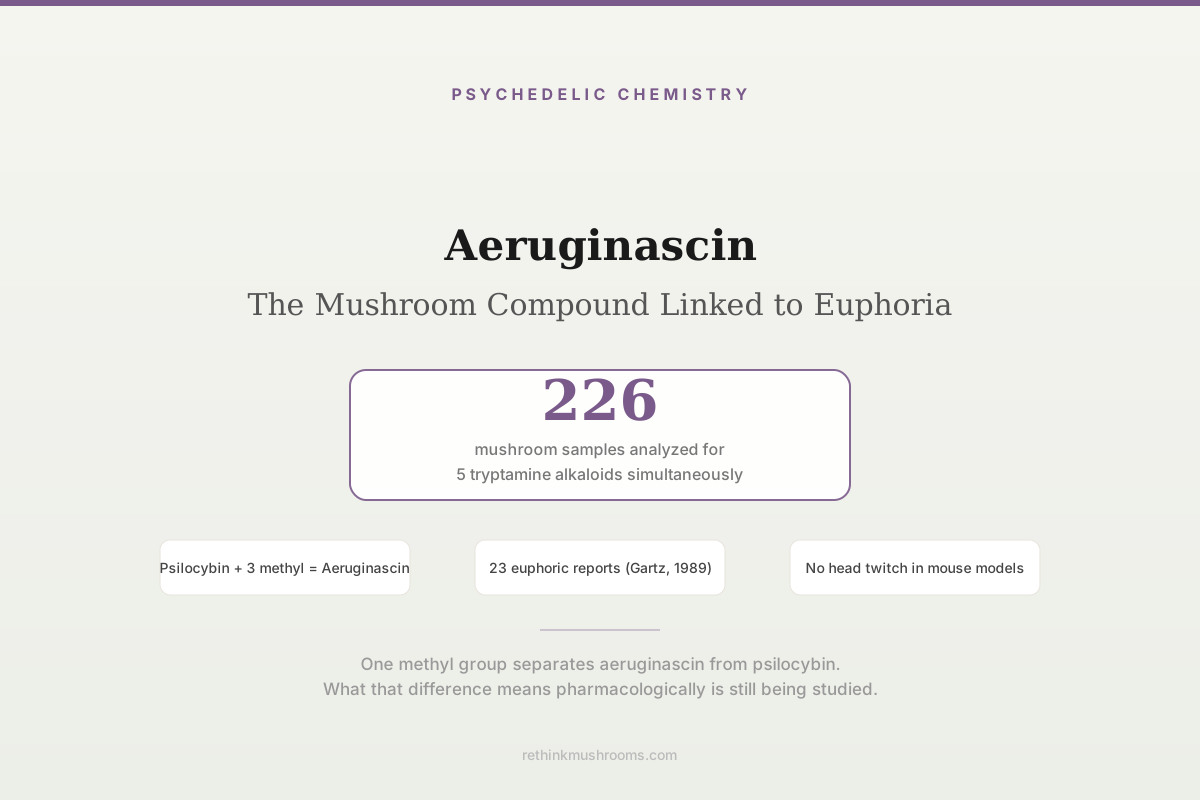
A 2022 analysis of 226 psychotropic mushroom fruiting bodies from 82 collections measured aeruginascin alongside psilocybin, psilocin, baeocystin, and norbaeocystin. Tryptamine concentrations varied enormously across species and even within species.
Gotvaldova et al., IJMS, 2022
5 Tryptamines
now measurable in mushroom tissue
1989
first link to euphoric experiences
No Head Twitch
in mouse models at tested doses
Gotvaldova et al., IJMS, 2022
 View as image ↗
Aeruginascin is a naturally occurring tryptamine alkaloid found in certain psilocybin-containing mushroom species. Its chemical name is N,N,N-trimethyl-4-phosphoryloxytryptamine. It differs from psilocybin by a single methyl group: where psilocybin has two methyl groups on its nitrogen (a tertiary amine), aeruginascin has three (a quaternary ammonium compound). That structural difference may change how the compound interacts with serotonin receptors, crosses the blood-brain barrier, and contributes to the overall experience produced by mushrooms that contain it. For a broader overview of the full chemical profile of psychedelic mushrooms, that article covers all the tryptamines. The question of whether minor tryptamines produce an entourage effect gets its own analysis.
Key Takeaways
- Aeruginascin was first isolated from Inocybe aeruginascens and structurally identified as N,N,N-trimethyl-4-phosphoryloxytryptamine, a quaternary ammonium analogue of psilocybin (Jensen et al., Planta Medica, 2006)
- In mouse models, only tertiary amines (psilocybin, psilocin, psilacetin) produced head twitch responses indicative of psychedelic activity; baeocystin and aeruginascin did not at tested doses (Glatfelter et al., ACS Pharmacology, 2022)
- Tryptamine alkaloid concentrations were measured in 226 fruiting bodies from 82 collections across 7 genera, with aeruginascin concentrations reported for many species for the first time (Gotvaldova et al., IJMS, 2022)
- Baeocystin's putative metabolite norpsilocin had potent 5-HT2A agonist activity in vitro, but baeocystin itself did not produce psychedelic-like activity in mice (Sherwood et al., Journal of Natural Products, 2020)
- Psilocybin and its four analogues show variable stability in dried mushroom biomass, with degradation rates differing by compound (Gotvaldova et al., Drug Testing and Analysis, 2021)
- A 1989 analysis of 23 accidental Inocybe aeruginascens intoxications reported exclusively euphoric outcomes, unlike mixed reactions from non-aeruginascin-containing species
Discovery and Structure
Aeruginascin was first described as a distinct compound in Inocybe aeruginascens, a psilocybin-containing mushroom species. Jensen, Gartz, and Laatsch published its structural identification in Planta Medica in 2006.[1] They determined it to be the quaternary ammonium compound N,N,N-trimethyl-4-phosphoryloxytryptamine. The paper noted that aeruginascin is structurally related to bufotenidine (5-HTQ), a frog skin toxin and potent 5-HT3 receptor agonist.
The structural relationship to psilocybin is direct. Psilocybin (4-phosphoryloxy-N,N-dimethyltryptamine) is a tertiary amine with two methyl groups on its nitrogen. Aeruginascin adds a third methyl group, creating a permanent positive charge. This charge has pharmacological consequences: quaternary ammonium compounds generally cross the blood-brain barrier less efficiently than their tertiary counterparts. Whether aeruginascin itself reaches the brain at meaningful concentrations, or acts through a dephosphorylated metabolite (4-hydroxy-N,N,N-trimethyltryptamine, or 4-HO-TMT), remains an open question.
The Euphoria Connection: What the Evidence Actually Shows
The claim that aeruginascin makes mushroom experiences "friendlier" traces to a single data source. In 1989, Jochen Gartz analyzed 23 cases of accidental Inocybe aeruginascens intoxication. All 23 cases involved exclusively euphoric experiences. This contrasted with reports from accidental ingestion of other psilocybin mushrooms (containing only psilocybin and psilocin), where some individuals reported dysphoric or anxious reactions.
Gartz hypothesized that aeruginascin modified the psychedelic effect of the co-occurring tryptamines, producing an overall euphoric feeling. This hypothesis has been widely cited in popular discussion of the "mushroom entourage effect." Several limitations apply: the sample was small (23 cases), the reports were retrospective, no plasma concentrations were measured, and the species identification was the primary variable (different species contain different ratios of all tryptamines, not just different aeruginascin levels). The euphoria could have been caused by aeruginascin, by the overall tryptamine ratio in Inocybe aeruginascens, by the lower total psilocybin content in that species, or by factors unrelated to chemistry.
Pharmacology: What Happens at Serotonin Receptors
Two major pharmacological studies have addressed aeruginascin and related tryptamines directly.
Sherwood and colleagues published a synthesis and biological evaluation of norbaeocystin, baeocystin, norpsilocin, and aeruginascin in the Journal of Natural Products in 2020.[2] Their key findings: baeocystin did not produce psychedelic-like activity in the mouse head twitch response assay, despite the fact that its putative dephosphorylated metabolite norpsilocin showed potent 5-HT2A agonist activity in vitro. This means the phosphorylated form (the one that exists in the mushroom) did not produce the behavioral proxy for a psychedelic experience, even though its broken-down form binds the relevant receptor. The implication is that metabolism and pharmacokinetics, not just receptor binding, determine whether a compound produces a psychedelic effect.
Glatfelter and colleagues expanded this work in a 2022 study published in ACS Pharmacology and Translational Science.[3] They tested psilocybin, baeocystin, aeruginascin, and their 4-acetoxy and 4-hydroxy analogues using radioligand binding assays in transfected cells, calcium mobilization assays, beta-arrestin 2 recruitment assays, and in vivo mouse experiments. The results were clear on one point: only the tertiary amines (psilocybin, psilocin, and psilacetin) induced head twitch responses (ED50 0.11-0.29 mg/kg) indicative of psychedelic-like activity. Head twitches were blocked by 5-HT2A antagonist pretreatment, confirming serotonin 2A involvement.
Baeocystin and aeruginascin did not produce head twitch responses at tested doses. Both secondary and tertiary amines decreased body temperature and locomotor activity at higher doses, effects that were blocked by 5-HT1A antagonist pretreatment. This means the minor tryptamines may have non-psychedelic serotonergic activity (through 5-HT1A) without producing the hallmark psychedelic response (through 5-HT2A).
The aeruginascin metabolite 4-HO-TMT has been separately synthesized and tested. Competitive radioligand binding assays show it binds at human 5-HT1A, 5-HT2A, and 5-HT2B receptors with inhibition constants of 4,400, 670, and 120 nM respectively. These affinities are weaker than psilocin's at 5-HT2A but the 5-HT2B affinity is notable. Whether 4-HO-TMT forms from aeruginascin in vivo and reaches serotonin receptors at functionally relevant concentrations has not been established.
How Much Aeruginascin Is in Mushrooms?
Gotvaldova and colleagues answered this question with the largest alkaloid profiling study to date, published in the International Journal of Molecular Sciences in 2022.[4] They measured psilocybin, psilocin, baeocystin, norbaeocystin, and aeruginascin in 226 fruiting bodies from 82 individual collections across seven mushroom genera, using ultra-high performance liquid chromatography coupled with tandem mass spectrometry. For many species, aeruginascin concentrations were reported for the first time.
The findings confirm what earlier, smaller studies suggested: tryptamine concentrations are extremely variable. Different species contain different tryptamine profiles. Psilocybe species had the highest psilocybin and psilocin concentrations overall, but no tryptamines were detected in P. fuscofulva and P. fimetaria collections. The paper explicitly noted that "the varied cocktail of tryptamines in wild mushrooms could influence the medicinal effect compared to therapy with chemically pure PSB." The corollary of understanding what baeocystin and norbaeocystin do fills in the rest of the tryptamine picture. The question of whether these minor compounds change the experience is explored separately.
A separate stability study by Gotvaldova and colleagues (2021) measured the stability of psilocybin and four of its analogues in dried Psilocybe cubensis biomass.[5] They found that degradation rates differ by compound, meaning the tryptamine ratio in a mushroom changes over time after harvest. This has direct implications for entourage effect claims: the ratio of tryptamines a person ingests depends not only on the species but on how the mushroom was stored and how long ago it was dried.
What Aeruginascin Does Not Tell Us
The current evidence has several gaps:
No human pharmacological studies exist for aeruginascin or 4-HO-TMT. All receptor binding and behavioral data come from in vitro assays and mouse models. The head twitch response is a well-validated behavioral proxy for psychedelic activity in mice, but mice are not humans.
The euphoria claim rests on 23 retrospective reports from a single species. Those reports did not control for dose, set, setting, individual variation, or the overall tryptamine profile of the mushrooms consumed. Attributing the euphoria specifically to aeruginascin rather than the full chemical cocktail of Inocybe aeruginascens is a hypothesis, not a conclusion.
Blood-brain barrier penetration is unknown. As a quaternary ammonium compound, aeruginascin carries a permanent positive charge that typically limits CNS penetration. Whether it crosses at relevant concentrations, and whether its metabolite 4-HO-TMT forms and accumulates in the brain, are unanswered questions.
The entourage effect remains unproven. The concept is borrowed from cannabis pharmacology. In the mushroom context, no controlled study has compared the subjective effects of pure psilocybin against a matched dose of psilocybin combined with aeruginascin, baeocystin, or other minor tryptamines in humans.
The Bottom Line
Aeruginascin is a real compound with a defined structure: the trimethylated, quaternary ammonium analogue of psilocybin. It was first found in Inocybe aeruginascens, and 23 accidental intoxications with that species produced exclusively euphoric reports. Pharmacological studies show that aeruginascin and baeocystin do not produce psychedelic-like head twitch responses in mice at tested doses, though they may have non-psychedelic serotonergic effects through 5-HT1A. The largest alkaloid survey to date confirms that aeruginascin occurs in multiple mushroom species at variable concentrations. Whether it contributes to a "friendlier" experience in humans requires controlled studies that do not yet exist.
Frequently Asked Questions
Sources & References
- 1RTHM-00101·Jensen, Niels et al. (2006). “Aeruginascin, a trimethylammonium analogue of psilocybin from the hallucinogenic mushroom Inocybe aeruginascens..” Planta medica.Study breakdown →PubMed →↩
- 2RTHM-00654·Sherwood, Alexander M et al. (2020). “Synthesis and Biological Evaluation of Tryptamines Found in Hallucinogenic Mushrooms: Norbaeocystin, Baeocystin, Norpsilocin, and Aeruginascin..” Journal of natural products.Study breakdown →PubMed →↩
- 3RTHM-00759·Glatfelter, Grant C et al. (2022). “Structure-Activity Relationships for Psilocybin, Baeocystin, Aeruginascin, and Related Analogues to Produce Pharmacological Effects in Mice..” ACS pharmacology & translational science.Study breakdown →PubMed →↩
- 4RTHM-00762·Gotvaldová, Klára et al. (2022). “Extensive Collection of Psychotropic Mushrooms with Determination of Their Tryptamine Alkaloids..” International journal of molecular sciences.Study breakdown →PubMed →↩
- 5RTHM-00688·Gotvaldová, Klára et al. (2021). “Stability of psilocybin and its four analogs in the biomass of the psychotropic mushroom Psilocybe cubensis..” Drug testing and analysis.Study breakdown →PubMed →↩