Psilocybin Mushroom Strains
0.879% to 1.36%
Total psilocybin and psilocin content across five pigmented Psilocybe cubensis strains, measured in one laboratory by mass spectrometry. None of the five were albino — the spread exists without pigmentation entering the picture at all.
Goff et al., Analytica Chimica Acta, 2024
Separate pathways
psilocybin is built from tryptophan, melanin from tyrosine — no shared enzyme or intermediate
Over 10×
variation in psilocybin between collections from different sources (Bigwood & Beug 1982)
Never tested
no study has compared an albino mutant against its own pigmented parent
Goff et al., Analytica Chimica Acta, 2024
 View as image ↗
Albino Psilocybe cubensis strains have a reputation in cultivation communities for being unusually potent. Albino Penis Envy (APE) in particular is often described as one of the strongest available P. cubensis varieties. That reputation has hardened into a widely repeated assumption: that albinism itself is somehow connected to psilocybin production, and that a whiter mushroom is a stronger one.
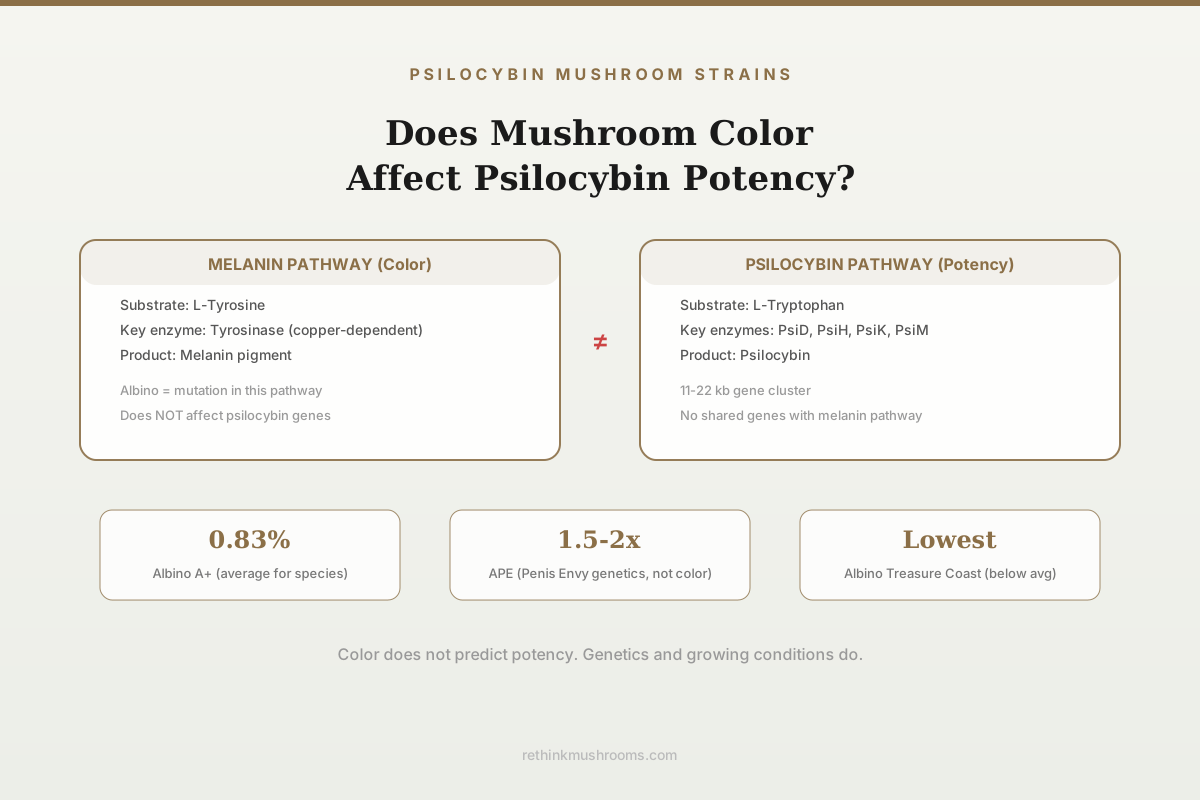
The published biochemistry does not support the connection. Psilocybin is assembled from tryptophan by four dedicated enzymes encoded together in a single biosynthetic gene cluster.[2][7] Mushroom melanin is assembled from tyrosine — and from a second, entirely separate naphthalene route — by an unrelated set of oxidases.[8] The two systems share no substrate, no enzyme, and no known regulatory link. When a strain like APE is both albino and potent, the most parsimonious reading is that two independent traits ended up in the same cultivated lineage, not that one causes the other.
That is the short answer. The longer and more interesting one is that we can now say something specific about why the Penis Envy lineage is potent — and it turns out to be a documented structural change in the psilocybin gene cluster itself, sitting nowhere near a pigment gene. For a broader look at how strain genetics relate to potency and what we know about mushroom strain variation genetics, see our dedicated articles.
Key Takeaways
- Psilocybin biosynthesis runs from L-tryptophan through four characterised enzymes — PsiD, PsiH, PsiK and PsiM — while mushroom melanin is built from L-tyrosine via the Raper–Mason route and from a separate 1,8-dihydroxynaphthalene route; the two pathways share no substrate, enzyme or intermediate (Fricke et al., 2017; Ma et al., 2022)
- The psilocybin genes sit together in one biosynthetic gene cluster consisting of a tryptophan decarboxylase, one to two P450 monooxygenases, a methyltransferase, a phosphotransferase and one to two transporters — a discrete genomic unit that has been horizontally transferred between mushroom genera without carrying pigment genes with it (Reynolds et al., 2018; Bradshaw et al., 2024)
- Across five pigmented P. cubensis strains measured by LC-MS/MS in a single laboratory, total psilocybin and psilocin ran from 0.879% (Thai Cubensis) to 1.36% (Creeper) — a 1.5-fold spread with no albino strain involved (Goff et al., 2024)
- Environmental variation is larger than that strain spread: psilocybin varied over a factor of four between flushes of the same culture, and by over a factor of ten between collections obtained from different outside sources (Bigwood and Beug, 1982)
- Psilocin behaves differently again — it was generally absent from the first fruiting of a culture, sometimes the second, and reached its maximum only by the fourth flush, meaning harvest number changes not just how much a mushroom contains but which alkaloids it contains (Bigwood and Beug, 1982)
- A draft genome assembly of Penis Envy identified a 4.6 kb insertion at the 3' end of the psiM methyltransferase gene, a structural variant resembling one seen in the more potent Psilocybe cyanescens — a candidate explanation for the lineage's potency located inside the psilocybin cluster, not in any pigment gene (McKernan et al., 2021)
- The one pigment in Psilocybe that genuinely tracks psilocybin is the blue bruise, and it forms by destroying psilocybin: the phosphatase PsiP and the oxidase PsiL convert it to psilocin and then to blue psilocyl oligomers (Lenz et al., 2020)
- No isogenic experiment — an albino mutant against its own pigmented parent under matched conditions — has ever been published, so the causal question the debate turns on remains formally untested
Two Separate Biochemical Pathways
How Mushrooms Make Pigment
Melanin is the pigment responsible for the tans, ochres and browns of a typical Psilocybe cap. It is not a single molecule but a class of polymers, and mushrooms make more than one kind. A detailed pathway study in the edible wood ear mushroom Auricularia auricula found that its melanin was composed of eumelanin, pheomelanin and 1,8-dihydroxynaphthalene (DHN) melanin, produced through two distinct routes: the Raper–Mason pathway, which runs from tyrosine through L-DOPA and dopaquinone, and a separate DHN pathway.[8]
The rate-limiting enzyme on the Raper–Mason side is tyrosinase, a copper-dependent oxidase. The key inputs are the amino acid L-tyrosine and copper. Neither is used anywhere in psilocybin production.
It is worth being precise about the limits here, because this is exactly where confident-sounding claims tend to outrun the evidence. The enzyme-level melanin work has been done in other mushroom genera, not in Psilocybe. And despite decades of cultivation, no published study has identified the causal mutation behind any commercial albino P. cubensis line. In fungi generally, loss of pigmentation can arise from a lesion almost anywhere along the melanin route — the structural enzyme, the copper handling that enzyme depends on, or the regulation upstream of both. Which of those is disrupted in Albino Penis Envy or Albino A+ is simply not known. What is known is that whichever it is, it lies outside the psilocybin cluster.
The distinction between "albino" and "leucistic" is used loosely in cultivation, and the underlying genetics of neither has been described in Psilocybe. In practice the terms describe appearance: leucistic strains are partially depigmented and often retain coloured spores, while strains sold as albino are more completely white. The widely traded Albino A+ is described in the review literature as having distinctive white, leucistic fruiting bodies rather than true albinism.[1] Neither condition has any documented effect on alkaloid biosynthesis.
How Mushrooms Make Psilocybin
Psilocybin biosynthesis was elucidated by Fricke and colleagues in 2017, who characterised four enzymes and reconstituted the reaction outside the mushroom.[2] The pathway starts from L-tryptophan — not L-tyrosine — and proceeds through four steps:
- PsiD, representing a new class of fungal L-tryptophan decarboxylases, removes the carboxyl group to give tryptamine
- PsiH, a P450 monooxygenase, hydroxylates the 4-position
- PsiK, a phosphotransferase, phosphorylates the 4-hydroxyl group, producing norbaeocystin
- PsiM, a methyltransferase catalysing iterative N-methyl transfer as the terminal step, produces baeocystin and then psilocybin
Fricke's team demonstrated the route by running a combined PsiD/PsiK/PsiM reaction from 4-hydroxy-L-tryptophan, a step-economic shortcut that bypasses the PsiH hydroxylation — which is why the paper is described as an enzymatic synthesis rather than a full end-to-end reconstitution from tryptophan.
Two Pathways, Zero Shared Parts
What Builds Psilocybin and What Builds Pigment
Trace both routes from their starting amino acid to their finished product and look for a point where they touch. They begin at different substrates, run on different enzymes, and sit at different places in the genome. Knocking out one leaves the other intact — which is why an albino fruiting body still makes psilocybin, and a deeply pigmented one is not thereby stronger.
Psilocybin route
L-tryptophan
starting substrate
decarboxylase
tryptamine
P450 monooxygenase
4-hydroxytryptamine
phosphotransferase
norbaeocystin
N-methyltransferase
baeocystin → psilocybin
Four characterised enzymes, encoded together in a single biosynthetic gene cluster alongside one to two MFS transporters (PsiT).
Melanin route
L-tyrosine
starting substrate
copper-dependent oxidase
L-DOPA
Raper–Mason route
dopaquinone
oxidative coupling
eumelanin / pheomelanin
Mushroom melanin is a mixture of eumelanin, pheomelanin and DHN-melanin; a parallel DHN route runs from acetyl units rather than tyrosine. Albino mutations disable this branch.
| Possible point of contact | Psilocybin | Melanin |
|---|---|---|
| Starting amino acid | L-tryptophan | L-tyrosine |
| Enzymes | PsiD, PsiH, PsiK, PsiM | tyrosinase, laccases |
| Genomic organisation | one Psi gene cluster | separate loci |
| Shared intermediate | — none — | — none — |
One caveat worth stating plainly: the enzyme-level melanin work shown here was done in other mushroom genera, not in Psilocybe. What is established is that the two pathways are chemically and genetically distinct wherever they have been characterised, not that anyone has knocked out pigment in a Psilocybe strain and re-measured its alkaloids. That experiment has not been published.
Sources: Fricke et al. 2017 (Angew Chem Int Ed 56:12352) for the four psilocybin enzymes and step order; Reynolds et al. 2018 (Evol Lett 2:88–101) for cluster composition including PsiT; Ma et al. 2022 (J Basic Microbiol 62:843–856) for the Raper–Mason and DHN melanin routes in mushrooms; Bradshaw et al. 2024 (PNAS 121:e2311245121) for the psilocybin cluster as a discrete biosynthetic locus.
Where These Genes Actually Sit
The psilocybin genes are not scattered across the genome. They travel together as a biosynthetic gene cluster, and its composition has been described precisely: a tryptophan decarboxylase (PsiD), one to two P450 monooxygenases (PsiH), a methyltransferase (PsiM), a phosphotransferase (PsiK), and one to two MFS transporters (PsiT).[7] Reynolds and colleagues found this cluster in three hallucinogenic mushroom genomes and reported evidence that it had moved horizontally between fungal lineages; the orthologs they identified shared 75–95% sequence similarity with the cluster Fricke's group had characterised concurrently.
Bradshaw and colleagues later mapped the cluster's evolutionary history across the genus shotgun sequencing of fungarium specimens, from which they obtained 71 metagenomes including 23 from type specimens, and a phylogenomic analysis of 2,983 single-copy gene families.[3] Their molecular clock places the stem lineage of Psilocybe at roughly 67 million years ago. Psilocybin biosynthesis, they conclude, first arose in Psilocybe, with four to five possible horizontal transfers into other mushroom genera between about 40 and 9 million years ago — into Panaeolus, Gymnopilus, Pluteus and Pholiotina. They also found two distinct gene orders within the cluster, corresponding to a deep split in the genus and possibly reflecting two independent acquisitions.
None of those transfer events is reported to have carried pigment genes along with the psilocybin cluster. That is an argument from what the analyses did not find rather than a positive result, and it should be read as such — but it is consistent with everything else: the psilocybin cluster behaves as a self-contained genetic module that can move into an unrelated mushroom and function there, which is difficult to reconcile with any dependence on the recipient's pigmentation machinery.
A related genomic survey by Dörner and colleagues examined the genomes of five Psilocybe species and found the genus capable of far more secondary metabolism than chemical analyses had revealed, identifying P. cyanescens and P. mexicana as aeruginascin producers and detecting compounds such as lumichrome and verpacamide A.[4] The relevant point for the colour question is a negative one: this survey of what Psilocybe genomes encode turned up no link between the alkaloid machinery and pigmentation.
What the Potency Data Actually Shows
If pigmentation drove potency, it would have to compete with the factors that demonstrably do. It does not compete well, because it has never been entered in the race.
What Actually Moves Potency
The Measured Sources of Variation, Largest First
Each bar is a fold difference in tryptamine content that someone has actually measured and published. The ordering is the argument: the two largest effects have nothing to do with genetics at all, and the one comparison the colour debate turns on has never been run.
- Between separate collectionsover 10×
Psilocybin content across samples obtained from different outside sources — different growers, substrates and handling. (Bigwood & Beug 1982)
- Flush to flush, one culture4×
Psilocybin varied over a factor of four across repeated harvests of genetically identical mycelium, with no upward or downward trend. (Bigwood & Beug 1982)
- Cap vs stipe, same mushroom~2×
Caps 1.03 wt.% vs stipes 0.52 wt.% total tryptamines — but the authors report this difference as not statistically significant, because between-mushroom variability swamps it. (Gotvaldová et al. 2021)
- Strain to strain, one lab1.5×
Five Psilocybe cubensis strains by LC-MS/MS in a single laboratory: Creeper 1.36% down to Thai Cubensis 0.879% total psilocybin + psilocin. None of the five were albino. (Goff et al. 2024)
- Albino vs pigmentednot measured
No study has compared an albino mutant against its own pigmented parent under matched conditions. There is no fold change to plot — not a small one, an absent one.
One measured effect is deliberately left off the axis. In the same 1982 experiment, psilocin was generally absent from the first fruiting — sometimes the second — and reached its maximum by the fourth flush. That is a change from approximately zero, which has no meaningful fold value and would be misrepresented as a bar. It is also the single clearest demonstration that harvest timing, not appearance, governs what a given mushroom contains.
Sources: Bigwood & Beug 1982 (J Ethnopharmacol 5:287–291); Gotvaldová et al. 2021 (Drug Test Anal 13:439–446); Goff et al. 2024 (Anal Chim Acta 1288:342161).
Strain-to-Strain Variation
Goff and colleagues quantified psilocybin and psilocin in five P. cubensis strains using liquid chromatography with tandem mass spectrometry, analysing three whole intact mushrooms individually per strain.[5] From most to least potent, average total psilocybin plus psilocin came out at 1.36% for Creeper, 1.221% for Blue Meanie, 1.134% for B+, 1.103% for Texas Yellow and 0.879% for Thai Cubensis.
Goff et al. (2024) · Analytica Chimica Acta
- Population
- Five strains of dried, intact Psilocybe cubensis: Blue Meanie, Creeper, B-Plus, Texas Yellow and Thai Cubensis — none albino
- Intervention
- LC-MS/MS quantification of psilocybin and psilocin with deuterated internal standards; three whole mushrooms analysed individually per strain
- Finding
- Average total psilocybin and psilocin ranged from 1.36% (Creeper) down to 0.879% (Thai Cubensis) by weight — a 1.5-fold spread entirely among pigmented strains. A subset was re-analysed at a separate non-affiliated laboratory with comparable results.
narrow-scope Strong analytical method, but five strains and three mushrooms each. The second laboratory reported improved precision only when multiple mushrooms were homogenised together first — a direct measure of how variable individual fruiting bodies are.
Goff R, et al. Anal Chim Acta. 2024;1288:342161. PMID 38220293
Two things follow. First, a 1.5-fold difference in potency arises among pigmented strains alone, so strain-level variation plainly does not require albinism to explain it. Second, the study's own methodological finding is the more telling one: precision improved when multiple mushrooms were homogenised together before extraction, which is a polite way of saying that individual mushrooms of the same strain differ enough to blur the measurement.
Flush-to-Flush Variation Within a Single Culture
The foundational work here is Bigwood and Beug's 1982 analysis of repeated harvests from the same P. cubensis culture, and its findings are more specific — and stranger — than they are usually reported to be.[6]
Psilocybin showed no upward or downward trend as fruiting progressed, but was variable over a factor of four. Psilocin behaved completely differently: it was generally at zero in the first fruiting of a given culture — sometimes even the second — and reached its maximum only by the fourth flush. Psilocybin was nearly always at least twice the level of psilocin. And samples obtained from outside sources varied by over a factor of ten from one collection to the next.
This also quietly corrects a common piece of cultivation lore. First flushes are frequently said to be the strongest. In the one systematic study of the question, psilocybin showed no such trend and psilocin ran the other way entirely.
Where in the Mushroom the Alkaloids Sit
Morphology is often invoked to explain strain potency: denser fruits, different cap-to-stipe ratios, different water content. Gotvaldová and colleagues dissected this directly, measuring tryptamines separately in caps, stipes, mycelium and spores of P. cubensis.[9]
Gotvaldová et al. (2021) · Drug Testing and Analysis
- Population
- Freshly cultivated Psilocybe cubensis fruiting bodies, separated into caps, stipes and basidiospores, plus mycelium
- Intervention
- UHPLC-MS quantification of psilocybin, psilocin, baeocystin, norbaeocystin and aeruginascin across tissue types and storage conditions
- Finding
- Stipes contained roughly half the tryptamine alkaloids of caps (0.52 wt.% vs 1.03 wt.%), but the authors state this difference was not statistically significant because alkaloid content in individual fruiting bodies is highly variable. No tryptamines were detected in basidiospores; mycelium contained only psilocin, at 0.47 wt.%.
mixed The cap-versus-stipe figures are widely quoted as established fact. The paper that produced them reports the difference as non-significant — the between-mushroom scatter is simply too large.
Gotvaldová K, et al. Drug Test Anal. 2021;13(2):439-446. PMID 33119971
This is worth dwelling on, because the 1.03% and 0.52% figures circulate widely as a settled two-to-one cap-to-stipe ratio. They come from a real measurement, but the authors explicitly decline to call the difference significant. If the variation between individual mushrooms is large enough to swallow a two-fold anatomical difference within the same fruiting body, it is certainly large enough to swallow any pigment effect between strains.
A separate review notes an older result pointing the same direction — in Psilocybe bohemica, fruiting body psilocybin ranged from 0.11% to 1.34% by dry weight with the highest concentrations found in the caps — though that is a different species and a different laboratory.[1]
How Wide the Range Gets Across the Genus
The larger surveys make the scale of natural variation hard to ignore. Gotvaldová and colleagues later determined five tryptamine alkaloids across 226 fruiting bodies from 82 individual collections spanning seven mushroom genera, most documented by fungarium specimens or DNA sequencing.[12] The highest psilocybin and psilocin concentrations were found in Psilocybe species, but no tryptamines at all were detected in the P. fuscofulva and P. fimetaria collections. Their conclusion is blunt: tryptamine concentrations in mushrooms are extremely variable, which they frame as a genuine overdose risk for consumers.
The review literature puts psilocybin across published P. cubensis analyses at anywhere from trace amounts up to 19.9 mg/g — roughly 2% by dry weight — with psilocin varying so widely that some samples show none at all.[1] Within one surveyed subset, psilocybin ran from 0.208 to 5.344 mg/g and psilocin from 0.651 to 3.509 mg/g. Against a range like that, a pigment effect would have to be enormous to be detectable at all — and nobody has detected one.
The Albino Strains That Are Not Potent
Here the evidence base thins out considerably, and it is important to be honest about that rather than borrow authority the data does not have.
The most-cited potency figures for named albino strains come from community analytical testing, principally the Oakland Hyphae Psilocybin Cup, which collects grower-submitted P. cubensis samples and measures tryptamine content. These datasets are the largest collections of strain-labelled potency measurements in existence, and within them albino strains appear across the full range rather than clustered at the top — some high, some middling, some at the bottom.
But this is not peer-reviewed literature. Samples are self-selected and grower-submitted, strain identity is self-reported, and cultivation conditions are uncontrolled and unrecorded. A PubMed search returns no peer-reviewed measurement of Albino Penis Envy, Albino A+ or Albino Treasure Coast potency at all. We are citing it here as what it is — a large, informative, non-peer-reviewed dataset — and not as an established finding, which is why no specific competition figure appears in this article's key takeaways.
The logical point survives the weak data, though, and does not actually depend on it. If albinism caused higher psilocybin production, albino strains would cluster at the high end of every distribution in which they appear. Nobody, in any dataset, reports that they do.
Fact Check
'Albino mushrooms are stronger'
The claim
“Albino Psilocybe cubensis strains are inherently more potent than pigmented ones, because the loss of pigment frees up resources for psilocybin production.”
The reputation of Albino Penis Envy, generalised from one potent lineage to albinism as a trait.
What research shows
UnsupportedPsilocybin and melanin are made from different amino acids by different enzymes encoded in different parts of the genome. Depigmentation does not redirect anything into psilocybin synthesis — the tryptophan psilocybin needs was never competing with the tyrosine melanin uses.
The honest position is not 'albinism lowers potency' either. No isogenic comparison has ever been published, so the causal claim is untested rather than refuted. What can be said is that every measured source of potency variation — harvest number, source, strain background, tissue type — is larger than any effect pigmentation has been shown to have, which is none.
Fricke 2017 (PMID 28763571); Ma 2022 (PMID 35419841); Bigwood & Beug 1982 (PMID 7201054); Goff 2024 (PMID 38220293)
Why Penis Envy Is Strong, and Why That Is Not About Colour
Until recently the potency of the Penis Envy lineage could only be explained by hand-waving — slower growth, denser fruits, "probably something in the genetics." A draft genome assembly of P. cubensis has since given the question a concrete answer to test.
McKernan and colleagues assembled the P. cubensis genome using high-fidelity long-read sequencing, producing a 46.6 Mb assembly in 32 contigs with a BUSCO completeness score of 97.6%.[11] The entire psilocybin synthesis cluster fell within a single 3.2 Mb contig. In the Penis Envy assembly specifically, they identified a 4.6 kb insertion at the 3' end of the psiM methyltransferase gene — a structural variation resembling one seen in the more potent Psilocybe cyanescens.
That is a genuinely important result for this article's question, and it needs stating with the right amount of confidence. It is a structural variant observed in a draft assembly, described as resembling a variant in a more potent species. It is a strong candidate mechanism, not a demonstrated cause: nobody has shown that this insertion raises alkaloid output, and a genome note is not a functional experiment. But it is a candidate located squarely inside the psilocybin biosynthetic cluster — in the gene encoding the enzyme that performs the final methylation steps — and nowhere near a pigment gene.
APE inherited the Penis Envy background along with a depigmentation trait. On the current evidence, the potency travelled with the psiM-containing cluster and the whiteness travelled with something else. They are co-inherited because they sit in the same cultivated lineage, not because they are linked. Cross an APE isolate with a low-potency pigmented strain and there is no biological reason the offspring could not be albino and weak, or pigmented and strong. For more on the lineage itself, see our article on why Penis Envy is significantly stronger.
| What varies between strains | Is it linked to pigmentation? | What the evidence says |
|---|---|---|
| Psilocybin gene cluster structure | No | A 4.6 kb psiM insertion distinguishes the Penis Envy assembly (McKernan 2021) |
| Cluster gene order | No | Two distinct gene orders exist across Psilocybe, tracking a deep phylogenetic split (Bradshaw 2024) |
| Total alkaloid content | Not demonstrated | 1.5-fold spread across five pigmented strains, no albino comparison run (Goff 2024) |
| Cap-to-stipe ratio | No | Caps ~2× stipes, but the difference is not statistically significant (Gotvaldová 2021) |
| Harvest number | No | Psilocybin varies 4-fold; psilocin rises from zero to maximum by flush four (Bigwood & Beug 1982) |
| Melanin production | Yes, by definition | Built from tyrosine by unrelated enzymes; no documented effect on alkaloids (Ma 2022) |
The One Place Where Colour and Psilocybin Really Are Connected
There is a colour in these mushrooms that does track psilocybin directly. It is just not the one anyone means.
Damage a psilocybin-containing mushroom and it turns intensely blue within seconds. Lenz and colleagues worked out the chemistry: two enzymes from P. cubensis carry out a two-step cascade that prepares psilocybin for oxidative oligomerisation.[10] The phosphatase PsiP removes the 4-O-phosphate group to yield psilocin; the oxidase PsiL then oxidises its 4-hydroxy group. Monitoring by in-situ carbon-13 NMR showed that oxidative coupling of the resulting psilocyl residues occurs primarily via C-5, producing a heterogeneous mixture of preferentially 3- to 13-unit oligomers. Those oligomers are the blue pigment. The authors also note the implication that psilocybin's phosphate ester serves a reversible protective function — it is what keeps the molecule stable until the tissue is broken.
The One Colour That Does Track Psilocybin
Why Bruised Mushrooms Turn Blue — and Why That Means Less, Not More
Damage a psilocybin-containing mushroom and it goes intensely blue within seconds. This is the only pigment in Psilocybe that is genuinely made out of psilocybin — and it forms by taking psilocybin apart. Each step below consumes the molecule people are trying to measure.
- 1/4
Psilocybin
Stable, colourless, phosphate-protected
- PsiPphosphatase strips the 4-O-phosphate2/4
Psilocin
Phosphate removed; now oxidisable
- PsiLoxidase acts on the 4-hydroxy group3/4
Psilocyl radicals
4-hydroxy group oxidised
- Oxidative couplingheterogeneous oligomer mixture4/4
Psilocyl 3- to 13-mers
Coupled primarily via C-5 — the blue pigment
Blue bruise
Made of psilocybin. Present in albino strains too — they bruise blue like any other, which is itself evidence that losing pigment leaves the psilocybin machinery untouched.
Brown cap
Melanin. Built from tyrosine by an unrelated set of enzymes, and the pigment that albino and leucistic strains lack. It contains no psilocybin and reports nothing about how much is present.
The practical reading runs against intuition. Heavy blue bruising marks material in which psilocybin has already been converted to psilocin and then polymerised into something inactive, so an intensely blue specimen is not a more potent one. Lenz and colleagues suggest the phosphate group on psilocybin serves a reversible protective function — it is what keeps the molecule stable until something breaks the tissue.
Sources: Lenz et al. 2020 (Angew Chem Int Ed 59:1450–1454) for the PsiP/PsiL cascade, C-5 coupling and 3- to 13-mer products; Ma et al. 2022 (J Basic Microbiol 62:843–856) for mushroom melanin chemistry.
Why Nobody Can Answer This Cleanly Yet
Two further problems sit underneath every strain-potency comparison ever published, and both make the colour question harder rather than easier.
The first is identity. Bradshaw and colleagues re-examined 94 Psilocybe fungarium specimens representing 18 species by DNA barcoding and found that, apart from a few well-known species, the taxonomic accuracy of specimen determinations was largely unreliable — in some cases even at the genus level — compounded by poor-quality and mislabelled sequence data in public repositories.[13] If species-level labels on museum vouchers cannot be trusted, cultivar labels on grower-submitted samples deserve considerably more scepticism than they usually get.
The second is decay. The same study evaluated psilocybin and psilocin stability across 25 specimens and found taxon- and time-dependent degradation, with some specimens containing no detectable quantities of either. Gotvaldová's work found the same thing from the storage side. A potency figure is therefore a measurement of a particular sample, handled and stored a particular way, at a particular moment — not a fixed property of a strain.
- Pathway biochemistrycompleted
Both pathways characterised at the enzyme level; psilocybin route fully described (Fricke 2017, Ma 2022)
- Comparative genomicscompleted
Cluster composition, evolution and a Penis Envy structural variant all described (Reynolds 2018, Bradshaw 2024, McKernan 2021)
- Observational potency measurementscurrent
Strain comparisons in confounded, non-isogenic material; plus large non-peer-reviewed community datasets
- Controlled isogenic comparisonmissing
An albino mutant against its own pigmented parent under matched conditions — never published
- Replicated multi-flush isogenic studymissing
Would need multiple flushes and biological replicates to clear the known 4-fold environmental variation
- Pooled synthesismissing
Nothing to pool — there are no controlled comparisons to combine
The mechanistic case that pigmentation and psilocybin are independent is strong and rests on characterised enzymes and sequenced genomes. The direct empirical test of whether albinism changes potency has never been run — so the correct description is 'no mechanism, no measured effect, and no controlled test', not 'proven to make no difference'.
Fricke 2017 (PMID 28763571); Reynolds 2018 (PMID 30283667); McKernan 2021 (PMID 34322225); Bradshaw 2024 (PMID 38194448)
Research Gap
What would settle the albino potency question
What experiment would actually determine whether losing pigmentation changes psilocybin content?
An isogenic pair
Generate an albino mutant from a known pigmented strain, or restore pigment to an albino one, so the two differ at the pigment locus and essentially nowhere else.
Matched growing conditions
Identical substrate, temperature, humidity, light and harvest timing — the variables shown to move psilocybin by a factor of four.
Multiple flushes and replicates
Enough harvests and biological replicates to clear the documented flush-to-flush variation, including the psilocin shift from zero to maximum by flush four.
Genotype confirmation
DNA verification of both variants, given how unreliable Psilocybe labels have proven to be even in curated collections.
Validated quantification
LC-MS/MS and UHPLC-MS methods for these alkaloids are established and cross-laboratory reproducible — this is the one piece already in place.
Bigwood & Beug 1982 (PMID 7201054); Goff 2024 (PMID 38220293); Bradshaw 2022 (PMID 36445079)
The reason this straightforward experiment has not been done is largely regulatory. Psilocybin-containing mushrooms remain controlled in most jurisdictions, which makes routine agricultural research on cultivars legally awkward in a way that it is not for, say, tomatoes. Bradshaw's team make a version of this point directly, noting the implications of their findings for policies governing the storage and sharing of fungarium specimens. The result is that cultivation-community knowledge has run ahead of formal investigation on exactly the questions growers care most about — and the community's answer to this one appears to be mistaken.
Until that isogenic experiment is run, the defensible conclusion is that pigmentation and psilocybin content are independent traits: they share no enzymes, no substrates, and no known regulatory connection, and no measurement has ever isolated an effect of one on the other. Whether a specific strain variety produces a different subjective experience is a separate question from raw alkaloid content, and one with even less controlled data behind it. For context on how psilocybin acts once consumed regardless of source strain, see the research on 5-HT2A receptor density and psilocybin response.
Safety & Legal Context
CriticalPotency cannot be judged by appearance, and mislabelling is well documented
Concern
The measurements in this article show that tryptamine content varies by over a factor of ten between collections, by a factor of four between flushes of one culture, and unpredictably between individual mushrooms of the same strain. Psilocin can be absent from early flushes entirely. DNA barcoding of curated Psilocybe collections found species labels unreliable even at genus level, and researchers characterise the variability in wild and grower-sourced material as posing a genuine risk of overdose.
What the research says
No visual feature — colour, size, density, degree of blue bruising — provides a usable estimate of alkaloid content. Blue bruising in particular indicates psilocybin that has already been converted to inactive oligomers, not a stronger specimen. Only laboratory quantification of a specific, homogenised sample gives a meaningful figure, and it applies to that sample alone.
Particularly relevant for: Misidentification risk extends beyond potency: several genera contain species that are seriously toxic and superficially similar to psychoactive ones, and foraged material carries identification risks that no potency discussion addresses.
What to do
Psilocybin remains a Schedule I controlled substance under US federal law and is controlled in most jurisdictions. This article describes analytical and genomic research findings and is not medical advice, nor guidance on obtaining or using these mushrooms.
Bigwood & Beug 1982 (PMID 7201054); Gotvaldová 2022 (PMID 36430546); Bradshaw 2022 (PMID 36445079); Lenz 2020 (PMID 31725937)
The Bottom Line
Melanin pigmentation and psilocybin biosynthesis are built by separate machinery: psilocybin from tryptophan via PsiD, PsiH, PsiK and PsiM, encoded together in one biosynthetic gene cluster; melanin from tyrosine via tyrosinase and a separate naphthalene route. They share no substrate, enzyme or intermediate, and the psilocybin cluster has moved horizontally between mushroom genera as a self-contained module. The measured drivers of potency are all larger than any pigment effect ever detected — over ten-fold between collections, four-fold between flushes of one culture, 1.5-fold across five pigmented strains — and psilocin can be absent from early flushes altogether. Penis Envy's potency now has a concrete candidate explanation in a 4.6 kb insertion in the psiM gene, inside the psilocybin cluster and nowhere near a pigment gene. The one pigment that genuinely tracks psilocybin is the blue bruise, and it forms by destroying it. What remains genuinely unresolved is that no one has ever compared an albino mutant with its own pigmented parent under controlled conditions — the question is untested rather than settled.
Frequently Asked Questions
Sources & References
- 1RTHM-00932·Kurzbaum, Eyal et al. (2025). “Exploring Psilocybe cubensis Strains: Cultivation Techniques, Psychoactive Compounds, Genetics and Research Gaps..” Journal of fungi (Basel.Study breakdown →PubMed →↩
- 2RTHM-00471·Fricke, Janis et al. (2017). “Enzymatic Synthesis of Psilocybin..” Angewandte Chemie (International ed. in English).Study breakdown →PubMed →↩
- 3RTHM-00865·Bradshaw, Alexander J et al. (2024). “Phylogenomics of the psychoactive mushroom genus Psilocybe and evolution of the psilocybin biosynthetic gene cluster..” Proceedings of the National Academy of Sciences of the United States of America.Study breakdown →PubMed →↩
- 4RTHM-00755·Dörner, Sebastian et al. (2022). “Genetic Survey of Psilocybe Natural Products..” Chembiochem : a European journal of chemical biology.Study breakdown →PubMed →↩
- 5RTHM-00879·Goff, Roman et al. (2024). “Determination of psilocybin and psilocin content in multiple Psilocybe cubensis mushroom strains using liquid chromatography - tandem mass spectrometry..” Analytica chimica acta.Study breakdown →PubMed →↩
- 6RTHM-00003·Bigwood, J et al. (1982). “Variation of psilocybin and psilocin levels with repeated flushes (harvests) of mature sporocarps of Psilocybe cubensis (Earle) Singer..” Journal of ethnopharmacology.Study breakdown →PubMed →↩
- 7RTHM-01000·Reynolds, Hannah T et al. (2018). “Horizontal gene cluster transfer increased hallucinogenic mushroom diversity..” Evolution letters.Study breakdown →PubMed →↩
- 8RTHM-00784·Ma, Zihui et al. (2022). “Studies on the biosynthetic pathways of melanin in Auricularia auricula..” Journal of basic microbiology.Study breakdown →PubMed →↩
- 9RTHM-00688·Gotvaldová, Klára et al. (2021). “Stability of psilocybin and its four analogs in the biomass of the psychotropic mushroom Psilocybe cubensis..” Drug testing and analysis.Study breakdown →PubMed →↩
- 10RTHM-01232·Lenz, Claudius et al. (2020). “Injury-Triggered Blueing Reactions of Psilocybe "Magic" Mushrooms..” Angewandte Chemie (International ed. in English).Study breakdown →PubMed →↩
- 11RTHM-02264·McKernan, Kevin et al. (2021). “A high-fidelity reference genome of the Psilocybe cubensis magic mushroom.” F1000Research.Study breakdown →PubMed →↩
- 12RTHM-00762·Gotvaldová, Klára et al. (2022). “Extensive Collection of Psychotropic Mushrooms with Determination of Their Tryptamine Alkaloids..” International journal of molecular sciences.Study breakdown →PubMed →↩
- 13RTHM-01490·Bradshaw, Alexander J et al. (2022). “DNA Authentication and Chemical Analysis of Psilocybe Mushrooms Reveal Widespread Misdeterminations in Fungaria and Inconsistencies in Metabolites..” Applied and environmental microbiology.Study breakdown →PubMed →↩