Psilocybin Strain Variation
50-100% more alkaloids
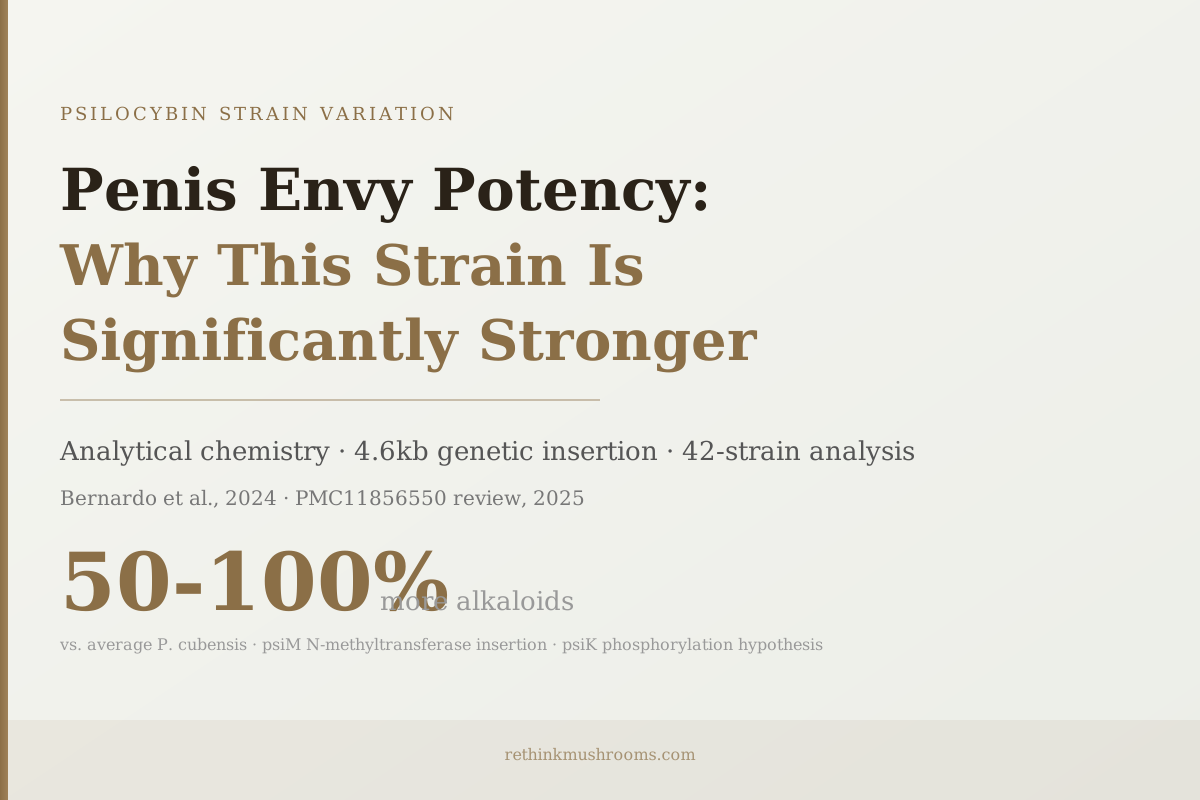
Analytical chemistry studies and crowd-sourced potency data consistently find Penis Envy P. cubensis strains contain 50-100% more total psilocybin-class alkaloids than average cubensis strains. A reference genome assembly identifies a specific genetic insertion that may explain why.
McKernan et al. 2021, F1000Research (PMC8220353)
4.6kb insertion
genetic change at the N-methyltransferase (psiM) gene found in the Penis Envy HiFi genome assembly
42 strains
analyzed in a comprehensive 2025 metabolomic profiling study of psilocybin-producing fungi
Storage matters
psilocybin degrades without proper storage, creating discrepancy between labeled and actual potency
McKernan et al. 2021, F1000Research (PMC8220353)
 View as image ↗
Penis Envy is the most frequently cited "strongest" Psilocybe cubensis strain in cultivation circles, and unlike many strain potency claims, this one has measurable data behind it. Analytical chemistry studies consistently find Penis Envy samples contain approximately 50-100% more psilocybin-class alkaloids than average P. cubensis. A high-fidelity reference genome assembly identified a specific genetic change in the psilocybin biosynthesis pathway that may explain why. This article covers what the chemistry data actually shows, what the genetics suggest, and what the variation data means for anyone using potency estimates to think about dose. This article is part of the broader guide to Psilocybe cubensis cultivation and strains.
Key Takeaways
- Analytical chemistry data from the Psilocybin Cup (crowd-sourced, N=thousands of submissions) and laboratory studies consistently shows Penis Envy containing 50-100% more total psilocybin-class alkaloids than the average P. cubensis strain
- Goff et al. (2024) measured psilocybin and psilocin content across multiple P. cubensis strains by LC-MS/MS, documenting real inter-strain potency differences (total alkaloid content ranged from 0.88% to 1.36% w/w across five strains)[1]
- The Psilocybe cubensis reference genome assembly (McKernan et al. 2021) identified a 4.6kb insertion at the N-methyltransferase (psiM) gene — part of the psilocybin biosynthesis pathway — in the Penis Envy HiFi genome assembly, providing a plausible genetic mechanism for the potency elevation[2]
- A comprehensive 42-strain metabolomic analysis (Cohen et al. 2025) documented substantial metabolite diversity both within and between psilocybin-producing strains, meaning "Penis Envy" from one source may differ substantially from another[4]
- Psilocybin and psilocin degrade with improper storage and processing (heat, moisture, light), so actual potency of a sample may differ significantly from initial measurements (Gotvaldová et al. 2021)[5]
- The higher alkaloid content means dose estimation based on average P. cubensis is unreliable for Penis Envy; starting with substantially less than a typical cubensis dose is a meaningful harm-reduction consideration
The Measured Potency Gap: What Analytical Chemistry Shows
Penis Envy mushroom potency is higher than average cubensis by a margin large enough to be consistently documented across multiple measurement approaches.
The Psilocybin Cup, run by Oakland Hyphae as a community science initiative since 2021, has compiled mass spectrometry and HPLC analytical data from thousands of voluntary submissions across multiple competition seasons. Penis Envy and its close genetic relatives (Albino Penis Envy, Trans Envy, Penis Envy Uncut) appear in the top percentiles of measured alkaloid content in virtually every Psilocybin Cup dataset reviewed. The average total tryptamine content of Penis Envy submissions typically runs 1.5-2 times the median for all P. cubensis submissions. This is crowd-sourced data with no pre-registration and some curation issues, but the sample size is large enough and the pattern consistent enough to treat as a real signal.
Goff and colleagues (2024) conducted laboratory measurements of psilocybin and psilocin content across five P. cubensis strains (Blue Meanie, Creeper, B+, Texas Yellow, and Thai Cubensis) by liquid chromatography–tandem mass spectrometry under controlled analytical conditions.[1] The study confirmed real inter-strain variability in total alkaloid content, ranging from 0.88% (Thai Cubensis) to 1.36% w/w (Creeper) — and also documented measurable variation between individual mushrooms of the same strain. Penis Envy was not among the strains Goff measured, but the result establishes that strain identity is a real, calibrated driver of potency. These laboratory values provide reference points that Psilocybin Cup crowd-sourced analytics approximate but cannot replace.
Penis Envy (PE) mushrooms contain 50-100% more total psilocybin-class alkaloids than average P. cubensis strains, based on analytical chemistry from both community submissions and laboratory studies. The genetic mechanism appears to involve a 4.6kb insertion in the N-methyltransferase gene (part of the psilocybin biosynthesis pathway). The practical implication: a sample that looks like a standard cubensis dose is not.
The 50-100% figure describes a central tendency. Individual samples vary. A given gram of Penis Envy could fall below the 50% elevation in a low-yield grow or above the 100% elevation from an exceptional cultivar. The range reflects real measurement variability, not a fixed number.
What Makes Penis Envy Different Genetically?
The explanation for Penis Envy's elevated potency is not fully characterized, but the high-fidelity Psilocybe cubensis reference genome assembly published by McKernan et al. (2021) provides the clearest published account of the genetic evidence.[2] A 2025 review of P. cubensis strains in the Journal of Fungi (PMC11856550) separately notes that the Penis Envy strain is recognized for its exceptional potency and distinct morphology, situating the genomic finding in the broader literature.[3]
The genome assembly describes a 4.6kb insertion found at the 3' end of the N-methyltransferase gene (psiM) in the "P. envy" HiFi assembly — a structural variation the authors note resembles the variation seen in the more potent species Psilocybe cyanescens. The N-methyltransferase enzyme is one of the four enzymes in the psilocybin biosynthesis pathway, specifically responsible for the final methylation step that converts norpsilocin to psilocybin. A structural change to this gene could alter enzyme activity, potentially increasing psilocybin production efficiency.
The psiK gene mutation hypothesis is a second proposed mechanism. psiK encodes the kinase enzyme that phosphorylates the psilocin precursor, a key step in the biosynthesis chain. Variations in psiK activity could affect how much of the substrate flows through to the final psilocybin product, and in what ratio psilocybin is produced relative to psilocin.
One of the observed features of Penis Envy samples is a shifted psilocin-to-psilocybin ratio compared to standard cubensis. Standard P. cubensis typically contains 98-99% psilocybin with very little free psilocin (which is more chemically unstable). Some Penis Envy analyses find a higher proportion of psilocin relative to total alkaloids, which could reflect altered psiK activity. This matters practically because psilocin is the active compound after dephosphorylation, and a higher psilocin fraction could mean faster onset.
Neither the psiM insertion nor the psiK variation has been functionally characterized in a controlled experiment confirming that these specific changes cause the potency elevation. The genome assembly documents the psiM insertion as a structural feature of the Penis Envy lineage; the psiK hypothesis is a mechanistic conjecture from the biosynthesis literature rather than a measured finding. Establishing causation requires targeted functional experiments not yet published.
The Biosynthesis Context: Where Genetics Meets Alkaloid Output
The four enzymes in the psilocybin biosynthesis pathway, encoded by the psilocybin gene cluster, convert tryptamine through a series of steps to the final product. In summary: tryptamine → 4-hydroxytryptamine → psilocin → psilocybin. The efficiency of each enzymatic step determines how much of the starting material becomes psilocybin, and variation at each enzyme can create different total yields and ratios.
What makes Penis Envy unusual is not that it operates through a different pathway. It uses the same four-enzyme system as all P. cubensis. What differs is apparently the efficiency or output of one or more of those enzymes. A gene insertion or mutation that makes the methyltransferase (psiM) work faster or the kinase (psiK) more efficiently would push more substrate through the pathway and produce more psilocybin per unit of substrate.
The deep genetics of the psilocybin gene cluster and how it varies across Psilocybe species are covered in the psilocybin gene cluster: genetics of magic mushrooms. For how environmental growing conditions interact with these genetic factors to determine actual measured potency, growing conditions and psilocybin content covers what can amplify or suppress the baseline genetic potential.
The Intra-Strain Problem: Not All "Penis Envy" Is Equally Potent
The 42-strain comprehensive metabolomic analysis published in 2025 in Scientific Reports documented a critical finding: substantial metabolite diversity both within and between psilocybin-producing strains, not just between species.[4] Goff et al. (2024) likewise found measurable content differences between individual mushrooms of the same strain.[1]
In plain terms: the variation in psilocybin content between two samples both labeled "Penis Envy" but grown by different cultivators under different conditions can be large enough to matter, potentially approaching the average difference between Penis Envy and a less potent strain.
This finding has significant implications. Penis Envy's elevated average potency is real. But "average" is a statistical property of a distribution, not a fixed property of each sample. A particular batch of Penis Envy could fall at the low end of its distribution and be substantially less potent than the strain average. A batch under highly optimized growing conditions could fall at the high end and be substantially more potent.
There is also a supply chain problem. Most commercially sold "named strains" cannot be genetically verified to be what they claim to be. Bradshaw and colleagues (2022) used DNA barcoding to re-examine 94 Psilocybe specimens across 18 species and found that the taxonomic accuracy of specimen identifications is largely unreliable — even at the genus level — alongside inconsistent and unstable alkaloid measurements.[6] The finding underscores how unreliable name-based identification can be, which applies to the illicit strain market as much as to herbarium collections. A product labeled "Penis Envy" in a jurisdiction where these mushrooms are sold is not necessarily Penis Envy genetically. This caveat does not undermine the potency data for actual verified Penis Envy samples, but it does mean that strain-name labeling alone is not a reliable proxy for potency.
Storage and Degradation: Why Potency Isn't Fixed Over Time
Even accurately measured psilocybin content at the time of harvest is not a fixed property of the dried mushroom. Gotvaldová and colleagues (2021) studied the stability of psilocybin and its four analogs in P. cubensis biomass under various storage and processing conditions.[5]
Their findings: storage form matters more than is commonly assumed. The highest degradation of tryptamines occurred in fresh mushrooms stored at −80°C, while the lowest decay was seen in dried biomass kept in the dark at room temperature — making proper drying, not freezing, the key to preservation. Alkaloid content also varied considerably between individual fruiting bodies and between mushroom parts (caps held roughly twice the alkaloid content of stipes, though that difference was not statistically significant given the high variability). Exposure to heat, moisture, light, or air accelerates degradation.
The practical implication: a Penis Envy sample measured at 2% total alkaloids at harvest may be measurably less potent after several months of suboptimal storage. The psilocin fraction specifically, which may be higher in Penis Envy than in average cubensis, is the most vulnerable component.
Any potency estimate for a mushroom sample is a point-in-time measurement. It begins degrading from the moment of harvest. This means that published analytical values are upper bounds on what's present in older or poorly stored samples, not exact predictions of what any individual sample currently contains.
The Dosing Implication: What the Potency Data Suggests
Penis Envy's higher alkaloid content has a direct practical implication for anyone using historical average cubensis dosing estimates, which are typically derived from data on less potent strains.
The general pharmacological logic: if a standard P. cubensis dose is calibrated based on strains averaging approximately 0.6-1% total psilocybin by dry weight, and Penis Envy averages 50-100% more, then the same weight of Penis Envy would be expected to produce a meaningfully more intense experience than expected.
This is not a recommendation about use. It is a statement about what the analytical data implies for potency estimation accuracy. The relevant harm-reduction point is that dose-weight estimates developed from average cubensis data do not transfer directly to Penis Envy without adjustment for the higher alkaloid content.
For the broader inter-species potency picture and how Penis Envy fits within the range of Psilocybe species more broadly, psilocybin content by species: a comprehensive potency guide provides the species-level comparison. For the general dosing unreliability that stems from natural mushroom variability, the problem with inconsistent dosing from natural mushrooms covers the systematic issues.
What Remains Uncertain
The 4.6kb insertion in psiM and the psiK mutation hypothesis are the best available genetic explanation for Penis Envy potency. They are associations found in genome sequencing data, not proven mechanistic causes established by functional experiments.
Specifically, what has not been shown:
- That the psiM insertion directly increases N-methyltransferase activity in a measured in vitro enzyme assay
- That altering psiM or psiK by targeted mutagenesis produces the observed Penis Envy alkaloid profile
- That all genuine Penis Envy strains carry the same insertion (or that cultivated lineages have preserved it consistently)
The McKernan et al. (2021) reference genome assembly is the source document describing the psiM insertion in the Penis Envy lineage. It is a structural-genomic observation, not a mechanistic proof. The Cohen et al. (2025) 42-strain metabolomic analysis provides chemistry data documenting wide strain-level variation, and the Kurzbaum et al. (2025) review situates Penis Envy's reputation for potency in the peer-reviewed literature. The combination of consistent measured chemistry and a plausible genetic mechanism makes the current explanation credible, even without complete functional validation.
For the broader question of how genetics varies between strains and what determines the genetic basis of potency across all P. cubensis varieties, the genetics of mushroom strain variation: what we know covers the full genetic landscape of strain diversity.
The Bottom Line
Penis Envy P. cubensis strains consistently measure 50-100% higher in total psilocybin-class alkaloids than average cubensis, documented by crowd-sourced Psilocybin Cup data, with calibrated LC-MS/MS strain measurements from Goff et al. (2024) confirming that strain identity is a real driver of potency. The McKernan et al. (2021) reference genome assembly identifies a 4.6kb insertion at the N-methyltransferase (psiM) gene in the Penis Envy HiFi assembly as a plausible genetic mechanism. Strain-level variation is substantial (Cohen et al. 2025) and DNA-verified mislabeling of mushroom samples is widespread (Bradshaw et al. 2022). Psilocybin degrades with improper storage (Gotvaldová et al. 2021). Any dose estimation based on average cubensis data does not apply to Penis Envy without accounting for its elevated alkaloid content.
Frequently Asked Questions
Sources & References
- 1RTHM-00879·Goff, Roman et al. (2024). “Determination of psilocybin and psilocin content in multiple Psilocybe cubensis mushroom strains using liquid chromatography - tandem mass spectrometry..” Analytica chimica acta.Study breakdown →PubMed →↩
- 2RTHM-02264·McKernan, Kevin et al. (2021). “A high-fidelity reference genome of the Psilocybe cubensis magic mushroom.” F1000Research.Study breakdown →PubMed →↩
- 3RTHM-00932·Kurzbaum, Eyal et al. (2025). “Exploring Psilocybe cubensis Strains: Cultivation Techniques, Psychoactive Compounds, Genetics and Research Gaps..” Journal of fungi (Basel.Study breakdown →PubMed →↩
- 4RTHM-02069·Cohen, Jonathan et al. (2025). “Comprehensive analysis of 42 psilocybin-producing fungal strains reveals metabolite diversity and species-specific clusters..” Scientific reports.Study breakdown →PubMed →↩
- 5RTHM-00688·Gotvaldová, Klára et al. (2021). “Stability of psilocybin and its four analogs in the biomass of the psychotropic mushroom Psilocybe cubensis..” Drug testing and analysis.Study breakdown →PubMed →↩
- 6RTHM-01490·Bradshaw, Alexander J et al. (2022). “DNA Authentication and Chemical Analysis of Psilocybe Mushrooms Reveal Widespread Misdeterminations in Fungaria and Inconsistencies in Metabolites..” Applied and environmental microbiology.Study breakdown →PubMed →↩