Psilocybin Strains
0.2-19.9 mg/g
Psilocybin concentrations in Psilocybe cubensis range from 0.2 to 19.9 mg/g across strains. The question is whether pigmentation predicts where a strain falls in this range.
Kurzbaum et al., Journal of Fungi, 2025
25x range
between weakest and strongest P. cubensis strains
~10 strains
with published genomic data as of 2025
4 enzymes
in the psilocybin biosynthetic gene cluster
Kurzbaum et al., Journal of Fungi, 2025
 View as image ↗
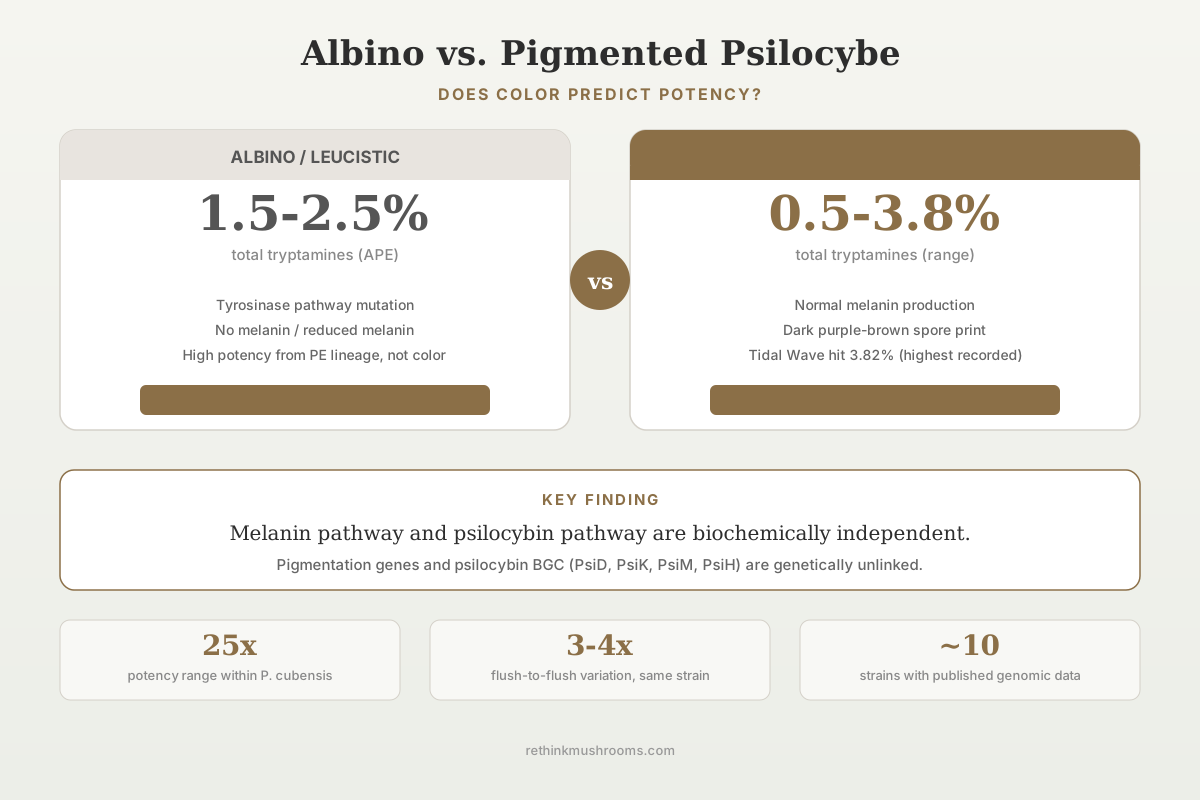
The internet consensus says albino Psilocybe cubensis strains are more potent than pigmented ones. The Albino Penis Envy, in particular, has earned a reputation as one of the strongest cubensis varieties, with reported tryptamine concentrations of 1.5-2.5% dry weight compared to 0.5-1.2% in standard strains. But the question this article addresses is specific: does the loss of pigmentation itself predict higher psilocybin production, or are the albino strains that test high simply derived from already-potent genetic backgrounds? The answer, based on the analytical and genomic data available through 2025, points firmly toward the latter.[1]
Key Takeaways
- Psilocybin concentrations in P. cubensis range from 0.2 to 19.9 mg/g across strains, a 25-fold or greater range driven primarily by genetics (Kurzbaum et al., 2025)
- Albino and leucistic phenotypes result from mutations in melanin biosynthesis (tyrosinase pathway), which is biochemically independent of the psilocybin biosynthetic gene cluster (PsiD, PsiK, PsiM, PsiH)
- Only approximately 10 P. cubensis strains have published genomic data; regulatory sequences controlling psilocybin gene expression remain unexplored (Kurzbaum et al., 2025)
- The psilocybin gene cluster has been horizontally transferred across Psilocybe species multiple times during evolution (Bradshaw et al., PNAS, 2024)
- Psilocybin content varies 3-4 fold between flushes of the same strain grown under identical conditions (Bigwood and Beug, 1982)
- Cultivation conditions, substrate composition, harvest timing, and drying method all influence final tryptamine content independently of strain genetics
Albino vs. leucistic: two different mutations
The terms "albino" and "leucistic" describe different degrees of pigment loss, and most strains marketed as "albino" P. cubensis are actually leucistic.
True albinism in fungi results from complete loss of function in the melanin biosynthesis pathway, typically through mutations in tyrosinase or related enzymes. Albino mushrooms produce no melanin whatsoever. Their spores are colorless (not the typical dark purple-brown of P. cubensis), and the entire fruiting body lacks pigmentation at every developmental stage.[1]
Leucism involves reduced but not absent pigmentation. Leucistic mutations can affect genes controlling pigment cell development and distribution (such as c-kit, mitf, or EDNRB homologs) rather than melanin production itself. Leucistic P. cubensis strains may appear white or very pale but can retain some pigment in the cap center, gills, or spore print. The popular "Albino A+" is leucistic, not truly albino, as it retains some pigmentation in its spores.
The distinction matters biochemically. Melanin and psilocybin are produced through entirely separate metabolic pathways. Melanin derives from tyrosine via tyrosinase-catalyzed oxidation. Psilocybin derives from tryptophan via a four-enzyme pathway encoded by the psi gene cluster.[2] A mutation that disables tyrosinase has no direct mechanistic reason to affect PsiD, PsiK, PsiM, or PsiH.
The psilocybin biosynthetic pathway
Psilocybin biosynthesis in Psilocybe species follows a defined enzymatic sequence. Tryptophan is first decarboxylated by PsiD to produce tryptamine. PsiH hydroxylates this to 4-hydroxytryptamine. PsiK phosphorylates the hydroxyl group. PsiM adds two methyl groups to the amine nitrogen, yielding psilocybin.[2]
These four genes occur in a biosynthetic gene cluster (BGC) that has been horizontally transferred multiple times across the genus Psilocybe during evolution.[2] Bradshaw et al. (2024) demonstrated through phylogenomic analysis that the psilocybin BGC has a different evolutionary history than the rest of the Psilocybe genome, suggesting repeated horizontal gene transfer events rather than simple vertical inheritance.
This evolutionary history is relevant because it means psilocybin production capacity can vary independently of other genomic features, including pigmentation genes. A strain could acquire a highly active psilocybin BGC through horizontal transfer while simultaneously carrying a melanin-disrupting mutation, or vice versa. The two traits are genetically unlinked.
The relationship between psilocybin BGC copy number, gene expression levels, and actual psilocybin output has not been characterized for most strains. Geiger et al. (2018) reviewed the chemistry of psilocybin and noted that the compound's pharmacology is well understood, but the genetics controlling its production in fungi remain an early-stage research area.[5] This is a critical gap: without knowing which genetic variants upregulate psilocybin BGC expression, we cannot determine whether any pigmentation-linked variants happen to co-segregate with potency-linked variants on the same chromosomal region.
Baeocystin, norbaeocystin, and aeruginascin are structurally related tryptamine alkaloids produced by the same or overlapping enzymatic machinery. Their concentrations also vary across strains: Gotvaldova et al. measured baeocystin at 0.139-0.881 mg/g, norbaeocystin at 0.044-0.161 mg/g, and aeruginascin at 0.026-0.053 mg/g in P. cubensis.[3] The relationship between these analogs and subjective effects (the "entourage effect" hypothesis) remains an active area of research.
What analytical testing actually shows
The largest published dataset on P. cubensis tryptamine variation comes from community testing initiatives and academic studies. The numbers tell a consistent story: strain matters, but within-strain variation is also substantial.
Academic data. Gotvaldova et al. analyzed multiple P. cubensis strains and found psilocybin concentrations ranging from 0.208 to 5.344 mg/g, with psilocin from 0.651 to 3.509 mg/g.[3] The Kurzbaum et al. (2025) review compiled data showing an even wider range of 0.2-19.9 mg/g for wild specimens, though the extreme high values likely represent analytical or biological outliers.[1]
Community testing. The Oakland Hyphae Psilocybin Cup has tested hundreds of P. cubensis submissions across multiple annual competitions. Albino Penis Envy entries have scored near the top, with reported total tryptamine concentrations of 1.89-1.94%. But the highest-scoring entries in these competitions have included both albino and pigmented strains. Tidal Wave, a pigmented hybrid, scored 3.82% total tryptamines at the 2021 Spring competition, higher than any reported albino strain. This single data point is important: if albinism itself drove higher potency, albino entries should dominate the top of every competition. They do not. The top slots are populated by a mix of pigmented and unpigmented strains, with genetic background (particularly PE lineage) being the clearest predictor of high placement.
Flush-to-flush variation. Bigwood and Beug (1982) demonstrated that psilocybin content varies 3-4 fold between successive flushes of the same genetic strain grown under identical conditions.[4] This means a single strain can produce mushrooms ranging from "weak" to "strong" depending entirely on harvest timing. This within-strain variation is large enough to overlap with the between-strain differences commonly attributed to genetics.
Why some albino strains test high
If albinism does not directly cause higher psilocybin production, why do albino strains like Albino Penis Envy consistently test above average?
Selection bias in lineage. Albino Penis Envy is a mutation derived from Penis Envy, which is itself one of the most potent known P. cubensis varieties. The high potency of APE reflects its Penis Envy genetic background, not its albinism. A pigmented Penis Envy and an albino Penis Envy grown side by side under the same conditions would be expected to produce similar tryptamine levels, differing only within normal biological variation.
Cultivator selection pressure. The mushroom cultivation community selectively breeds for potency. Albino mutations, because they are visually striking, attract attention from experienced cultivators who then optimize growing conditions for these strains. Higher potency in albino strains may partly reflect the skill of the cultivators who grow them, not an inherent biological advantage.
Publication and testing bias. Cultivators who grow albino strains are more likely to submit samples for testing at competitions and analytical services, and they tend to submit their best specimens. This creates a dataset enriched for high-potency albino samples while standard-potency pigmented strains go untested.
Small sample problem. Only about 10 P. cubensis strains have published genomic data.[1] The regulatory sequences controlling psilocybin gene expression remain unexplored. Without systematic, controlled studies comparing albino and pigmented siblings from the same cross, any potency difference attributed to pigmentation is confounded by genetics, cultivation, and selection.
What actually predicts potency
Based on the available data, the factors most reliably associated with psilocybin content are:
Genetic lineage. Penis Envy variants (including PE, APE, PE Uncut, and PE6) consistently test above average regardless of pigmentation. This reflects the specific genetics of the PE lineage, likely involving regulatory differences in psilocybin BGC expression.[1]
Harvest timing. Psilocybin content per gram tends to be highest in immature (pre-sporulation) fruiting bodies and decreases as the mushroom matures and the cap opens. Picking earlier in the development cycle concentrates tryptamines in less tissue mass.[4]
Flush number. First and second flushes generally produce higher tryptamine concentrations than later flushes from the same substrate block.[4]
Substrate and growing conditions. The Kurzbaum et al. (2025) review emphasized that "very limited knowledge" exists about how cultivation techniques and environmental influences affect psilocybin production, but available data suggests substrate composition, temperature, and light exposure all play roles.[1]
Drying and storage. Gotvaldova et al. (2021) found that drying method and storage conditions significantly affect measured tryptamine content. Dried biomass stored in the dark at room temperature showed the lowest decay, while fresh mushrooms stored at -80 degrees C showed the highest degradation.[3] This means two samples of the exact same strain, dried differently and stored under different conditions, can yield substantially different analytical results. Any comparison between albino and pigmented strains that does not control for post-harvest handling is confounded from the start.
The genetics gap
The honest assessment of the albino-potency question is that we do not have enough genetic data to answer it definitively. With only about 10 strains genomically characterized, the regulatory architecture of the psilocybin BGC remains a black box. It is theoretically possible that some pigmentation mutations could have pleiotropic effects on tryptamine metabolism through mechanisms not yet identified. But the most parsimonious explanation for the current data is simpler: different strains have different potencies for genetic reasons that correlate with lineage, not color.
Answering this question rigorously would require growing isogenic pairs (albino and pigmented siblings from the same cross) under controlled conditions and analyzing tryptamine content with validated chromatographic methods. The experiment would need to control for substrate, temperature, humidity, light exposure, flush number, harvest timing, and drying method. Samples would need to be analyzed using liquid chromatography-tandem mass spectrometry (LC-MS/MS) with validated reference standards for psilocybin, psilocin, baeocystin, norbaeocystin, and aeruginascin. This experiment has not been published.
The Kurzbaum et al. (2025) review identified the broader "strain documentation" problem as one of the field's critical gaps. Despite the informal recognition of dozens of P. cubensis strains in the cultivation community, there remains "a compelling imperative for formal academic documentation."[1] The albino-potency question is one manifestation of this gap. Without rigorous strain characterization, including genomic analysis of strain variation, community observations about potency differences remain anecdotal rather than scientific.
Until controlled studies are published, the claim that albinism predicts potency remains an uncontrolled observation, not a demonstrated biological relationship.
The Bottom Line
Albino Psilocybe cubensis strains like Albino Penis Envy often test high for psilocybin, but the available evidence does not support a direct biological link between pigment loss and tryptamine production. The melanin and psilocybin pathways are biochemically independent. High-potency albino strains derive their potency from their genetic lineage (particularly the Penis Envy background), cultivator selection, and testing bias. With only about 10 strains genomically characterized and no published controlled comparisons of isogenic albino/pigmented pairs, the question remains open but the current data favors lineage over color as the primary potency determinant.
Frequently Asked Questions
Sources & References
- 1RTHM-00932·Kurzbaum, Eyal et al. (2025). “Exploring Psilocybe cubensis Strains: Cultivation Techniques, Psychoactive Compounds, Genetics and Research Gaps..” Journal of fungi (Basel.Study breakdown →PubMed →↩
- 2RTHM-00865·Bradshaw, Alexander J et al. (2024). “Phylogenomics of the psychoactive mushroom genus Psilocybe and evolution of the psilocybin biosynthetic gene cluster..” Proceedings of the National Academy of Sciences of the United States of America.Study breakdown →PubMed →↩
- 3RTHM-00688·Gotvaldová, Klára et al. (2021). “Stability of psilocybin and its four analogs in the biomass of the psychotropic mushroom Psilocybe cubensis..” Drug testing and analysis.Study breakdown →PubMed →↩
- 4RTHM-00003·Bigwood, J et al. (1982). “Variation of psilocybin and psilocin levels with repeated flushes (harvests) of mature sporocarps of Psilocybe cubensis (Earle) Singer..” Journal of ethnopharmacology.Study breakdown →PubMed →↩
- 5RTHM-00509·Geiger, Haden A et al. (2018). “DARK Classics in Chemical Neuroscience: Psilocybin..” ACS chemical neuroscience.Study breakdown →PubMed →↩